

With a Human Resources certificate, you can qualify for entry-level and mid-level HR roles, move into an HR specialty, or support a career change into HR. It works as proof that you have learned and can apply practical HR skills, even without an HR degree. A certificate is most useful when it closes the specific skill gap a hiring manager wants to fill and you can show what you are now able to do.
A certificate can show employers you’ve learned specific HR skills, such as recruitment, employee relations, HR data, or compensation and benefits. The roles and salary it can lead to depend on the program you choose, the experience you already have, and the skill gap you’re trying to close. This article looks at what you can prove with an HR certificate, the kind of HR jobs you can get with it, and how to use it to advance your career.
Contents
What can you do with a Human Resources certificate?
Types of HR certificate programs to consider
Jobs you can do with an HR certificate
Skills an HR certificate proves to employers
How far an HR certificate can take your career
How to turn your HR certificate into a career move
What can you do with a Human Resources certificate?
With a Human Resources certificate, you can apply for entry-level HR jobs, transition into HR from another field, or develop specialized skills in areas such as recruitment, employee relations, and people analytics. Common career paths include HR Assistant, HR Coordinator, Recruiter, HR Generalist, and Training and Development Coordinator. With relevant experience, a certificate can also support progression into specialist or management roles.
Before you decide what to do with a Human Resources certificate, it helps to know what you’re holding. Some people may think a certificate, certification, and degree mean the same thing, but employers think otherwise.
HR certificate
A credential confirming completion of a structured HR learning program
Finish a course or program, often online and sometimes with a final assessment
Building and proving practical skills, entry to mid-level roles, and career changes
HR certification
A professional credential earned by meeting a certifying body’s requirements and passing an exam, such as the SHRM-CP or an HRCI credential
Pass an exam, then keep it current with recertification credits
Meeting an employer’s formal credential requirement
HR degree
A multi-year academic qualification in HR or a related field
Complete a university program
A long-term academic foundation and roles that require a degree

Types of HR certificates and certifications to consider
The right HR credential depends on what you want to achieve. Some programs help you develop practical skills for your first HR job or a new specialty, while professional certifications assess your HR knowledge and competencies through an exam.
Here are three options to consider:
- AIHR Certificate Programs: Suitable for professionals who want to build practical HR skills, enter the profession, or develop expertise in a specific area. Academy to Innovate HR (AIHR) offers programs in HR coordination, HR generalist work, recruitment, people analytics, and other HR specialties. Its programs combine structured learning with practical exercises and assessments.
- SHRM certifications: The SHRM-CP is designed for professionals performing operational HR duties and people pursuing an HR career. The SHRM-SCP is intended for experienced professionals working at a strategic HR level. Both assess HR knowledge and competencies through a certification exam.
- HRCI certifications: Credentials such as the aPHR, PHR, and SPHR serve different career stages. The aPHR is an option for people starting their HR careers, while the PHR and SPHR are aimed at professionals who meet specific experience and education requirements.
Jobs you can do with an HR certificate
An HR certificate is most useful at the start and middle of your HR career. While it likely won’t qualify you for a directorial role on its own, it can help you get on the HR career ladder and build from there. Here are the roles an HR certificate most commonly supports.
HR Assistant or HR Coordinator
Entry
You understand core HR processes, onboarding, and HR records before day one
Recruitment, HR operations, or a generalist role
Recruiting Coordinator
Entry
Schedule interviews, post job openings, communicate with candidates, and support the hiring team
You know how a structured hiring process works
Payroll or Benefits Administrator
Entry
Process payroll records, track time, and administer health, retirement, and leave benefits
You can handle pay and benefits accurately and follow compliance basics
HRIS or HR Systems Assistant
Entry
Maintain employee data, run reports, and support an HR system such as Workday, BambooHR, or ADP
You can work with HR data and common HR software
Training and Development Coordinator
Entry
You understand how to organize training activities, track participation, and support employee development
L&D Specialist or Training Specialist
HR Generalist
Entry to mid
You understand multiple HR functions, including recruitment, employee relations, benefits, and compliance
Senior HR Generalist, HR Manager, or HRBP
Compensation and Benefits Specialist
Mid
You understand compensation structures, salary benchmarking, and benefits administration
Senior C&B Specialist or Compensation Manager
L&D Specialist
Mid
You can design, deliver, and evaluate employee learning programs
Senior L&D Specialist or L&D Manager
HR Business Partner
Mid to senior
You can connect people-related decisions to business priorities and advise stakeholders
Senior HRBP or HR Director
HR Assistant or HR Coordinator
The HR Assistant or HR Coordinator role is a classic entry point into HR. In this role, you may support recruitment logistics, onboarding, HR records, employee questions, and daily HR administration. A certificate helps because it shows you understand basic HR processes before you step into the role, which can set you apart from candidates who have administrative experience but no HR training.
It also gives you a practical view of how an HR team works. This makes the next step easier, whether you move into recruitment, operations, employee relations, or a generalist role.
If you’re new to HR, a foundational program such as AIHR’s HR Coordinator Certificate Program can help you develop knowledge of core HR operations, policies, and employee life cycle administration.
HR Generalist
An HR Generalist handles a broad mix of HR work, including recruitment, employee relations, policy, benefits questions, HR compliance, and performance support. This role is a natural next step after coordinator work. It can also suit career changers from office management, operations, customer service, or administration. A broad HR certificate fits this path well because it helps close knowledge gaps across the employee life cycle.
AIHR’s HR Generalist Certificate Program is one option for developing knowledge across HR operations and broader HR responsibilities. It can be particularly relevant if you want to move from an administrative role into a more comprehensive HR position.
Recruiter or Talent Acquisition Specialist
If you enjoy sourcing, screening, and hiring, a certificate with recruitment content can help you become a Talent Acquisition Specialist. Recruiting is one of the more accessible HR specialties, and it gives you a visible business impact because hiring affects team capacity, productivity, and growth. A strong certificate should help you learn how to write job criteria, structure interviews, reduce bias, and improve candidate communication.
For people entering recruitment, a Recruiting Coordinator or Talent Acquisition Assistant role can provide an opportunity to build experience before taking on more independent hiring responsibilities.
Compensation and Benefits Specialist
A C&B Specialist works with pay structures, benefits administration, job analysis, and related data. This is a more technical HR path, so employers may expect stronger analytical skills. A focused Human Resources certificate can help you understand the language of pay, job levels, salary benchmarking, and benefits design. It can also help you decide if this particular specialist path fits your strengths.
If you’re starting out, payroll administration, benefits coordination, or HR operations may be more accessible entry points into this specialty.
Training and Development Coordinator
A Training and Development Coordinator helps organize employee learning activities, schedule training sessions, maintain learning records, and support onboarding programs. Depending on the organization, the role may also involve updating learning management systems (LMS), communicating with participants, and collecting training feedback.
An HR certificate covering learning and development can help you understand how employee training is planned, delivered, and evaluated. This makes it a potential career path for people with experience in administration, education, training coordination, or employee support.
Learning and Development Specialist
As you gain HR experience, certificates in areas like learning and development (L&D), people analytics, or HR business partnering can help you move beyond generalist work. An L&D Specialist designs, delivers, and measures employee training. A certificate can help you show you know how to build learning programs, set learning goals, and measure results.
HR Business Partner
An HRBP works with leaders to connect people decisions to business goals. A focused certificate can help you build consulting, stakeholder management, and data skills for that path.
Because HR business partnering typically involves advising managers on complex workforce challenges, employers often look for previous HR experience alongside relevant qualifications. A certificate can help experienced HR professionals develop the strategic and consulting skills needed to move into this role.
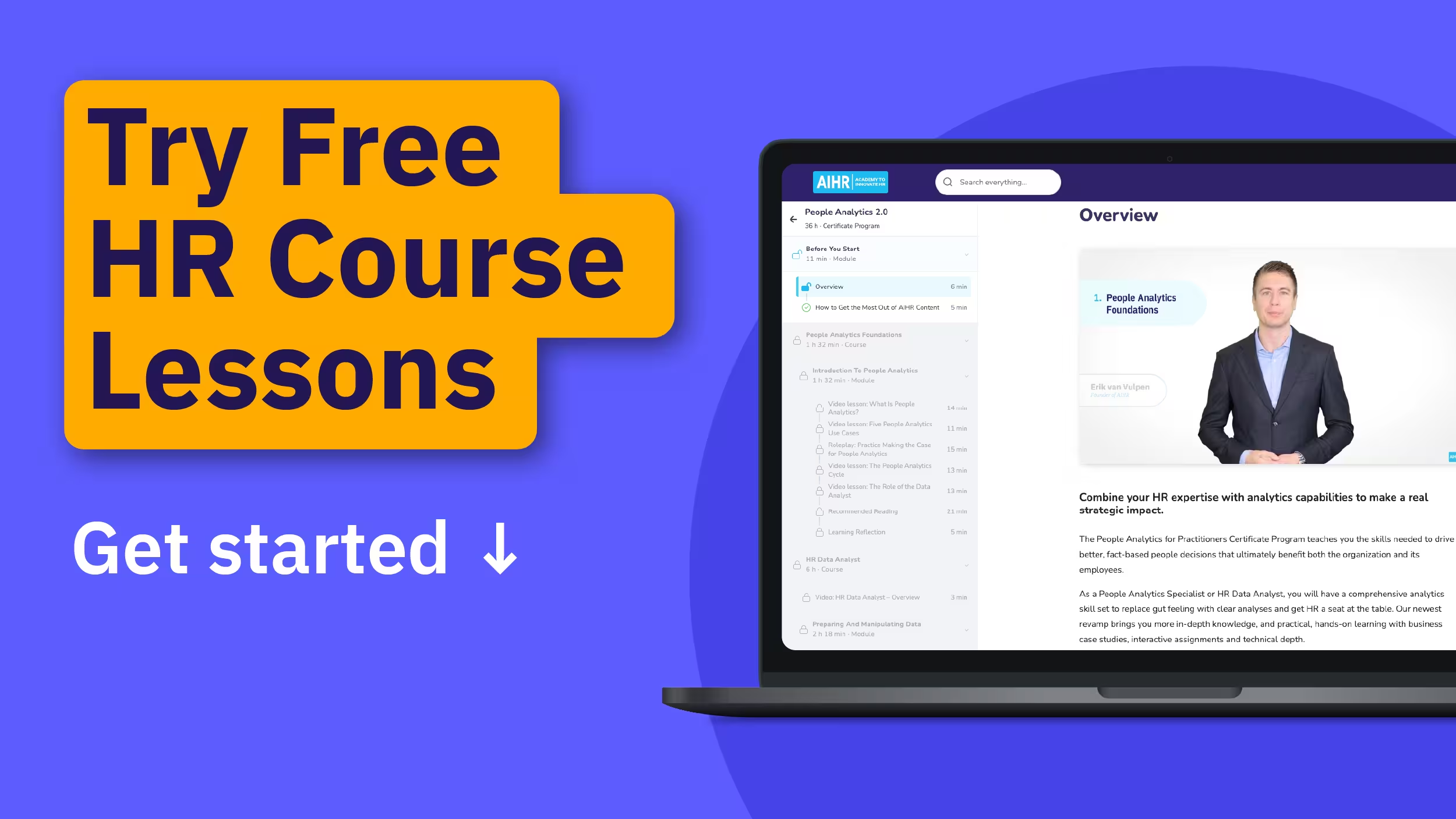
Choosing an HR certificate program is easier when you can see how the learning connects to real HR work. From HR operations to analytics, talent acquisition, and strategic HR, the right learning path can help you build practical skills for your next step.
AIHR’s Demo Portal lets you explore practical HR learning by:
✅ Sampling HR lessons to see which topics match the roles you’re aiming for
✅ Browsing practical tools, templates, and guides used in day-to-day HR work
✅ Exploring different HR career paths and identifying the skills each one requires
✅ Using AIHR Copilot to get learning suggestions based on your goals and interests
🎓 Visit the Demo Portal to preview Certificate Program lessons and explore the skills you could build next.
Skills an HR certificate proves to employers
The strongest HR certificate programs build skills that help you take on real HR tasks. The following skills are especially valuable in HR:
1. People analytics
People analytics is the use of HR data to understand workforce trends and make better people decisions. A certificate in this area can show you’re comfortable with HR data, dashboards, and basic analysis. That’s useful even in generalist roles, where leaders may expect HR to explain trends in turnover, hiring, engagement, or absenteeism. For example, you might use people analytics to spot high turnover in one department, then work with managers to review workload, leadership issues, or pay concerns.
2. AI in HR
Artificial Intelligence is becoming part of recruitment, employee support, HR administration, and learning. A certificate that covers AI in HR can signal that you know how to use these tools responsibly. This includes checking outputs, protecting employee data, reducing bias, and knowing when human review is needed. This skill can help you work faster without treating AI as a shortcut for judgment.
3. Business partnering and consulting
Business partnering is about connecting HR work to business needs. Consulting skills help you ask better questions, diagnose problems more accurately, and advise stakeholders. A certificate in this area can show you’re ready to move beyond administration, and can also help you explain how HR work affects outcomes such as employee retention rate, productivity, risk, or strategic workforce planning.
4. Core HR fundamentals
Core HR skills like recruitment, employee relations, compliance basics, compensation and benefits, onboarding, and HR policies still matter. For entry-level roles, proving these fundamentals can be enough to help you get an interview. For career changers, they help translate your previous experience into HR language. A program that helps you build a dashboard, run a structured hiring process, or design onboarding provides proof you can use.
5. Employment law and compliance
Employers expect HR to protect the organization and its people. A certificate that covers employment law basics, such as EEOC guidelines, FMLA, and ADA can help you understand the legal requirements involved in common HR processes. This matters in benefits, employee relations, and generalist roles.
6. HR systems and HR technology
Most HR work now runs on software. Familiarity with an HRIS such as Workday, SAP SuccessFactors, BambooHR, ADP, or Gusto shows you understand the technology used in day-to-day HR operations. A certificate that includes hands-on work with HR data and systems makes you more competitive for entry-level roles.
What an HR certificate can and can’t do for your career
An HR certificate can strengthen your qualifications, demonstrate relevant training, and help you prepare for new responsibilities. However, its value depends on the role you’re targeting and the experience you already have.
What an HR certificate can do:
- Build foundational HR knowledge: Learn about recruitment, employee relations, compliance, and other core HR responsibilities.
- Support a career change: Demonstrate relevant training when moving into HR from administration, operations, customer service, or another field.
- Help you specialize: Develop skills in areas such as people analytics, compensation and benefits, or learning and development.
- Support career advancement: Strengthen your qualifications when applying for more specialized or senior responsibilities, particularly when combined with experience.
What an HR certificate can’t do:
- Guarantee a job: Employers also consider your work experience, education, and ability to perform the role.
- Replace every degree requirement: Some positions specifically require a bachelor’s degree or another academic qualification.
- Automatically qualify you for senior positions: HR management and leadership roles typically require several years of relevant experience.
How far an HR certificate can take your career
A certificate is usually a foundation you build on. A common path starts with an HR Assistant or HR Coordinator role. From there, you may move into a generalist role, a specialist track, or management. According to the U.S. Bureau of Labor Statistics, Human Resources Managers earn a median annual wage of $149,280 in the United States. You won’t reach that level through a certificate alone, but it can help you take the early steps that build experience.
A typical HR career progression might look like this:
Entry-level
HR Assistant / HR Coordinator
Build foundational HR experience
Mid-level
HR Generalist / HR Specialist
Manage HR processes or specialize in a specific area
Management / Strategic
HR Manager / HR Business Partner
Lead HR initiatives and advise business leaders
Senior leadership
HR Director / CHRO
Lead HR strategy and organizational priorities
You don’t have to follow this exact progression. Some HR professionals move into specialist roles in recruitment, compensation and benefits, L&D, or people analytics, while others pursue HR management or business partnering.
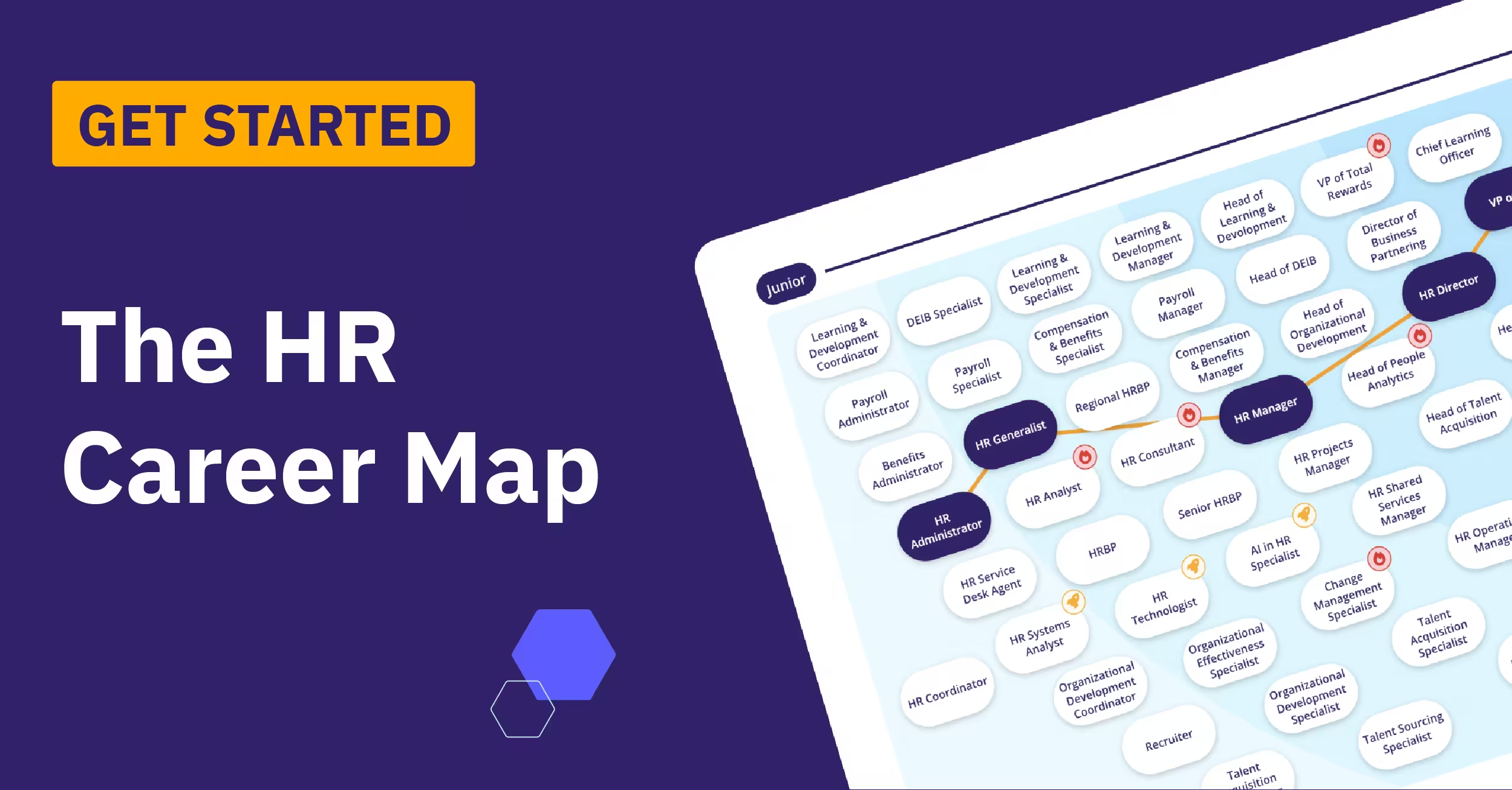
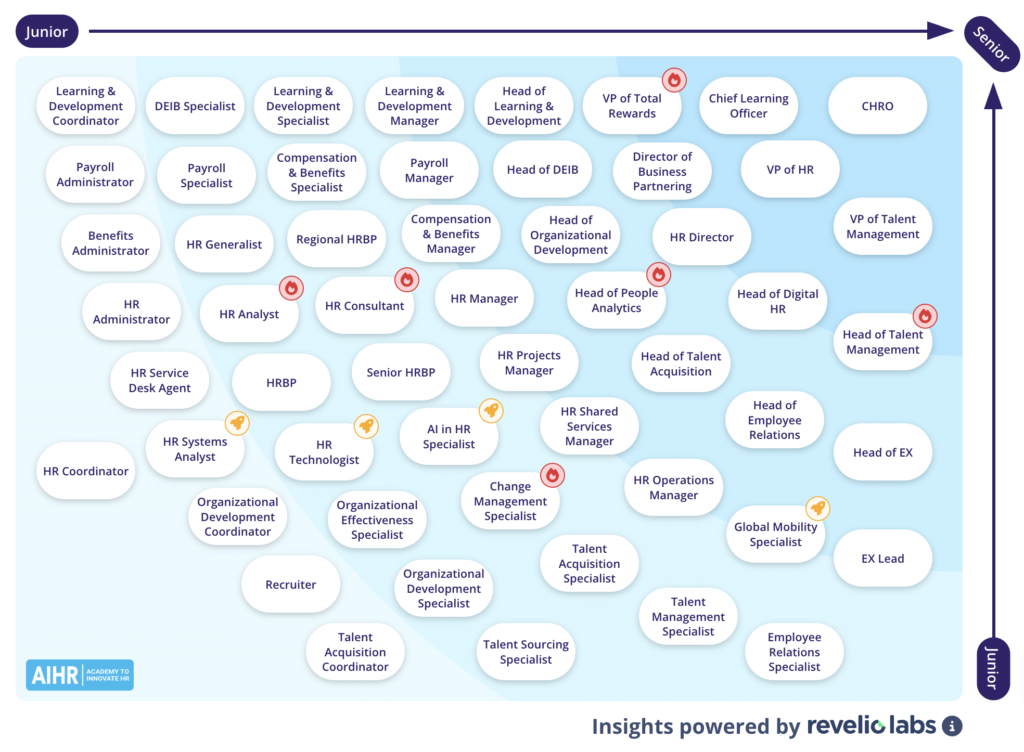
The type of certificate you choose can also shape your path. For example, a people analytics certificate can point you toward data-heavy HR roles, while a business partnering certificate can support a more strategic path. If you prefer to plan your HR career path before deciding on which certificate would push you in the right direction, you can use AIHR’s free HR Career Map to help you along the way.
At the same time, recognition can extend the value of your learning. If you later earn a formal credential, such as the SHRM-CP or an HRCI certification, you’ll need to maintain it. SHRM certification-holders need 60 professional development credits (PDCs) within a three-year recertification cycle. HRCI-certified professionals must also recertify every three years through professional development activities or by retaking the exam.
This is where continued learning can do two jobs: help you build new skills and support recertification requirements, depending on the provider and program.
For example, AIHR is recognized by SHRM to offer Professional Development Credits (PDCs) for SHRM-CP® or SHRM-SCP® recertification activities. Its certificate programs are also recognized for HRCI recertification credits. This means you can continue developing practical HR skills while meeting applicable professional development requirements.
How to turn your HR certificate into a career move
To turn your HR certificate into an actual role that can advance your career, you must have a clear plan:
Start with the role, not the certificate
Decide where you want to be in the next 12 to 24 months. Do you want to break into HR, move into a generalist role, or shift into recruitment, analytics, C&B, or L&D? Start with the role you want, then work backward. This helps you avoid collecting certificates that look good but don’t help you move forward. If you already have a certificate, identify the role it best supports, then target that in your résumé, LinkedIn profile, and applications.
Name the gap and close it
Write down three to five skills your target role requires, then compare them with what your certificate taught you. For example, an HR Coordinator role may require onboarding, HR systems, employee communication, and basic policy knowledge, while Talent Acquisition Specialist role may require sourcing, interviewing, candidate management, and hiring metrics.
If you still have a skills gap, close it directly. A focused program in analytics, recruitment, or employee relations may help you more than a broad certificate.
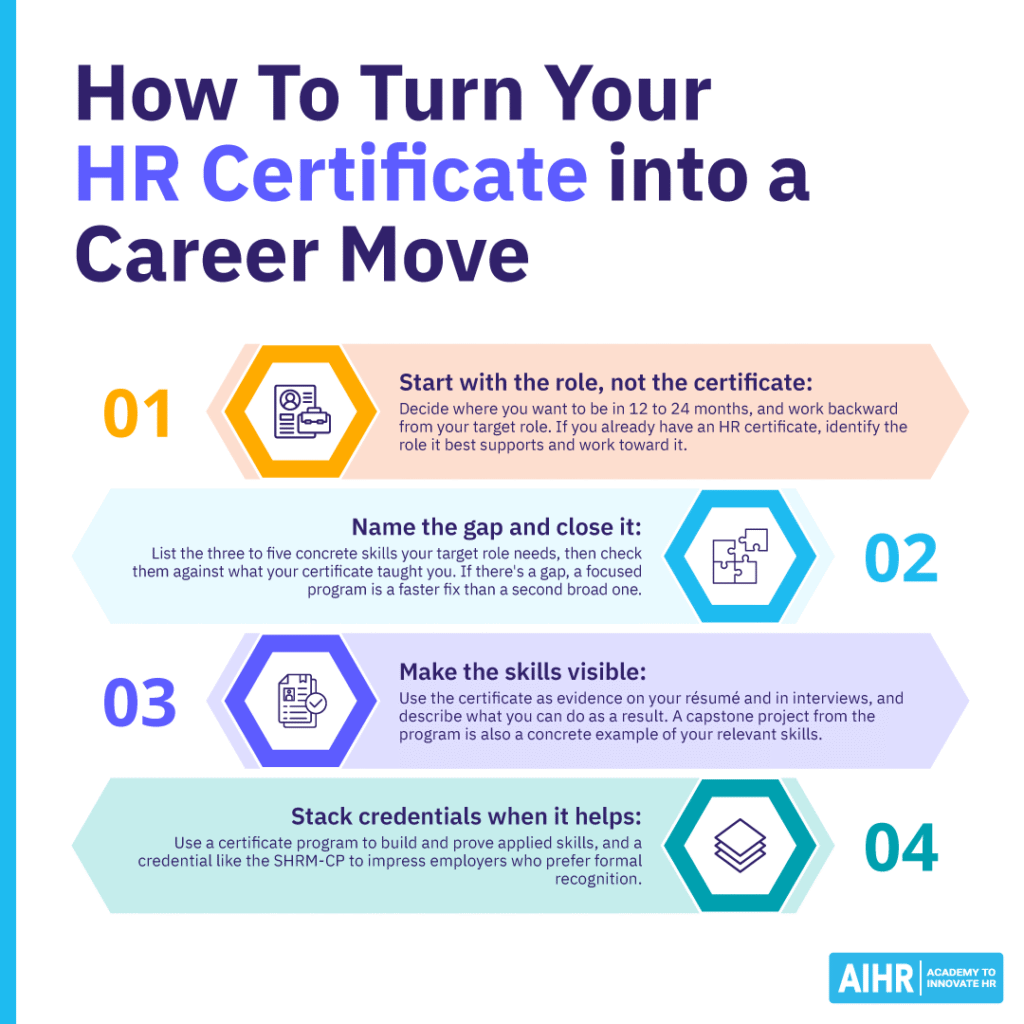
Make the skills visible
Instead of just listing the certificate name on your résumé, translate it into evidence. For example, say what you can now do, whether it’s:
- Build an HR dashboard using turnover and headcount data
- Design a structured interview guide
- Create an onboarding checklist
- Review a benefits communication plan
- Map an employee life cycle process.
If your program included a capstone project, use it. A project gives you something concrete to discuss in interviews, especially if you’re still building HR experience.
Stack credentials when it helps
A certificate and a certification can work well together. You can use a certificate to build applied skills, and a certification (such as SHRM-CP or an HRCI credential) to meet employers’ formal recognition requirements. They serve different purposes, but when combined, they can show prospective employers that you understand HR concepts not just in theory, but also how to apply them in a practical manner at work.
Next steps
What you can do with a Human Resources certificate comes down to fit. Match the certificate to the role you want, use it to close a real skills gap, and show employers what you can now do. Combine your training with relevant experience, and use practical examples to demonstrate your capabilities when applying for HR positions.
If you’re still choosing a program, preview the learning experience before you commit. AIHR’s Demo Portal lets you explore sample lessons before enrolling, and the Certificate Programs page can help you compare HR specialties. From there, choose the certificate that can help you build the skills you need for your next HR career step.
FAQ
It is worth it when the certificate closes a specific skill gap for the role you want and you can show the work behind it. It is strong for breaking into HR or moving into a new specialty. On its own, it is less useful for senior roles that expect years of experience or a formal credential.
There is no single best HR certificate. The right one matches the role you want and the skills you need to prove, whether that is a generalist foundation or a specialty like people analytics, talent acquisition, or compensation and benefits. AIHR offers 16+ certificate programs across these HR specialties, so you can choose one that fits your goals.
Yes, you can earn an HR certification without a college degree. For example, the SHRM-CP doesn’t require a degree or previous HR experience, while HRCI’s aPHR requires only a high school diploma or equivalent. Other certifications, such as the PHR, have specific experience requirements that vary based on your education. You can also pursue HR certificate programs, such as those offered by AIHR, to build practical HR skills without a degree.