



The employee onboarding process is key to laying the foundation of the employee-employer relationship. A well-designed onboarding program helps new hires understand their role, connect with their team, and contribute sooner. It can also support performance, job satisfaction, and employee retention.
In this guide, you’ll learn what the employee onboarding process entails, the five stages every new hire goes through, how to build an onboarding program step by step, and which metrics indicate whether it’s working. You’ll also find free onboarding checklist templates in Excel, Word, and PDF to put each stage into practice.
Contents
What is employee onboarding?
Why is employee onboarding important?
Employee onboarding process: 5 key stages
Employee onboarding checklist templates
How to create an employee onboarding program
Employee onboarding process examples
Employee onboarding best practices
Employee onboarding software and tools HR can use
Employee onboarding success metrics
Common employee onboarding challenges and how to solve them
FAQ
What is employee onboarding?
Employee onboarding is the process of helping new hires settle into your organization, understand their role, and build the relationships they need to succeed. It starts before their first day and continues until they can work confidently and independently.
A strong onboarding program introduces new employees to the company’s people, culture, tools, workflows, and expectations. This includes setting up equipment, sharing key documents, explaining role responsibilities, arranging meetings with managers and colleagues, and helping new hires understand the company’s mission and values.
The goal is to help new hires become productive without leaving them to figure everything out alone. Onboarding also shapes their first impression of the company, which can influence how engaged and supported they feel in their new role.
After successful onboarding, the employee should:
- Understand their role, responsibilities, and success criteria
- Have the tools, systems, and resources they need to do their work
- Know who to contact for support
- Have built early relationships with their manager and colleagues
- Understand the company’s culture, values, and ways of working
- Feel welcomed, supported, and equipped to contribute.
Avoid treating onboarding as a short administrative process. New hires typically take 6 to 7 months to feel settled in a new role. The first 30 to 90 days are important, but onboarding support should continue beyond that period to help employees build confidence, form relationships, and reach full productivity.
A simple way to check whether onboarding is working is to ask new hires three questions regularly: Do you understand what success looks like? Do you have the tools and knowledge to perform? Do you feel welcomed and supported by your team? If the answer to any of these is no, the onboarding plan needs attention.

Why is employee onboarding important?
Employee onboarding is important because it helps new hires understand their role, build early connections, and start contributing with confidence. Without this support, employees may struggle to understand expectations, access the right tools, or feel part of the team.
The stakes are high. Employees who had an effective onboarding are up to 18x more likely to feel committed to their workplace than those who felt their onboarding was less effective. BambooHR also found that 89% of employees with effective onboarding said it helped them feel very engaged at work.
Onboarding also accelerates time to productivity, which refers to the time it takes for a new employee to fully contribute. A structured onboarding process helps new hires understand expectations, access the right tools, and build the relationships they need to perform confidently.
It also helps prevent common early frustrations. For example, 97% of employees say it’s important for onboarding to include training on the tools and software they’ll use at work. When new hires don’t get this support, they’re more likely to feel confused, disconnected, and unable to perform at their best.
For organizations trying to recruit and retain talent, a structured onboarding plan helps protect the hiring investment. It gives new hires clear expectations, the right support, and the confidence to perform in their role.
Employee onboarding process: 5 key stages
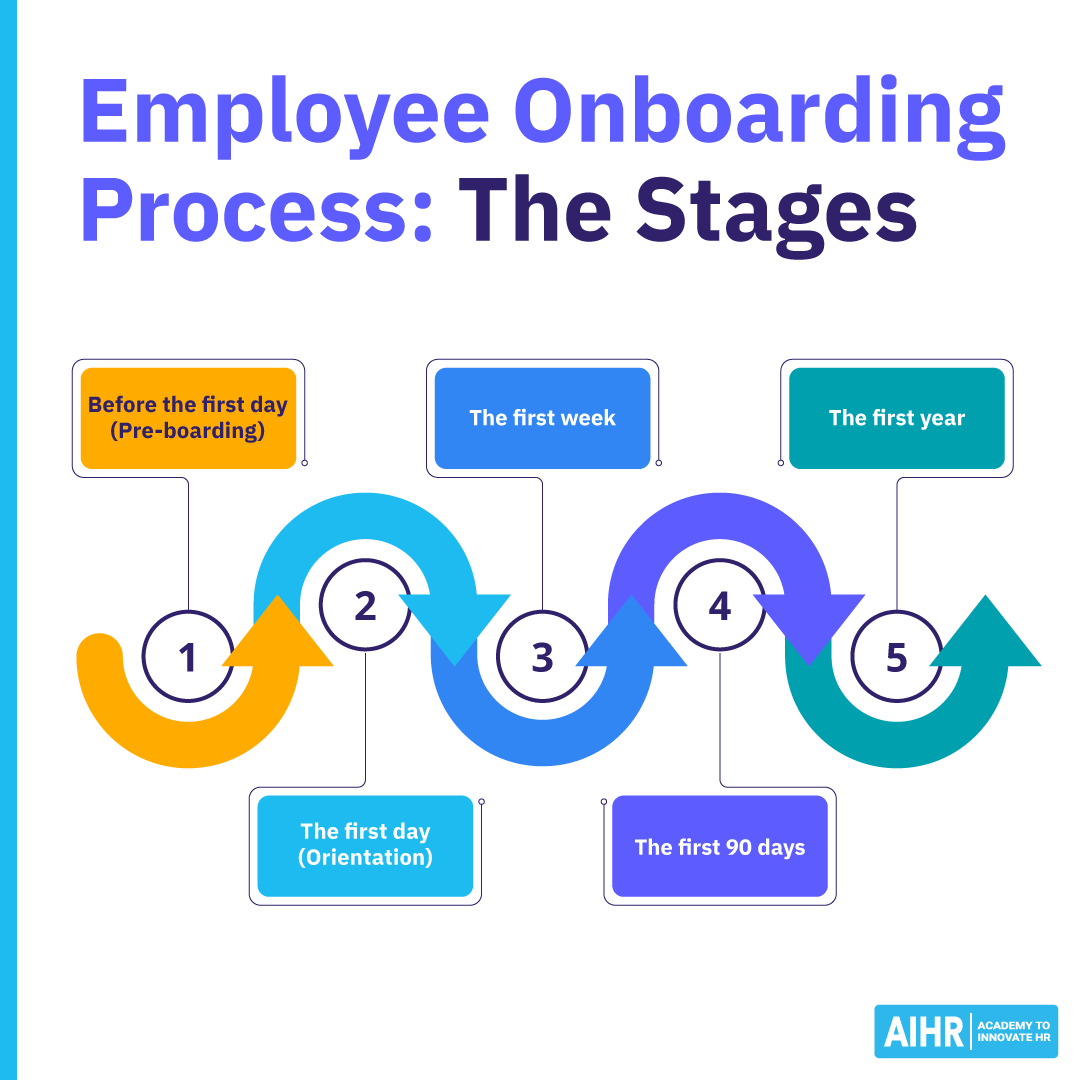
The employee onboarding process is the structured set of steps that takes a new hire from offer acceptance to full productivity, usually across five stages. The onboarding period starts when a candidate signs their offer letter and ends when they can perform their role with confidence and autonomy.
While every organization structures onboarding differently, most effective programs include five key stages:
- Before the first day (preboarding)
- The first day (orientation)
- The first week
- The first 90 days
- The end of the first year
1. Before the first day: Preboarding
Preboarding begins once the candidate accepts the job offer. This stage helps new hires feel informed, welcomed, and ready to start before their first official day.
Preboarding checklist
- ✔ Keep in touch with the new hire between offer acceptance and their first day
- ✔ Send a welcome email with the start date, manager name, first-day agenda, and key contact details
- ✔ Share practical information, such as where to go or log in, what to bring, and what to expect on day one
- ✔ Prepare employment documents and collect any required information
- ✔ Set up the new hire’s email, systems, software, and access permissions
- ✔ Prepare equipment, workplace access, remote setup instructions, or a welcome kit
- ✔ Inform the team about the new hire’s role, responsibilities, and start date
- ✔ Draft the 30-60-90 day plan with early priorities, learning goals, and success measures

2. The first day: Orientation
The first day, or job orientation, is more about the experience than the information. You’ll share a lot of details with the new hire on day one, but they won’t be able to remember and process all of it right away.
Orientation checklist:
- ✔ Welcome the new hire and review the day’s agenda
- ✔ Complete any remaining paperwork or admin tasks
- ✔ Confirm that all logins, equipment, and access credentials work
- ✔ Introduce the new hire to their manager, team, and key colleagues
- ✔ Give a workplace tour or digital tour for remote employees
- ✔ Explain the company’s mission, values, structure, and ways of working
- ✔ Review essential policies, resources, and employee handbook information
- ✔ Introduce the onboarding buddy or main point of contact
- ✔ Walk through the 30-60-90 day plan at a high level
- ✔ Explain the role’s weekly and monthly routines, such as team meetings and check-ins
Example: Alida’s first-day onboarding experience
Hermina Khara, SVP, People & Talent at Alida explains that the company has a dedicated onboarding portal and a buddy program to create a memorable onboarding experience for new hires from day one.
“Our amazing HR Generalists do a really great job of conducting HR orientations on the first day. The IT team also does an orientation so that people know how to use their equipment, making sure that they have the right signatures, and so on. When all that comes together, it’s a truly great experience for our employees,” Khara notes..
3. The first week
In the first week, the employee continues to get familiar with the team, the company, and their role. This stage should help them build relationships, understand how work gets done, and feel more confident using the tools and systems they need.
First-week onboarding checklist:
- ✔ Schedule individual meetings with direct colleagues and key stakeholders
- ✔ Hold regular manager check-ins to answer questions and clarify expectations
- ✔ Give the new hire time to learn tools, systems, workflows, and communication channels
- ✔ Review immediate priorities and first-week goals
- ✔ Schedule 30-, 60-, and 90-day check-ins
- ✔ Invite the new hire to relevant team meetings, channels, and calendar events
- ✔ Encourage the employee to share early questions, concerns, or support needs
- ✔ Check that the employee understands where to find key resources and contacts
4. The first 90 days
The first 90 days help new hires move from learning to contributing. A 30-60-90 day plan gives this period structure and helps managers track progress, feedback, and support needs.
First 90 days onboarding checklist:
- ✔ Set clear 30-, 60-, and 90-day goals with measurable outcomes
- ✔ Focus the first 30 days on learning the organization, role, tools, and team
- ✔ Use the next 30 days to help the employee take on more role-specific work
- ✔ Use the final 30 days to support greater independence and measurable contribution
- ✔ Provide role-specific training, mentoring, job shadowing, or on-the-job practice
- ✔ Hold scheduled progress check-ins with the manager
- ✔ Ask the employee what support they need to succeed
- ✔ Review progress against the 30-60-90 day plan and adjust goals where needed.
5. At the end of the first year
The end of the first year is a good time to close the formal onboarding experience and connect it to ongoing performance, development, and engagement.
First-year review checklist:
- ✔ Review the employee’s performance, role clarity, and progress against goals
- ✔ Discuss how well the employee has integrated into the team and company culture
- ✔ Identify remaining support, training, or development needs
- ✔ Ask for feedback on the onboarding experience
- ✔ Discuss career goals, learning opportunities, and future growth
- ✔ Use feedback from the employee and manager to improve the onboarding process for future hires.
Employee onboarding works best when each step connects to the wider employee lifecycle, from hiring to performance and engagement. HR needs practical skills to make these processes clear, consistent, and easy to follow.
AIHR’s HR Generalist Certificate Program teaches you to:
✅ Set up HR processes across recruitment, onboarding, performance management, and employee engagement
✅ Create policy frameworks that help HR processes run more consistently
✅ Use the HR Canvas to clarify how HR supports the business
✅ Plan and organize HR work so daily operations run more smoothly
💡 Check out the lessons in AIHR’s Demo Portal for a clear idea of what you’ll get.
Employee onboarding checklist templates
Download our free employee onboarding checklist templates in Excel, Word, and PDF formats to give HR, managers, and IT a clear structure for every stage of onboarding.
Use these checklists to bring structure and consistency to each stage of onboarding, so HR, managers, and IT know what needs to happen before day one, during the first week, and throughout the employee’s first months.

How to create an employee onboarding program
A strong employee onboarding program gives new hires a consistent, structured experience from the moment they accept the offer through their first months on the job. It also helps HR, managers, IT, and team members understand their responsibilities at each stage of the process.
Here’s how to create an employee onboarding program that supports new hire success:
Step 1: Define what successful onboarding looks like
Start by clarifying what a successful onboarding experience should achieve. This may include helping new hires understand their role, build relationships, learn key systems, complete required training, and reach productivity within a realistic timeframe.
HR and managers should also define what success looks like for different roles. For example, a sales employee, HR specialist, and software engineer will need different goals, training, tools, and timelines.
Step 2: Map the onboarding journey
Create a clear onboarding journey from offer acceptance to the end of the first year. This should include preboarding, orientation, the first week, the first 90 days, and the first-year review.
For each stage, define what needs to happen, who owns each task, and what the new hire should experience. This helps prevent missed steps and gives every stakeholder a shared view of the process.
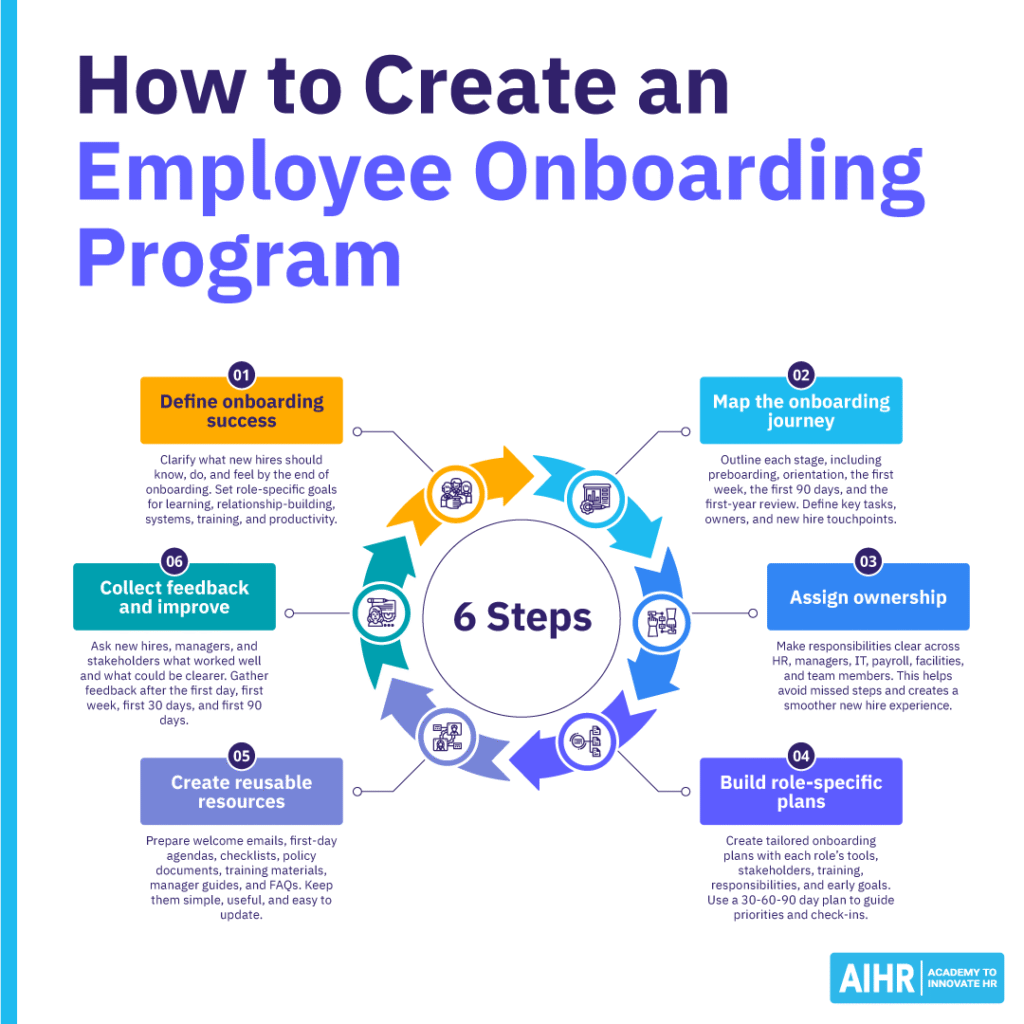
Step 3: Assign ownership across HR, managers, and IT
Employee onboarding involves multiple people, so clear ownership is essential. HR usually leads the overall process, but managers, IT, payroll, facilities, and team members all play a role.
For example, HR may handle documents and benefits, IT may prepare equipment and system access, and managers may create the 30-60-90 day plan. Assigning responsibilities early helps make the process smoother for the new hire.
Step 4: Build role-specific onboarding plans
A general onboarding program creates consistency, but new hires also need support that reflects their specific role. Work with managers to create role-specific onboarding plans that include key responsibilities, tools, stakeholders, training, and early goals.
A 30-60-90 day plan can help structure this. It gives the new hire clear priorities for their first month, second month, and third month, while giving managers a framework for feedback and check-ins.
Step 5: Create reusable onboarding resources
Standardized resources help HR deliver a consistent onboarding experience. These may include welcome emails, first-day agendas, checklists, policy documents, training materials, manager guides, and new hire FAQs.
These resources should be easy to update and simple for managers and employees to use. The goal is to reduce manual work while keeping the experience clear and personal.
Step 6: Collect feedback and improve the program
An employee onboarding program should improve over time. Ask new hires, managers, and other stakeholders what worked well and what could be clearer.
Collect feedback after key moments, such as the first day, first week, first 30 days, and first 90 days. Use this input to improve communication, training, manager support, and the overall onboarding experience.
A well-designed onboarding program helps new employees feel prepared, supported, and connected. It also gives HR a repeatable process that can scale as the organization grows.
Employee onboarding experience examples
Here are some of the best employee onboarding experiences to inspire your own process:
Example 1: GitLab
GitLab documents its onboarding process publicly in its company handbook. New hires complete onboarding tasks through a GitLab issue, with a main section for tasks that apply to all team members and additional department or role-specific tasks. Each onboarding issue has a 30-day due date, and new hires can reach out to an onboarding buddy or other team members for support.
This gives new hires a clear path to follow while supporting GitLab’s asynchronous way of working. The company also recommends taking at least two full weeks for onboarding before moving into team-specific training in week three, which helps employees settle in before taking on heavier role responsibilities.
What HR can learn: Create a clear onboarding workflow with shared tasks, role-specific tasks, deadlines, and named support contacts.
Example 2: Meta
Meta, then Facebook, used an Engineering Bootcamp to help new engineering hires learn how the company worked before joining a specific team. During the program, new hires rotated through different groups, learned the code base, worked on real tasks, and received mentorship from more experienced engineers. They could then choose a team after the bootcamp, giving them a better sense of where their skills and interests fit.
This approach shows how onboarding can support role fit, confidence, and cultural integration. Instead of assigning engineers to a team immediately, the bootcamp gave them time to understand the organization, build relationships, and make a more informed decision about where they could contribute.
What HR can learn: Use onboarding to help new hires explore the organization, connect with mentors, and understand where their skills can create the most value.
Example 3: Zappos
Zappos is known for using onboarding to reinforce culture fit. Its “Pay to Quit” approach started at Zappos before Amazon adopted it for fulfillment centers. The idea is to give employees a chance to reflect on whether they truly want to stay with the company after joining.
This type of onboarding example is less about admin tasks and more about alignment. It shows how onboarding can help employees understand the company’s culture, expectations, and working style early, rather than waiting until disengagement becomes a retention problem.
What HR can learn: Use onboarding to reinforce culture and expectations, so new hires can assess whether the role and company are the right fit.
Employee onboarding best practices
Here are a few practical tips you can add to the onboarding process in your organization today:
Align the job description and the onboarding plan
Your 30-60-90-day plan should explain why the role was created and accurately reflect the job description and job posting. If it doesn’t, the candidate may feel they applied for one job but started another.
When a new hire joins and realizes the actual role is different from what they expected, it can lead to frustration, disengagement, and a higher risk of early turnover.
To prevent this, integrate your HR practices from the start. Conduct a thorough vacancy intake, align the job description with the job posting, and make sure the 30-60-90-day plan reflects the role the new hire accepted.
Create effective onboarding workflows
It’s likely that your organization already has an onboarding workflow and different systems and processes applicable to your organization’s size. Implement new, suitable ways of working into those existing workflows. For example, what steps mentioned above in this article are missing in your process? How can you bring them in?
Ensure that whatever workflows you use, you leverage onboarding to build a personal connection between the direct manager and the employee. Personalizing the onboarding process and giving new hires attention is the root of a successful onboarding experience that your employees will rave about.
Use onboarding checklists
Onboarding checklists help keep your employee onboarding process consistent. An HR professional or the employee’s manager can physically or digitally check the boxes as they onboard the new hires. It provides structure and ensures that necessary steps are completed methodically.
You can utilize various types of checklists for different aspects of onboarding:
- Onboarding checklist for HR
- Onboarding IT checklist
- Onboarding checklist for managers
- New hire training checklist.
Ensure consistency
Your checklist is only as good as you are. If your onboarding team or managers have a checklist but don’t use it, items will likely be forgotten or missed, and the onboarding process will lack structure and consistency.
Implement an onboarding checklist template (or another digital system that is easy to track) and ensure all people responsible for onboarding new employees use it.
Communicate
Communicate clearly and frequently with employees throughout the onboarding process. This should start when they sign their acceptance letter and continue throughout their full first year of employment.
Set clear expectations from the start, conduct progress check-ins, and ensure there is a point of contact for every new hire to go to with any queries or concerns.
Bring in organizational culture & values
It’s important to weave your culture and values into the onboarding process and beyond. Provide your new hires with a strong understanding and examples of what these values mean at your organization so they can adopt them and strengthen your organizational culture.
Measure and improve your onboarding process
As you receive feedback from your new hires, you can improve and optimize your onboarding process and tailor it to convey your unique company culture, values, and mission.
Use employee onboarding metrics such as new hire turnover, onboarding satisfaction, and training completion rate to track the effectiveness of your onboarding, uncover issues, and prevent unwanted turnover.
Employee onboarding software and tools HR can use
Depending on your organization’s needs, you can use different types of tools to support onboarding:
- Communication tools: Tools like Slack, Microsoft Teams, and Zoom help new hires connect with colleagues, join team meetings, ask questions, and build relationships, especially in remote or hybrid teams.
- All-in-one HR platforms: Tools like BambooHR can help manage employee records, hiring, onboarding tasks, documents, and HR workflows in one place.
- Dedicated onboarding platforms: Tools like Enboarder, Eloomi, and ClearCompany focus on creating structured onboarding journeys, assigning tasks, and helping HR guide new hires through the process. These are useful for organizations that want a more formal onboarding workflow.
- Learning and training tools: Learning management systems can support role-specific training, compliance courses, product education, and professional development during the first 30, 60, and 90 days.
- Project management tools: Platforms like Asana, Trello, or Monday.com can help smaller HR teams track onboarding tasks, assign owners, and monitor progress without using a dedicated onboarding platform.
- Payroll and pay stub tools: Tools like ThePayStubs, PayStubCreator and PayStubs.net can help HR teams create organized pay stubs and maintain accessible payroll documentation for new hires and employees throughout the employment process.
Employee onboarding success metrics
You can track these employee onboarding metrics to understand whether new hires are settling in, receiving the right support, and progressing toward productivity.
- Time to productivity: Track how long it takes new hires to perform their role with confidence. Define productivity based on role-specific KPIs or manager expectations.
- New hire turnover: Measure how many employees leave within their first year, or another period your organization defines as the new hire stage.
- Onboarding satisfaction: Use surveys after the first month, three months, six months, and one year to understand how new hires experience onboarding.
- New hire retention rate per manager: Review retention by manager to identify teams that may need more onboarding support or manager enablement.
- Training completion rate: Track how many new hires complete required training, such as compliance, systems, role-specific learning, and onboarding modules.
Common employee onboarding challenges and how to solve them
HR teams can use the table below to identify common onboarding challenges and address them early:
Unclear ownership
Assign responsibilities before the new hire starts. HR can own the overall process, IT can manage system access and equipment, and managers can lead role-specific planning, check-ins, and team integration.
Information overload
Spread onboarding across the first week, first 90 days, and first year. Focus day one on essential information, then introduce role-specific training, goals, and deeper company context over time.
Missing tools or system access
Prepare equipment, logins, permissions, and remote setup instructions during preboarding. Test access before the employee’s first day.
Inconsistent manager support
Schedule manager check-ins in advance, including first-week, 30-day, 60-day, and 90-day conversations. Use these meetings to answer questions, review progress, and adjust support.
Generic onboarding plans
Create role-specific onboarding plans with clear responsibilities, training, key stakeholders, and success measures. Use a 30-60-90 day plan to keep expectations clear.
On a final note
A strong onboarding process helps new hires feel welcome, understand what success looks like, and build confidence in their role. While the practical setup is important, the real impact comes from creating a thoughtful experience that connects people to their team, manager, and company culture from the start.
Strong onboarding is also a core HR skill. If you want to build confidence across the full employee life cycle, AIHR’s HR Generalist Certificate Program can help you develop the knowledge, tools, and templates to set up and run key HR processes, from recruitment to employee engagement.
FAQ
Employee onboarding is the process of helping new hires settle into the organization, understand their role, and build the relationships they need to succeed. It starts before their first day and continues until they can work confidently and independently.
An onboarding checklist is a structured list of tasks that helps HR, managers, IT, and new hires track each step of the onboarding process. It can include preboarding tasks, first-day activities, equipment setup, payroll documents, training, check-ins, and 30-60-90-day goals.
The 5 C’s are compliance, clarification, culture, connection, and check-back. They describe what effective onboarding should cover: the legal basics, a clear role, the company culture, early relationships, and regular follow-up to support the new hire over time.
The employee onboarding process has five stages: preboarding before the first day, orientation on day one, the first week, the first 90 days, and a first-year review. Each stage helps the new hire move from preparation to independent contribution.
The 30-60-90 rule splits a new hire’s first three months into three phases. The first 30 days focus on learning, the next 30 on applying role-specific skills, and the final 30 on working independently and showing measurable results.


 POPULAR: 3,687 DOWNLOADS