




Character reference letters land on HR’s desk from two directions. Candidates submit them to vouch for personal qualities a résumé can’t show, and current or former employees ask managers to write them for everything from court hearings to rental applications. Both directions carry real upside but also real risk.
A poorly worded letter can expose your organization to defamation or discrimination claims, while an over-weighted incoming reference can bias a hiring decision. This article covers what character reference letters are, where HR encounters them, and the policies that let managers help without putting the company at risk.
Contents
What is a character reference letter?
Character reference letter vs. professional reference letter
What to include in and exclude from a character reference letter
8 steps to guide managers to write character reference letters
Character reference letter example
Free character reference letter template
8 best HR practices for handling character reference letters
Key takeaways
- Character reference letters speak to personal qualities like integrity and reliability, providing context that résumés and professional references don’t capture.
- HR sees them in two flows: Candidates submitting letters to support an application, and former employees asking managers to write letters on their behalf.
- A clear written policy, manager training on legal risks, dedicated ATS reference categories, and treating character references as supporting (not primary) evidence keep both flows defensible.
What is a character reference letter?
A character reference letter talks about a person’s qualities beyond just their job skills. It gives the reader insight from someone who knows the person either professionally or personally. As such, the writer can be a current or former employer or colleague, or a friend, teacher, or mentor who can speak about the person’s behavior, values, and how they interact with others.
Here are the two main scenarios in which you might come across character reference letters in an HR context:
Outgoing: What employees may ask managers to write
Current employees may request character references for court cases, immigration or citizenship applications, rental or housing applications, university admissions, scholarships, or volunteer positions. Former employees may also contact their previous supervisors or managers to request character references for job opportunities.
For HR, it’s more important to know whether a character reference letter is written personally or on the company letterhead than to focus on the specific use case. This distinction determines if you should treat it as a private personal endorsement or an organization-backed communication, which influences approval, recordkeeping, confidentiality, and risk controls.
Incoming: When candidate-submitted letters add value
Job candidates may choose to submit character references, especially if they have little work experience or gaps in their employment history. Recruiters might also ask for them if they value personal qualities as much as job skills. This is common for roles that involve working with vulnerable people, handling money, sensitive information, or making important decisions without supervision.
A good character reference does not replace employment references, but it can provide helpful context for roles that require a great degree of trust, internships, or checking cultural fit for entry-level jobs. You can use it as extra information, but not as the deciding factor in hiring decisions.

Character reference letter vs. professional reference letter
A character reference letter and a professional reference letter serve different purposes. The table below explains the differences:
Who writes it
Personal connection (friend, teacher, or mentor) or professional contact (former or current employer, manager, or colleague)
Professional contact only (current or former employer, manager, coworker, or client)
Focus
Character and values
Skills and work performance
Tone
Warm, personal
Formal, professional
Typical use
Legal proceedings, housing/education/job applications, or volunteer role
Recruitment, promotions
Format and length
Concise, informal structure
Detailed, formal structure
A professional reference letter is useful for a hiring manager who wants to know if a candidate can do a specific job. If you need to understand a person’s temperament, reliability, or ethics, a character reference letter is more appropriate.
What to include in and exclude from a character reference letter
Character reference letters do not need to be very formal, but they should be organized so that all important information is included. Here are the key features of a character reference letter:
- Recipient’s contact information: Their full name, contact details (phone number or email address), designation, and company name should be placed at the top of the letter.
- Date: The next line should be the date the letter is finalized and ready to be sent.
- Salutation: This should address the recipient with their name, if known. Otherwise, use a professional salutation such as “To whom it may concern”.
- Opening paragraph: The letter writer should explain who they are, how they know the person, the circumstances of their relationship, and how long they’ve known each other
- Body paragraphs: This portion should elaborate on two to three positive traits about the person, backed with specific, real examples that describe relevant situations, actions taken, and outcomes.
- Statement of recommendation: This is a clear endorsement of the person, tailored to suit the opportunity or situation the letter is meant for.
- Offer to provide more information (optional): The final part of the letter may include a sentence inviting follow-up questions, if appropriate.
- Sign-off and signature: This portion should be a professional closing like “yours sincerely”, followed by the manager’s name and title.
When a manager agrees to write a character reference for a current or former employee, HR should make sure the letter does not create risk for the manager or the company. Advise managers to leave out:
- Sweeping superlatives: Bold claims like “they’re the best person I’ve ever met” read as exaggeration and affect the credibility of the writer and even the company, especially in legal settings.
- Unsupported assertions: Without supporting examples, vague statements like “she is loyal” or “he goes above and beyond” are easy to challenge. Every claim must have an accompanying example.
- Confidential company information: Any and all information on projects, clients, colleagues, or internal matters, even if it could flatter the subject.
- Generic adjectives: Generic compliments like “they’re nice” could apply to anyone, and don’t actually speak to the subject’s character.
- Statements on guilt, innocence, and legal matters: Such statements tend to have a combative tone, which distracts from the letter’s purpose and can put the writer on the stand.
- References to protected characteristics: Mentioning age, ethnicity, disability, national origin, gender identity, or sexual orientation could make the manager or organization appear discriminatory.
- Personal details: Including information on the subject’s finances, health, or personal relationships that aren’t directly relevant to the situation or opportunity breaches of the subject’s privacy. This also affects your company’s reputation and employer brand, and could lead to legal action.
Build the right HR foundations and policies to help you respond consistently and fairly to employee requests, while reducing legal and reputation risk for your organization.
With AIHR’s HR Generalist Certificate Program, you’ll learn to:
✅ Set up policy frameworks that clarify how HR handles employee requests
✅ Apply consistent employee life cycle processes, from onboarding to offboarding
✅ Navigate sensitive workplace conversations with clear, professional communication
✅ Identify and avoid common HR mistakes that can create confusion or risk
8 steps to guide managers to write character reference letters
When a manager writes a character reference for a current or former employee, the company faces two main risks. First, the subject could claim defamation if the letter contains false or harmful statements. Second, a third party could claim negligent referral if the letter exaggerates the employee’s character and someone is harmed as a result.
Your role is to guide managers so the letter helps the employee without putting the business at risk. Below are eight steps you can take to guide managers in handling character reference letters safely, truthfully, and responsibly.
Step 1: Confirm whether the manager should write it at all
Before anything else, check what your reference policy permits. Some employers restrict references to dates, title, and employment status; others allow performance references but exclude character letters.
If your company’s existing policy doesn’t address this, decide if the manager should write the letter personally (using their own observations and a clear statement that the views are their own) or officially (using company letterhead and following your template and approval process).
At the same time, if the manager has had a mainly negative professional experience with the requester and can’t write a positive letter without resorting to untruths, they should politely but firmly decline the request with a standard reply. Below is a sample email they could send in response to such a request:
Step 2: Get the purpose and recipient in writing from the requester
Ask the manager to confirm what the requester will use the letter for, who will read it, and the submission deadline. The associated risks differ across character references for a new role, court proceedings, custody disputes, immigration, professional licensing, or housing.
For instance, a letter sent to a regulator or court may be quoted publicly and stay on file for years. Knowing the use case lets you decide if the request aligns with company policy, if Legal should review it, and if including the company letterhead is appropriate. Be sure to also log the request and your approval in the employee file for record-keeping purposes.
Step 3: Help the manager choose traits they’ve directly observed
Advise managers to focus on qualities they’ve directly observed and can support with concrete examples. Avoid broad character statements like “honest” or “of high moral character”, as these can be hard to defend if issues arise later.
Concrete, observable traits, such as “reliability under pressure”, “ability to calmly resolve conflict”, and “consistent communication with stakeholders”, are easier to substantiate and less likely to be quoted back at the company.
Step 4: Require examples grounded in records, not impressions
Managers should leave out any trait they can’t back up with records, and include only traits they can support with a brief situation-action-outcome example they could point to in performance reviews, project records, or documented peer feedback. This strengthens the letter and gives the company evidence if a statement is ever challenged.
Also advise managers to remove any information they can’t prove, anything based on second-hand information, and any detail that could come across as a comment on protected characteristics like age, ethnicity, nationality, disability, gender identity, or sexual orientation.
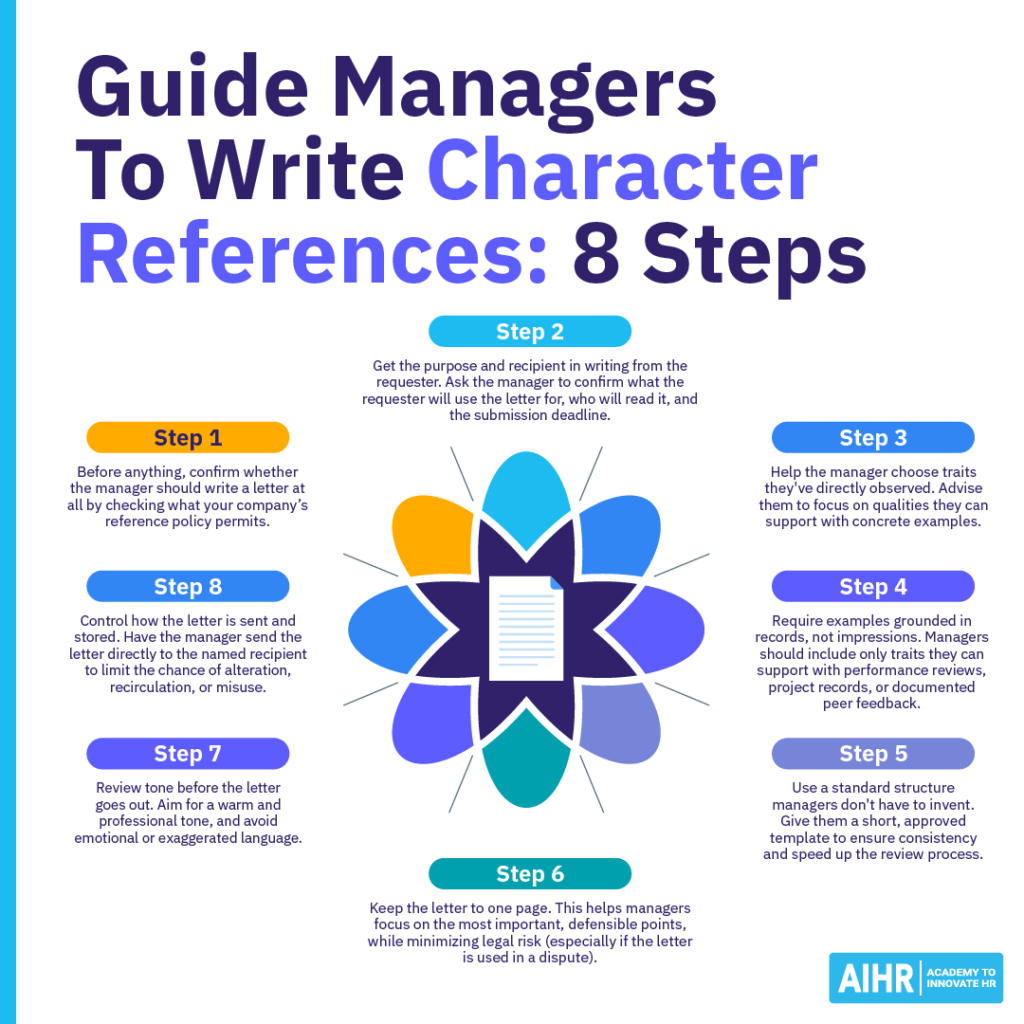
Step 5: Use a standard structure managers don’t have to invent
Give managers a short, approved template. It should start by stating the relationship and how long they’ve known the person, and include two or three paragraphs about specific traits with supporting examples. It should then offer a recommendation for the purpose, and end with a sign-off and contact details.
A template helps keep language consistent across the organization, which ensures fairness and consistency. Giving positive references to some employees but not others can lead to discrimination or retaliation claims, especially if patterns that disadvantage employees of minority backgrounds emerge. Using a template also speeds up your review process.
Step 6: Keep the letter to one page
Longer letters increase risk. Each extra paragraph adds more for the company to defend if the letter is used in a dispute. Keeping the letter to one page helps managers focus on the most important, defensible points and reduces the chance of including off-topic comments, such as reasons for leaving, conflicts with colleagues, or guesses about future performance, which can cause issues.
Step 7: Review tone before the letter goes out
Aim for a warm and professional tone. Avoid emotional language like “they’re the best employee I’ve ever had” or “I’d trust them with anything,” as these can sound like exaggeration or be used against the company in legal situations.
Tone also shows who’s speaking. If a letter sounds personal but is on the company letterhead, it can be unclear whether ot not it represents the company. Proofread as usual, but focus on removing any statements the business cannot support.
Step 8: Control how the letter is sent and stored
Where possible, have the manager send the letter directly to the named recipient rather than handing it to the employee to forward. Direct delivery limits the chance the letter might be altered, recirculated, or used outside its stated purpose.
Keep a signed copy in the employee’s file with the original request, so you have a clear record of what was said, when, and to whom. If the recipient calls later for follow-up, the manager should route them through HR rather than answer ad hoc.
Character reference letter example
Here’s a sample character reference letter written from a manager’s viewpoint:
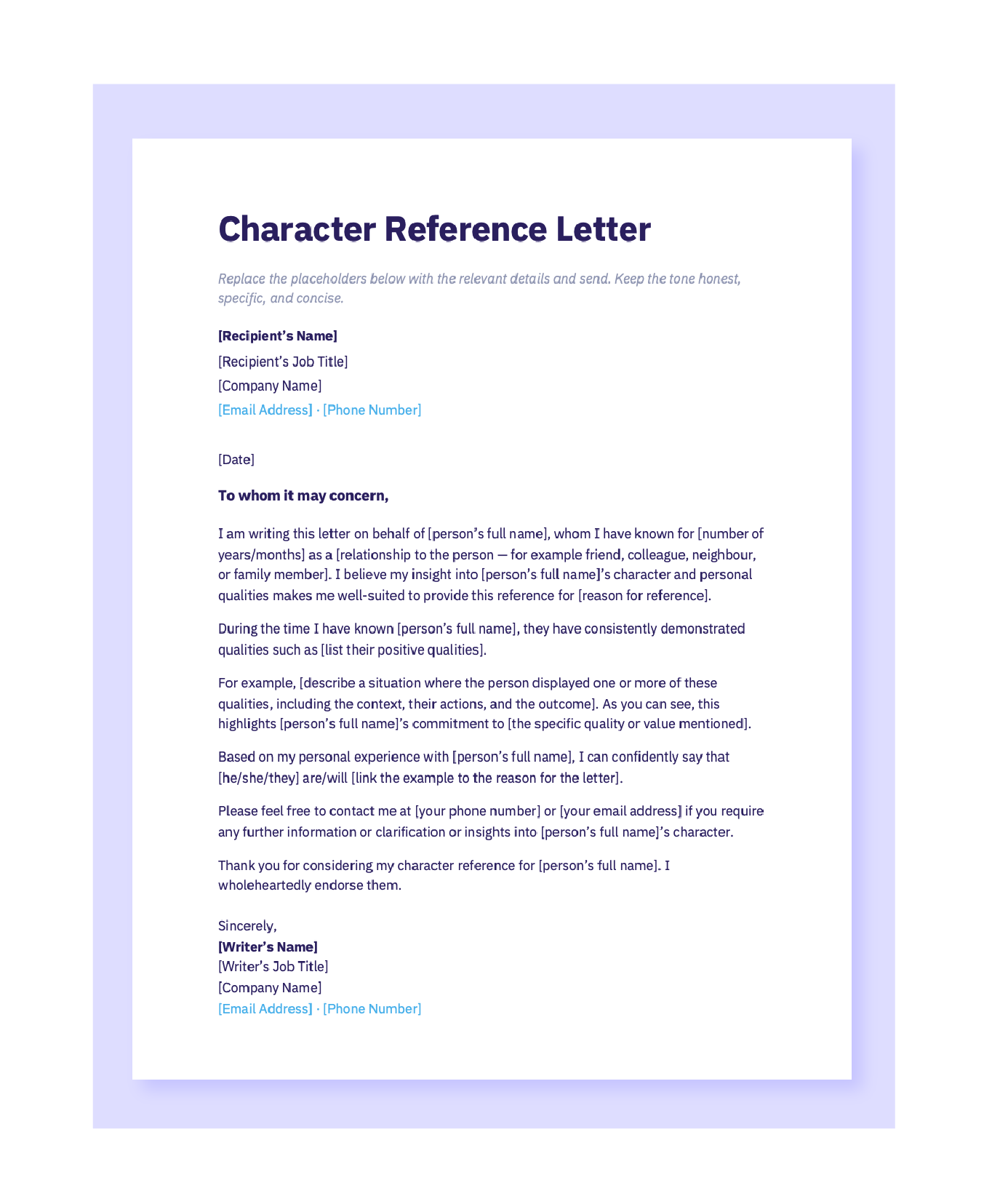
Free character reference letter template
We’ve created a free customizable character reference letter template you can help managers adapt for different recipients and situations, whether it’s going to an employer, a landlord, a membership committee, or a court or immigration officer. You can download this template for free and quickly compose a clear, professional character reference letter on the first draft.
8 best HR practices for handling character reference letters
Guidelines help keep character reference letters factual, brief, and in line with company policy. Here are some best practices for HR to follow:
When managers write them (outgoing)
- Create a clear written policy: This determines whether the company allows character references and when managers can write them. Include guidelines on when references are appropriate, the difference between personal and official capacity, and the use of the company’s official template.
- Authorize specific roles: Doing so makes it clear who should write or approve official character references, and requires everyone else to write only in a clearly personal capacity using personal contact details.
- Train managers: Ensure managers are aware of the risks of defamation and discrimination before they write any references. As a rule, they should only write a reference if they can support it with specific, factual examples, and maintain a respectful tone.
- Include a redirection protocol: If the company doesn’t provide character references, redirect requestors to standard employment verification procedures, and make sure managers know to do the same.
When candidates submit them (incoming)
- Distinguish reference types in your ATS: Set dedicated fields for Professional Reference, Character Reference, and Employment Verification, so you don’t make the mistake of treating them interchangeably.
- Use character references only as extra information: Character references shouldn’t be the main factor in screening. A positive letter from a former colleague, for instance, shouldn’t outweigh stronger professional qualifications from other candidates.
- Look out for biased content: If a letter mentions protected characteristics, personal details, or uses vague praise, note the issue and give the letter less weight. Also, consider if your job description is encouraging the right type of references.
- Document the influence of character references: It’s important to note how character references factor into hiring decisions. A defensible audit trail matters as much for references as it does for any other input.
Next steps
Character reference letters can provide HR with helpful context that résumés and professional references may miss, but only if there are proper policies, training, and processes in place. As such, it’s crucial to make sure your company has a clear policy for writing character reference letters.
For incoming letters, it is important to know how to use them to assess a candidate’s integrity and cultural fit without adding bias or risk. To improve your sourcing, screening, and evaluation process, consider AIHR’s Sourcing & Recruitment Certificate Program.







 POPULAR: 3,687 DOWNLOADS