



A well-planned job orientation helps new hires feel welcome, understand what’s expected of them, and start contributing sooner. It also gives employers a chance to reduce confusion, support compliance, and create a better first impression from day one.
A BambooHR survey found that 70% of new hires decide whether a job is the right fit within the first month, while 29% know within the first week. So, how can your organization create a job orientation process that sets new hires up for success? In this article, we’ll look at what job orientation is, why it matters, what to include, and how to make it more effective.
Contents
What is a job orientation?
What is the purpose of a job orientation?
Why is a job orientation important?
Orientation vs. onboarding: What are the differences?
Does a new hire get paid for a job orientation?
What are the key stages of a job orientation process?
Free job orientation checklist for HR
How to make job orientation a success at your organization
FAQ
Key takeaways
- Job orientation is the first stage of onboarding and helps new hires understand their role, workplace, and employer.
- A strong orientation process helps reduce uncertainty, improve compliance, and support faster productivity.
- Effective orientation starts before day one and continues with follow-up after the initial welcome.
- HR can improve orientation by combining clear communication, practical support, and a structured first-day experience.
What is a job orientation?
A job orientation is the first stage of the onboarding process that helps a new hire understand their role, workplace, and employer. It usually takes place before the first day or during the first few days of work and covers key information such as job expectations, company policies, paperwork, introductions, and the tools employees need to get started.
A typical new hire orientation covers essential information employees need to get started, such as job expectations, company policies, paperwork, introductions, access to tools and systems, and any required new hire training. It may also include a workplace tour, team introductions, and policy or safety training.
For remote employees, these activities may happen virtually, but the goal stays the same: to help the employee feel prepared, supported, and ready to begin work with confidence.
How long is orientation for a job?
A typical job orientation lasts anywhere from a couple of hours to a full work week. It usually depends on how complex the role is and the organization. For remote or hybrid employees, orientation may be spread across two half-days or delivered virtually, though the core activities remain the same.

What is the purpose of a job orientation?
The purpose of a work orientation is to help new employees get off to a strong start by providing the information, tools, and support they need from day one.
A well-run orientation process helps you:
- Clarify the employee’s role and responsibilities
- Set expectations early
- Explain company policies and workplace rules
- Complete the required paperwork and compliance steps
- Introduce the new hire to their manager, team, and key contacts
- Provide access to systems, technology, and other resources
- Reduce first-day anxiety and build confidence.
In practice, this means a new employee is less likely to feel lost, confused, or disconnected in their first days on the job. Instead, they have a clear starting point and know where to go for help.
Why is a job orientation important?
Job orientation helps new hires settle in faster and gives employers a more consistent way to welcome and prepare employees from day one. When done well, it can reduce uncertainty, improve the new hire experience, and support a smoother transition into each role.
Benefits of job orientation for new hires
- Better understanding of the organization: Job orientation helps new hires learn about the company’s mission, values, culture, policies, and procedures. It also introduces practical details such as benefits, workplace expectations, and available support.
- Stronger early connections: Meeting managers, teammates, and key contacts early on can help employees feel more welcome and build positive working relationships from the start.
- Clearer role expectations: Orientation gives employees a better understanding of their responsibilities, priorities, and how their work contributes to broader company goals. This can reduce confusion and help them settle in faster.
- Greater confidence from day one: Knowing where to go, who to ask, and how the workplace operates can make the first few days feel less overwhelming.
- Easier access to tools and resources: Orientation helps employees get familiar with the systems, equipment, and materials they need so they can start work with fewer delays.
Benefits of job orientation for the organization
- A chance to get to know the new hire: Orientation is not only about sharing information. It also helps the organization learn more about the employee’s goals, strengths, and any support they may need early on.
- Improved employee retention: A positive first impression can shape how employees feel about the organization in the early weeks. According to BambooHR, employers have an average of 44 days to influence a new hire’s long-term retention, making those first weeks especially important.
- Faster time to productivity: When employees understand their role, workplace expectations, and available tools from the start, they can contribute sooner. This helps shorten the ramp-up period and improves the return on investment for the organization.
- More consistent onboarding experience: A structured orientation helps ensure all new hires receive the same essential information, which can reduce gaps and miscommunication.
- Better compliance and administrative accuracy: Covering forms, policies, and required procedures early can help reduce errors and make sure employees are ready to work in line with company and legal requirements.
Orientation vs. onboarding: What are the differences?
While people often use orientation and onboarding interchangeably, they serve different purposes. Orientation gives new hires the basics they need to start work, while onboarding supports their longer-term integration, performance, and connection to the organization.
Focus
Welcome, setup, policies, and basic role clarity
Integration and helping the employee become productive
Duration
One to three days
Three to six months, sometimes up to the first year
Main emphasis
Organizational identity
Departmental identity and getting to know the team
Content
Company videos, presentations, employee handbook, tax forms, and IT setup
One-on-ones, mentorship, shadowing, and feedback on early assignments
Employee role
More passive, receiving information
More active, engaging in learning and feedback
Goal
Prepare the employee legally and logistically to work
Build loyalty, job satisfaction, and connection to the organization
Does a new hire get paid for a job orientation?
In most cases, time spent in job orientation is paid because it’s part of the start-up process. Under the Fair Labor Standards Act (FLSA), required activities such as completing paperwork, reviewing company policies, following safety instructions, and taking part in training generally count as hours worked.
This means new employee orientation is typically paid when attendance is mandatory and its content directly relates to the role. The same applies to virtual orientation sessions for remote employees.
There are some exceptions, however. Under 29 CFR § 785.27, training time may be unpaid only if it takes place outside regular working hours, is voluntary and not job-related, and involves no productive work. If those conditions are not all met, the time is generally paid.
For HR, the safest approach is to treat orientation for new hires as paid time, unless employment counsel or a state-specific rule clearly says otherwise. This helps reduce compliance risk and supports a better first impression during the broader orientation process.
What are the key stages of a job orientation process?
The job orientation process starts before the employee’s first day and continues after the initial welcome. While the exact format will vary by organization, most new hire orientation programs include three main stages: preboarding, orientation day, and early follow-up.
Stage 1: Before day one
The first stage begins before the new hire arrives. This is when HR and the hiring manager prepare everything the employee needs to start smoothly. This includes sending a welcome email, sharing the first-day agenda, preparing contracts and forms, setting up payroll and benefits, and making sure the employee has access to the right tools and systems.
This stage is also a chance to reduce uncertainty. Clear communication about where to go, what to bring, what to wear, and who to report to can make a big difference in how confident a new employee feels before they start.
Stage 2: Orientation day
The second stage is the formal orientation day itself. This is when you or the hiring manager introduces the employee to the organization, their team, and the basics of workplace operations. A typical new employee orientation may include a workplace tour, introductions, paperwork, policy reviews, safety procedures, and an overview of the employee’s role and first-week priorities.
The goal at this stage is not to overload the new hire with information. It’s to help them feel welcome, give them the essentials they need right away, and make sure they know where to go for support.
Stage 3: Early follow-up after orientation
A good orientation process doesn’t end after the first day. The final stage focuses on making sure everything is working as expected and helping the employee settle in. This can include answering follow-up questions, sharing useful resources, confirming that systems and paperwork are complete, and scheduling check-ins with HR and the hiring manager.
This stage is important because it helps make orientation part of a smoother onboarding experience. It also gives HR a chance to gather feedback and spot issues early during onboarding for new hires.
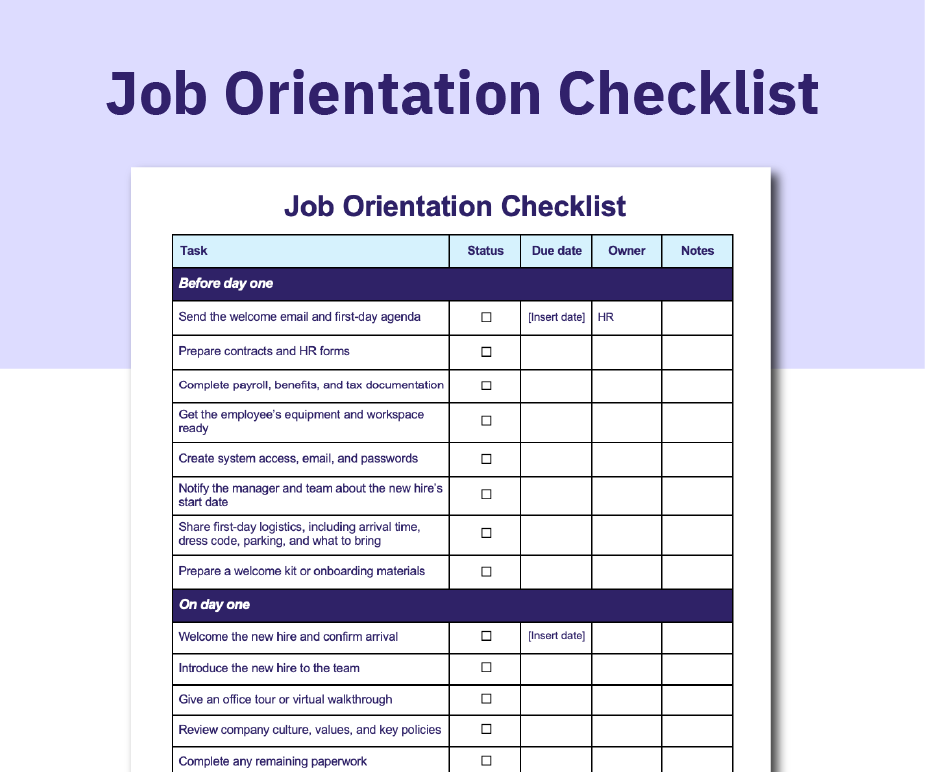
Free job orientation checklist for HR
Use these practical orientation examples as a checklist to help HR teams plan each stage of the process.
Before day one
- ✔ Send the welcome email and first-day agenda
- ✔ Prepare contracts and HR forms
- ✔ Set up payroll, benefits, and tax documentation
- ✔ Prepare the employee’s equipment and workspace
- ✔ Set up system access, email, and passwords
- ✔ Inform the manager and team about the new hire’s start date
- ✔ Assign a buddy or point of contact
- ✔ Share first-day logistics, including arrival time, dress code, parking, and what to bring
- ✔ Order a welcome kit or onboarding materials (company swag, notepad, etc.).
On day one
- ✔ Welcome the new hire and confirm arrival
- ✔ Introduce the new hire to the team
- ✔ Lead an office tour or virtual walkthrough
- ✔ Review company culture, values, and key policies
- ✔ Complete any remaining paperwork
- ✔ Confirm that tools, systems, and equipment are working properly
- ✔ Explain the role, responsibilities, and first-week priorities
- ✔ Introduce the buddy or point of contact
- ✔ Confirm the new hire’s emergency contact details
- ✔ Leave time for questions.
After orientation
- ✔ Share useful resources, documents, and key contacts
- ✔ Check that all forms and system setup are complete
- ✔ Schedule follow-up check-ins with HR and the manager
- ✔ Gather feedback on the orientation experience
- ✔ Send a summary email recapping key contacts, tools, and next steps
- ✔ Check in at the 30-day mark to assess how the new hire is settling in.
How to make job orientation a success at your organization
The following best practices can help you create a more organized and effective job orientation experience.
Minimize first-day jitters
Include a plan for the employee’s start date to reduce stress and communicate it to them. Inform them of the arrival time and whom to report to, and provide detailed directions to the workplace and parking (if applicable). Also include information about the dress code and whether they should bring any documentation with them. If your new hire is remote, let them know in advance how to check in and what to expect on their first day.
Prepare the new hire’s workstation
Before they arrive at work, have all work-related items your new employees need ready and waiting. This can include devices, an identification badge, a keycard, a cabinet or locker, desk supplies, email and passwords, and invitations to company communications and project systems.
Remote employees will need these items sent to them well in advance. Be ready to provide them with helpful guidelines for setting up a comfortable and professional home workspace.
Welcome them to the team
Personalize the job orientation with some nice new hire perks, such as a corporate T-shirt, notepads, pens, or water bottles. Add their name to their workstation before they arrive.
You can also welcome them with a plant or a thoughtful card signed by their team members. Host a group lunch or online event to help them get to know everyone, and assign a mentor from among your more seasoned employees to show the new hire the ropes.
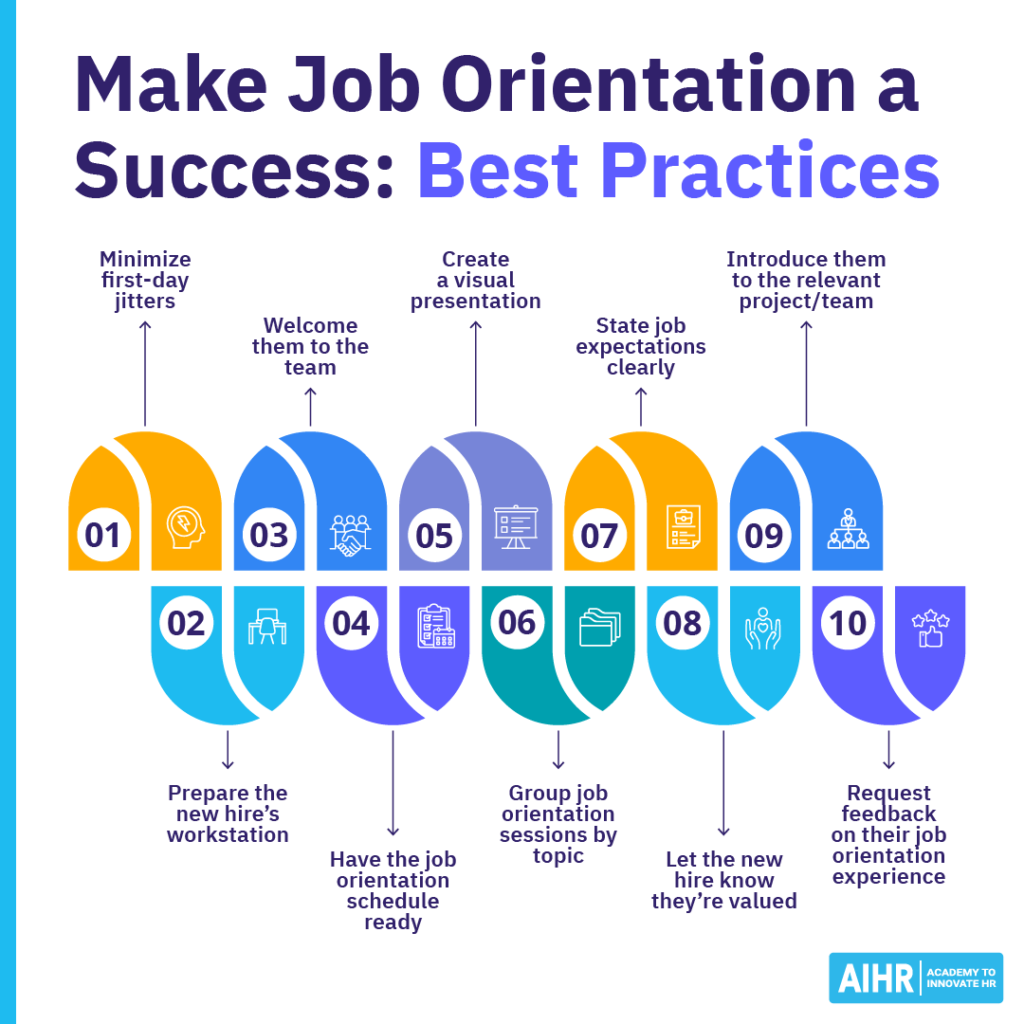
Have the job orientation schedule ready
When developing your job orientation program schedule, make sure it includes information the new hire must know. Include breaks, snacks, and touchpoints with a supervisor at least twice a day. Continue with this practice in the first few weeks as well.
At the same time, encourage employees to ask questions and get to know their peers. Keep the program specific and consistent for all new hires by using a quick job orientation checklist.
Create a visual presentation
Instead of relying on long verbal explanations about the company, try creating an audiovisual presentation to provide visual and auditory stimulation that keeps new hires engaged and interested. You can send this presentation to new hires ahead of employee onboarding, or go over it in a virtual meeting or orientation webinar with them.
Group job orientation sessions by topic
A typical orientation will include going over the company culture, leadership, mission and vision, and processes and procedures. Remember to include time for an office tour, introductions to core team members, department leaders, and the facilities where they will be working.
Group sessions by topic: HR handles administrative tasks, leaders handle vision- and mission-driven talks, and more. You can also manage remote sessions in a similar way.
State job expectations clearly
While each employee may be assigned to different jobs and tasks, you must communicate core expectations from day one. For example, all employees must take responsibility for their work, do their best, seek help when needed, and act professionally, as well as with integrity and honesty. They must also understand that respect is vital to a positive working relationship with others.
Let the new hire know they’re valued
In addition to voicing its expectations of employees, the company should also communicate that it values and rewards employees for their hard work. Make sure all employees understand the performance system and how it ties to recognition and promotion. Moreover, all employees must know that the company offers inclusive, equitable work opportunities to enable everyone to thrive.
Introduce them to the relevant project/team
Employees will be eager to learn about the work you have in mind for them, so feel free to give them a high-level overview of any projects they’ll be a part of. Give them some background on each project, who they’ll be working with, and how important they are to the success of the project.
Request feedback on their job orientation experience
To ensure continuous improvement, always have a survey ready to send to employees to gather feedback on the job orientation process. Note any concerns employees bring up, suggestions for improvement, and questions they may have. This is also a good time to quickly review their performance to ensure they’re settling in well.
Next steps
A strong job orientation does more than welcome a new hire. It helps HR create consistency, reduce confusion, support compliance, and give employees a better start from day one. To do that well, HR professionals need a mix of skills, including communication, policy knowledge, onboarding design, stakeholder management, and day-to-day HR operations.
For HR practitioners who want to build those capabilities, AIHR’s HR Generalist Certificate Program is a relevant next step. It helps HR professionals strengthen core operational skills and manage essential HR processes that support the employee experience across the organization.
FAQ
A job orientation is a structured introduction that helps a new employee understand the workplace, their role, and what they need to get started. It usually covers practical information such as company policies, paperwork, team introductions, workplace expectations, and access to tools and systems. It is typically the first step in the broader onboarding process.
The length of a job orientation varies by employer and role, but it often lasts anywhere from a few hours to a few days. Some organizations complete orientation in one day, while others spread it across the first week so new hires have more time to absorb information, complete training, and meet key people. This timing is usually shaped by the complexity of the role, compliance needs, and whether the employee works on-site, remotely, or in a hybrid setup.
In many organizations, orientation takes place on the employee’s first day of work, but it can also begin before day one or continue through the first few days. For example, some employers complete forms and basic setup before the start date, then use the first day for introductions, training, and role expectations. Orientation is often the start of onboarding, but it is not always limited to a single day.
In most cases, yes. Under the Fair Labor Standards Act, required orientation and job-related training generally count as paid work time. If attendance is mandatory and the session is directly related to the job, it will usually count as hours worked.
There are limited exceptions. Under 29 CFR § 785.27, training time may be unpaid only if it is voluntary, outside regular working hours, not job-related, and involves no productive work. State laws may also set additional rules.


 POPULAR: 3,687 DOWNLOADS