


As HR roles become more strategic, more HR professionals are looking for an HR Business Partner certification that helps them act as true partners to the business. With formal certifications, training programs, and certificate courses all promising to make you a more strategic HRBP, choosing the right one can feel overwhelming.
Some options focus on credentials and recognition, while others help you build practical skills you can use at work the same week. The best choice depends on what you need for your next career step, and many HR professionals end up combining both over time.
This guide compares five leading options side by side, starting with AIHR’s HR Business Partner 2.0 Certificate Program, so you can choose the HR Business Partner certification or certificate program that fits your goals, experience, and the type of HRBP you want to become.

Contents
What is an HR Business Partner certification?
What should you look for before choosing a certification or program?
Best HR business partner certification and certificate programs
– Practical certificate programs for HRBPs
– Formal certification-focused options
– Other HRBP training courses
How to choose the right HRBP path for your career
Key takeaways
- There is no single best HR Business Partner certification; the right choice depends on your career goals.
- Formal certifications and certificate programs serve different purposes.
- HRBPs benefit most from learning that builds strategic and business-focused capability.
- For many professionals, a practical HR Business Partner course is the most effective first step.
What is an HR business partner certification?
An HR Business Partner certification is a credential or learning program that helps HR professionals develop the skills to act as strategic partners to the business. Because the term is used broadly, it can refer to:
- Formal certifications offered by professional bodies, which usually end in an exam
- Specialized HRBP training programs, often delivered live over a few days or months
- Certificate programs focused on HR business partnering, which build practical skills and award a certificate when you finish
Some options emphasize recognition and formal credentials. Others focus on the practical skills HRBPs need to influence stakeholders, support decision-making, and drive business outcomes.
Before you decide, look past the program’s name and focus on what it will help you do in your job. When you compare options, use a few evaluation criteria:
- Does the program develop strategic and business skills, or mainly HR fundamentals?
- How practical is the learning? Do you get tools, templates, or case studies you can apply at work?
- Do employers in your industry or region recognize and value the credential?
- How flexible is it in pace and format?
- Will you interact with instructors or peers?
It also helps to ask yourself a few questions as you compare programs:
- What new skills or outcomes will I gain by completing this program?
- How will it improve my ability to influence stakeholders and drive business goals?
- Does it fit my current experience level and the direction I want my career to take?
What should you look for before choosing a certification or program?
When you know what makes an HRBP-focused program valuable, it becomes much easier to compare your options. A strong HR Business Partner learning path should help you build:
- Strategic thinking: HRBPs connect people strategy with business goals, so choose a program that goes beyond basic HR tasks and focuses on business impact.
- Stakeholder influence: Much of an HRBP’s work involves influencing leaders, which means good training should cover communication, consulting, and influencing skills.
- Business acumen: The best programs connect HR decisions to financial and operational outcomes, because you can’t advise the business without understanding how it makes money.
- Practical application: Theory alone isn’t enough. You should be able to apply what you learn directly in your role, ideally with ready-to-use templates.
- Relevance to modern HR: As the HRBP role changes, look for programs that cover today’s challenges, such as HR metrics, change management, employee experience, and using AI in your work.
- Flexibility: Since you’ll likely learn while working, online and self-paced options make it easier to fit learning around your job.
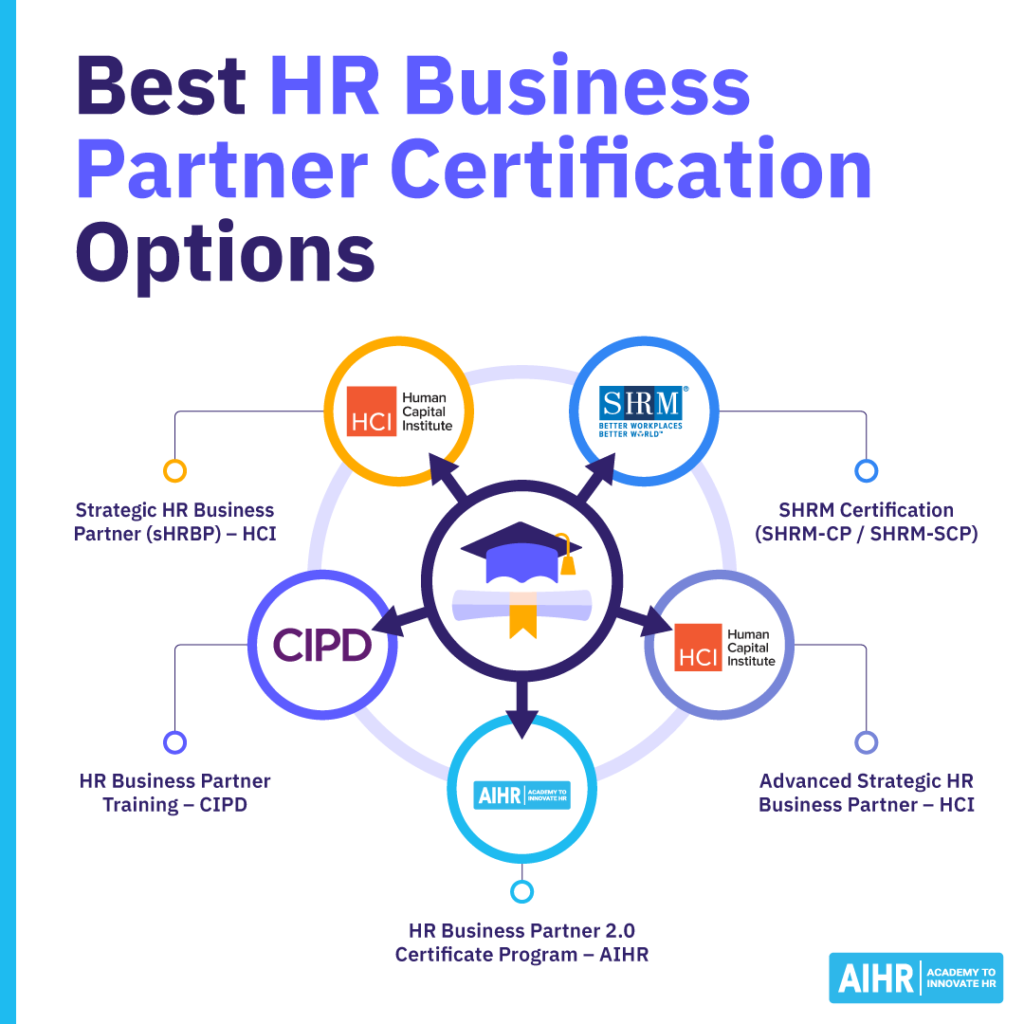
Best HR business partner certification and certificate programs
The options below fall into two main types: practical certificate programs that build skills, and formal certifications that validate knowledge through an exam. Each serves a different purpose, so the best choice depends on whether you need capability, credibility, or both.
Practical certificate programs for HRBPs
If your goal is to perform better as an HRBP, start here. These programs focus on building skills you can use in your role right away.
1. AIHR HR Business Partner 2.0 Certificate Program
Academy to Innovate HR (AIHR)’s HR Business Partner 2.0 Certificate Program is designed for current and aspiring HRBPs who want to move from operational HR work to strategic partnering. Instead of preparing you for an exam about HR theory, it teaches you to apply your HR expertise in a business context, with tools and templates you can take straight into your next meeting with a leader.
Who it’s for: Mid-level HR professionals moving from tactical work into HRBP roles, and existing HRBPs who want to strengthen their strategic impact and move beyond operational work.
What it covers: The program includes several courses, including:
- Becoming a Strategic HR Business Partner: The HRBP role and model, strategic vs. operational HR, and developing a strategic mindset
- Understanding Business Strategy: How businesses create value, how to evaluate strategic choices, and how strategy and culture fit together
- Customer-Centric HR: Customer-centric HR practices and customer journey mapping
- HR Consulting Skills: Stakeholder management, root cause analysis, solution design, implementation planning, and impact monitoring
- Driving HR Impact with Metrics, Dashboards, and OKRs: HR metrics, reading dashboards, the HR value chain, KPIs, and OKRs
- Driving the Employee Experience: Design thinking, personas, and designing and testing employee experiences
- Building Influence and Credibility as an HRBP: Building trust, the SCARF model, influencing tactics, and navigating office politics
- AI Tutorials for HR Business Partners: Using generative AI for meeting prep and follow-ups, communications, and practicing difficult conversations with AI role-plays
How it works: The program is 100% online and self-paced, and AIHR certificate programs take 25 to 45 hours to complete, with 12 months of access. Video lessons follow AIHR’s Tell-Show-Do-Apply method, alongside quizzes, case studies, and exercises. You also get downloadable resources, such as a Business Context Canvas, Stakeholder Management Template, KPI Tree Template, SCARF Diagnostic Guidebook, and Strategic Influencing Toolkit.
How you earn the certificate: The program ends with a capstone project in two parts. In the capstone assignment, you step into the role of an HRBP at a healthcare network facing a patient safety crisis and practice what you’ve learned in a realistic, safe scenario. You then take the capstone exam, and when you pass it with a score of 70% or higher, you earn a digital certificate you can share on LinkedIn. The capstone takes about two hours in total, and you can retake the exam as many times as you need.
Recognition and credits: AIHR is accredited by 15+ HR organizations. AIHR is recognized by SHRM to offer Professional Development Credits (PDCs) for SHRM-CP® or SHRM-SCP® recertification activities, and its programs are eligible for HRCI, HRPA, CPHR, and ATD credits. AIHR is also CPD-accredited by CPD UK, so CIPD members can record AIHR programs as verified Continuing Professional Development. This means the program complements a formal certification rather than replacing it, and it can help you keep an existing credential current.
Cost and plans: You can enroll in the program on its own for $1,125, with 12 months of access and a 30-day money-back guarantee. Alternatively, Full Academy Access ($1,850/year) gives you all 16+ AIHR certificate programs, 85+ courses and mini courses, 300+ templates in the HR Resource Library, AIHR Copilot, and personal coaching. HR leaders who want to upskill a whole team of HRBPs can also explore AIHR’s HR Business Partner Boot Camp, a cohort-based program for groups of 2 to 20 people.
Why it stands out: AIHR focuses only on HR, and its instructors are experienced HR practitioners. More than 85,000 HR professionals have trained with AIHR, and 97% of students recommend it, with an average rating of 4.66 out of 5 from 12,000+ verified reviews on Reviews.io.
What you can apply on the job:
As you work through the program, you can start using what you learn in your current role, for example by mapping your stakeholders before a major change, building a KPI tree that links an HR initiative to a business result, or running a root cause analysis before proposing a solution. Over time, this builds your credibility with leaders and your ability to contribute to strategic decisions.
Formal certification-focused
If you need a recognized credential that you earn by passing an exam or completing a structured, instructor-led program, these options are worth comparing.
2. Strategic HR Business Partner (sHRBP) – HCI
The Human Capital Institute (HCI)’s Strategic HR Business Partner (SHRBP) certification is a short, intensive program that helps HR professionals act as strategic partners and advisors to the business.
Who it’s for: HR professionals who want to move from reactive work, such as managing policies and handling issues as they arise, to proactive, strategic advisory roles with business leaders.
What it covers: The program is built around HCI’s Prepare, Partner, Perform, and Amplify framework. It covers developing a strategic mindset, analyzing business data (including the three financial statements), aligning talent strategy with business priorities, consulting and root cause analysis, change management, and implementing, measuring, and scaling talent initiatives. It also covers using AI and analytics tools to support HR consulting.
What makes it useful: The program runs over three days, virtually or in person. To earn the certification, you attend all sessions, complete all classwork, and pass a multiple-choice exam with a score of 80% or higher. It costs $2,795, earns 19.5 SHRM and HRCI recertification credits, and you renew it every three years by earning 60 credits.
3. Advanced Strategic HR Business Partner – HCI
HCI’s Advanced Strategic HR Business Partner certification is a next-step program for experienced HRBPs who want to deepen their strategic influence at a senior level.
Who it’s for: Experienced HRBPs who have completed HCI’s SHRBP certification or have a proven track record of leading strategic talent initiatives. SHRBP is recommended but not required.
What it covers: The program focuses on consulting and influence, systems thinking, behavioral economics in talent strategy, future of work and scenario planning, workforce analytics for storytelling, and influencing senior leaders through courageous conversations.
What makes it useful: It’s delivered virtually over two days, and you bring a current organizational challenge to work on. The program includes a design lab and ends with capstone presentations. You earn the certification by attending all sessions and completing all classwork. It costs $1,995 and earns 13.5 SHRM and HRCI recertification credits.
3. SHRM Certification (SHRM-CP / SHRM-SCP)
SHRM certifications are widely recognized HR credentials from the Society for Human Resource Management (SHRM). They aren’t HRBP-specific, but the SHRM-SCP is often relevant for HRBPs working at a strategic level.
Who it’s for: The SHRM-CP suits HR professionals in operational roles and has no degree or experience requirement, so it works for early-career professionals. The SHRM-SCP is for senior HR professionals in strategic roles and requires three or more years in strategic HR, or holding the SHRM-CP for three years.
What it covers: Both exams are built on the SHRM Body of Applied Skills and Knowledge (SHRM BASK). They assess HR knowledge and situational judgment across areas such as leadership, business knowledge, and organizational effectiveness.
What makes it useful: Employers widely recognize SHRM certifications. You prepare on your own or with a prep course, then take a computer-based exam at a Prometric test center. The exam fee ranges from $350 to $499, depending on SHRM membership and when you apply, and preparation materials cost extra.
SHRM certifications require recertification every three years, which you can do by earning Professional Development Credits (PDCs) or retaking the exam. Because AIHR is recognized by SHRM to offer PDCs, an AIHR certificate program can count toward your SHRM recertification.
Other HRBP training courses
5. CIPD Business Partner Programme
The Chartered Institute of Personnel and Development (CIPD) offers a dedicated Business Partner Programme to help people professionals build business partnering skills.
Who it’s for: People professionals who are new to business partnering or want to become business partners.
What it covers: The program focuses on commercial focus, data and analytics, professional courage and influence, and acting as an organizational coach or mentor.
What makes it useful: It runs virtually over four to six months, combining two live virtual classes a month with self-directed learning. It costs £2,588 excluding VAT, with 15% off for CIPD members, and you receive a certificate when you attend 100% of the course dates.
How to choose the right HRBP path for your career
When you compare HRBP programs, the name on the certificate tells you very little about how much it will help you in your role. Instead, judge each option against what HRBPs do every day: advising leaders, linking people decisions to business results, and keeping their own skills current. Here are some considerations:
1. Practical skills you can use right away
If a program ends with an exam on theory, you still have to work out how to apply it at work on Monday morning. Look for one built around applied learning, with case studies, realistic scenarios, and downloadable templates, such as stakeholder maps, KPI trees, and implementation plans, that you can take into your next conversation with a leader.
2. Connecting HR objectives to business goals
Since your credibility as an HRBP depends on showing how people initiatives move business results, the program should teach you how the business creates value and how to turn its strategy into HR priorities. Check that it covers HR metrics, dashboards, KPIs, and OKRs, so you can measure the impact of your work and report it in the language leaders use.
3. Strategic thinking
As you move from operational HR into business partnering, the biggest shift is in how you approach problems. A strong program helps you build a strategic mindset, which means diagnosing root causes before jumping to solutions, weighing strategic choices, and designing HR interventions around business priorities rather than HR processes.
4. Getting a seat at the table
A seat at the table comes from trust, and you earn it by understanding the pressures leaders face and influencing them well. Look for content on stakeholder management, consulting skills, building credibility, and influencing tactics, ideally with role-plays or scenarios that let you practice difficult conversations before you have them in real life.
5. Recertification credits
If you already hold a certification, such as the SHRM-CP, SHRM-SCP, or PHR, choose a program that earns recertification credits, so the same learning builds new skills and keeps your credential current. Check that the provider is recognized by SHRM to offer Professional Development Credits (PDCs) and eligible for HRCI recertification credits, and whether HR bodies in your region, such as HRPA, CPHR, or CIPD, also recognize it.
6. Self-paced learning
Because most HRBPs learn alongside a full workload, fixed class dates and multi-day sessions can be hard to fit in. A 100% online, self-paced program lets you learn in short blocks, slow down during busy periods, and apply each lesson at work before you move on. It also helps to check how long you keep access, since 12 months gives you time to revisit material when a new challenge comes up.
Next steps
The best next step depends on what you want to achieve. If your priority is a recognized credential, start by exploring the formal HRBP certifications above and what each one requires.
If your goal is to become more effective in your role, a practical HR Business Partner certificate program is often the better place to start, because it helps you build the skills you need now rather than focusing only on a credential.
AIHR’s HR Business Partner 2.0 Certificate Program is built for this. It focuses on the skills HRBPs use every day, from business acumen and consulting to HR metrics and influence, and lets you develop them online at your own pace.
Explore the program or visit the AIHR demo portal to see how it fits your learning goals before you decide on your next step.
FAQ
It depends on your goals. If you want practical skills you can use right away, AIHR’s HR Business Partner 2.0 Certificate Program is a strong first step: it’s online, self-paced, and eligible for SHRM PDCs and HRCI recertification credits. If you need a formal, exam-based credential, consider HCI’s Strategic HR Business Partner (SHRBP) certification or the SHRM-SCP.
Most HRBPs have experience in HR roles, along with strong business understanding, stakeholder management skills, and strategic thinking. A formal certification isn’t always required, but a certificate program or certification can help you show employers these skills.
Most HRBPs move into the role after gaining experience in HR operations or generalist roles, then develop strategic and business-focused skills, such as business acumen, consulting, and influencing. A practical program like AIHR’s HR Business Partner 2.0 Certificate Program can help you build these skills while you work.
HRBPs benefit from training in business acumen, stakeholder management, consulting skills, HR metrics, and strategic HR. Training that includes templates and realistic case studies helps you apply these skills on the job.
Yes. AIHR’s HR Business Partner 2.0 Certificate Program is 100% online and self-paced. HCI’s SHRBP is available virtually or in person, and CIPD’s Business Partner Program runs as live virtual classes. SHRM-CP and SHRM-SCP exams are taken at Prometric test centers.
A certification usually focuses on recognition and validates your knowledge through an exam. A course or certificate program, such as AIHR’s, focuses on building skills and applying them in practice. The two are complementary, and many HR professionals combine them.
Yes. AIHR is recognized by SHRM to offer Professional Development Credits (PDCs) for SHRM-CP or SHRM-SCP recertification activities, and its certificate programs are eligible for HRCI recertification credits. AIHR’s certificate complements these certifications rather than replacing them.