
Employee experience management (EXM) helps you shape how employees experience work, from the first job ad to their final day. Strong employee experience management helps you spot friction, improve key moments, and enable people to do their best work. The need is urgent; Gallup reports that global employee engagement has fallen to 20%, which could cost the world economy $10 trillion in lost productivity.
Better processes, clearer manager support, and the right technology can help you improve engagement, productivity, and retention. This article explains what EXM is, how it applies across the employee life cycle, and how to develop an effective employee experience management program.
Contents
What is employee experience management?
Why you should invest in employee experience management
How employee experience management looks across the employee life cycle
7 steps to develop an effective employee experience management program
5 employee experience management software tools to consider
What is employee experience management?
Employee experience management (EXM) is the proactive process of shaping and improving every interaction employees have with your organization. These interactions include cultural, physical, and digital touchpoints, such as manager support, workplace design, technology, communication, workload, and career growth.
EXM spans the full employee life cycle. It starts when someone first sees your job posting and continues through recruitment, onboarding, development, retention, offboarding, and alumni engagement. The goal is simple: create a workplace where employees feel supported, equipped, and motivated to do great work.
EXM is not a one-time engagement project. Employee needs change as roles, teams, tools, and business priorities change. To manage employee experience well, HR should collect feedback across the life cycle, act on what employees share, and work with leaders and managers to build a workplace where people can thrive.

Why you should invest in employee experience management
An employee experience management program can benefit organizations of any size or industry. It gives HR a structured way to understand what employees need, where work gets harder than it should, and which changes will have the greatest impact.
Productivity gains
Employee experience management helps you identify what slows employees down. This may include unclear workflows, outdated tools, poor communication, or a workplace setup that doesn’t support focus and collaboration. When employees feel supported, they’re more likely to stay engaged and do better work.
Reduced turnover costs
When employees feel valued, supported, and able to grow, they’re less likely to leave. That protects your organization from replacement costs, lost knowledge, and manager time spent backfilling roles. SHRM Labs cites Gallup research estimating replacement costs at one-half to two times an employee’s annual salary.
Better collaboration
Effective employee experience management creates a two-way line of communication between employees, managers, and leaders. Employees can raise concerns, leaders can explain decisions, and teams can work through issues faster. Over time, this builds trust and helps people work together with less friction.
Improved customer satisfaction scores
By boosting employee engagement and motivation, your staff is less likely to make service errors and more likely to empathize with customers and go out of their way to help them. Research from the Institute of Customer Service shows that when employee engagement rises, so does customer satisfaction.
A culture of continuous improvement
Regular feedback helps employees see that raising concerns is safe and useful. When HR and leaders act on that feedback, employees learn that their voice can shape the workplace. This, in turn, helps them feel more motivated and makes them more likely to remain engaged at work.
Financial performance
Lower turnover, stronger productivity, better collaboration, and improved customer experience can reduce costs and support business results. Employee experience management helps HR connect employee needs with organizational goals.
Managing employee experience effectively requires a clear understanding of how people interact with HR and the wider organization. Build this expertise so you can identify friction, improve key moments, and connect employee needs with business priorities.
Through AIHR’s HR Business Partner 2.0 Certificate Program, you’ll learn to:
✅ Map the employee journey to understand the moments that shape employee perceptions
✅ Identify opportunities to improve interactions between employees, HR, and the business
✅ Use data and strategic HR metrics to support evidence-based people decisions
✅ Communicate employee experience priorities in ways that resonate with business stakeholders
💡 Explore preview lessons, practical resources, and more in the AIHR Demo Portal.
How employee experience management looks across the employee life cycle
Employee experience management should apply to every stage of the employee life cycle. These stages include attraction, recruitment, onboarding, retention, development, offboarding, and alumni relationships.
Every interaction shapes how candidates and employees see your organization. This includes your careers page, interviews, first day, manager check-ins, learning opportunities, internal communication, exit interview, and final handover. Here’s what strong EXM can look like across these stages:
Attracting the right people to your organization
Your employer brand speaks before you do. It should reflect your mission, values, culture, and ways of working.
Start with the people you want to attract. What do they care about, and what questions will they have before applying? Then work backward. Build an accessible careers page that helps candidates understand the role, team, expectations, benefits, and growth opportunities.
A strong attraction experience gives candidates a realistic view of your organization, which helps people self-select in or out before they enter the hiring process.
Creating a memorable onboarding experience for new hires
Onboarding starts when a candidate accepts your offer. From that point, communication should be clear, timely, and consistent. New hires should know what happens next, who to contact, and how to prepare for their first day.
A frequently cited historical example is Zappos. New hires joined a four-week training program that covered the company’s culture, customer service approach, and core processes. After training, the company offered new hires $2,000 to leave if they felt the company wasn’t the right fit.
The HR lesson here is to design onboarding around clarity, culture, and fit. New hires should leave onboarding knowing what your organization values and how their role contributes.
Providing relevant development and growth opportunities
Employees are more likely to stay engaged when they can see a future with your organization. That means giving them clear growth paths, useful feedback, and learning opportunities that connect to real work.
CarMax is a good example. In 2008, it reported adding nearly 70 new courses to KMX University and delivering over a million hours of training. It also noted that the average associate completed nearly 10 courses in the previous 12 months. This shows that development works best when staff can connect learning to performance, pay, promotion, and long-term career growth.
Retention strategies that consistently address monetary and non-monetary motivators
Retention strategies must take into account more than pay. Compensation matters, but employees also look for recognition, flexibility, purpose, career growth, supportive managers, and work that connects to their interests.
Different employees value different things. Use engagement surveys, stay interviews, and manager check-ins to understand what motivates each group. Then tailor your retention approach where possible.
For example, MTU Aero Engines GmbH created profiles for “bottleneck employees” and developed tailored programs to promote talented junior employees in those roles. This shows it’s important not to rely on one broad retention initiative. Instead, identify the roles, skills, and employee groups most at risk, then design targeted support.
Designing a respectful offboarding process
Even strong organizations lose employees. A respectful offboarding process helps you protect relationships, learn from departures, and leave a positive final impression.
Use exit interviews to understand why people leave and what would have helped them stay. Ask about manager support, workload, career growth, recognition, pay, and team culture, then look for patterns across teams, roles, and employee groups. The final stage of the employee life cycle can shape how former employees talk about your organization. Make the process clear, fair, and human.
Nurturing alumni relationships
Former employees can become future candidates, customers, referral sources, or brand advocates. Invite existing employees to join your alumni network and track registration rates to see how well your approach works.
Stay in touch through relevant emails, event invitations, job updates, or a short handwritten note when appropriate. The goal is to keep the relationship warm without overwhelming former employees.
7 steps to develop an effective employee experience management program
A structured approach keeps your employee experience management efforts focused, measurable, and tied to business goals. Here are seven steps to build an effective EXM program.
Step 1: Audit your current employee experience
Start by reviewing the employee experience across the full life cycle, including all departments, locations, and job levels. Use a mix of surveys, one-to-one interviews, focus groups, HR data, and behavioral data. That could include turnover, absenteeism, internal mobility, time to productivity, performance trends, and engagement scores.
Look for friction points. Where do employees get stuck? Which moments create confusion? Which teams report inconsistent manager support? This audit will help you see what’s working and what needs attention first.
Step 2: Define specific, measurable objectives tied to business outcomes
Set clear objectives before you launch new initiatives. This keeps EXM from becoming a collection of disconnected projects. For example, you may want to:
- Increase retention in critical roles by 15%
- Reduce new hire time to productivity by 20%
- Improve employee Net Promoter Score (eNPS) by 10 points
- Increase internal mobility for high-potential employees.
Employee Net Promoter Score (eNPS) measures how likely employees are to recommend your organization as a place to work. It gives you a simple way to track employee sentiment over time.
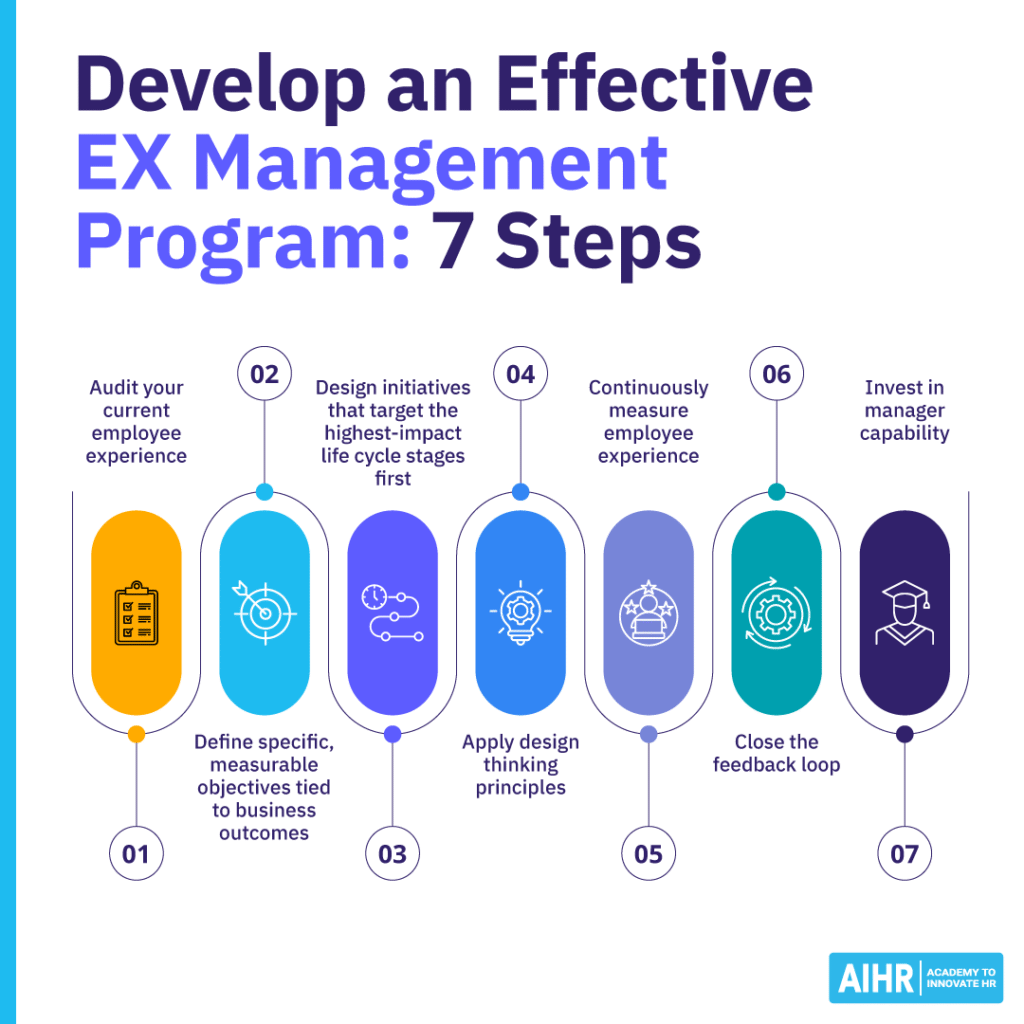
Step 3: Design initiatives that target the highest-impact life cycle stages first
It can be tempting to fix the smallest issues first. That may help in the short term, but it won’t always create the biggest shift. Start with the moments that matter most to employees and the business. These often include onboarding, manager transitions, career development, performance reviews, internal mobility, and retention in critical roles.
For example, if turnover is high during the first six months, focus on onboarding, role clarity, manager check-ins, and early feedback. If experienced employees are leaving, focus on career growth, recognition, manager quality, and workload.
Step 4: Apply design thinking principles
Design thinking is a problem-solving approach that starts with the people who will use the solution. In HR, that means designing processes around employee needs, behaviors, and pain points. Start by listening to employees. Build simple employee personas, map key touchpoints, and identify where the current experience breaks down. Then test small improvements before rolling them out more widely.
AIHR’s Design Thinking & Employee Experience online course covers how to apply design thinking principles to create people-centered employee experiences that reflect organizational values and strategic goals.
Step 5: Continuously measure employee experience
You can’t improve EXM if you only measure it once a year. Use continuous listening to understand how employees feel and how their needs change. Pulse surveys can help you collect quick, frequent feedback. Pair those results with deeper methods, such as stay interviews, listening sessions, and one-to-one conversations.
AIHR recommends measuring employee experience using a mix of metrics, including retention rate, intent to stay, employee referrals, productivity, absenteeism, internal mobility, and eNPS. That gives you a clearer picture of how people experience work at your organization.
Step 6: Close the feedback loop
Collecting feedback is only the first step. If employees share input and nothing happens, trust can drop. Close the feedback loop by telling employees what you heard, what you’re changing, and what you can’t change yet.
Remember to be specific. For example, say, “You told us onboarding felt inconsistent across teams. We’re introducing a 30-day manager checklist and a new hire buddy system next quarter.” When employees see visible action, they’re more likely to keep sharing honest feedback.
Step 7: Invest in manager capability
Managers shape the day-to-day employee experience. They influence workload, feedback, recognition, psychological safety, career growth, and how well employees understand priorities. Invest in manager training, coaching, mentoring, and practical tools. Help managers run better check-ins, give useful feedback, spot disengagement early, and support career conversations.
This is especially important for first-time managers, many of whom are promoted because they performed well as individual contributors, but they still need support to lead people effectively.
5 employee experience management software tools to consider
Employee experience technology can help you collect feedback, spot trends, and turn insights into action. These tools are not the strategy. They work best when HR has clear goals, trusted data, and leaders who are ready to act.
Below are five employee experience management platforms to consider as part of your EXM strategy:
Software provider | What they do | Best for | Pricing |
Combines performance management, team health and engagement reports, surveys, feedback, recognition, goals, people analytics, and AI-supported manager tools. | HR teams that want to support managers, collect feedback, and connect people insights with action. | Standard starts at $4,999 per year, Pro at $11,999 per year. Enterprise pricing is custom. | |
Offers engagement, performance, development, people science support, AI Coach, HRIS integrations, and tools for feedback and growth. | Organizations that want to connect employee listening, performance, and development in one platform. | Pricing depends on employee count, product, and service tier. Products are billed annually, and quotes are available on request. | |
Provides employee experience tools for engagement, onboarding, exit, pulse listening, lifecycle insights, and predictive analytics. | Organizations that want to capture signals across the employee life cycle and connect EX data with business outcomes. | Pricing depends on product, suite, interaction volume, industry, and security requirements. Quotes are available on request. | |
Supports performance reviews, goals and OKRs, pulse surveys, onboarding and exit surveys, action planning, eNPS, analytics, and career growth tools. | Organizations that want modular people management tools for performance, engagement, goals, and growth. | Engagement starts at $4 per seat/month. Foundations is listed at $13 per seat/month. Enterprise pricing is custom. | |
Connects employees through intranet, employee app, email, digital signage, live town halls, content tools, and integrations. | Organizations with frontline, hybrid, desk-based, or distributed teams that need stronger internal communication. | Quote-based. Staffbase shapes pricing around workforce composition, channel mix, scale, and configuration. |
Next steps
Effective employee experience management starts with understanding the full employee life cycle, applying design thinking, building capable managers, and using data to act on what employees need. You can explore related AIHR resources through the Demo Portal, including roleplays and resource library previews.
To build deeper skills, explore AIHR’s Driving the Employee Experience online course. It covers design thinking principles, employee personas, key touchpoints, and how to link people needs with business goals. The course is available through AIHR’s HR Business Partner 2.0 Certificate Program and Full Academy Access.