

Employee retention strategies are the deliberate practices, policies, and programs HR uses to keep workers engaged and reduce turnover. They matter more now than ever, because hiring remains hard: 69% of US employers report difficulty finding the talent they need. When replacing people is this costly and slow, protecting the employees you already have becomes one of the highest-value things HR can do.
This guide explains why employee retention matters and outlines the best employee retention strategies HR can implement, with real examples you can adapt to your organization.
Contents
What are employee retention strategies?
Why employee retention is important
15 best employee retention strategies
How to improve employee retention: Best practices
FAQ
What are employee retention strategies?
Employee retention strategies are the coordinated efforts an organization uses to keep its workforce engaged, satisfied, and committed over the long term. They cover the full employee life cycle, from hiring and onboarding through to pay, career growth, recognition, and the quality of everyday management.
It helps to separate two related ideas. Retention is the outcome you’re after (i.e., the share of people who stay with you across a given period), while the strategies are how you reach it. A single perk, such as a one-off bonus, rarely shifts the numbers on its own. Lasting results come from a connected set of practices that address the real reasons someone chooses to build a career with you or move on.
For HR, this depends on where the work is done. Unlike programs that respond only after someone has already resigned, the strongest programs act sooner. They identify what makes top performers choose to remain, and build those things into how the job actually feels day to day.

Why employee retention is important
Recruiting the right people is only half the job. Keeping them protects the investment, because losing someone costs far more than a final paycheck. That’s where a deliberate retention strategy earns its keep.
Let’s explore why employee retention matters in more detail.
- Cost savings: Replacing one person can run anywhere from a third to double their annual salary once you factor in recruitment, hiring, and training.
- Better team morale: When someone leaves, their role is often vacant for months, and the rest of the team has to absorb the workload in the meantime. That extra pressure builds stress and lowers morale, which can prompt even more resignations down the line.
- Knowledge retention: As employees build tenure, they accumulate institutional knowledge that they can develop and apply, and that expertise is often what keeps things running smoothly. Long-tenured employees also pass along what they know to new hires, so the knowledge remains in the business, rather than walking out with them.
- Stronger competitiveness: Giving employees the chance to develop and grow is a retention strategy in its own right, and tends to raise the overall skill level of your workforce. A more capable team is one of the clearest advantages you can hold over rivals competing for the same customers and talent.
- Sustainable business growth: High retention means you depend less on a constant stream of new hires to fill gaps. That stability makes the business easier to run and plan for, and supports steadier long-term growth without lurching from one hiring scramble to the next.
- Better collaboration: The longer someone works at an organization, the better they understand its ways of working and how their colleagues operate. That shared familiarity smooths day-to-day teamwork and makes it easier for everyone to pull toward the same goals.
Employment verification letters are simple documents, but they still need to be accurate, consistent, and handled professionally. HR needs practical processes that make routine employee requests easier to manage.
AIHR’s Talent Management & Succession Planning Certificate Program teaches you to:
✅ Build a strategic talent management practice aligned with business priorities
✅ Use talent segmentation and demand planning to guide retention decisions
✅ Apply career management and mobility practices to keep talent engaged
✅ Use talent data to support workforce and succession planning
💡 Check out the lessons in AIHR’s Demo Portal for a clear idea of what you’ll get.
15 best employee retention strategies
Here are some employee retention strategies examples you can put into practice:
1. Start in the attraction and hiring phase
Retention starts well before someone’s first day. It begins while you’re still drawing candidates in, which means a strong employer brand does double duty as a retention tool by attracting people who genuinely fit. Pair it with a well-built recruitment funnel that screens for the skills, values, and traits someone needs to thrive in the role and push the business forward.
Honesty at this stage carries just as much weight. Be straight about your culture and what the job actually involves, so new joiners arrive with expectations you can meet.
2. Strengthen your employee onboarding
A strong onboarding experience is one of the surest ways to hold on to the talent you’ve just invested in, yet most organizations fall short. Gallup found that only 12% of employees strongly agree that their companies do a great job of onboarding new hires. With around a third of turnover happening in the first year, those early weeks are decisive in terms of whether someone stays.
Most people arrive eager to settle in, prove themselves, and make a good impression. A weak start undercuts all that, leaving new hires unsure how to succeed and quietly disengaged before they’ve properly found their feet.
The process runs from the moment a candidate signs their offer letter until they can handle the role independently. Map out every stage along the way, including preboarding, the first day, the opening week, the first 90 days, and the close of year one.
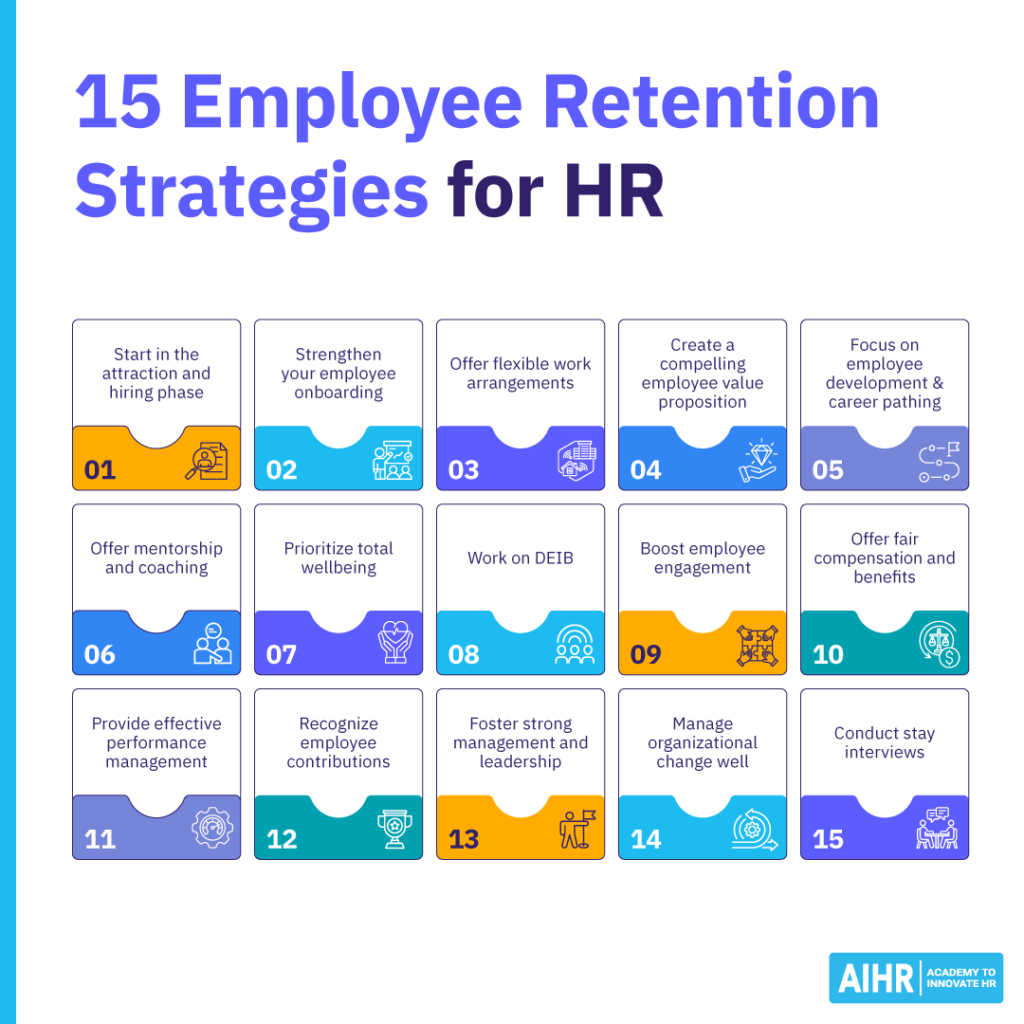
3. Offer flexible work arrangements
Flexibility has shifted from a nice-to-have to an expectation, and for many workers, it now weighs heavily on the choice to stay or start looking elsewhere. Letting someone adjust their hours to manage childcare or fit in a medical appointment shows you trust them and value their time.
Options such as remote work, hybrid setups, part-time roles, job-sharing, and a compressed workweek can all raise satisfaction without denting performance. Since most teams still need time together, a practical approach is to set a few core in-office days or let individuals choose their own remote days within clear guidelines, so flexibility and collaboration reinforce each other as opposed to pulling in opposite directions.
4. Create a compelling employee value proposition
Your employee value proposition (EVP) is the distinct package of value you offer in return for someone’s work. A strong one pulls together everything that makes staying worthwhile, from benefits and growth opportunities to culture and work-life balance. Priorities vary across ages, life stages, and roles, so the sharpest EVPs speak to those different groups rather than treating everyone alike.
The question worth sitting with is a simple one. Why would someone choose to remain with you over a competitor? Whatever the answer, whether it’s fully remote working, generous leave, a solid pension, or flexible hours, spell it out, check that it fits your values, then follow through on it consistently.
5. Focus on employee development & career pathing
Career growth is one of the most direct levers you have for retention. According to a LinkedIn report, 88% of organizations named retention a concern, and offering learning opportunities was the most common way they responded to it. The logic is simple: career progress is the top motivation to learn, and when they stop moving forward, they tend to move on, taking their skills with them.
Training should always ladder up to a business goal, but the payoff is broad when it does, lifting productivity, performance, engagement, and retention together. Giving team members room to learn and grow signals that you see a future with them, and that sense of momentum strengthens long-term commitment.
Hilton put this into practice with a life-skills program called Passport to Success, built to help newer team members handle guest problems with empathy and composure. Among those who completed the training, 96% were still with the company six months later, and 40% had earned a promotion.
Walmart takes a similar approach at scale. The company supports retention through education benefits and a promote-from-within pipeline, funding formal education for hourly associates and moving them into supervisory and management roles as they grow. For a large frontline workforce, that visible path from an entry-level job to a career gives employees a clear reason to keep building their future there.
6. Offer mentorship and coachings
Formal training builds skills, but a lot of long-term growth comes from relationships at work. A mentorship program pairs employees with more experienced colleagues who can offer guidance, share hard-won context, and help them navigate a path through the organization. That connection gives them a reason to stay that goes beyond the role itself.
Mentoring works in more than one direction. New joiners get up to speed faster and feel supported early, when the risk of leaving is highest, while the mentors themselves gain recognition and a sense of investment in others’ success. Pair employees thoughtfully, set light expectations for how often they meet, and make coaching a normal part of how managers lead throughout the year.
7. Prioritize total wellbeing
Wellbeing has become one of the clearest dividing lines between organizations that retain talent and those that lose it. Many now actively avoid a “hustle” culture built on unmanageable workloads and always-on expectations, and gravitate toward employers who prioritize their health.
Flexible and remote options help, but they only go so far if the workload itself is unrealistic or people feel obliged to answer messages late at night or on holiday. Managers play a central role here. Regular, honest check-ins about capacity, along with cutting low-value meetings and admin, help teams focus their energy on meaningful work.
It also helps to treat wellbeing as more than physical health. Mental, social, financial, and career health all shape how someone feels about their job, and looking after the full picture keeps people both healthier and more productive. When you show genuine care across all of it, loyalty tends to follow.
SAS is a long-standing example of this paying off. Its sustained investment in employee health and wellbeing has helped lower turnover to around 4%, well below the industry average of 15%.
8. Work on DEIB
A Culture Report by the Achievers Workforce Institute found a sense of belonging to be a major retention driver. Among those with a strong sense of belonging, 40% rarely think about leaving, compared with just 5% of those who feel they don’t belong.
Building diversity and inclusion into how you hire and operate creates stronger teams and a wider sense of belonging across the organization. The returns reach past retention, too, showing up in productivity and in how your employer brand is seen from the outside.
9. Boost employee engagement
Engagement and retention move together. Team members who feel connected to their work, their team, and the wider mission are far less likely to start looking elsewhere, which is why employee engagement sits at the heart of any serious retention effort.
The practical levers are the ones already running through this list, including meaningful work, recognition, good managers, and a clear sense of progress. Where engagement adds something is in the measuring. Regular pulse surveys and honest listening sessions surface how employees actually feel while there’s still time to act, instead of leaving you to piece it together from exit interviews once someone has already made up their mind.
10. Offer fair compensation and benefits
People value different things at work, but compensation is a constant. Someone can feel genuinely appreciated, but will still start looking the moment they suspect they’re underpaid for what they bring.
Be open about your pay structure and keep the policy behind it simple. Check your pay against industry benchmarks regularly, and establish a clear way to reward strong performers through bonuses and steady increases.
Benefits also play a crucial role. Forbes reports that almost six in 10 employees see a company’s benefits package as the most important non-salary factor when considering a job. And perks like lower healthcare premiums, flexible hours, and extended parental leave can often make the difference between an employee staying and leaving.
11. Provide effective performance management
Done well, performance management gives people a clear read on what’s expected of them and how to grow into the next stage of their career.
A strong approach connects the dots for employees, pairing them with learning opportunities, showing how their work feeds into wider goals, and making progress visible along with the steps to a promotion. That clarity also builds a sense of being valued, which lifts engagement and makes feedback something welcome rather than dread. When someone can see exactly where they’re headed with you and how to get there, they have fewer reasons to leave.
12. Recognize employee contributions
A Gallup and Workhuman survey found that employees who feel recognized for their work are 56% less likely to job-hunt, yet only 18% believe their organization has a strong recognition culture. This gap is an easy one to close.
Encourage managers to acknowledge their team’s efforts as a matter of routine, and back that up with structured employee recognition programs across the department or company. Employee retention strategies that pair recognition with gifts (from a simple thank-you and a spot bonus to extra time off), give that appreciation a tangible form and make people feel genuinely valued for going above and beyond.
13. Foster strong management and leadership
Managers shape the daily experience that often determines whether employees remain with the organization. Monster’s report found that 56% of workers have left a job primarily because of a bad manager, while 55% have stayed longer than they planned because of a great one. This shows that the quality of your leaders cuts both ways.
Build management skill into how you review performance, and give leaders at every level regular training and coaching, with extra support for anyone stepping into their first management role. Investing in the people who run your teams is one of the highest-leverage moves you can make for retention, because their influence reaches every person they manage.
14. Manage organizational change well
Employees are most likely to head for the door during periods of upheaval. Restructures, leadership changes, mergers, and shifting priorities all create uncertainty. That uncertainty can push even settled ones to start weighing their options.
Good change management is largely about communication. Explain what’s changing and why, be honest about what you don’t know yet, and give people a clear sense of where they fit once the dust settles. Involve them in the process where you can, and make sure managers are equipped to answer their teams’ questions. When employees feel informed and considered throughout a transition, they’re more likely to remain engaged after the change.
15. Conduct stay interviews
Most organizations learn why workers leave only after they’re already out the door. Stay interviews flip that timing. Instead of waiting for an exit interview, sit down with the people who are still here to understand what keeps them, what frustrates them, and what might tempt them to look elsewhere, while there’s still time to address any issues.
The value is in the follow-through, not the conversation itself. Ask what makes a good day at work, what would make them consider leaving, and what they’d change if they could. Then, act on what you hear. When employees see that speaking up leads to real change, they’re more likely to keep sharing honest feedback. This gives you time to address problems before someone decides to go.
Run these regularly, not as a one-off, and keep them separate from performance reviews so the conversation stays open instead of evaluative. Managers are usually best placed to hold them, since the direct relationship is where most of the useful signal lives.
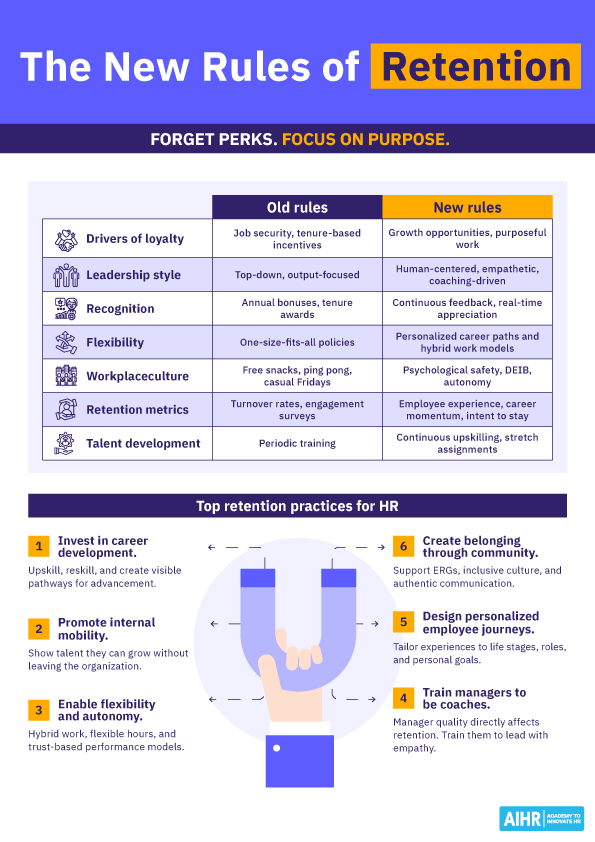
How to improve employee retention: Best practices
These best practices will help you put your retention strategy into action:
- Track the right metrics: You can’t improve what you don’t measure. Keep an eye on employee turnover and retention metrics, so you know who’s leaving and who’s staying, then use those patterns to target your efforts. If mostly women leave after a year while men stay, for example, that points you toward promotion rates, pay data, and other specifics worth a closer look.
- Diagnose before you act: Before rolling out changes, work out why people actually leave your organization, specifically. Exit data, engagement scores, and stay interviews can reveal the real drivers, which may differ from the common assumptions, helping you address the right problem.
- Act on employee feedback: Listening only builds trust if something changes as a result. Gather input regularly, share back what you heard, and make visible changes so people see that speaking up matters.
- Segment your approach: Different groups leave for different reasons. What keeps early-career employees is rarely what keeps senior staff or working parents, so tailor your efforts to the groups your data flags as opposed to applying one fix to all.
- Keep communication open: When employees feel able to raise concerns and ideas with managers and leaders, problems get addressed early instead of building up. That openness is what turns individual strategies into a culture of trust.
Next steps
Effective employee retention depends on the full employee experience, from hiring and onboarding to career growth, recognition, and manager support. HR teams that connect these areas can reduce turnover and build a workforce that stays engaged over time.
To strengthen your retention approach, AIHR’s Talent Management Certificate Program can help. You’ll learn how to identify high-potential employees, build succession plans, design career paths, and create development programs that support employee growth and long-term engagement.
FAQ
The most effective employee retention strategies work across the entire employee experience instead of relying on any single fix. These include strong onboarding, fair pay and benefits, flexible working, clear development and career paths, regular recognition, and good management. The right mix depends on why people actually leave your organization, so the best starting point is understanding your own turnover data.
There is no single factor that guarantees retention, but the quality of management consistently ranks among the strongest. Workers often stay or leave because of their direct manager, so how leaders communicate, give feedback, and support their teams has an outsized effect. Close behind sit fair compensation, career growth, and a sense of being recognized and valued.
Retention improves when employees feel fairly paid, supported in their growth, and genuinely valued for their work. Practical steps include strengthening onboarding, offering flexible arrangements, building clear paths for progression, and acting on employee feedback rather than just collecting it. Tracking your retention and turnover metrics helps you see which of these moves is making a difference.