

Talent reviews help HR teams make better workforce decisions when skills, roles, and business needs are changing. This matters now, as 77% of business leaders say organizations should help employees build relevant skills, yet only 5% strongly agree they’re investing enough in new skills development.
Talent reviews can be used to prioritize development, support internal mobility, reduce leadership risk, and align talent decisions with business goals. This article explains how to conduct a talent review, use the 9-box grid, choose the right frameworks, and turn review outcomes into action.
Key takeaways
- A talent review helps HR and business leaders assess employees’ performance, potential, skills, and readiness for future roles.
- Talent reviews support succession planning by identifying possible successors for critical roles before gaps appear.
- The 9-box grid can help structure talent review conversations, but clear criteria and calibration are essential.
- Talent review outcomes should lead to action, including development plans, stretch assignments, internal mobility, and follow-up reviews.
Contents
What is a talent review?
Why perform a talent review?
Talent review vs. performance review
The talent review process: 9 steps using the 9-box grid
Talent review frameworks and tools
Talent review best practices
Talent review and succession planning
Talent review questions to ask
Talent review template collection
FAQ
What is a talent review?
A talent review is a structured process HR and business leaders use to assess employees’ performance, potential, skills, and readiness for future roles. It helps organizations understand where their talent stands today and what actions they need to take to support future business needs.
During a talent review, managers discuss employees’ strengths, development areas, career aspirations, and growth potential. These conversations help inform decisions about promotions, internal mobility, succession planning, stretch assignments, and employee development.
The goal of a talent review is to identify and develop high-potential employees, address skills gaps, and make sure the organization has the right people in the right roles to achieve its goals.

Why perform a talent review?
A talent review helps organizations assess their current talent pool and identify opportunities to improve workforce planning, succession planning, and employee development. It helps HR and business leaders understand whether they have the right people, skills, and capabilities in place to meet current and future business needs.
Benefits of talent reviews
- Identify high-potential talent: Talent reviews help organizations pinpoint employees with exceptional skills, leadership potential, and the ability to contribute significantly to the company’s future success. This allows for targeted development and investment in key talent.
- Succession planning: By assessing employees’ readiness for more significant roles, talent reviews enable organizations to identify potential successors for critical positions. This mitigates the risk of leadership gaps due to retirements or unexpected departures.
- Strategic workforce planning: Talent reviews aid in aligning the workforce with the company’s long-term goals. They help determine where talent shortages or surpluses may exist, allowing for proactive workforce planning and optimization.
- Improved employee engagement: Employees benefit from knowing that their growth and potential are being considered, leading to increased motivation and engagement. This can enhance retention and job satisfaction.
- Customized development plans: Talent reviews inform tailored development plans for individuals, helping them acquire the skills and experiences necessary for career progression and contributing to organizational success.
Risks of not performing talent reviews
- Missed opportunities: Without talent reviews, your organization may overlook high-potential individuals who could drive innovation and growth, potentially losing them to competitors.
- Leadership gaps: Failing to identify and develop successors can lead to leadership gaps during transitions, causing disruptions and decreased performance.
- Stagnation: Employees may become disengaged and demotivated if they perceive limited growth opportunities, resulting in decreased productivity and retention issues.
- Inefficient resource allocation: Without insights from talent reviews, your organization may allocate resources ineffectively, investing in employees who may not be well-suited to key roles.
- Limited adaptability: In rapidly changing business environments, organizations risk being ill-prepared for shifts in talent needs and marketplace demands, potentially hindering competitiveness.

Talent review vs. performance review
A talent review and a performance review serve distinct but complementary purposes. A performance review focuses on an employee’s past performance, accomplishments, goals, and responsibilities in their current role. It usually includes feedback, areas for improvement, and goal setting for the next review period.
A talent review takes a broader and more future-focused view. It looks at an employee’s performance, potential, skills, leadership qualities, adaptability, and readiness for future opportunities within the organization.
Focuses on future potential and readiness
Focuses on past performance and goal achievement
Looks at employees across teams, roles, or talent pools
Looks at an employee’s performance in their current role
Supports succession planning, internal mobility, and workforce planning
Supports feedback, performance improvement, and goal setting
Usually involves HR, managers, and business leaders
Usually happens between an employee and their manager
In short, performance reviews help managers assess how employees are performing today, while talent reviews help organizations understand how employees could contribute in the future.
Talent review frameworks and tools
Talent review frameworks and tools help HR and business leaders consistently assess employees throughout the process. Here are practical options for comparing talent, identifying development needs, and supporting better people decisions.
9 box grid
The 9 box grid is a practical talent review tool for comparing employees based on performance and potential. It gives HR and business leaders a quick visual overview of high-potential employees, strong performers, possible successors, and employees who may need additional development or support.
Pros
- Easy to use and understand
- Provides a clear overview of employee performance and potential
- Helps identify high-potential employees and possible successors
- Supports development planning and succession planning
Cons
- Can be subjective if criteria are not clearly defined
- May oversimplify employee strengths, motivations, and development needs
- Does not always account for an employee’s career goals or role context

Performance, potential, and readiness framework
A performance, potential, and readiness framework builds on the logic of the 9-box grid by adding a third question: How ready is this employee for their next role?
This matters because high potential does not always mean immediate readiness. An employee may show strong long-term potential but still need more experience, coaching, exposure, or skills development before moving into a larger or more complex role. In this framework, HR and managers assess:
- Performance: How well the employee is delivering in their current role
- Potential: The employee’s ability to grow, adapt, and take on more complex responsibilities
- Readiness: How soon the employee could step into a larger, more senior, or business-critical role
This framework is especially useful when the talent review is closely connected to succession planning, leadership pipeline development, or internal mobility.
Pros
- Gives a more complete view of employee growth and future fit
- Helps distinguish long-term potential from immediate readiness
- Supports more accurate succession planning decisions
- Makes development actions more specific and practical
Cons
- Requires clear definitions of performance, potential, and readiness
- Can be applied inconsistently if managers interpret criteria differently
- Needs reliable data and calibration to support fair decisions
Leadership competency framework
A leadership competency framework defines the behaviors, skills, and capabilities employees need to succeed in leadership roles. These may include strategic thinking, decision-making, communication, coaching, collaboration, change management, and business acumen.
During a talent review, this framework can help HR and leaders assess leadership potential more consistently. It is particularly useful when identifying future managers, preparing successors for critical roles, or designing leadership development plans.
Pros
- Provides a more detailed assessment of employee leadership potential
- Helps identify specific leadership development needs
- Creates a shared standard for assessing future leaders
- Can be used to track leadership growth over time
Cons
- Can take time to design and implement well
- Requires manager and senior leadership buy-in
- May be less relevant for specialist or technical career paths unless adapted
360-degree feedback
360-degree feedback is not a full talent review framework on its own, but it can be a valuable tool in the talent review process. It gathers feedback from an employee’s manager, peers, direct reports, and other stakeholders to provide a broader view of their performance, behaviors, strengths, and development areas.
This can help balance a manager’s perspective with input from people who work closely with the employee. It is especially useful when assessing leadership behaviors, collaboration, communication, and influence.
Pros
- Provides a broader view of employee performance and behavior
- Helps uncover strengths and blind spots
- Can support leadership development and coaching
- Encourages a stronger feedback culture
Cons
- Can be time-consuming to collect and analyze
- Requires careful communication and follow-up
- Feedback quality can vary depending on the reviewers

Skills-based talent review framework
A skills-based talent review framework focuses on the skills employees have today and the skills the organization will need in the future. It helps HR identify skills gaps, development priorities, and opportunities to move talent into roles where they can have the greatest impact.
This approach aligns with Deloitte’s view of skills-based organizations, where skills are used as a basis for decisions about work, talent, and workforce planning. In a talent review, this means looking beyond an employee’s current role and considering how their skills could support future business needs.
Pros
- Connects talent decisions to current and future business needs
- Helps identify skills gaps and development priorities
- Supports workforce planning, reskilling, and internal mobility
Cons
- Requires accurate and up-to-date skills data
- Can be difficult to maintain across large or changing organizations
- Works best when skills are clearly defined across roles and teams
Talent risk assessment matrix
A talent risk assessment matrix helps HR and business leaders identify workforce risks that could affect business goals. Gartner’s Talent Risk Evaluation Matrix is one example of this type of tool. It maps talent risks based on their likelihood and potential impact, helping leaders prioritize areas that need action.
In a talent review, this can add a useful risk lens to the discussion. For example, HR can use it to assess retention risk, succession risk, development risk, or talent availability risk.
Pros
- Helps HR and business leaders identify the most pressing talent risks
- Supports more data-driven workforce planning and talent investment decisions
- Makes risk conversations more actionable by comparing likelihood and business impact
Cons
- Requires reliable internal and external workforce data
- May be less useful if data is outdated, incomplete, or poorly benchmarked
- Requires careful interpretation when assessing business impact and setting risk thresholds
Which talent review framework or tool should you use?
For most organizations, the 9-box grid or a performance, potential, and readiness framework is the best starting point. These options are easy to understand, practical for talent review meetings, and closely linked to succession planning and employee development.
More mature HR teams can combine multiple tools. For example, they might use the 9-box grid to structure talent discussions, leadership competencies to assess future leaders, skills data to identify capability gaps, 360-degree feedback to add context, and a talent risk evaluation matrix to identify retention or succession risks.
The key is to define your criteria clearly and apply them consistently across teams. This helps make talent review decisions fairer, more useful, and easier to act on.
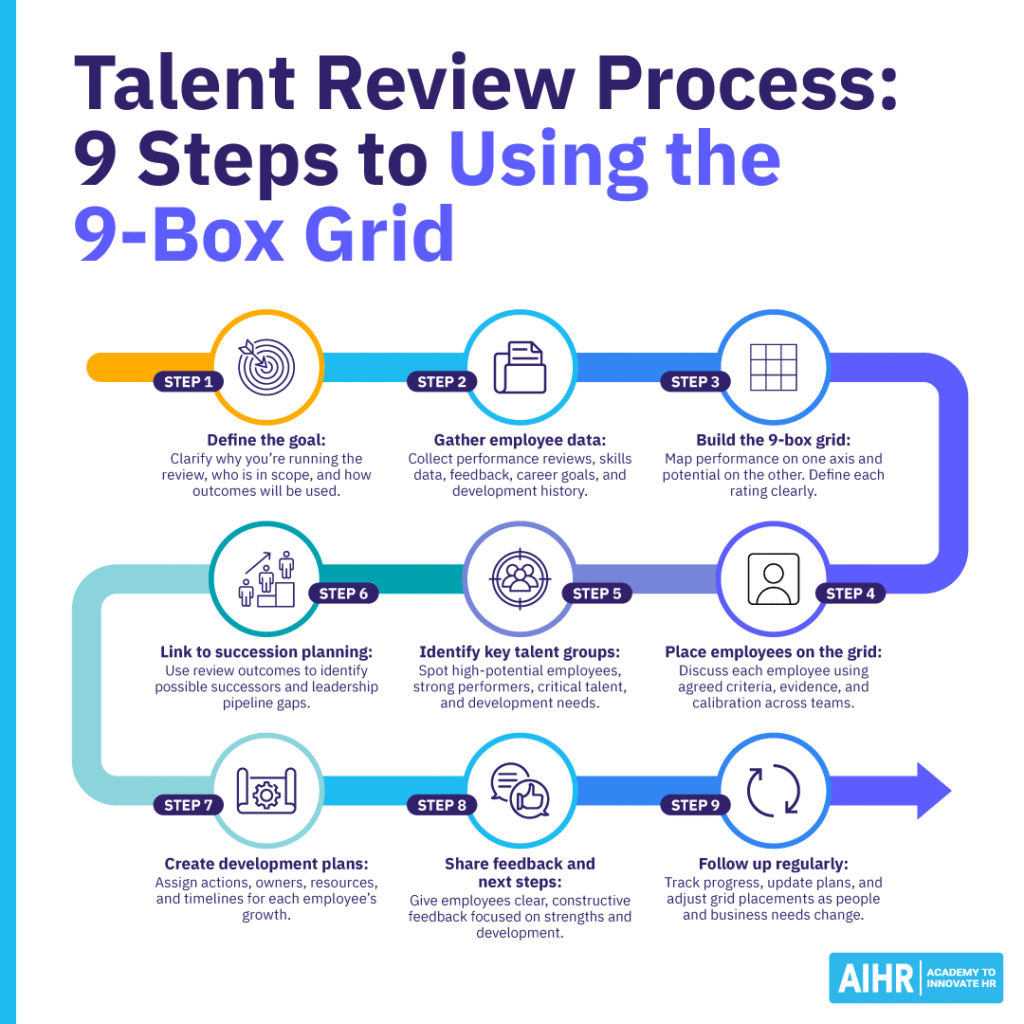
The talent review process: 9 steps using the 9-box grid
A talent review process helps HR and business leaders evaluate employees’ performance, potential, readiness, and development needs in a consistent way. One of the most common tools used in this process is the 9-box talent review grid, which maps employees based on their current performance and future potential.
The 9 box grid was originally developed by McKinsey & Company in the 1970s and used by General Electric to assess business units and investment priorities. It has since become a widely used HR framework for identifying high-potential employees, supporting succession planning, and addressing skills gaps across the workforce.
Here’s how to run a talent review process using the 9-box grid:
Talent reviews help HR connect performance, potential, skills, and readiness to future business needs. Exploring the right lessons and resources can help you see how talent reviews fit into stronger succession planning and talent management.
Preview lessons from AIHR’s Talent Management & Succession Planning Certificate Program to see how:
✅ Conduct talent mapping and talent reviews as part of a structured succession planning process
✅ Build succession pipelines for critical roles and future leadership needs
✅ Segment leadership talent into development pools based on readiness and potential
✅ Use talent data to support workforce planning, retention, and mobility decisions
💡 Explore the Demo Portal to preview lessons, tools, and resources from the Talent Management & Succession Planning Certificate Program.
Step 1: Define the objectives and goals of the talent review process
Start by clarifying why you are conducting the talent review. For example, your goal may be to identify high-potential employees, support succession planning, prepare for leadership transitions, improve internal mobility, or address skills gaps.
Set clear expectations for what the process should achieve, who will be reviewed, which roles or departments are in scope, and how the results will be used. This helps managers assess employees consistently and keeps the process aligned with business priorities.
Step 2: Collect employee performance and potential data
Gather relevant employee data before the talent review meeting. This may include recent performance reviews, 360-degree feedback, skills assessments, manager feedback, career aspirations, learning history, mobility preferences, and previous development plans.
The data should be accurate, current, and comparable across employees. This gives managers and leaders a more objective starting point and reduces the risk of relying only on opinion or recent events.
Step 3: Create the 9-box talent review grid
Create a 9-box grid with performance on one axis and potential on the other. Performance usually reflects how well an employee is delivering in their current role, while potential reflects their ability to grow, take on more complex work, or move into future leadership or critical roles.
Define what low, moderate, and high performance and potential mean in your organization. For example, performance criteria may include goal achievement, quality of work, behavioral expectations, and business impact. Potential criteria may include learning agility, leadership capability, adaptability, ambition, and readiness for broader responsibilities.
Use AIHR’s free 9-box grid template to get started.
Step 4: Place employees on the grid
During the talent review meeting, managers and leaders discuss each employee and place them on the grid based on the agreed performance and potential criteria.
The goal is to reach a shared and evidence-based view of each employee’s current contribution and future potential. Encourage managers to explain their reasoning, challenge assumptions, and use data to support their assessments.
This step is also where calibration matters. Leaders should compare ratings across teams to make sure employees are assessed fairly and consistently.
Step 5: Identify high-potential employees and critical talent segments
Once employees are placed on the grid, identify the key talent groups that need attention. This may include high-potential employees, strong performers who are ready for more responsibility, employees who need targeted development, or people in critical roles who may require retention support.
This helps HR and business leaders focus development resources where they will have the greatest impact.
Step 6: Connect talent review outcomes to succession planning
Use the results of the talent review to identify potential successors for critical roles. Employees in high-performance and high-potential categories may be strong candidates for succession pipelines, leadership development programs, or stretch assignments.
Create a clear roadmap for how these employees can build the skills, experience, and visibility needed to move into future roles. This helps reduce leadership gaps and supports long-term workforce planning.
Step 7: Create individual development plans
Develop action plans based on each employee’s grid placement and career goals. High-potential employees may need leadership development, mentoring, coaching, or stretch projects. Employees with strong performance but lower readiness may benefit from skill-building, role expansion, or clearer career pathways.
Each individual development plan should include specific actions, owners, resources, and timelines so progress can be tracked after the review.
Step 8: Communicate feedback and next steps
After the review, managers should communicate relevant feedback to employees in a clear and constructive way. The conversation should focus on strengths, development areas, career aspirations, and the support available to help the employee grow.
Be thoughtful about how you discuss sensitive topics such as potential, readiness, or placement on the 9-box grid. The goal is to encourage development and clarity, not label employees in a way that limits their growth.
Step 9: Follow up and review progress regularly
A talent review should lead to action. Track progress against development plans, succession plans, and agreed talent decisions. Schedule follow-up discussions to review employee growth, update placements where needed, and adapt plans as business priorities change.
Periodic reviews also help keep the 9-box grid accurate and useful. As employees grow, roles change, and business needs shift, talent decisions should evolve with them.
Talent review best practices
Strong talent reviews depend on clear goals, reliable data, and consistent follow-through. These best practices can help HR teams make the process fairer, more useful, and easier to act on.
- Set clear objectives: Use SMART goals to define what the talent review process should achieve, such as identifying high-potential employees, strengthening succession planning, addressing skills gaps, or improving internal mobility.
- Use consistent criteria: Define how managers should assess performance, potential, readiness, skills, and leadership capability. Clear criteria make it easier to compare employees fairly across teams and reduce confusion during talent review discussions.
- Balance qualitative and quantitative data: Combine objective data, such as KPIs, performance ratings, skills assessments, and goal achievement, with qualitative insights, such as manager feedback, peer input, career aspirations, and examples of leadership potential.
- Involve the right stakeholders: Consult managers, department heads, HR business partners, and senior leaders to gather diverse perspectives on employees’ strengths, development needs, future potential, and business impact.
- Calibrate talent decisions: Use calibration discussions to compare assessments across teams, challenge assumptions, and reduce bias. This is especially important when using tools like the 9-box grid, where placement can influence development and succession decisions.
- Protect employee privacy and confidentiality: Handle talent review data carefully, especially information related to performance, potential, readiness, retention risk, and career progression. Follow relevant data protection regulations and internal privacy guidelines.
- Turn insights into action: Document decisions, assign owners, and set timelines for development plans, succession actions, mobility opportunities, or retention interventions. A talent review should result in clear next steps, not just discussion.
- Review and improve the process regularly: Update the talent review process as organizational goals, workforce needs, and business priorities change. Look for ways to improve fairness, efficiency, and follow-through after each review cycle.
Talent review and succession planning
Talent reviews play an important role in succession planning by helping HR and business leaders identify employees who may be ready for future critical roles. By assessing performance, potential, readiness, skills, and career aspirations, organizations can build stronger succession pipelines and reduce the risk of leadership gaps.
The talent review process helps answer key succession planning questions, such as:
- Which employees are ready for a larger or more complex role?
- Who has long-term leadership potential but needs more development?
- Which critical roles have no clear successor?
- Where do skills gaps or readiness gaps create business risk?
- What development actions are needed to prepare future successors?
These insights help HR create more targeted development plans, assign stretch opportunities, and invest in employees who can support future business needs. They also help leaders make succession planning more proactive, rather than waiting until a key role becomes vacant.
Talent review questions to ask
| 1. Performance |
| • How has the employee performed in their current role? |
| • What specific achievements or accomplishments can be attributed to this employee? |
| • Are there any performance metrics or KPIs that highlight their contributions? |
| • Have there been any performance issues or areas for improvement? |
| 2. Potential |
| • Does the employee demonstrate the potential to take on more significant responsibilities or leadership roles in the future? |
| • What skills or qualities suggest they have the capacity for growth and development? |
| • Are there specific examples of when they’ve shown adaptability, creativity, or problem-solving abilities? |
| 3. Development needs |
| • What areas of skill or knowledge development would benefit this employee’s career growth? |
| • Are there any gaps in their competencies that need to be addressed for future roles? |
| • Do they have any specific career aspirations, and what development steps are needed to achieve those goals? |
| 4. Feedback and collaboration |
| • What feedback have they received from peers, subordinates, or managers regarding their teamwork and collaboration skills? |
| • How effectively do they communicate and interact with others in the organization? |
| • Are there any leadership qualities or potential identified by colleagues? |
| 5. Leadership (if relevant) |
| • How do they demonstrate leadership qualities, even in non-leadership roles? |
| • Have they led any projects or teams successfully, and what were the outcomes? |
| • Do they exhibit qualities that align with the organization’s leadership competencies or values? |
| 6. Career path |
| • What roles or positions within the organization align with their skills and aspirations? |
| • How do they fit into the organization’s succession plan, if applicable? |
| • Are there specific career development opportunities or paths that should be explored? |
| 7. Employee’s self-assessment |
| • What are the employee’s own perceptions of their performance, strengths, and areas for improvement? |
| • How do they see their career trajectory within the organization? |
| • What are their development goals and aspirations? |
| 8. Development plan |
| • What specific actions and resources will support the employee’s professional growth? |
| • How can the organization provide mentorship, training, or coaching to help them reach their potential? |
| 9. Feedback from managers and peers |
| • What do their immediate supervisors and colleagues have to say about their contributions and potential? |
| • Are there consistent themes or observations from different sources? |
| 10. Alignment with organizational goals |
| • How does the employee’s performance and potential align with the strategic objectives and future needs of the organization? |
| • Are there specific roles or projects where their skills can have the most impact? |
Talent review template collection
Use these templates to structure your talent review process, compare employees more consistently, and gather useful feedback before making development or succession planning decisions.
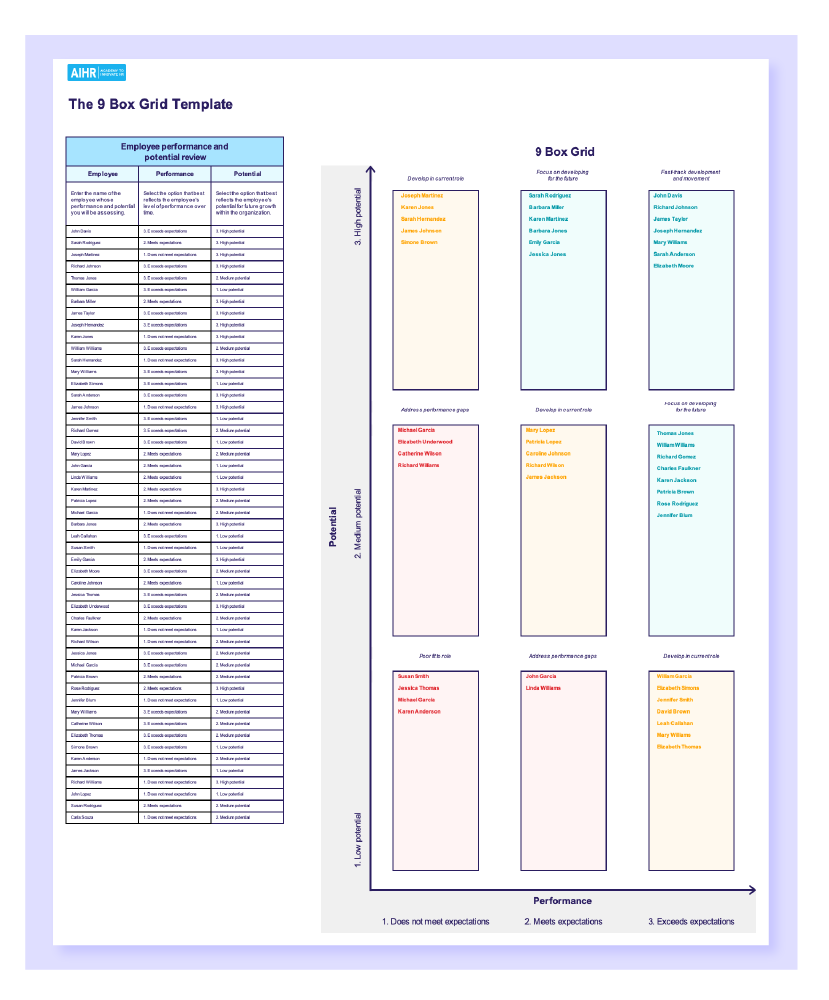
9-box grid template
Use our free 9-box grid template to map employees based on performance and potential, identify high-potential talent, and plan development actions.
360-degree feedback template
Use our free 360-degree feedback template to gather input from managers, peers, direct reports, and stakeholders before or during the talent review process.

To sum up
A talent review helps you evaluate your current talent pool, identify risks and opportunities, and make better decisions about employee development and succession planning. When done well, it can support stronger performance, engagement, retention, and workforce agility.
To conduct an effective talent review, define clear objectives, collect relevant employee data, identify gaps, create action plans, communicate next steps, and review progress regularly.
Want to build your talent management skills further? AIHR’s Talent Management & Succession Planning Certificate Program teaches you how to manage talent pipelines, identify and develop future leaders, and use talent data to improve talent management practices.
FAQ
In a talent review, HR and business leaders discuss employees’ performance, potential, readiness, skills, development needs, and possible next roles. The goal is to identify high-potential employees, spot talent or skills gaps, and agree on clear actions for development, succession planning, or internal mobility.
To prepare for a talent review, define the goal of the review, gather relevant employee data, and align managers on the criteria for assessing performance, potential, and readiness. HR should also prepare any templates, such as a 9-box grid or feedback form, and make sure leaders understand how the outcomes will be used.
Most organizations conduct formal talent reviews once or twice a year. However, HR teams should also review progress throughout the year to track development plans, succession actions, and changes in business priorities.
A performance review focuses on how an employee has performed in their current role, while a talent review looks at their broader potential, readiness, skills, and future fit within the organization. Performance reviews look mostly at past performance, while talent reviews are more future-focused.
A talent review helps HR and business leaders identify employees who are ready for critical roles or could become ready with the right development. It also shows where succession gaps exist, so you can build stronger pipelines before key roles become vacant.