

An employee review template is one of the most effective tools you can use to deliver consistent, constructive feedback across your organization. In fact, 80% of employees who say they’ve received meaningful feedback recently report being fully engaged at work.
Strong reviews build a development-focused culture linked to innovation, productivity, and retention. A good template keeps that feedback structured and specific. This article explains what an employee review is, how to write one, and how to use a template to do it well. It also includes a free, customizable employee performance review template in Word, Excel, and PDF to get you started.
Contents
What is an employee review?
Why employee reviews matter for HR
Key elements of an effective employee review template
Free employee review template (Word, Excel & PDF)
7 types of employee review templates and when to use them
Employee review questions to ask
Employee review comments and phrases (with examples)
How to write an employee review: 10 HR tips and best practices
What is an employee review?
An employee review (also called an employee evaluation or performance review) is a structured conversation, backed by a written record, that assesses an employee’s performance over a set period. A good review clarifies expectations, delivers feedback, sets measurable goals, and documents progress, so decisions about pay and development stay fair and consistent.
Every employee works under an employment agreement, so you have a responsibility to assess performance fairly, transparently, and consistently. A structured review process is the most reliable way to meet it.
Employee reviews serve five core functions:
- Aligning expectations: Roles and business priorities change; reviews confirm what success looks like now and how the employee’s work maps to company goals.
- Providing feedback: Employees need clear input on strengths and gaps. A structured written review reduces ambiguity and directs effort where it matters most.
- Setting new goals: After evaluating past performance, focus on the future. Set realistic goals to guide staff and create accountability for them and their managers.
- Supporting pay and promotion decisions: Reviews provide the evidence base for fair compensation and career progression by focusing on results, not opinions.
- Documenting performance: Written reviews create an official record for legal compliance, performance improvement plans, and future decisions.

Why employee reviews matter for HR
Here’s why employee reviews are important not just for managers and staff but also for you and your HR team:
Consistency across managers
Without a structured process, employee reviews can be inconsistent or even biased. Some employees may get detailed assessments, while others receive only minimal feedback. This damages trust and can create perceptions of favoritism. A structured review process helps assess all staff against the same criteria, making the reviews fairer and more equitable.
Legal defensibility
Reviews serve as a record of performance over time. In cases of disputes or terminations, this is critical. Inconsistent or poorly documented reviews can lead to increased legal risk for your company. Documenting employee reviews to help maintain accurate records ensures you have the information needed to protect both your employees and the organization.
Engagement and retention
Employees who receive regular, meaningful feedback are far more likely to be engaged at work. This, in turn, increases employee productivity and reduces turnover. A structured review process supports this by demonstrating that the organization takes employee development seriously, thereby contributing to a higher employee retention rate.
Identifying skill gaps and development needs
Reviews show where each person needs to grow. Aggregated across teams, that becomes a map of where your organization is strong and where it’s stretched. HR can then direct learning and development investment with evidence instead of guesswork, and tie individual growth to business priorities.
Employee reviews work best when they connect performance, feedback, and development. HR needs the right skills to make reviews fair, consistent, and useful for both employees and the business.
AIHR’s Talent Management & Succession Planning Certificate Program teaches you to:
✅ Build a talent management practice aligned with business priorities
✅ Use talent data to support development and retention decisions
✅ Connect employee growth to career management and mobility
✅ Apply talent reviews and succession planning to future talent needs
💡 Check out the lessons in AIHR’s Demo Portal for a clear idea of what you’ll get.
Key elements of an effective employee review template
Below are the essential elements every good employee review template should include:
- Employee and role information: Basic details, such as the employee’s name, job title, department, and review period, help create context for the evaluation and establish a clear record of it.
- Rating scale: A clear rating scale (e.g., a behaviorally anchored rating scale) helps managers evaluate performance consistently. A scale of three to five points (with defined meanings such as 1 = “falls below expectations” and 5 = “consistently exceeds expectations”) allows for straightforward comparison.
- Core competencies: These are the skills and behaviors expected of all employees, regardless of role. They may include job knowledge, quality of work, productivity, communication, teamwork, and problem-solving. Evaluating these ensures a balanced view that goes beyond role-specific results.
- Role-specific metrics: Every role has unique key performance indicators (KPIs) or objectives and key results (OKRs). Including these helps tie performance directly to job responsibilities.
- Behavior examples: Include two or three concrete behavior examples using the Situation–Action–Result (SAR) model to ground the review in observable facts by clearly outlining the impact of the employee’s actions on business metrics.
- Goals: Reviews should include a section to assess goals from the previous review period and list goals to achieve by the next review period. Write them in the SMART format: specific, measurable, achievable, relevant, and time-bound.
- Development plan: In addition to performance goals, the template should include development plans. These outline the skills the employee must build, required learning actions, and resources the organization will provide.
- Employee comments: A section for employee input encourages self-reflection and ensures the review is a two-way process. Staff should be able to record their own perspective on their performance and acknowledge the feedback they’ve received.
- Confidentiality statement: HR should prepare and include a confidentiality statement in the template to assure employees that they’ll keep all the information in the review private and confidential. This will build trust and encourage both staff and managers to provide honest feedback.
- Signatures and dates: Finally, the template must include a section for signatures from the manager, employee, and HR to confirm the review has taken place, and that all parties have seen the record.
Free employee review template (Word, Excel & PDF)
Use the free AIHR employee review template to put all of this into practice. Available in Word, Excel, and PDF, it pulls the 10 elements into a single customizable document, with a worked example you can follow or replace with your own details.
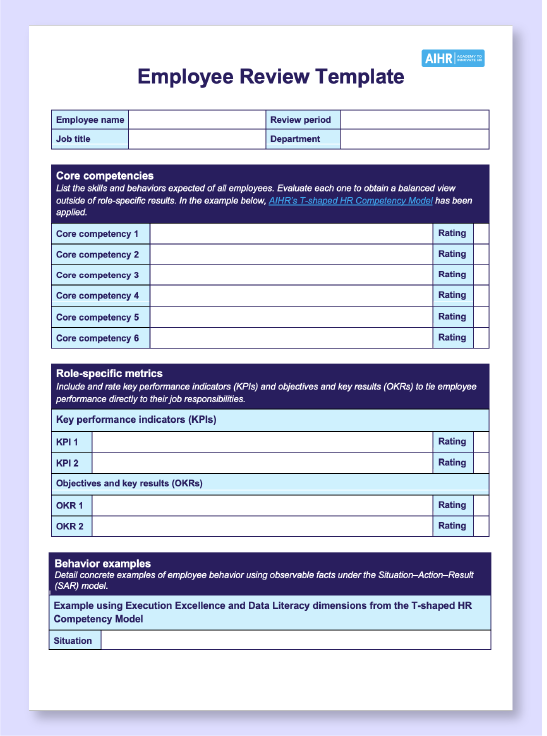
How to use the employee review template
- Add the employee and review details. HR or the employee completes the name, job title, department, and review period at the top.
- Complete the core sections. The reviewer, usually the direct manager, fills in the core competencies, role-specific KPIs and OKRs, behavior examples, goals, and the development plan.
- Apply the rating scale. Score each item on the same 1-to-5 scale, from 1 (“falls below expectations”) to 5 (“consistently exceeds expectations”), so ratings stay consistent across the review.
- Invite the employee’s input. The employee reflects on their performance and adds their own comments before the review meeting, keeping the process a two-way conversation.
- Acknowledge and sign. HR adds a confidentiality statement, then HR, the manager, and the employee sign to confirm the review is complete and on record.
7 types of employee review templates and when to use them
The template above covers a general employee review. For more specific situations, use the right format for the moment, and lean on AIHR’s dedicated guides and free templates for each:
Performance review template
A performance review template can help streamline the review process, help employees better understand their development and career progression, and show them how their role contributes to organizational success. This guide shows you how to conduct reviews and provides free, fully customizable performance review templates.
Annual review template
An employee annual review template gives you a structured way to evaluate an employee’s performance, goals, and growth once a year. This guide walks you through running effective annual reviews and comes with a free, customizable annual review template to keep evaluations consistent across teams.
90 day review template
An employee 90 day review template provides a structured framework for assessing and supporting new hires. This article provides a free 90 day review template that can help employees understand the skills and knowledge they need to excel, leading to better performance, engagement, and retention.
360 feedback template
An employee 360 review template can enhance the 360 review process by offering a more well-rounded view of employee performance from multiple sources, focusing on measurable skills instead of personal opinions. This guide shows you how to customize and implement your own, and comes with a free 360 feedback template to get you started.
Employee evaluation template
Employee evaluation templates allow HR professionals to develop a structured approach to assessing each employee’s performance, growth, and potential within an organization. This article looks at various methods and types of employee evaluations, and comes with three free employee evaluation templates (in Word, Excel, and PDF).
Manager review template
A manager review template helps you evaluate people managers and team leads on leadership, communication, and team development, with input from the manager’s own team. It keeps assessments of management performance consistent and grounded in observable behavior. You’ll find a manager review template in AIHR’s performance review template collection.
Peer review template
An employee peer review template gathers feedback from colleagues who work alongside an employee day to day, surfacing perspectives a manager may not see. It’s especially useful for collaboration-heavy and team-based roles. You’ll also find a peer review template in AIHR’s performance review template collection.
Employee review questions to ask
The right questions turn a review from a one-way rating into a two-way conversation. As an HR professional, you can give managers a shared set of open-ended questions covering the key review topics, including performance, goals, challenges, career, and support needs, so every review covers the same ground and stays fair across teams.
Managers don’t need to ask every question in every review. Instead, they can choose the ones that best fit the employee and the review type, then follow up with specific examples to keep the conversation grounded in what they’ve actually seen.
Questions about performance and achievements
| What accomplishments from this period are you most proud of, and why? |
| Which goals did you meet, and what helped you get there? |
| Where did results fall short of expectations, and what got in the way? |
| Which of your contributions had the biggest impact on the team or the business? |
Questions about goals and development
| What skills do you most want to build over the next review period? |
| Which goals feel most important to you for the months ahead? |
| What kind of work would you like more of, and what would you like less of? |
| What support or resources would help you reach your SMART goals? |
Questions about challenges and support
| What has been the most frustrating part of your role lately? |
| Where do you feel blocked, and what would help remove that blocker? |
| Is anything getting in the way of doing your best work? |
| How can I support you more effectively as your manager? |
Questions about career and growth
| Where do you see your career heading over the next year or two? |
| What would a meaningful next step look like for you? |
| Are there projects, skills, or roles you’d like more exposure to? |
| What does success in your role look like to you right now? |
Self-evaluation questions for employees
Before the review, employees can use these to reflect on their own performance and prepare to discuss it:
| What am I most proud of achieving this period? |
| Where did I struggle, and what would I do differently next time? |
| Which skills do I most want to develop, and how? |
| What support do I need from my manager or team to do my best work? |
| How does my work connect to the team’s and the company’s bigger goals? |
Employee review comments and phrases (with examples)
The hardest part of any review is putting feedback into words. Effective comments are specific, tied to observable behavior, and balanced between strengths and areas to improve. The tables below group example phrases by theme, with positive and developmental wording for each.
Communication
- Communicates complex information clearly, so stakeholders consistently understand priorities and next steps.
- Proactively flags risks early instead of waiting to be asked, which keeps projects on track.
- Would benefit from sharing project updates earlier, so the team can adjust before deadlines are at risk.
- Could strengthen written updates by leading with the key decision or request, then the supporting detail.
Collaboration and teamwork
- Actively supports colleagues and regularly steps in to help the team meet shared goals.
- Builds strong working relationships across departments, which improved [specific cross-team outcome].
- Could involve other team members earlier in decisions to build broader buy-in.
- Would benefit from balancing independent work with more visible collaboration on team projects.
Quality and reliability of work
- Consistently delivers accurate, high-quality work that needs little revision.
- Can be relied on to meet commitments, even under tight timelines.
- Would benefit from building in a final review step to catch small errors before work is shared.
- Could improve consistency, as the quality of recent deliverables has varied.
Productivity and time management
- Manages a heavy workload effectively, prioritizing the tasks that create the most value.
- Meets deadlines reliably and keeps stakeholders updated on progress along the way.
- Could set clearer priorities when several deadlines compete for attention.
- Would benefit from breaking large projects into smaller milestones to maintain steady progress.
Problem-solving and initiative
- Approaches problems methodically and proposes practical solutions, not just issues.
- Took initiative on [specific situation], which led to [measurable result].
- Could take more ownership of challenges before escalating them.
- Would benefit from testing ideas on a small scale before a full rollout.
Leadership and people management
- Sets clear expectations and gives the team regular, useful feedback.
- Supports team members’ development and creates space for them to grow.
- Could delegate more to give the team room to take ownership.
- Would benefit from holding more consistent one-on-ones to stay close to the team’s progress.
Self-evaluation comment starters
Employees can use these prompts to write their own section of the review:
- This period, I’m most proud of…
- An area I want to develop further is…
- A challenge I faced was…, and I handled it by…
- To do my best work next period, I’d like support with…
When writing any comment, name the specific behavior, give an example, and explain its impact. That keeps feedback fair, useful, and tied to evidence rather than impressions, and it gives the employee a clear path to act on.
How to write an employee review: 10 HR tips and best practices
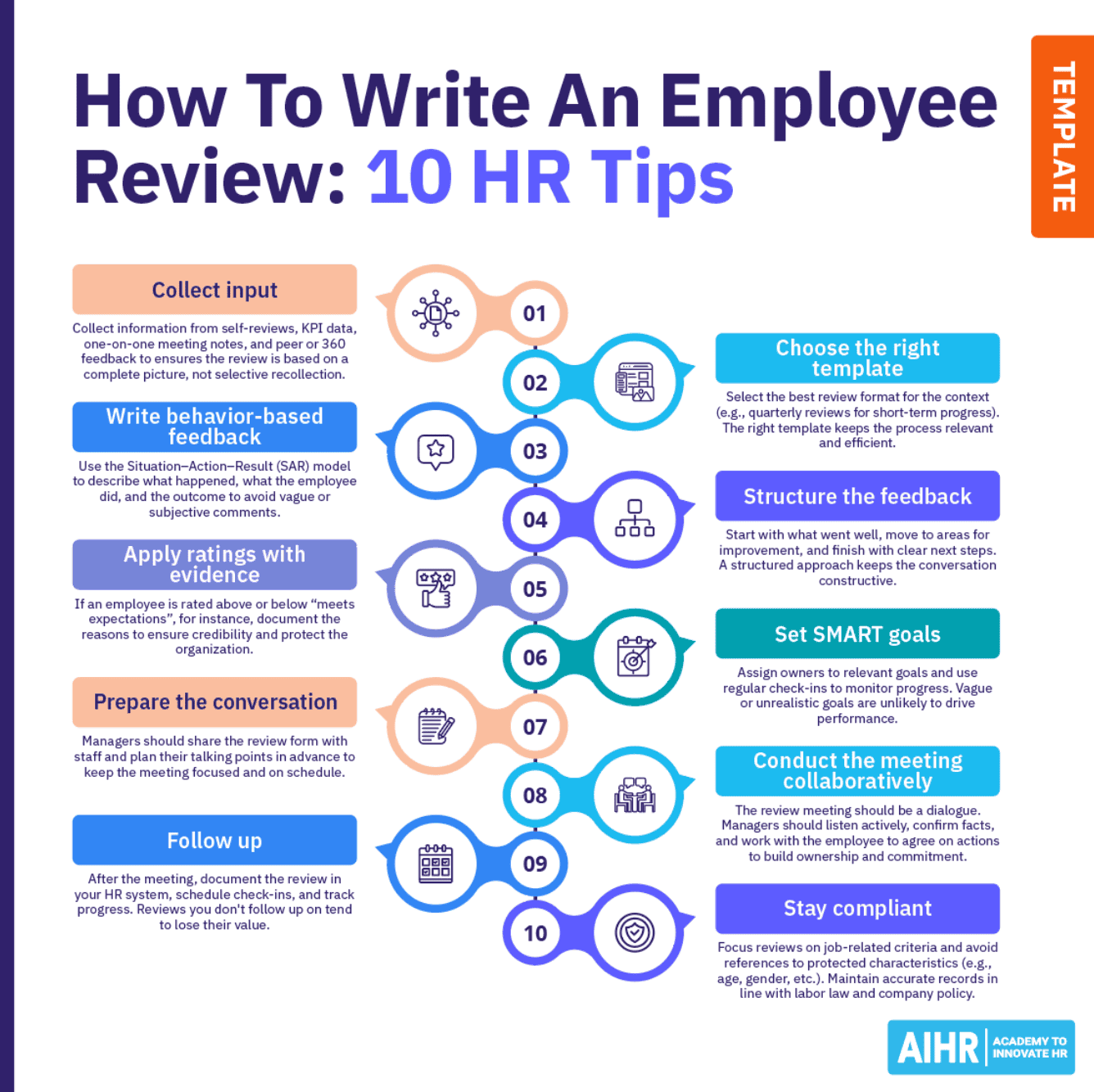
Writing fair, helpful reviews requires attention to detail. The following 10 tips and best practices can help you and your managers improve the quality of your employee evaluations.
1. Collect inputs
Don’t rely on memory. Collect information from self-reviews, KPI data, one-on-one meeting notes, and, where appropriate, peer or 360 feedback. This ensures the review is based on a complete picture rather than selective recollection.
2. Choose the right template
Select the best review format for the context. For instance, annual reviews are tied to compensation, while 90-day reviews focus on a new hire’s early progress. The right template keeps the process relevant and efficient.
3. Write behavior-based feedback
Base feedback on what the employee actually did, not on personality or general impressions. Describe the specific behavior, the context, and its impact, using the Situation, Action, Result approach from the template. For example, “Missed three project deadlines this quarter, which delayed the client launch” is far more useful than “has poor time management.” Behavior-based feedback is clearer to act on and easier to defend.
4. Structure the feedback
Balance is important. Start with what went well, then move to areas for improvement, and finish with clear next steps. A structured approach keeps the conversation constructive and informative, which helps the employee progress.
5. Apply ratings with evidence
Ratings are only meaningful when supported by examples. If an employee is rated above or below “meets expectations,” document the reasons. This helps build credibility and ensures ratings are fair and consistent across the team.
6. Set SMART goals
Goals should be specific, measurable, achievable, relevant, and time-bound (SMART). Assign owners to relevant goals and establish regular check-ins to monitor progress. Vague or unrealistic goals are unlikely to drive performance.
7. Prepare the conversation
Managers should share the review forms with staff and plan their talking points in advance. Careful preparation keeps meetings focused, on time, and respectful of everyone’s schedule.
8. Conduct the meeting collaboratively
The review meeting should be a dialogue. Managers should listen actively, confirm facts, and work with the employee to agree on actions they must take in the future. This will help employees build ownership and commitment at the individual and team levels.
9. Follow up
After the meeting concludes, be sure to document the review in your HR system, schedule check-ins, and track progress. Failing to follow up on reviews will cause them to lose their value and result in wasted time for both managers and employees.
10. Stay compliant
Focus reviews on job-related criteria and avoid references to protected characteristics (e.g., age, gender, ethnicity, etc.). Additionally, be sure to maintain accurate records in line with labor law and company policy.
Next steps
Employee reviews work best when they support a culture of continuous feedback, not a once-a-year event. Employees who receive weekly, meaningful feedback are four times more likely to be engaged, yet only 21% strongly agree they received meaningful feedback from their manager in the past week. A structured employee review template helps managers give timely, consistent feedback.
Reviews can also become development conversations. With 88% of organizations concerned about employee retention, HR needs review processes that connect performance, career growth, and learning opportunities.
To build this skill set, explore AIHR’s Talent Management & Succession Planning Certificate Program. It covers talent strategy, talent pipelines, talent data, and succession planning, helping you create review processes that support employee growth and business needs.