

Talent shortages, skills gaps, slower conversion rates, and shifting candidate expectations are putting real pressure on recruiting teams. A recent hiring insights report found that 90% of companies fell short of their recruitment goals, showing how difficult it has become to hire at the pace organizations need. Building the right tool stack can help teams make faster, higher-quality decisions.
This article breaks down 35 top recruiting tools for finding talent. These tools can help teams reduce manual work and create a better candidate experience from first touch to final offer. It also covers the key steps for choosing the right technology for your organization.
Contents
What are recruiting tools?
Top recruiting tools at a glance
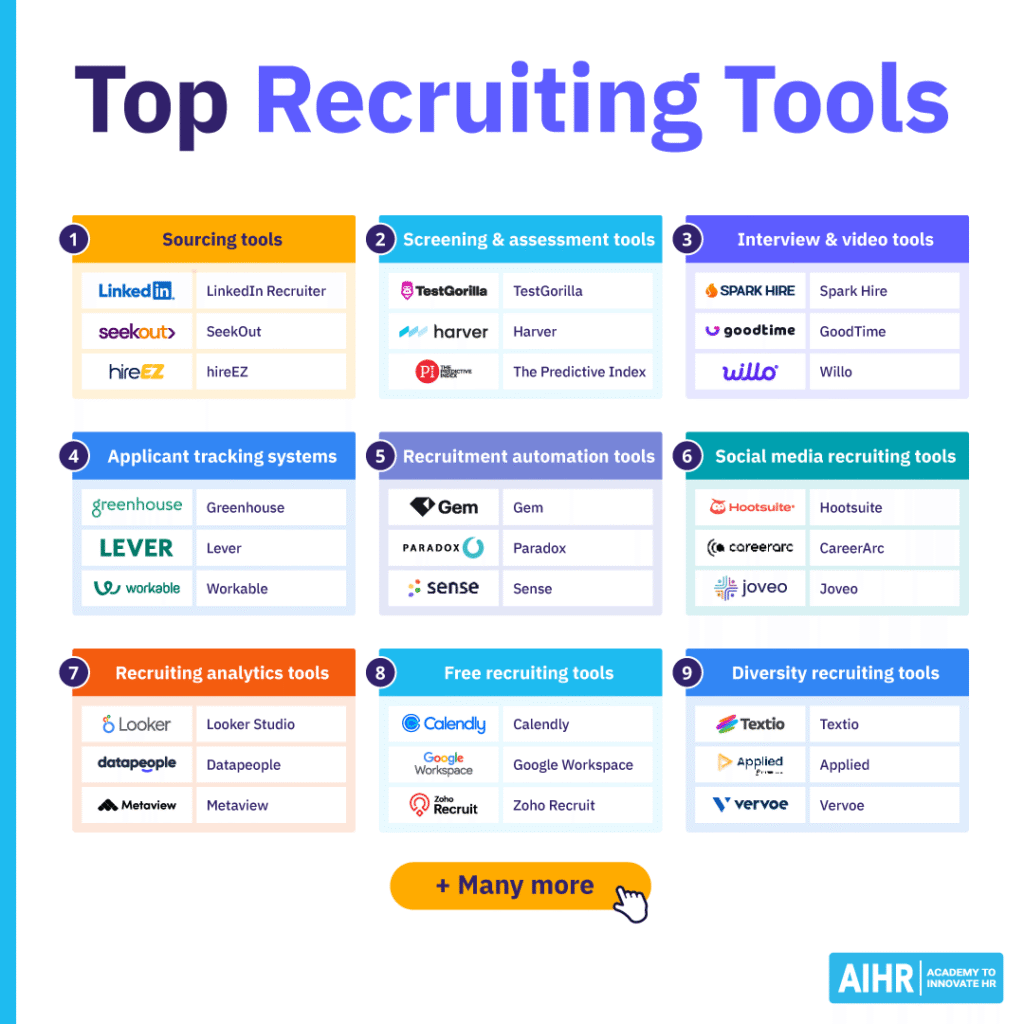
Recruiting sourcing tools
Screening and assessment tools
Interview scheduling and video tools
Applicant tracking systems (ATS)
Recruitment automation tools
Social media recruiting tools
Recruiting analytics tools
Free recruiting tools
Diversity recruiting tools
How to choose the best recruiting tools
What are recruiting tools?
Recruiting tools are digital solutions and software platforms that automate talent acquisition and applicant management. They are designed to streamline and optimize each stage of the recruitment process, making hiring more efficient and effective.
The best recruiting tools for employers usually share these traits:
- Task automation: They automate repetitive work, such as candidate sourcing, scheduling, outreach, and follow-up.
- Centralized candidate data: They store candidate information in an applicant tracking system (ATS), candidate relationship management (CRM) platform, or unified workflow.
- Recruitment analytics: They help teams track key metrics, such as time to hire, source of hire, and funnel drop-off.
- Tool integrations: They connect to core HR and recruitment systems, including HRIS platforms, job boards, email, calendars, and assessment tools.
- Candidate experience support: They make the process smoother through mobile access, faster communication, and easier interview scheduling.

Top recruiting tools at a glance
Screening and assessment
Skills-based hiring before resumes
Free tier; from $142/mo (annual)
Screening and assessment
AI screening for small teams doing high-volume hiring
From $49/mo; 7-day free trial
Interview scheduling and video
One-way video with wide ATS integration
From $249/mo (annual)
Recruiting sourcing tools
Sourcing tools help you find and engage candidates across search engines, talent databases, and channels such as LinkedIn. They are especially useful for reaching passive candidates who are not actively applying.
- LinkedIn Recruiter: Searches LinkedIn’s member database with advanced filters and provides InMail messaging access, allowing you to reach and manage both active and passive candidates.
- SeekOut: An AI-powered talent intelligence platform that helps recruiters source, screen, and engage candidates at scale. It supports skills-based searches, diversity sourcing, and labor market insights.
- hireEZ: An AI sourcing platform for broader outbound recruiting that integrates with existing ATS systems. It scans public profiles, builds talent pipelines, and automates personalized outreach across multiple workflows.
- Juicebox (PeopleGPT): Especially useful for niche or technical roles, this AI-first talent search engine uses natural-language search to find and rank candidates across multiple candidate pools and offers automated candidate engagement.
Screening and assessment tools
Screening and assessment tools use machine learning to analyze resumes, assess candidate skills or cultural fit, and reduce bias.
- Truffle: An AI screening platform for small teams doing high-volume hiring. Recruiters set the criteria for each role, and Truffle scores and ranks applicants in one shortlist with the evidence shown, leaving every decision to the hiring team.
- TestGorilla: For teams moving toward skills-based hiring, this platform helps assess candidates before relying on resumes alone. Recruiters can combine skills tests, custom questions, resume scoring, video questions, and culture-related assessments to compare candidates more consistently.
- Canditech: Uses an AI assessment builder to create tailored, role-specific skills assessments from a job description or role details. It also auto-scores responses, supports technical and non-technical tests, and includes anti-cheating features.
- Harver: This suite of science-backed hiring solutions offers predictive assessments (including game-based), automation, and analytics for efficiently screening, matching, and moving candidates through the hiring process with less bias. It also includes scheduling, video interviews, reference checking, and talent insights.
- The Predictive Index Hire: Helps employers define a role’s behavioral requirements, assess candidates using behavioral and cognitive tools, and identify the best fit for the job. The platform also supports data-informed interviewing and candidate ranking for making faster, more consistent hiring decisions.
Interview scheduling and video tools
Interview scheduling and video interviewing tools streamline hiring by automating coordination and remote assessment, with hiring-specific features such as ATS integration and calendar syncing.
- Spark Hire: Provides one-way video interviews, AI scoring, scheduling support, automation, and reporting. It also offers 40+ ATS integrations to help teams connect video interviewing with their existing recruitment workflow.
- Willo: Candidates can complete asynchronous interviews through video, audio, or text. Recruiters can then use AI-generated transcripts, summaries, benchmarks, and role-specific insights while keeping people in control of hiring decisions.
- GoodTime: This AI-driven interview scheduling automates coordination, reminders, interviewer matching, rescheduling, and candidate communications, including self-scheduling for complex interview loops. In addition, it provides branded candidate portals, analytics, and deep ATS integrations that keep hiring teams aligned.
- VidCruiter: An interview management system powered by ethical AI that offers live and one-way video interviews, structured scorecards, and automated scheduling. Personalized interviewer coaching during interviews and automated communications are also available.
Applicant tracking systems (ATS)
Applicant tracking systems (ATSs) centralize job postings, resume screening, candidate tracking, interview workflows, and hiring data. They help teams manage applicants from the first application to the final decision.
- Jarvi: An all-in-one ATS and CRM for recruiting agencies and freelance recruiters. It combines multi-channel sourcing, AI-assisted candidate scoring, automated outreach, client reporting, and an AI agent for resume generation, meeting notes, and pipeline updates.
- Greenhouse: Manages scalable, fair recruiting by consolidating job postings, candidate pipelines, interview scheduling, scorecards, and hiring analytics into a single platform. It makes hiring structured and collaborative with AI features, candidate experience tools, and 500+ integrations.
- Workable: Combines core ATS features with an AI hiring agent that sources from 400 million+ profiles, personalizes outreach, and screens candidates against job criteria. Recommendations can be reviewed, adjusted, or overridden, ensuring final decisions remain with the hiring team.
- Lever: Offers applicant tracking and candidate relationship management (CRM) in one platform. Recruiters can manage active applicants, nurture passive talent, automate workflows, and track recruitment analytics from a single system.
- Bullhorn: An ATS and CRM built for staffing and recruitment teams, helping recruiters manage candidates, clients, jobs, and communication workflows in one platform. It also supports integrations with communication tools, including Ringover’s Bullhorn integration, which connects calling activity with recruitment workflows.
AIHR’s Sourcing & Recruitment Certificate Program teaches you to:
✅ Use sourcing methods and channels to identify best-fit candidates
✅ Apply screening techniques to improve candidate quality
✅ Work with recruitment IT systems and ATS data more effectively
✅ Use recruitment analytics to improve funnel efficiency and hiring outcomes
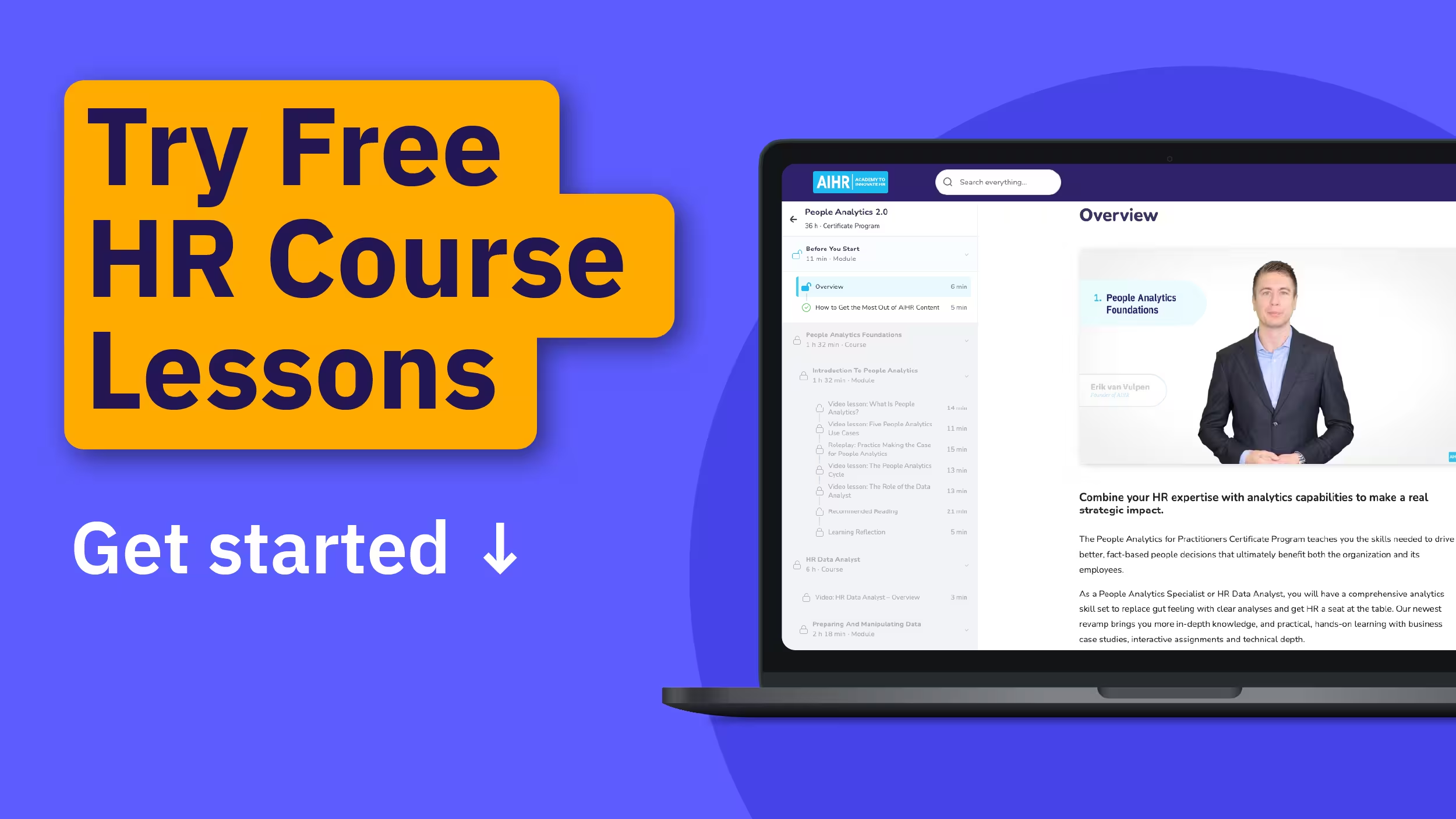
💡 Check out the lessons in AIHR’s Demo Portal for a clear idea of what you’ll get.
Recruitment automation tools
Recruitment automation tools use AI, machine learning, and workflow automation to streamline repetitive talent acquisition tasks such as sourcing, screening, scheduling, and communication.
- Gem: This AI-first recruiting platform combines ATS, sourcing, CRM, scheduling, and analytics in one system. It automates application review, fraud/risk flagging, and interview summaries, assisting HR teams in ranking candidates, streamlining workflows, and keeping hiring decisions in context.
- Sense: An AI-powered talent engagement platform that automates outreach, screening, scheduling, and other repetitive hiring tasks while personalizing candidate communication. Features include SMS/chatbot messaging, candidate matching, referrals, and onboarding engagement to improve speed and the candidate experience.
- Paradox: This conversational AI recruiting software automates high-volume hiring tasks, such as candidate screening, interview scheduling, job matching, FAQs, and communication, through text, chat, and mobile channels. It also provides tools for career sites, onboarding, and integrations that help recruiters move candidates through recruitment faster with less manual work.
- Manatal: Combines applicant tracking and candidate relationship management to manage sourcing, resume parsing, candidate matching, pipelines, and collaboration in one system. It also supports job board distribution, reporting, automation, and AI features such as interview assistance and candidate assessment.
Social media recruiting tools
Social media recruiting tools help employers find, attract, and engage candidates across networks like LinkedIn, Facebook, Instagram, and X. Common features include multi-channel job posting, social scheduling, audience targeting, campaign analytics, and automated messaging.
- CareerArc: Promotes jobs and employer brand content across social media, with automation for posting, reposting, and managing campaigns from one place. It also offers ATS integrations, job maps, analytics, and content tools to increase job visibility.
- Hootsuite: An all-in-one social media management platform that allows you to schedule and publish content, manage messages, and analyze performance from a single dashboard. This includes social listening, trend and competitor monitoring, collaboration workflows, and AI-assisted content tools to help employers manage their social presence more efficiently.
- Joveo: Runs programmatic job ads across social, search, display, job boards, and niche sites. Its AI-driven targeting, retargeting, and analytics help recruiting teams reach relevant audiences and track campaign performance.
Recruiting analytics tools
Recruiting analytics tools collect, analyze, and visualize hiring data. They help teams turn raw recruitment information into insights on pipeline health, source performance, process bottlenecks, and hiring outcomes.
- Datapeople: Recruiting analytics that turn ATS and job-post data into dashboards and recommendations for tracking job performance, pipeline health, source effectiveness, and process bottlenecks. It also surfaces content and compliance issues, such as missing key details or pay-transparency risks, in real time.
- Google Data Studio (formerly Looker Studio): A visualization and reporting tool that combines data from sources such as Google Sheets, Google Analytics, BigQuery, and other systems into interactive dashboards. Recruiting teams can use it to build custom reports on hiring metrics, campaign performance, and recruitment pipelines, making data easier to track, share, and understand.
- Metaview: The reports feature of this recruiting platform provides a customizable analytics layer for real-time searching, filtering, and reporting on recruiting conversations and interviews. It can surface trends, extract structured data from calls, create charts, and send alerts on signals such as compensation, candidate concerns, or interview quality.
Free recruiting tools
If you’re a solo recruiter or a small team with limited resources and can’t invest in an ATS, there are various free tools you can take advantage of. Here are four:
- Google Workspace (Forms and Sheets): A simple DIY option for collecting applications, tracking candidates, creating structured interview questions, and running basic assessments. You can also sort, filter, score, and share candidate data.
- Calendly: Automates interview scheduling, allowing candidates and recruiters to book time without back-and-forth emails. It also supports reminders, follow-ups, round-robin or group scheduling, and ATS and video-conferencing integrations.
- Zoho Recruit: The free version of this cloud-based recruiting software covers the basics, including one active job, candidate and contact tracking, interview scheduling, a career site, five email templates, and 256 MB of storage.
- Breezy: The free Bootstrap plan includes unlimited users and candidates, one active position or candidate pool, a branded career site, automatic job board distribution, resume parsing, and privacy and security features.
Diversity recruiting tools
Diversity recruiting tools help build more representative pipelines by reducing bias across the hiring process and using stage-level analytics to identify where demographic gaps and drop-offs occur.
- Textio: Uses real-time language guidance and AI-generated drafts to improve job posts, sourcing messages, and interview feedback. It helps teams create clearer, more inclusive recruiting content while staying consistent with employer brand guidelines.
- Applied: Supports skills-based screening through anonymized applications, work sample questions, and calibrated scoring. Its process helps teams focus on job-relevant evidence before reviewing personal details that can introduce bias.
- Vervoe: Uses skills-based assessments to evaluate candidates on job-related tasks rather than resumes alone. The platform includes assessment templates, AI-assisted grading and ranking, automated candidate communication, and bias monitoring features.
How to choose the best recruiting tools
Finding the right recruiting tools takes more than comparing popular options. Start with your team’s needs, priorities, and hiring goals, then use a structured evaluation process to narrow the list.
Here are practical steps to guide your decision:
- Identify your biggest bottleneck: Clarify where your recruiting process slows down or creates the most friction. This could include high-volume hiring, sourcing quality, recruiter productivity, candidate communication, or time to fill.
- Review your current HR tech stack capabilities: List every recruiting-related tool you already use, what it does, who uses it, what it costs, and how it connects to the rest of your HR systems. Gather input from recruiters, hiring managers, HR operations, and IT to spot overlap, gaps, and underused features.
- Set clear evaluation criteria: Decide how you will compare vendors before reviewing demos. Useful criteria include integrations, usability, technical support, security, customization, scalability, reporting, implementation effort, and cost. Separate must-have features from nice-to-have ones.
- Map tools to your hiring volume and process: Match the complexity of available tools to your organization’s hiring volume, recruiting timelines, and the level of process control you need. Review cost, compliance, security, and implementation effort.
- Run real-scenario demos: Go beyond generic sales demos and ask vendors to show how the tool handles your actual recruiting process.
- Pilot the top options: Invite end users to test the leading options using realistic workflows.
- Select the tool(s) that best fit your organization: Make the final decision based on how well each option supports your team’s daily work and long-term hiring needs. Prioritize:
- Integration with your ATS, HRIS, calendar, and email systems
- Ease of use for recruiters and hiring managers
- Useful reporting and analytics
- Straightforward implementation and reliable support
- Scalability for future hiring needs.
Next steps
The right recruiting tools can improve sourcing, reduce manual work, and strengthen the candidate experience. But they work best when recruiters know how to use them strategically.
AIHR’s Sourcing & Recruitment Certificate Program helps you build practical skills across the recruitment cycle, so you can choose technology more confidently and create a stronger, more effective hiring process.