

Strategic interview questions are designed to help employers assess more than a candidate’s technical ability or experience. They reveal how a person thinks, makes decisions, responds to challenges, and aligns their work with broader business goals.
For HR professionals and hiring managers, these questions can provide a clearer view of a candidate’s judgment, long-term potential, and fit for the role. This article explains what strategic interview questions are, why they matter, and provides 32 strategic interview questions to ask candidates, with guidance on what strong answers can reveal. It also includes a downloadable PDF version for easy reference.
Contents
What are strategic interview questions?
Types of strategic interview questions
How to use strategic interview questions effectively
32 strategic interview questions to ask candidates
– Career-oriented interview questions
– Behavioral interview questions
– Situational interview questions
Strategic interview questions to ask candidates in PDF
Key takeaways
- Strategic interview questions help you assess how candidates think, decide, and solve problems, not just their experience.
- Use a mix of career-oriented, behavioral, and situational questions to get a complete view of each candidate.
- Open-ended questions encourage detailed answers and make it easier to evaluate judgment and long-term potential.
- Follow up on vague or rehearsed responses to understand the candidate’s reasoning and real approach.
- Consistent evaluation criteria help you compare candidates fairly and make more informed hiring decisions.
What are strategic interview questions?
Strategic interview questions are open-ended questions that help employers assess how candidates approach real workplace challenges. They can reveal judgment, problem-solving ability, interpersonal skills, career direction, and alignment with the organization’s broader goals.
Because these questions invite candidates to explain their thinking and share examples, they give interviewers a fuller picture than closed questions alone. This can help HR professionals and hiring managers evaluate not only whether a candidate can do the job, but also whether they are likely to adapt, contribute, and grow in the role.

Types of strategic interview questions
Strategic interview questions can be classified into three categories:
- Career-oriented interview questions: These help assess a candidate’s long-term goals, growth mindset, and likely fit with the organization’s future direction. They can also show whether the candidate is likely to grow with the business and contribute over time.
- Behavioral interview questions: These focus on past experiences to show how a candidate has handled challenges, made decisions, and worked with others. They can reveal patterns in strategic thinking, problem-solving, and alignment with business goals.
- Situational interview questions: These present real or hypothetical workplace scenarios to assess how a candidate would respond in practice. They help evaluate judgment, prioritization, foresight, and the ability to think strategically under pressure.

How to use strategic interview questions effectively
Strategic HR interview questions work best when they are tied to the role’s real priorities, not asked as a generic checklist. Focus on questions that help you understand how a candidate thinks, makes decisions, balances short-term needs with long-term goals, and approaches uncertainty or change.
Use a mix of career-oriented, behavioral, and situational questions to get a fuller picture of the candidate. Career-oriented questions can reveal ambition and long-term fit, behavioral questions show how the candidate has approached challenges in the past, and situational questions help assess how they may respond in future scenarios.
It is also important to ask follow-up questions when an answer sounds polished but lacks detail. This can help you move beyond rehearsed responses and better understand the candidate’s reasoning, judgment, and ability to connect their actions to broader business goals.
To keep the interview fair and useful, evaluate answers against clear criteria tied to the position. Rather than looking only for confidence or strong communication, pay attention to whether the candidate shows strategic thinking, sound prioritization, adaptability, and awareness of the bigger picture.
32 strategic interview questions to ask candidates
The right strategic questions to ask in an interview can vary by role and industry, but the examples below offer a strong starting point for assessing how candidates think, make decisions, and align with broader business goals.
Career-oriented interview questions
These questions assess whether the candidate’s ambitions, skills, and motivations fit the role and the organization’s trajectory.
1. What are your short- and long-term career goals?
Job candidates whose values and aspirations align with organizational goals are less likely to leave, according to research by Qualtrics. Asking about a candidate’s career goals can help you assess whether their ambitions align with the role and the company’s direction.
For example, a candidate who does not see themselves working in the industry long term may be less likely to stay and grow with the organization. By contrast, a candidate who wants to build a lasting career in the field may be a stronger fit, especially if the company can support their development over time.
2. How do you seek out opportunities for professional development, and what specific skills are you focusing on improving right now?
A candidate’s commitment to their professional development plan provides insight into their growth mindset. A strong answer should demonstrate their proactive approach to learning and their focus on staying up-to-date with skills relevant to their career.
3. What is the professional achievement you’re most proud of, and what did the experience teach you about your abilities?
Asking about professional achievements allows a candidate to highlight a key career success. Their answer will give you insight into their drive, problem-solving skills, and what they value most in their work.
4. What motivates you to pursue this role, and how does it fit into your overall career plan?
This question helps you understand why the candidate wants the role and whether they see it as a meaningful next step rather than just another job opportunity. It can reveal how intentional they are about their career decisions and whether their motivations align with what the role actually offers.
A strong answer should show genuine interest in the position, a clear understanding of the role, and a logical connection between the opportunity and the candidate’s broader career direction.
5. What key milestones or achievements do you hope to accomplish in your career over the next five years, and how does this role align with those goals?
This question helps assess whether a candidate has a clear sense of direction and has seriously considered their long-term professional growth. It also shows whether the role fits into that path in a realistic and mutually beneficial way.
Look for answers that reflect ambition, self-awareness, and a clear connection between the candidate’s future goals and the opportunities available in your organization.
6. What skills or experiences are you hoping to gain from this role to help you in your broader career aspirations?
This question focuses on development rather than long-term ambition alone. It helps you understand whether the candidate sees the role as an opportunity to build relevant capabilities and whether your organization can realistically support that growth.
A thoughtful answer should show that the candidate has identified specific skills or experiences they want to develop and understands how the role can help them progress.
7. What innovations are likely to transform the industry in the next five years?
Staying informed about industry developments is an important sign of curiosity, initiative, and long-term professional commitment. This question helps assess a candidate’s engagement and knowledge of the field.
In their responses, observe the candidate’s understanding of the upcoming trends and factors the industry is expected to encounter, and how they are likely to influence the organization.
Strategic interview questions help recruiters look beyond the resume and assess whether a candidate has the skills, motivation, and potential to succeed. Building this skill is part of creating a more structured, effective hiring process.
AIHR’s Sourcing & Recruitment Certificate Program gives you the tools to:
✅ Conduct structured job intake sessions with hiring managers
✅ Create targeted candidate personas and job descriptions
✅ Apply effective screening and candidate evaluation methods
✅ Use recruitment analytics to improve hiring quality and funnel efficiency
🎓 Build the practical recruitment skills to identify, assess, and hire best-fit talent.
Behavioral interview questions
Behavioral questions explore past actions or general habits and help uncover a candidate’s established patterns.
8. What type of organizational culture helps you do your best work, and why?
This question helps you understand the kind of work environment in which a candidate is most likely to perform well. It can also show whether their preferences align with how your organization operates day to day.
Look for thoughtful answers that go beyond surface-level preferences and connect culture to collaboration, communication, accountability, or ways of working.
9. How do you motivate yourself and stay productive in the face of difficult challenges?
Employees face various challenges in their daily work routine that can impact their motivation and output. As an employer, it’s crucial to evaluate how a potential employee handles such difficulties and remains motivated.
This question can help the interviewer assess a candidate’s ability to overcome challenges without affecting their productivity or motivation.
10. Tell me about a change you proposed and how it impacted your workplace.
The purpose of this question is to assess whether a candidate is able to adjust and adapt their work style when needed. Encourage the candidate to share examples of when they proposed ideas for change, and the role they played in implementing them.
You could also ask a follow-up question on whether they perceived the change as beneficial to their team or organization. This will help you understand whether the candidate can assess the bigger picture.
11. Tell me about a time when you had to use an unorthodox approach to solve a problem.
Effective problem-solving is a valuable skill in any organization. Candidates who possess this skill are likely to succeed in the workplace. Asking this question during an interview can give you insight into a candidate’s problem-solving capacity.
Inquire about situations where the candidate had to use an unconventional approach to solve a problem. This will help you determine their ability to think outside the box when faced with complex challenges.
12. How do you stay informed about industry news and trends?
Closely related to the previous question, this question seeks to determine the information sources a candidate relies on for industry developments. In their response, find out which publications they read, podcasts they listen to, or thought leaders they follow.
A positive answer demonstrates their initiative and passion for staying up to date with the industry. A lack of high-quality sources or a lack of knowledge of trends could indicate a low commitment to self-improvement.
13. Describe a time when you made a serious mistake at work and how you handled it.
Even the best professionals can make mistakes. Making mistakes is not a sign of personal failure, but how one handles, learns, and moves on from them will tell you a lot about their personality. Asking this question allows you to assess a candidate’s understanding of accountability.
14. How do you handle criticism?
Constructive criticism is part of every workplace, especially in roles that involve collaboration, decision-making, and continuous improvement. Asking this question helps you assess a candidate’s self-awareness, adaptability, and willingness to learn from feedback.
A strong response should show that the candidate can accept feedback professionally, reflect on it, and use it to improve their performance. This can also reveal how well they respond in environments where priorities, expectations, or approaches may shift over time.
15. How would you describe your learning process?
This question helps you understand how a candidate approaches learning, adapts to change, and builds new skills over time. It is especially useful for assessing whether they can grow in roles that require ongoing development and evolving responsibilities.
A strong answer should demonstrate curiosity, initiative, and the ability to apply new knowledge in practical situations. Look for candidates who describe learning as an active process rather than something that only happens when required.
16. Describe a time when you were involved in a workplace conflict and how you handled the experience.
The ability to manage workplace conflict is a valuable trait for any worker. Asking about conflict resolution allows the interviewer to evaluate how a candidate perceives and manages workplace conflicts.
A candidate who can address conflicts from various angles and handle them positively can be an excellent addition to the team. A candidate who struggles to manage conflict may not communicate well with management or could be inflexible on most matters.
17. What is your general rule for handling competing tasks?
Task prioritization is a necessary skill to ensure productivity and high-quality work. This question enables an interviewer to assess a candidate’s ability to manage their schedule and prioritize tasks in order of urgency and importance. Candidates who answer this question successfully demonstrate their time-management skills and ability to work productively.
18. How do you motivate and support the people you lead?
Maintaining high team morale is crucial for leaders as it often results in better performance outcomes. During the selection process for a leadership role, evaluating a candidate’s ability to motivate and inspire people is essential.
Ask for concrete examples of how the candidate previously motivated their team to accomplish specific objectives. This information can help you choose the best individual for the job based on their interpersonal and motivational capabilities.
19. Describe a situation where you worked with people from diverse cultures or backgrounds.
As workplaces become more diverse, it’s important for employees to be able to work well with colleagues from different backgrounds. This question can help hiring managers gauge a candidate’s awareness of diversity and their ability to demonstrate inclusive behavior at work. To assess cultural competence and sensitivity, look at examples of the candidate demonstrating these qualities in previous positions.
20. Describe a time when you had to make a difficult decision.
This question helps the interviewer assess the candidate’s decision-making skills and approach to complex situations. Consider the candidate’s approach in such a situation, how they managed potential risks or negative consequences, and finally, the outcome of their decision.
From their response, assess whether they were able to communicate the situation or the decision with relevant stakeholders and what they learned from the experience. Their response should demonstrate sound judgment and effective risk management.
21. Tell me about a time when you set a goal and achieved it.
Asking candidates about their goal-setting strategies can provide valuable insights into their level of ambition and dedication, as well as their approach to achieving objectives. This question can help interviewers gauge a candidate’s determination, motivation, and ability to develop and implement effective strategies to reach their goals.
22. Can you describe a situation where you failed to meet a goal? How did you reflect on the experience, and what changes did you make afterward?
A candidate’s ability to self-reflect and learn from failure is crucial for growth. This question allows you to assess how they handle setbacks, process lessons learned, and apply those insights to future situations.
23. Tell me about a time when you had to learn something new quickly to meet a deadline. How did you manage it, and what was the result?
Here, you’re assessing the candidate’s adaptability and ability to perform under tight time constraints. The answer will show how resourceful they are in their learning process and whether they can handle fast-paced environments while still delivering results.
24. How do you build and maintain strong relationships with colleagues or clients, especially when faced with disagreements or conflicting priorities?
This question helps assess a candidate’s ability to build trust, manage stakeholder relationships, and work effectively through tension or competing demands. These are important qualities in roles that require collaboration, influence, and sound judgment.
A solid answer should show that the candidate can communicate clearly, stay professional during disagreements, and balance relationship management with the need to move work forward.
25. How do you handle feedback from both peers and supervisors, and how have you used it to improve your performance?
This question evaluates a candidate’s self-awareness, coachability, and willingness to improve based on feedback from different sources. It can also reveal how well they respond in collaborative environments where input from others shapes decisions and performance.
Ideal candidates should be able to share specific examples of feedback they received, how they reflected on it, and what they changed as a result.
Situational interview questions
Situational interview questions present specific hypothetical scenarios and ask how a candidate would respond. They test problem-solving and decision-making in unique situations that are likely to happen on the job.
26. What would you do if a project you’ve been working on for a long time suddenly hits a major obstacle that affects its progress?
This question can be adapted to reflect a scenario relevant to the role, but the main goal is to understand how a candidate responds when a major challenge threatens progress.
Their answer can reveal whether they can reassess the situation, involve the right people, and find a practical way forward. It also provides insight into whether they stay solution-focused and collaborative under pressure.
27. What steps do you take to prepare and deliver a persuasive pitch to management, and how do you handle potential objections or pushback?
This question can reveal a candidate’s ability to communicate their ideas effectively, think critically, and anticipate and address potential objections. It can also provide insight into their strategic thinking style and their ability to influence and persuade others.
The interviewer should assess the candidate’s approach, whether they can anticipate and address potential objections or concerns, and whether they can provide data or evidence to support their proposal. Additionally, the candidate should demonstrate confidence and clarity in their delivery and be able to adjust their approach based on management feedback.
28. When working on a complex project, how would you explain technical topics to people unfamiliar with the topic?
Employees sometimes have to take charge of challenging projects. In such situations, they must be able to simplify technical concepts so their team can understand the project and they can secure leadership buy-in for it. By asking this question, you can assess the candidate’s expertise in the field and their capacity to explain a topic in easy-to-understand language.
29. How do you handle ambiguity and uncertainty in your work?
This question allows the interviewer to assess a candidate’s ability to handle situations that lack clear guidelines. It also helps determine how the candidate manages stress and adapts to change. From their response, evaluate how comfortable they are with ambiguity and uncertainty, and whether they can remain calm under pressure.
You can also ask the candidate to describe how they managed an ambiguous or uncertain situation in their previous role. Their response will show whether they can communicate effectively, collaborate with others, or seek help from their manager.
30. How would you respond if you were expected to deliver quick results, but believed the proposed approach could create long-term problems for the business?
This question helps assess how a candidate balances short-term execution with long-term thinking. It can reveal whether they are willing to raise concerns, challenge assumptions professionally, and make decisions that support broader business outcomes rather than short-term convenience.
A strong answer should show that the candidate would assess the risks, communicate their concerns clearly, and suggest a practical alternative where possible. Look for someone who can balance diplomacy, accountability, and strategic judgment.
31. What would you do if you found out a colleague was routinely violating company policies?
This question provides the interviewer with an opportunity to assess a candidate’s ethics, judgment, and ability to handle sensitive situations. The candidate should illustrate how they’d handle the matter—both individually and on a company level. Does the candidate show a willingness to work collaboratively to resolve the issue and display good ethical judgment? An ideal candidate would display integrity, diplomacy, and professionalism.
32. How would you approach a situation where two business priorities compete for the same limited resources?
This works well as a situational strategic interview question because it helps assess how a candidate thinks through trade-offs, prioritizes under pressure, and aligns decisions with broader business goals. It can also reveal whether they consider stakeholder needs, short-term demands, and long-term impact before deciding on a course of action.
A strong answer should show that the candidate would first assess the urgency, importance, and potential business impact of each priority. It should also indicate that they would communicate clearly with stakeholders, weigh the risks of different options, and make a decision based on what best supports organizational goals rather than personal preference or convenience.
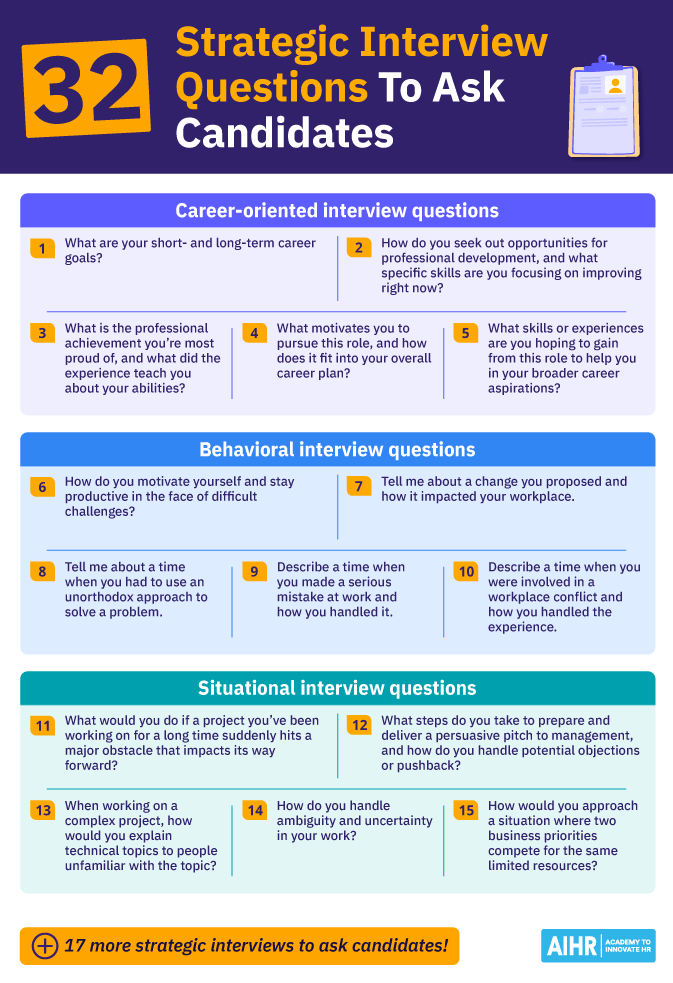
Strategic interview questions to ask candidates in PDF
Download this PDF to keep strategic interview questions on hand and support more informed hiring decisions. Use it during interview preparation, screening calls, or panel interviews to keep a practical list of questions close by.

To sum up
Strategic interview questions help you look beyond a candidate’s résumé and assess how they think, solve problems, make decisions, and connect their work to broader business goals.
Use a mix of career-oriented, behavioral, and situational questions to understand the candidate’s goals, past behavior, and likely response to real workplace scenarios. To keep the process fair, ask consistent questions, use clear evaluation criteria, and follow up when answers lack detail.
Strong interviewing is a skill HR professionals can continue to build. If you want to strengthen your sourcing, screening, and candidate evaluation skills, AIHR’s Sourcing & Recruitment Certificate Program covers end-to-end recruitment, candidate screening methods, recruitment analytics, and practical tools for improving hiring decisions.