

Talent acquisition challenges are becoming harder to tackle as skills needs change fast, hiring expectations rise, and traditional recruiting methods fall short.
Specifically, technological developments and AI accelerate the need for different technical skills. Suitable candidates are often concentrated in specific geographic areas and scarce elsewhere, and traditional screening methods exclude potentially perfect talent from the get-go.
In this article, we’ll unpack some of the biggest challenges in talent acquisition (TA) right now. We’ll discuss the current state of talent acquisition and share strategic solutions for TA leaders to overcome today’s challenges.
Contents
The current state of talent acquisition
7 key talent acquisition challenges
Strategic solutions to common talent acquisition challenges
Key takeaways
- Talent acquisition faces a paradox. While employers report talent shortages, job seekers struggle to find jobs. Traditional hiring models and screening methods often exclude qualified candidates.
- Key talent acquisition challenges include shifting from reactive hiring to strategic workforce planning, moving from role-based to skills-based hiring, and integrating AI responsibly.
- Organizations need to implement strategic solutions like building skills-based talent strategies, upskilling TA teams, and developing stronger talent intelligence.
- TA leaders must address both external skill and workforce changes and internal skill gaps in their teams to better meet evolving business needs and improve recruitment and retention.
The current state of talent acquisition
The current labor market paints an interesting, albeit initially paradoxical picture. On the one hand, there are reports of talent shortages, stating that as many as 72% of employers say they are struggling to find the skilled people they need.
On the other hand, however, job seekers are having a hard time finding jobs. In the U.S, the overall unemployment rate has been rising, as has the number of weeks someone is unemployed. For young people in particular, the situation is dire: entry-level job postings in the U.S. are down 35% since 2023, partially due to AI taking over certain tasks entry-level employees had previously performed .
So why did we call it an “initially” paradoxical picture? Because it would be too easy to say the labor market is simply “candidate-rich” or “talent-scarce”. It’s uneven. Many candidates are actively looking, while employers still struggle to fill specific roles. This creates a matching problem: available candidates don’t always match the skills, location, pay, flexibility, or experience level employers require.
Talent acquisition teams, therefore, now need to work more closely with workforce planning, L&D, internal mobility, retention, and business leaders.
7 key talent acquisition challenges
Today’s TA challenges don’t just involve “hard-to-fill roles”. They stem from a mismatch between business demand, available talent, rapidly changing skills, and outdated hiring models. Let’s unpack seven key challenges in talent acquisition:
1. Shifting from reactive hiring to strategic workforce planning
TA teams are expected to anticipate future capability needs, instead of responding only when vacancies open up. However, traditional strategic workforce planning isn’t enough to address this anymore.
An additional challenge in today’s environment is that the current market may not be able to provide the talent the business needs and workforce plans promise (whereas before, this was usually the case). Lightcast research shows that in Europe, for instance, working-age populations are declining, and that simultaneously, a third of the skills in the average job have changed over the last three years.
2. Balancing short-term hiring pressure with long-term talent strategy
Recruiters must fill urgent roles while also building sustainable pipelines for critical skills. In particular, the latter has become more difficult in today’s environment. Skills change and expire rapidly, making it harder to determine which are critical to the organization in the long term, and how to build them effectively.
This requires a broader approach to capability development, one that connects TA with workforce planning, internal mobility, and upskilling.
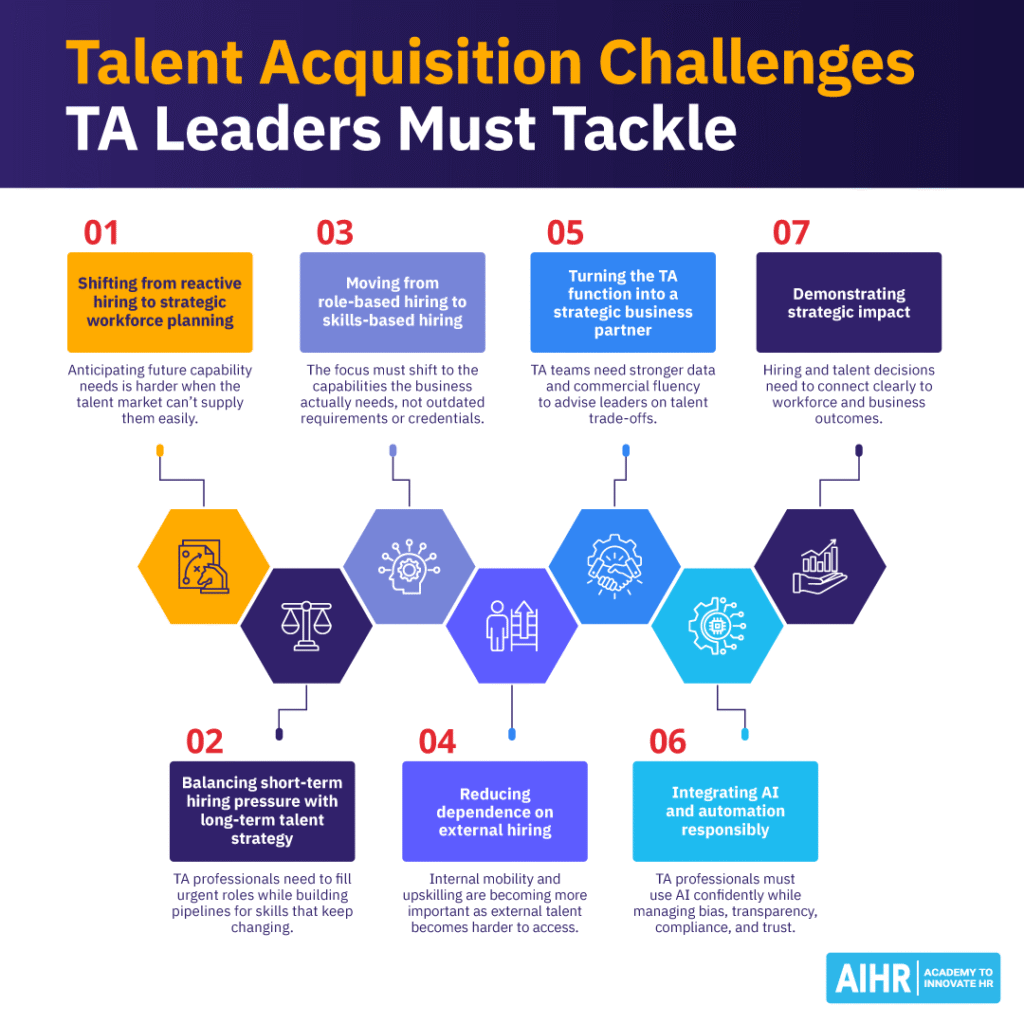
3. Moving from role-based hiring to skills-based hiring
Traditional job descriptions and credential requirements may no longer reflect the capabilities the business actually needs. Many organizations still use degrees, specific credentials, and years of experience as part of their initial screening criteria.
There are two main issues with this. The first is that companies often don’t even know whether these requirements actually predict performance. The second is that a lot of high-demand talent, especially in fast-moving fields like AI, has developed sought-after skills through on-the-job experience, self-directed learning, or adjacent roles.
By applying credential requirements such as the ones mentioned above, organizations automatically filter out candidates who could have been perfect for the job.
4. Reducing dependence on external hiring
TA leaders are under pressure to support internal mobility, workforce redeployment, and upskilling rather than relying solely on external talent markets. For many critical roles, the talent organizations need is not readily available externally, or is too expensive, scarce, or concentrated in specific markets.
That means TA teams need to look more intentionally within the organization, creating visibility into internal skills, employee aspirations, and adjacent career paths. At the same time, traditional upskilling cycles are often too slow for fast-changing roles. That’s why TA teams need to work with HR and L&D to build more agile talent pathways and develop critical capabilities from within.
5. Turning TA into a strategic business partner
TA teams are increasingly expected to advise leaders on talent availability, labor market realities, and workforce trade-offs. This requires a different mindset and skillset for talent acquisition professionals.
We already mentioned that 30% of skills have changed for the average job since 2022. To respond to this shift, TA professionals need stronger data literacy and commercial fluency to translate talent trends into hiring decisions and capability plans. They also need stakeholder management and consulting skills to turn talent trends into practical business decisions and positive outcomes.
6. Integrating AI and automation responsibly
TA teams must improve efficiency with AI while managing risks related to bias, transparency, compliance, and candidate trust. To do this successfully, TA professionals must first become AI-fluent. They need to be able to work with AI confidently and thoughtfully, and use it effectively.
At AIHR, we’ve defined AI Fluency as one of the six core HR competencies within the T-Shaped HR competency model. We’ve also identified four dimensions necessary for proficiency:
- Confident AI application
- Responsible AI practice
- AI adoption advocacy
- AI work integration.
To learn more about how to build AI fluency in your talent acquisition team, check out our article on the AI fluency framework for HR teams.
7. Demonstrating strategic impact
Organizations increasingly expect TA teams to demonstrate their impact on quality of hire, workforce capability, retention, and business performance. This means talent acquisition professionals need to know how to use metrics and analytics effectively to show how their TA strategies affect performance and results.
A common challenge is that this data is often incomplete, inconsistent, or scattered across different HR systems. Many TA teams also need stronger above-mentioned data literacy to turn those insights into a clear business story.
Strategic solutions to common talent acquisition challenges
There are certain strategic shifts TA leaders need to make to address the talent acquisition challenges we’ve discussed. Here’s how TA teams can start moving from reactive recruiting to a more strategic, skills-based, data-informed, and business-aligned function.
Redefine TA’s role in the organization
Talent acquisition teams need to move from taking hiring requests to shaping talent decisions. This starts with getting involved before roles are approved, not after.
To earn that seat at the table, TA professionals need stronger business acumen and better consulting skills. They should ask sharper questions, such as: Which business goal does this role support? What happens if we don’t hire? Could we build, move, or redesign talent instead? This helps TA shift from order taker to strategic advisor.
AIHR’s Talent Acquisition Capability-First Roadmap helps you plan the move from reactive hiring support to a more strategic, capability-driven TA function.
Build a skills-based talent strategy
Organizations are moving away from rigid role definitions toward capabilities, adjacent skills, and long-term workforce adaptability.
As in-demand skills change rapidly, the ones that hold their value are not purely technical; they’re capabilities that enable people to adapt as technology evolves. Examples include communication, continuous learning, sound judgment, and problem-solving. Yes, companies will still need to include development investments in technical skills with a short half-life in their strategies. But they also need to focus on durable capabilities, such as those just mentioned. Relevant questions to ask in that regard are:
- Do we have an up-to-date view of our organization’s skills demand, or are we depending on a competency framework that we review every couple of years?
- Do we have people in the organization who either already have that capability, or who can build it quickly before turning to the external market?
- Do we also invest in capabilities that maintain their value over time?
Develop stronger talent intelligence capabilities
TA leaders need better visibility into labor markets, workforce and talent acquisition trends, skills availability, and future talent risks to support decision-making.
This means TA teams must be able to collect and analyze talent data, and combine internal workforce data with the relevant external (market) insights we just mentioned to drive the organization’s talent decisions. To build the necessary talent intelligence capabilities, TA teams first need to become data-literate; they need to know how to think critically about what the data reveal, how to apply it, and how to communicate it.
Create more agile talent access models
Organizations can no longer rely solely on traditional external hiring to meet their talent needs. TA strategies should combine internal mobility, upskilling, contingent talent, automation, and external recruitment.
But rather than simply combining these talent access tools, companies need to adapt them to today’s environment if they want them to be effective.
Take external recruitment, for instance. As we’ve discussed earlier, eliminating candidates based on (outdated) requirements, such as degrees and years of experience, raises likelihood of filtering out the right people for the job and reducing your talent pool. For example, the Lightcast research mentioned above shows that 66% of global job postings demand college-level credentials, while only 31% of the workforce have them.
Instead, ask yourself the following three questions when determining job requirements:
- Is this requirement predictive of success?
- Who are we excluding because of this requirement, and how many capable people are we filtering out?
- What other ways are there to prove capability?
Invest in upskilling TA teams
A recurring theme throughout this article is that TA teams need more to develop new skills and strengthen other capabilities to meet today’s expectations from the business. Skills like business acumen, workforce planning, labor market analysis, stakeholder management, AI, data literacy, and strategic advisory work continue to grow in importance. Other capabilities, such as execution excellence, are essential, too.
Team-based learning can help TA leaders build these capabilities consistently across the function. It gives everyone a shared baseline, common language, and practical tools they can apply to real hiring challenges. AIHR’s Strategic Talent Acquisition & Recruiting Boot Camp is an instructor-led, intensive program designed to build the capabilities and mindset your TA team needs to deliver practical, real-world impact in just one to three months.
Use AI to augment, not replace, recruiting expertise
AI can improve efficiency and insight generation, but TA teams still need human judgment, governance, and relationship-building capabilities.
To ensure your talent acquisition team knows how to balance AI use with human judgment, it must become AI-fluent. As mentioned earlier, AI fluency is one of the core HR competencies and something TA leaders need to build within their teams.
Measure TA through business impact
TA success should increasingly be tied to workforce capability, quality of hire, retention, internal mobility, and organizational resilience, not just hiring speed. This means TA teams need to include KPIs and metrics related to each of these aspects as part of their strategy and goals.

A final word
The talent acquisition challenges TA leaders face today are a combination external and internal factors. Externally, skill requirements are changing quickly as AI, automation, and new technologies reshape how work gets done. At the same time, talent supply is becoming harder to predict, and traditional screening methods can exclude capable candidates too early. Internally, business leaders expect TA teams to provide more strategic guidance, not just fill open roles.
The good news is that solutions listed in this article can be a great place to start for TA leaders and their teams to overcome these challenges and thrive in what they do best: finding, selecting, and retaining the best people for the job and the business.