

Only half of HR teams have the skills to deliver real impact, and building those skills alongside a full-time job can be challenging. For some working professionals, the gap comes from transitioning into HR from a second or third career, without a strong HR background. For others who have had HR training, the sector’s demands may have moved faster than their training did.
Simply put, if you don’t have the luxury of stepping away from your job to catch up, you need HR skills you can apply as soon as you learn them. This list covers 16 HR courses to help you achieve this, as well as become HR certified. From short online HR courses to certificate programs that strengthen your HR expertise, you’ll find options that work for you.
Contents
What are HR courses for working professionals?
Hacks for taking an HR course as a working professional
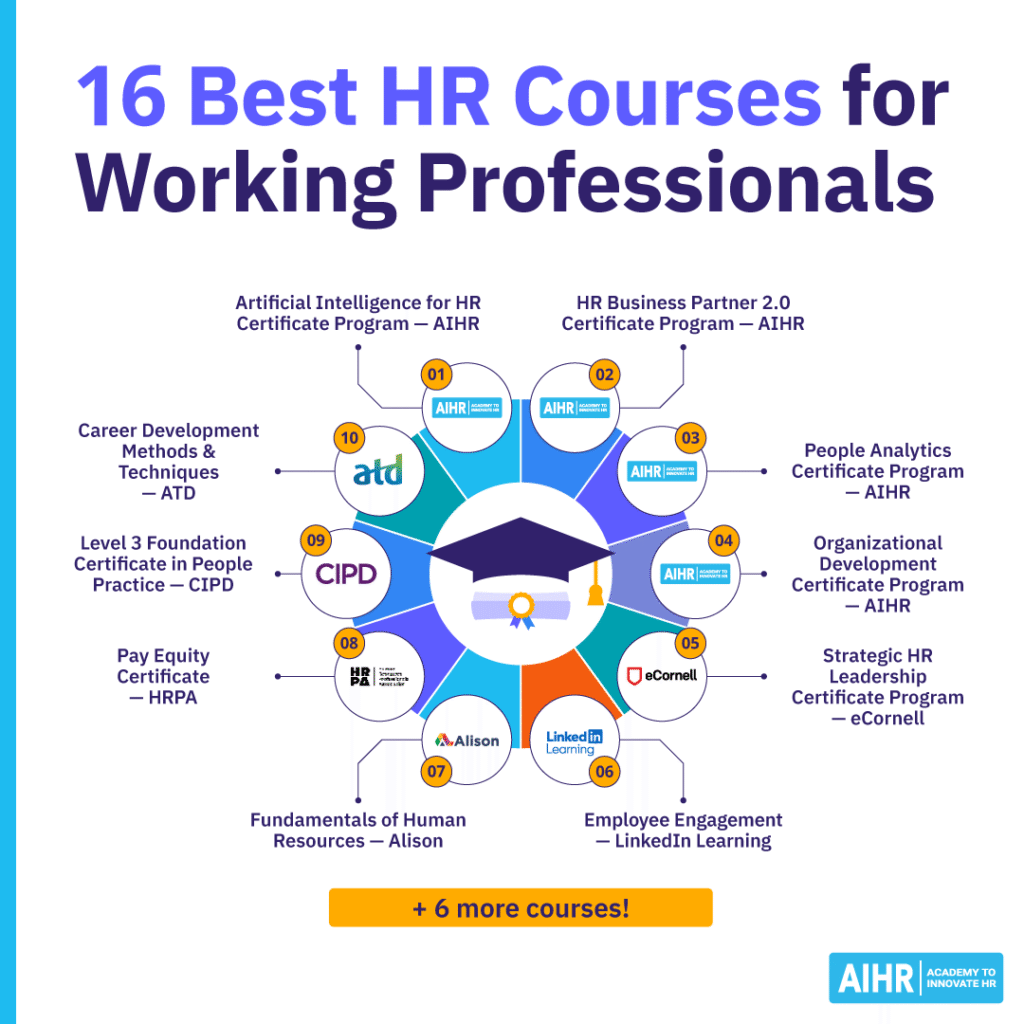
16 best HR courses for working professionals
Your career transition toolkit: Moving into HR from another field
What are HR courses for working professionals?
HR courses offer flexible learning to improve HR skills while fitting around your work and personal schedules. These courses typically cover topics like talent management, employee relations, employment law, HR analytics, talent acquisition, and Diversity, Equity, Inclusion, and Belonging (DEIB).
They’re available in various formats: online, self-paced, hybrid, and in-person. Online courses and HR certificate programs are popular as they let you learn anywhere, at any time. In-person and hybrid courses and HR classes, on the other hand, are designed to work with your schedule, with many even offering HR certifications.
Continuous training is vital as new HR technologies and changing compliance standards emerge. HR courses help keep you competitive and updated on the latest trends, regulations, and technologies. They also build a solid foundation for both personal and career growth and may include attending conferences, independent research, or even mentoring.

Why should HR professionals consider further education?
Further education in HR is important for several reasons:
- Career growth: Keeping your skills current with new laws and technologies makes you a strong candidate for promotions and new opportunities.
- Compliance and legal knowledge: Regular training ensures you understand workplace laws, helping your organization stay compliant and protecting it legally.
- Networking opportunities: Many courses offer connections with professionals from various industries, providing you with valuable insights and contacts.
- Leadership development: Courses can enhance your leadership skills in areas like talent management, coaching, and communication, preparing you for managerial roles.
Hacks for taking an HR course as a working professional
Juggling a full-time job with coursework can be challenging but achievable with the right strategies. Here are some actionable tips to help you manage both a full-time job and an HR course while maintaining a healthy work-life balance:
Use time blocking
Create a non-negotiable schedule to make your learning time as essential as any work meeting. Review your weekly calendar and block realistic, consistent slots using specific notes. For instance, you can schedule “Tuesday evenings, 7 p.m. — 9 p.m., HR Law reading”. At the same time, be sure to remain flexible. Structure is important, but in case unexpected work demands pop up it’s good to include buffer time in your week to catch up.
Study hacks
- Early bird focus: Spend 30 to 60 minutes before work on focused review tasks when you’re mentally fresh.
- Evening deep dives: Dedicate specific evenings to comprehensive study sessions.
- Weekend catch-up: Set aside a few hours over the weekend for assignments or wrapping up what you’ve missed during the week, dividing it into manageable sessions.
Make the most of small moments
Turn downtime into learning time — studying does not require uninterrupted focus. In fact, taking regular breaks and using brief windows in your day to make meaningful progress may benefit you more in the long run. Even if you can spare only 10 minutes to read a particular chapter in your study materials, it still counts as progress.
Study hacks
- Maximize your commute: Listening to HR podcasts, course recordings, or audio lessons during your train or bus ride can quickly boost your knowledge.
- Make breaks productive: Use short gaps in your day, like lunch breaks or 15-minute intervals, to skim course notes, review flashcards, or complete quick online activities. Even a few minutes can help reinforce your learning.
- Use digital tools: Download key materials, such as lecture slides or e-books, to your devices so they’re always accessible. This makes it easy to study on the go.
Protect your wellbeing
Prioritize your health and wellbeing to maintain focus and stay on track. While you might think you need to burn the candle at both ends to progress quickly in your learning, this may actually do more harm than good. Making sure you get enough rest, water, and food is important and will help you avoid excessive stress, as well as burnout.
Study hacks
- Take strategic breaks: Short, regular breaks during study sessions (e.g., five minutes after every 25 minutes of work) can boost productivity and prevent fatigue.
- Set milestones and rewards: Break big assignments or lessons into smaller tasks. Celebrate when you reach goals, like finishing a webinar or aceing a quiz. Rewards can be as simple as a coffee break or watching an episode of your favorite show.
- Find your rhythm: Everyone studies differently. Pay attention to your natural energy levels and productivity patterns, and experiment with schedules to discover the method that suits you best.
Communicate and leverage workplace support
Let your employer and colleagues know about your study commitments. Speak with your manager about your goals, share your study schedule, and set boundaries, so colleagues know when you’re unavailable. Some companies also offer certain types of tuition assistance, even for short-term courses, so don’t forget to enquire about that as well.
Study hacks
- Ask about resources: Many companies offer tuition reimbursement or professional development benefits. Explore what your organization offers to see if it can support you in this regard and help alleviate some of your stress.
- Apply your learning to your work: Use what you’re studying to solve real-life challenges at work. For instance, testing a new HR strategy or tool could solidify your understanding while demonstrating initiative and showing your employer the value of your studies.
Use tech to stay organized
Apps like Trello, Todoist, or Google Calendar can help with time management. Use them to stay organized and ensure you’re on track with your studies while managing your work duties. You might also benefit from using a physical organizer, as writing things down can help you plan and remember important details better.
Study hacks
- Streamline your notes: Apps like Evernote or OneNote make capturing, syncing, and organizing course details easy, so you never need to waste time searching for materials.
- Choose what works for you: If you like writing things down, combine digital tools with physical alternatives so you have the best of both worlds. Tailor your setup to help you stay consistent and motivated.
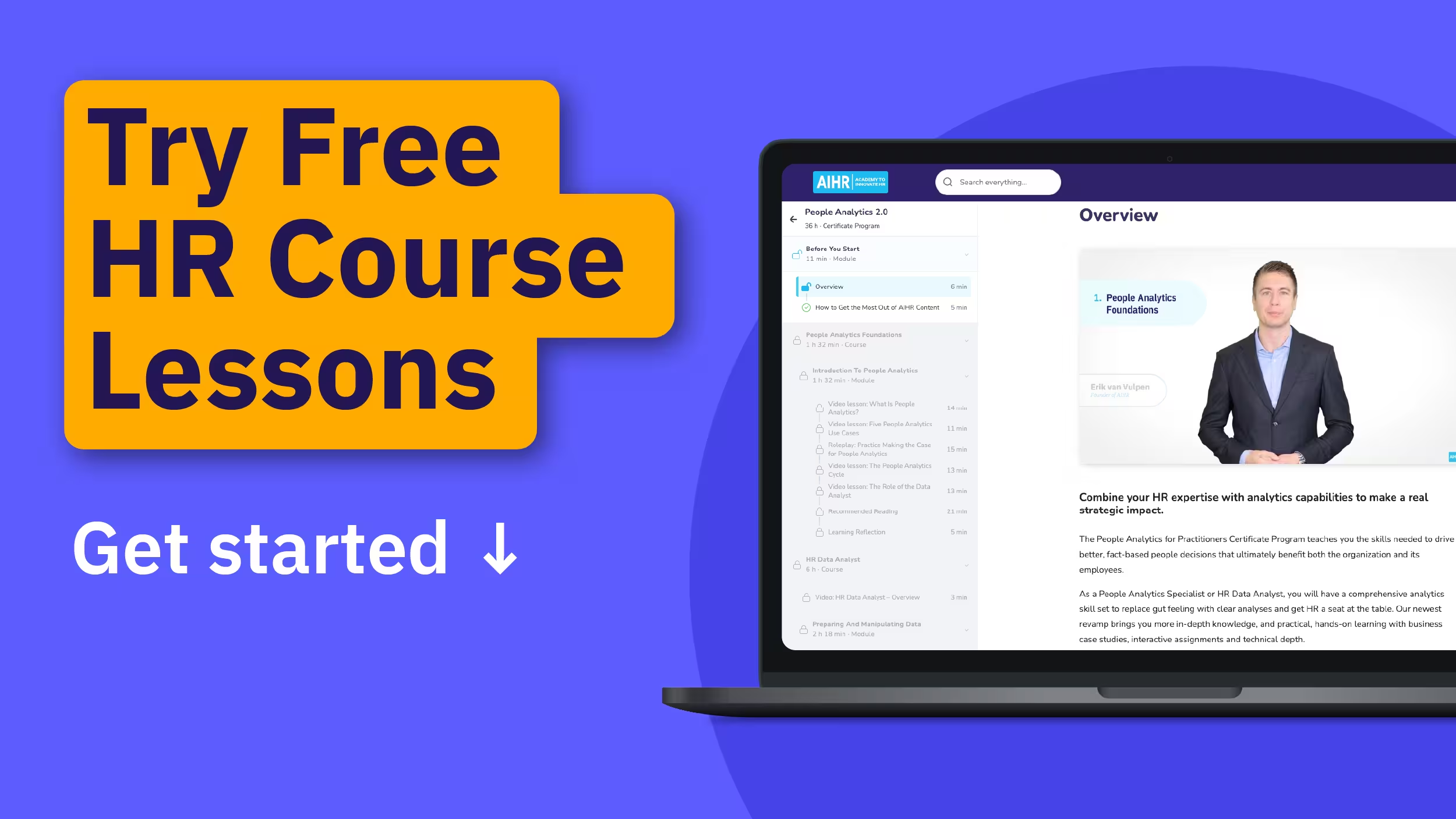
Choosing an online HR course is an important step in your professional development. Before you enroll, it helps to see how the learning experience supports practical skill-building and continuous growth.
AIHR’s Demo Portal gives you a preview of what learning with AIHR looks like:
✅ Watch sample lessons from AIHR’s HR courses and certificate programs
✅ Explore practical guides, templates, and resources you can apply in your HR work
✅ See how bite-sized online learning fits around your schedule and career goals
✅ Discover learning paths that help you choose the right next step for your HR development
💡 Visit the Demo Portal to explore the platform and find the learning experience that fits your goals.
16 best HR courses for working professionals
Below are some top HR courses for working professionals that cover the different aspects of HR. Whether you’re looking to build a solid foundation in HR or add to your existing HR expertise, you’ll find options that work for you.
1. Artificial Intelligence for HR Certificate Program (AIHR)
You’re already expected to use AI at work, but you may not have been taught how to do so. This program covers generative AI for HR tasks, from streamlining routine work to using AI responsibly in decisions that affect people.
- Format and duration: Online and self-paced over 32.5 hours, with 12-month access.
- Pros: Covers relevant AI tools and prompting techniques for HR tasks, and every module pairs a concept with a template or prompt you can use immediately.
- Cons: AI tools and prompting conventions change quickly. Expect to revisit a few sections within a few months as the tools themselves are likely to change.
- Find out more: Artificial Intelligence for HR Certificate Program
2. HR Business Partner 2.0 Certificate Program (AIHR)
If you want to strengthen your skills as an HRBP, or want to step into an HRBP role, this is a good option. It covers business acumen, consulting skills, and data literacy, along with a module on using generative AI to draft meeting agendas, talking points, and stakeholder communications.
- Format and duration: Online and self-paced over 33 hours, with 12-month access.
- Pros: The program is based on real HRBP scenarios, and covers financial and data literacy specifically for business partnering conversations. It also includes hands-on practice with AI prompts for the specific communications an HRBP writes daily.
- Cons: It assumes you already have a working knowledge of core HR functions. If you’re stepping into an HRBP role without prior experience in another HR role, the program may be more advanced than you’re ready for.
- Find out more: HR Business Partner 2.0 Certificate Program
3. People Analytics Certificate Program (AIHR)
You don’t need a statistics background to start using data in HR decisions. This program teaches Excel and Power BI skills through real case studies, plus how to use AI tools responsibly when analyzing employee data.
- Format and duration: Online and self-paced over 43.3 hours, with 12-month access.
- Pros: No prior technical or statistics knowledge required. You’ll also learn Excel and Power BI using real HR datasets, as well as where AI fits and where it doesn’t when handling employee data.
- Cons: The Power BI sections work best on a Windows machine. Mac users can still complete the course, but with more limited functionality.
- Find out more: People Analytics Certificate Program
4. Organizational Development Certificate Program (AIHR)
OD skills used to be a specialist track, but they’re becoming a baseline expectation as companies deal with more frequent restructuring and change. This certificate program covers diagnostics, culture change, and org design.
- Format and duration: Online and self-paced over 40 hours, with 12-month access.
- Pros: The capstone project is built around a real restructuring or change scenario, giving you a concrete example of your practical OD skills.
- Cons: It’s a broad survey of OD rather than a deep dive into one method. If you already know which OD specialty you want, a narrower course may serve you better.
- Find out more: Organizational Development Certificate Program
Did you know?
Not every skill gap needs a full certificate program. Through Full Academy Access, AIHR gives you unlimited access to its full library of mini courses, Certificate Programs and tutorials, so you can mix and match based on what you actually need to learn next.
5. Talent Management (LinkedIn Learning)
This course is a good choice if you already have a talent management role but haven’t received formal training for it. It covers building a talent strategy, assessing existing talent, and running succession planning.
- Format and duration: Online and self-paced; one hour.
- Pros: Short, focused video format, easy to fit into a lunch break or a commute.
- Cons: As it’s a single course, there’s no capstone project or credential, just a completion badge.
- Find out more: LinkedIn Learning Talent Management course
6. Fundamentals of Human Resources (Alison)
This course is for people newer to HR, but it’s also useful if you were handed HR duties on top of another role and need to learn the basics fast. It covers the employment cycle, recruitment, and core HR responsibilities in one sitting.
- Format and duration: Online and self-paced; three hours.
- Pros: The course is free of charge and fully self-paced, so you can start any time.
- Cons: It’s a primer, so once you’re past the basics, you’ll need something with more depth to keep growing.
- Find out more: Fundamentals of Human Resources
7. Pay Equity Certificate (HRPA)
Pay equity compliance isn’t optional if you’re an HR professional based in Ontario, and this program walks through the legal obligations and practical steps to get and stay compliant.
- Format and duration: Online; five hours.
- Pros: The course is specifically around Ontario’s Pay Equity Act, so its content aligns with a real compliance requirement.
- Cons: It’s regionally specific, so if you’re not working under Ontario’s pay equity legislation, the content won’t be relevant to your situation.
- Find out more: HRPA Pay Equity Certificate
8. Level 3 Foundation Certificate in People Practice (CIPD)
This globally recognized entry-level HR qualification is useful if you’re just starting your career in Human Resources, and want a credential that’s applicable across employers.
- Format and duration: Online and instructor-led; six weeks.
- Pros: The certificate is internationally recognized, and lays the groundwork for CIPD’s Level 5 qualification if you want to keep progressing.
- Cons: It’s built around a structured timeline with assignments due on a schedule, so it requires more calendar commitment than a fully self-paced course.
- Find out more: CIPD Level 3 Foundation Certificate in People Practice
9. Employee Engagement (LinkedIn Learning)
Using practical real-world examples, this course walks you through what drives employee engagement and how to build it using effective strategies.
- Format and duration: Online and self-paced; 1.5 hours.
- Pros: Practical framing throughout, built around real workplace scenarios. Also covers actionable strategies for HR professionals to foster a more engaged and productive workforce.
- Cons: Covers the concept well but stops short of the data side. Combine it with an analytics-focused course if you need to measure engagement, not just improve it.
- Find out more: LinkedIn Learning Employee Engagement course
10. Career Development Methods & Techniques (ATD)
This course covers different approaches to career development, and how to match them to what an individual actually needs.
- Format and duration: Online and self-paced over approximately 45 minutes; available for up to 12 months from your registration date.
- Pros: Walks through identifying individual training needs and building an actual training plan, in addition to the theory behind career development.
- Cons: Because it’s a single 45-minute session, it’s more of a focused refresher than a substitute for a full talent development program.
- Find out more: ATD Career Development Methods & Techniques course
11. Strategic HR Leadership Certificate Program (eCornell)
This program is built for HR managers and directors who need to operate as strategic partners. It covers aligning HR strategy with business strategy, and building influence with senior leaders.
- Format and duration: Online and instructor-led; three months (three to five hours of study per week).
- Pros: The program is split into six courses of two weeks each, so you get a clear finish line every fortnight instead of one long, open-ended commitment.
- Cons: It’s positioned for manager- and director-level HR professionals. If you’re earlier in your HR career, the content may not be useful to you yet.
- Find out more: Strategic HR Leadership Certificate Program
12. Developing Your Skills As An HR Professional (Open University)
This course focuses on the skills underneath each HR jopb: managing your time, managing stress, and working effectively in teams.
- Format and duration: Online and self-paced; nine hours.
- Pros: It’s free, and you can start the first lesson immediately without creating an account.
- Cons: It doesn’t cover HR-specific technical skills at all, so it’s best to treat it as a companion to a technical course.
- Find out more: Developing Your Skills As An HR Professional course
13. HR Management and Analytics Certification Course (The Wharton School)
Through this course, you get a broad view of how HR management and data analytics intersect, which is useful if you need to start making evidence-based decisions in your role.
- Format and duration: Video- and instructor-led over two months (four to six hours of study per week).
- Pros: Combines recorded lectures with instructor-led project work, so you can apply the analytics to a real HR project you may be working on.
- Cons: It’s a two-month program with a defined schedule that includes live and structured content, so it requires more sustained weekly commitment than a fully self-paced option.
- Find out more: HR Management and Analytics Certification Course
14. Employment Law Update (CIPD)
You may find this course suitable for you if you need to keep current on recent and upcoming changes in employment law.
- Format and duration: Online and self-paced; one day.
- Pros: The content is updated to reflect current and upcoming changes to the law, so your employment law knowledge will be up to date.
- Cons: You would already need to know the basics of employment law. If you’re starting from zero, you’ll need to take a foundational course first.
- Find out more: Employment Law Update course
15. Conflict Resolution Certificate Program (eCornell)
If your job involves mediating disagreements among employees or coaching managers through a difficult conversation, this program gives you a structured process for it.
- Format and duration: Online and self-paced; two months
- Pros: Gives you a specific, repeatable process for diagnosing conflicts before reaching a resolution.
- Cons: The courses are designed to be completed in a specific order, so you can’t skip ahead to the module you need most right now.
- Find out more: eCornell Conflict Resolution Certificate Program
16. HR Metrics, Analytics and KPI: Data-Driven Decision Making (Udemy)
This course walks through the specific metrics HR teams track, recruitment, engagement, compensation, and retention, and how to use them to back up a decision.
- Format and duration: Online and self-paced; three to four hours.
- Pros: Recruitment, engagement, compensation, and retention are separate sections, so you can jump straight to the one you need to focus on.
- Cons: It may be too theoretical or surface-level for you, as it lacks hands-on guidance for complex tools like advanced Excel, Power BI, or Python that you need in real-world jobs.
- Find out more: HR Metrics, Analytics and KPI: Data-Driven Decision Making
Your HR career transition toolkit: Moving into HR from another field
This roadmap outlines the key steps to successfully transition into a Human Resources (HR) career from a different professional background, based on the provided information.
Step 1: Identify transferable skills
- Action: Start by identifying the skills you already possess from your previous field.
- Examples: Communication, problem-solving, or project management skills.
- Analysis: Recognize how you can apply these existing skills within an HR context.
- HR applications: Understand how your skills relate to managing people, resolving conflicts, or organizing workplace processes.
Step 2: Build your HR foundation through education
- Action: Enroll in relevant HR courses designed for working professionals.
- Focus: Seek out the most suitable HR courses to help you gain essential knowledge.
- Key topics: Ensure the courses cover fundamental HR areas like talent management, employment law, and HR analytics.
Step 3: Tailor your application materials
- Action: Adapt your résumé and cover letter to reflect your career transition.
- Highlight transferable skills: Emphasize the skills identified in Step 1 that are relevant to HR.
- Showcase HR coursework: Clearly mention any HR courses you have completed.
- Align experience: Explicitly outline how your previous experience directly aligns with HR responsibilities.
- Demonstrate commitment: Mention any specific courses or certifications to showcase your dedication to your new career path.
Step 4: Network within the HR community and seek experience
- Action: Actively engage with the HR professional community.
- Networking methods: Join industry groups, attend webinars, and connect on professional platforms.
- Seek opportunities: Look for entry-level roles or internships to help you gain hands-on experience.
Did you know?
Full Academy Access, AIHR’s all-in-one learning subscription, includes a resource library of templates and playbooks alongside its courses. You can download and customize them for your own role right away, so what you learn can turn into something you use immediately.
To sum up
HR courses for working professionals can help you stay competitive, expand your knowledge, and prepare for future challenges as the field of HR evolves. Whether you’re just starting out or are looking to sharpen your existing skills, there’s likely a course designed to meet your needs.
Curious about AIHR’s certificate programs? You don’t have to choose one without knowing what the learning experience is like. The AIHR Demo Portal lets you preview real lessons, tools, and templates before you enroll in anything. See what the learning actually looks like, then decide if it fits how you work.