



Employee relations shape how employees experience trust, fairness, communication, and conflict at work. When employee relations are weak, small issues can turn into formal complaints, disengagement, or turnover. When they’re strong, managers address concerns early, employees know how to raise issues, and HR can build a healthier workplace.
In this article, we’ll explain what employee relations means, why it matters, common employee relations examples, and how HR can build a strategy for handling workplace issues fairly and consistently.
Contents
What is employee relations?
The importance of employee relations
Employee relations examples
10 tips for an effective employee relations strategy
Employee relations metrics to track
Common employee relations issues and solutions
Employee relations process: 8 steps
Employee relations jobs and career paths
FAQ
What is employee relations?
Employee relations (ER) is how an organization manages the relationship between employees, managers, and the business. It covers the day-to-day interactions, policies, conversations, and decisions that shape how people experience work.
At its core, ER is about building trust, fairness, and respect at work. It helps ensure employees feel heard, managers know how to respond to issues, and the organization applies its policies consistently.
So, what does employee relations do? In practice, employee relations involves:
- Managing the employee-employer relationship in a fair and consistent way
- Building a healthy company culture and positive work environment
- Supporting employees, listening to their concerns, and helping resolve conflict
- Helping managers handle sensitive workplace situations with confidence
- Making sure workplace policies are applied clearly and consistently.
Employee relations go beyond formal policies or workplace disputes. It also includes the practical and emotional parts of work, from employment contracts to how supported employees feel by their managers.
The term can refer to an organization’s policies and programs. It can also describe the people responsible for this work. In many organizations, HR employee relations work sits within the broader Human Resources function. In smaller companies, an HR Generalist may manage it as part of their wider role. In larger organizations, a dedicated employee relations manager or team may lead this work.

Employee relations vs. Human Resources
While employee relations and Human Resources overlap, they have distinct purposes:
- Human Resources is the broader function that manages an organization’s workforce and work environment. This includes areas such as recruitment, training and development, compensation and benefits, health and safety, and compliance.
- Employee relations is a specialized part of HR that focuses on the relationship between the organization and its employees. It also looks at how employees interact with their managers and each other across the employee experience.
A useful way to understand the difference is to look at the work environment. HR focuses on practical requirements, such as safe, compliant, and well-equipped workspaces. ER focuses on how employees experience that environment. Do they feel heard, respected, and able to raise concerns safely?
In short, HR creates the systems and policies that support employees. ER helps those systems work in everyday situations involving trust, communication, conflict, and fairness.
Industrial relations vs. employee relations
Industrial relations (IR) focuses on the formal relationship between employers, employees, unions, and institutions. It often deals with employment laws, workplace rules, collective agreements, wages, working conditions, and dispute resolution.
Employee relations (ER) takes a broader day-to-day view of the employee-employer relationship. It focuses on how employees experience work, how managers communicate, how concerns are handled, and how the organization builds trust, engagement, and fairness.
In simple terms, IR looks more at the formal structures that govern work, while ER looks at how workplace relationships function in practice. Both are important, but ER is more commonly used in many modern HR teams because it reflects the wider employee experience.
Employee relations relies on clear policies, fair processes, and early action on workplace concerns. HR needs practical skills to support employees and guide managers before issues escalate.
AIHR’s HR Generalist Certificate Program teaches you to:
✅ Set up HR policies and processes across the employee lifecycle
✅ Navigate difficult conversations with employees and managers
✅ Apply communication and conflict management skills in sensitive situations
✅ Plan and structure HR work so issues are handled more consistently
💡 Check out the lessons in AIHR’s Demo Portal for a clear idea of what you’ll get.
The importance of employee relations
Employees drive every organization’s performance, so it’s important to maintain healthy relationships between employees, managers, and the business.
Effective employee relationship management can lead to the following advantages:
- More effective workplace communication: Strong employee-employer relationships encourage open communication across the organization. This helps employees understand expectations, goals, and how their work contributes to business success.
- Less workplace conflict: When managers and employees have stronger relationships, they’re more likely to address issues early and honestly. If disputes do arise, clear processes help employees feel heard and make conflict resolution faster and more effective.
- Higher employee morale and loyalty: Treating employees as valued partners shows respect and appreciation. When employees feel connected to their employer, they’re more likely to feel satisfied, motivated, and committed to their work.
- Better reputation as an employer: Employees who feel valued are more likely to speak positively about their workplace. This can strengthen the company’s reputation among candidates, customers, investors, and other stakeholders.
- Lower employee turnover: Employees who have a positive relationship with their employer are more likely to focus on what works well in their role. This helps organizations retain valuable employees and reduce turnover.
- Improved organizational performance: When employees feel supported, connected, and motivated, they’re more likely to perform well and contribute to long-term business success. Great Place To Work analysis found that companies on the Fortune 100 Best Companies to Work For list found that revenue per employee increased 7% year over year for companies on the list.
Employee relations examples
When organizations honor employees’ rights and meet their expectations, employee relations issues are less likely to turn into problems. Making ER a priority requires incorporating it throughout operations and the employee life cycle.
The following are eight examples of various types of employee relations matters:
Employee onboarding
A new hire’s introduction to their job and the company is where the employer-employee relationship can get off to a good start. A thorough onboarding program offers a positive first impression and ensures that employees are welcome, informed, and equipped to hit the ground running.
Workplace conflict management
Workplace conflict is a common employee relations issue. On average, managers spend more than 4 hours a week dealing with conflict, but nearly 1 in 4 people think their managers handle conflict poorly.
Tension and disagreements trigger discontent in the workplace. Having formal procedures in place and ER professionals to guide the process can keep conflict from escalating and breeding negativity.
Also, taking problems and employee complaints seriously by investigating allegations of misconduct or harassment demonstrates that an employer is committed to preserving a healthy work environment for everyone.
“Employee-employer conflict is no longer accepted as the norm,” notes Anjela Mangrum from a manufacturing recruiting agency and executive search firm Mangrum Career Solutions. “Instead, both management and staff are expected to actively build positive working relationships around common goals.”

Absenteeism
Unplanned absences disrupt workflows when tasks aren’t done, or others have to pick up the slack. Excessive absenteeism can occur when employees feel unappreciated, are burned out, or are struggling with health issues or personal matters.
An ER approach searches out the reasons behind absenteeism and how to address them with support for employees or restructured work procedures.
Insubordination
Leaders must be able to direct their teams and the work they do. When employees demonstrate a lack of respect or refuse to follow an authority figure’s direction, it undermines a leader’s ability to lead.
Insubordination causes conflict among teams when people sense tension or choose sides. ER helps prevent these situations by setting behavior expectations, providing communication training for managers, having a conflict resolution framework in place, and promoting a culture of teamwork, listening, and mutual respect.
Employee misconduct
When an employee’s behavior harms the work environment, it must be addressed. This includes lesser infractions, such as being consistently late to work or meetings, as well as serious misconduct, such as harassment.
Effective employee relations sets the tone for what behavior will not be tolerated with clear policies, a confidential method for reporting it, and procedures for investigating and putting an end to it.
Employee wellbeing
A visible way to place value on the employee-employer relationship is to invest in employees’ wellbeing. Employee assistance programs, flexible work arrangements, paid mental health days, gym memberships, and other such initiatives demonstrate that employees’ health and happiness matter to the organization.
Encouraging strong connections among employees also supports their wellbeing because they can socialize to relieve stress and rely on each other for emotional support.
Workplace health and safety
Ensuring the physical and mental safety of your employees is critical to any organization’s success. Prioritizing health and safety includes implementing industry safety standards but also fostering a supportive and stress-free work environment.
Additionally, educating employees about safety protocols and health precautions reinforces an atmosphere of respect and care, creating a foundation of trust between the employer and the employees.
Labor and industrial relations
The relationship between employers and unions is a cornerstone of employee relations. These relations are centered around negotiations, collective bargaining, and dispute resolution, all in the pursuit of fair treatment and improved working conditions.
Keeping the communication channels open between employers and unions is key to avoiding misunderstandings.
Constructive dialogues and transparency strengthen labor relations, which, in turn, contribute to a harmonious work environment.
Of course, these examples don’t even begin to cover the wide variety of ER issues companies have to handle. What they do illustrate, however, is that each issue concerns either the contractual, emotional, physical, or practical aspects of the employee-employer relationship – or several of these dimensions at the same time.
10 tips for an effective employee relations strategy
Every organization needs a clear strategy for managing employee relations. The goal is to treat employees as important stakeholders in the company’s mission and create a workplace where trust, fairness, and communication guide day-to-day decisions.
Here are 10 ways to strengthen your employee relations strategy:
Tip 1: Understand the psychological contract
At the heart of the employee-employer relationship is the psychological contract. This is the informal understanding between employees and the organization about what each side expects from the other.
When employees believe the organization has failed to meet those expectations, it can affect their trust, job satisfaction, intention to stay, sense of obligation, and performance. Research by Morrison and Robinson identifies two root causes of perceived psychological contract breaches: reneging and incongruence.
Reneging happens when someone in the organization recognizes that an obligation exists but fails to meet it. For example, a recruiter may explicitly promise a new hire a promotion within three years, but the company does not follow through.
Incongruence occurs when the employee and the organization interpret an obligation differently. For example, a recruiter may say employees often get promoted quickly, and the new hire may interpret this as a promise.
The two key principles of successful employee relations management are:
- Keep your promises: Don’t oversell career opportunities, flexibility, rewards, or promotions to candidates or employees.
- Communicate clearly and honestly: Poor communication can create conflict. If you cannot meet an expectation, explain what changed as early as possible.

Tip 2: Ensure honest communication
Honest and timely employee communication is the foundation of strong employee relations. It should be clear, consistent, and sensitive to how messages affect employees.
Managers should share organizational updates with their teams, communicate people changes early where appropriate, and create an environment where employees feel safe to speak up or ask questions.
Communication should also go both ways. Giving employees opportunities to share feedback is essential to managing employee relations well.
Tip 3: Promote the company’s vision
Frequently share the organization’s mission and vision, and explain how employees’ work connects to them. When people understand what the company is trying to achieve, they are more likely to see how their role contributes to the bigger picture.
“It’s extremely important to clearly inform employees about the goals, values, plans, and challenges of the organization,” says Diane Gayeski, a workplace communication and learning expert from Ithaca College. “Employees expect transparency and want to be asked for input in ways that make a difference.”
This helps employees feel part of something larger than their individual tasks. It can also strengthen motivation, alignment, and commitment to shared goals.
Tip 4: Trust people
Don’t micromanage employees. People want to feel trusted to manage their work, make decisions, and contribute in a meaningful way.
Research by Paul J. Zak found that employees in high-trust companies liked their jobs 60% more, felt 70% more aligned with their company’s purpose, and felt 66% closer to their coworkers than employees in low-trust companies.
Once employees know what they need to do, what is expected of them, and where they can get support, give them room to do the work. Train managers to set clear expectations, offer useful feedback, and avoid stepping in too often.
Tip 5: Improve recognition and appreciation
Recognition is a key part of strong employee relations because it helps employees feel seen and valued. O.C. Tanner found that employees identified recognition as the top thing their company could do to help them produce great work.
One way to do this is by building public praise into everyday work. Managers can use team meetings to recognize strong contributions, celebrate goals reached, and connect achievements to wider business outcomes.
You can also create opportunities for coworkers to praise each other. For example, a “cheers for peers” moment at the end of the week gives employees a simple way to thank colleagues for help, support, or strong work.

Tip 6: Invest in your people
One of the most worthwhile employee relations best practices is to provide resources that benefit people personally. Opportunities such as learning and development (L&D), peer mentoring or peer coaching programs, or an employee wellness program show employees that the company is mindful of their individual growth and wellbeing.
Offer time for people to work on their development and look after themselves. Giving them a certain flexibility to manage their own days and workload will allow them to fit in learning and self-care.
Tip 7: Foster DEIB
Strong employee relations require fairness and consistency. Prioritizing Diversity, Equity, Inclusion, and Belonging (DEIB) helps create a workplace where employees from different backgrounds can participate, grow, and be heard.
This includes inclusive hiring practices, fair access to career development, bias training, and consistent decision-making across teams.
Tip 8: Consider legal aspects of employee relations
All stages of the employment relationship have legal considerations. These may include wages and overtime, discrimination, workplace safety, wrongful termination, protected activity, and employee rights.
For U.S.-focused guidance, HR teams should refer to official sources such as the Department of Labor’s Fair Labor Standards Act guidance, the EEOC’s equal employment opportunity laws, OSHA’s workplace safety standards, and NLRB guidance on protected concerted activity.
Employers must understand and follow the regulations that apply to them. They should also make sure employees understand their rights, benefits, and reporting options.
Proper compliance and enforcement can help prevent disputes and support a fair employee relations investigation process. However, only 57% of organizations have a required, structured process for investigations, while 38% use a suggested process and 4% have no specific guidelines.
Tip 9: Monitor employee relations
Measuring employee relations helps HR understand what is working, where issues keep coming up, and where employees or managers may need more support. By combining surveys, case data, employee feedback, and workplace trends, HR can spot problems earlier and take more targeted action.
Tracking this data also helps HR move from reacting to individual issues to improving the broader employee experience.
Tip 10: Have an employee relations policy in place
Having a plan for employee relations issues gives the organization a clear foundation for action. Policies that promote fairness and wellbeing can help prevent conflict, resolve issues, and create more positive workplace interactions.
Employee relations policies are unique to each company, but they often include the policy’s purpose, guiding principles, legal compliance, collective bargaining or industrial relations, misconduct procedures, and disciplinary processes.
Here are examples of employee relations policies from four organizations:
Best practices for improving employee relations
Use these practices to build trust, address concerns early, and handle employee relations more consistently:
- Ask for feedback: Regularly gather individual and team feedback so employees feel heard and HR can spot issues early.
- Clarify company policies: Make policies easy to access, understand, and apply.
- Communicate transparently: Explain workplace changes, policy updates, and decisions as clearly as possible.
- Address conflict early: Encourage managers to raise and resolve issues before they become formal complaints.
- Respond promptly: Act quickly when concerns arise to show employees that issues are taken seriously.
- Follow the process: Use consistent steps for documenting, reviewing, and resolving employee relations issues.
Employee relations metrics to track
Tracking employee relations metrics helps HR spot patterns, address issues earlier, and understand whether its ER strategy is working. Key metrics to monitor include:
- Employee engagement scores: Show how connected, motivated, and supported employees feel at work.
- Absenteeism rate: Helps HR spot patterns that may point to burnout, low morale, workload issues, or manager concerns.
- Turnover rate: Indicates whether employees may be leaving because of unresolved workplace issues or poor employee experience.
- Number of complaints: Shows how often employees raise formal or informal concerns.
- Complaint response times: Tracks how quickly HR or managers respond when employees raise issues.
- Time to resolution: Measures how long it takes to resolve employee relations cases.
- Repeat issue rate: Helps HR identify whether the same problems keep appearing in the same teams, departments, or locations.
Common employee relations issues and solutions
Employee relations issues need a fair, timely, and consistent response. The right approach depends on the type of issue, the level of risk, and the organization’s policies.
Workplace conflict
Two employees repeatedly argue about responsibilities
Clarify roles, mediate the conversation, document agreements, and follow up
Poor communication
Employees say they hear about changes too late
Review communication channels, coach managers, and create a clear update rhythm
Absenteeism
An employee has frequent unplanned absences
Review records, meet with the employee, understand the context, and apply policy fairly
Policy violations
Employees misunderstand attendance, remote work, or conduct rules
Clarify the policy, communicate expectations, and update documentation if needed
Misconduct
An employee violates workplace behavior standards
Document the concern, investigate where needed, and decide on corrective action
Manager-employee tension
Employees report unclear feedback or inconsistent instructions from a manager
Coach the manager, gather feedback, set expectations, and monitor improvement
Harassment or discrimination concerns
An employee reports inappropriate behavior
Follow the investigation process, protect confidentiality where possible, and involve legal counsel when needed
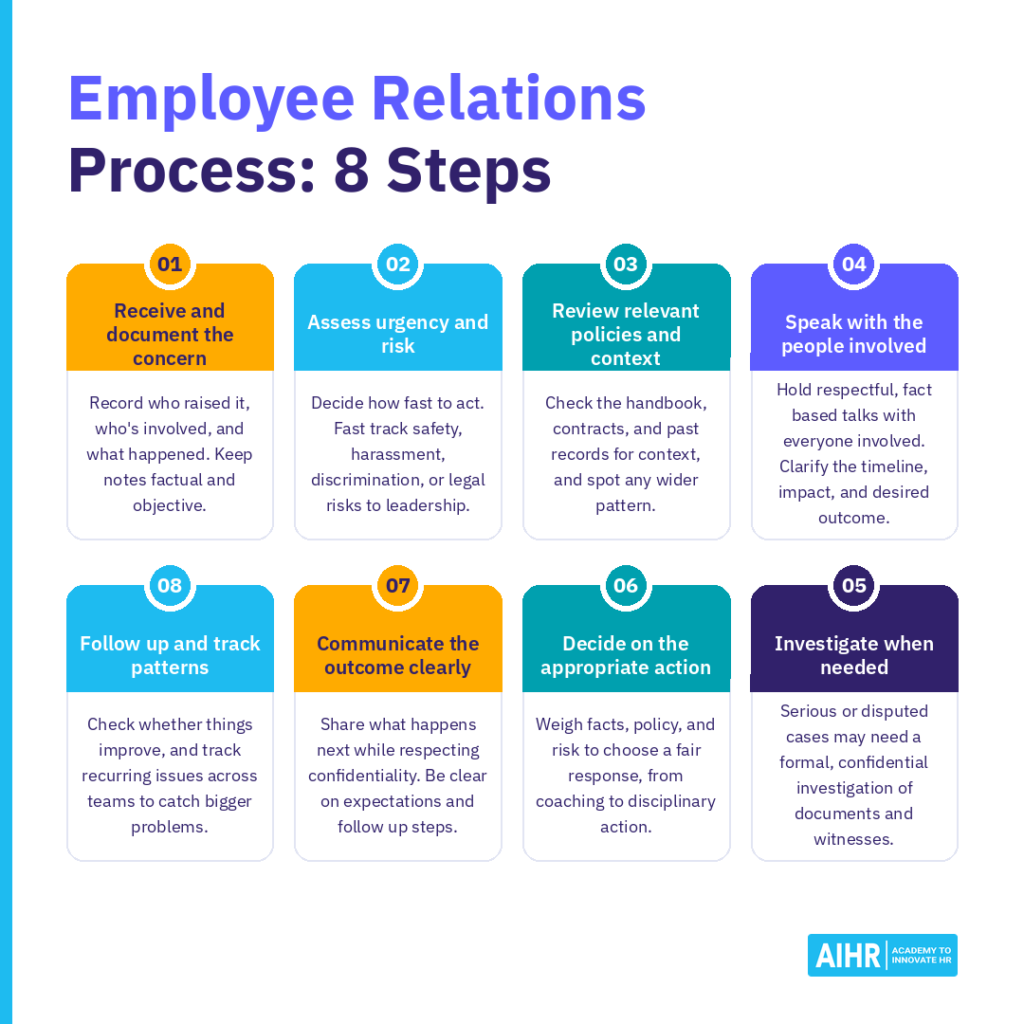
Employee relations process: 8 steps
An employee relations process gives HR a consistent way to respond when workplace issues arise. It helps HR understand what happened, assess the level of risk, apply policies fairly, and decide what action to take.
The exact process will depend on the issue, but the following steps give HR a practical framework to follow.
Step 1: Receive and document the concern
Start by recording the basic facts. Note who raised the concern, who is involved, when the issue happened, what was reported, and any supporting details.
Keep documentation factual and objective. For example, instead of writing “the employee was aggressive,” describe the specific behavior: “The employee raised their voice during the meeting and interrupted the manager several times.”
This creates a clearer record and helps HR review the issue without relying on assumptions.
Step 2: Assess urgency and risk
Next, decide how quickly HR needs to act. Some issues can be handled through manager coaching, mediation, or a follow-up conversation. Others require immediate escalation.
Cases involving safety risks, harassment, discrimination, retaliation, threats, serious misconduct, legal risk, or labor relations concerns should be prioritized. These situations may require support from HR leadership, legal counsel, senior management, or another specialist team.
Step 3: Review relevant policies and context
Before taking action, review the policies, procedures, and records connected to the issue. This may include the employee handbook, code of conduct, attendance policy, grievance procedure, performance records, previous documentation, employment contract, or collective agreement.
This helps HR understand the full context. It can also show whether the issue is isolated, recurring, or part of a wider pattern.
Step 4: Speak with the people involved
Hold respectful, fact-based conversations with the employee, manager, witnesses, or other relevant people. Give each person space to explain what happened from their perspective.
Ask questions that help clarify the timeline, people involved, impact, previous attempts to resolve the issue, and the outcome the employee is hoping for. Document each conversation carefully, focusing on facts, examples, dates, and impact.
Step 5: Investigate when needed
Not every employee relations issue requires a formal investigation. However, serious, sensitive, disputed, or high-risk concerns often do.
A structured investigation may include reviewing documents, interviewing witnesses, checking records, assessing evidence, and summarizing findings. HR should keep the process as confidential as possible and avoid drawing conclusions before reviewing the facts.
For example, a simple misunderstanding between two employees may need mediation. A harassment complaint will usually require a more formal investigation process.
Step 6: Decide on the appropriate action
Use the facts, policies, context, and level of risk to decide what happens next. The right action may include coaching, mediation, training, policy clarification, a manager conversation, corrective action, disciplinary action, or further escalation.
The goal is to resolve the issue fairly and reduce the chance of it happening again. HR should also consider whether the issue points to a wider problem, such as unclear policies, poor manager communication, workload pressure, or lack of training.
Step 7: Communicate the outcome clearly
Let the relevant people know what happens next while respecting confidentiality. Employees may not receive every detail, but they should understand that HR reviewed the concern and took appropriate action.
Be clear about expectations, responsibilities, timelines, follow-up steps, and where employees can go if they have further concerns. Clear communication helps employees trust the process, even when HR cannot share every detail.
Step 8: Follow up and track patterns
After the issue is addressed, check whether the situation has improved. Follow up with the employee, manager, or team where appropriate.
HR should also track patterns across employee relations cases. Repeated issues within the same team, department, location, or manager group may indicate a broader problem.
For example, recurring complaints about unclear expectations may show that managers need more training. Repeated absenteeism in one team may point to workload, scheduling, wellbeing, or leadership issues.
Employee relations jobs and career paths
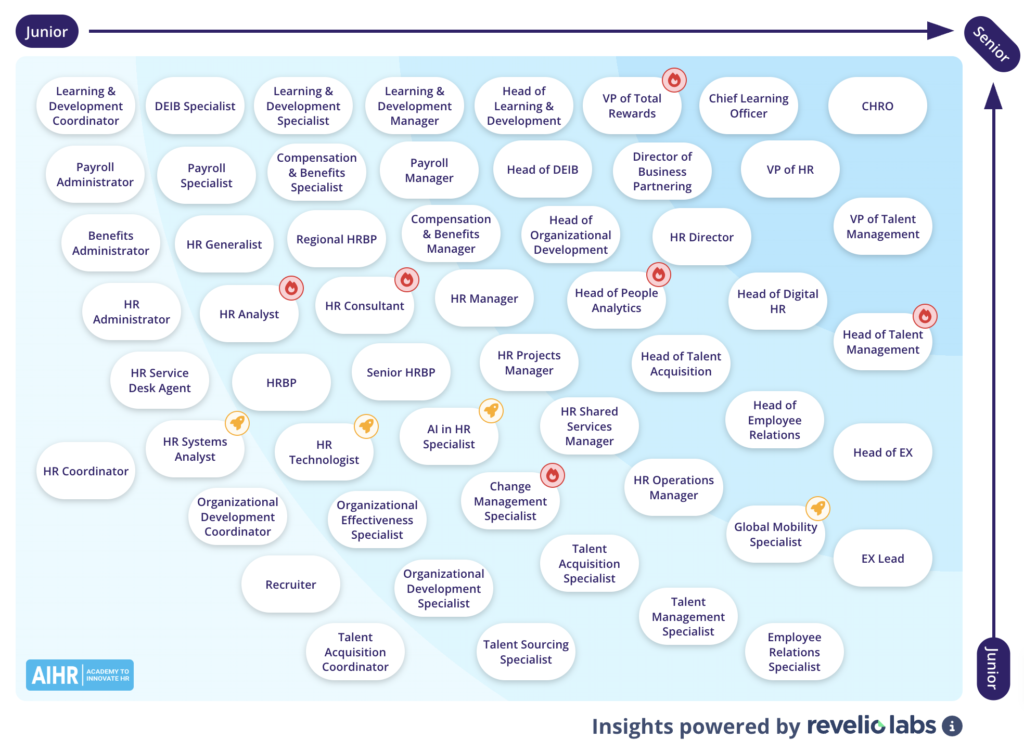
Employee relations can be a dedicated HR career path or part of a broader HR role. In smaller organizations, an HR Generalist or HR Manager may handle this work alongside other responsibilities. In larger organizations, common roles include Employee Relations Specialist, Employee Relations Manager, Senior Employee Relations Manager, Employee Relations Partner, and Head of Employee Relations.
Employee Relations Specialist
An Employee Relations Specialist usually focuses on day-to-day employee concerns and workplace issues. They often work closely with managers and employees to resolve conflict, support policy compliance, and maintain positive working relationships.
Key responsibilities can include:
- Handling employee grievances and complaints
- Supporting workplace investigations
- Advising managers on employee relations policies
- Maintaining employee relations case records
- Supporting disciplinary action processes
- Coordinating training on conflict resolution or labor law topics.
Employee Relations Specialist salary
Employee Relations Specialists in the U.S. earn around $64,315 to $83,492 per year, depending on job level and source. PayScale reports an average salary of $72,626, while Glassdoor lists $83,492. Salary.com lists its Employee Relations Specialist I benchmark at $64,315.
Employee Relations Manager
An Employee Relations Manager usually oversees employee relations programs, processes, and complex cases. They may also advise leaders, review employee feedback, support investigations, and help the organization apply policies fairly and consistently.
Their responsibilities include oversight or collaboration within many areas of HR, including the following:
- Developing and improving employee relations programs
- Advising managers and leaders on complex ER cases
- Resolving disputes and supporting grievance procedures
- Leading or overseeing workplace investigations
- Supporting fair and consistent policy application
- Collaborating with HR, legal, leadership, and internal communications teams.
Employee Relations Manager salary
Employee Relations Managers in the U.S. earn around $93,435 to $123,338 per year, depending on the source. Indeed reports an average base salary of $93,435, while PayScale lists $93,597. Salary.com lists a higher average salary of $123,338, and Glassdoor lists median total pay at $137,000.
To explore where employee relations jobs fit into the wider HR career landscape, use AIHR’s HR Career Map to compare roles, skills, and possible next steps.
To wrap up
Employee relations shape workplace trust, communication, conflict, and performance. When HR manages these relationships consistently, employees know how to raise concerns, managers understand how to respond, and the organization can address issues before they escalate.
To build strong ER practices, HR professionals need practical skills across the employee life cycle, from applying policies fairly to handling sensitive conversations. AIHR’s HR Generalist Certificate Program helps you develop these skills and build the confidence to manage core HR responsibilities, including employee relations, more effectively.
FAQ
Employee relations is the way an organization manages its relationship with employees. It shapes how people experience trust, fairness, communication, and support at work, from everyday manager conversations to more formal concerns like complaints or policy issues. Strong employee relations help create a workplace where employees know what to expect and feel confident raising concerns.
The role of employee relations is to help the organization maintain a healthy, fair, and productive work environment. In practice, this means helping managers handle workplace concerns consistently, supporting employees when issues arise, and making sure policies are applied in a way that builds trust rather than confusion or resentment.
Human Resources manages the broader employee lifecycle, including hiring, onboarding, development, compensation, performance, and compliance. Employee relations sits within that wider HR function, but it focuses more closely on the relationship between employees, managers, and the organization, especially when communication, trust, fairness, or conflict are involved.
Employee relations issues often start when something disrupts trust or makes employees or managers work harder. This might be an ongoing conflict between colleagues, concerns about a manager’s behavior, repeated absenteeism, misconduct, harassment complaints, inconsistent policy application, or low morale. What matters most is how quickly and fairly the organization responds.
In HR, employee relations often shows up in moments where the organization needs to protect trust and fairness. For example, HR may help a manager address repeated lateness, guide a team through conflict, investigate a complaint, improve employee feedback channels, or support wellbeing when workload or stress starts affecting performance.



 POPULAR: 3,687 DOWNLOADS