

The best HR generalist certifications match your experience and next career goal. Some teach practical skills across the employee life cycle, from hiring to an employee’s departure. Others test your HR knowledge. Compare HR generalist certifications based on the work you’ll do and the credentials employers request.
Your options include AIHR’s HR Generalist Certificate Program, as well as the SHRM Certified Professional (SHRM-CP) and the Professional in Human Resources (PHR). Below, you’ll compare eligibility, costs, and formats, then learn how to show employers what you’ve learned.
Contents
What to look for in an HR Generalist certification
HR Generalist certifications at a glance
Best HR Generalist certifications to consider
HR Generalist certifications outside the U.S.
Which HR Generalist certification should you choose?
What to look for in an HR Generalist certification
Your week might include recruitment planning on Monday, payroll questions Wednesday, and an employee concern Friday, so your training should reflect that range. Use these five criteria to compare your options:
- Employee life cycle coverage: Check for recruitment, onboarding, performance, rewards, employee relations, and offboarding. Employee relations covers workplace relationships and concerns. Offboarding covers the steps you take when someone leaves.
- Eligibility: Some credentials require professional HR experience, while others accept beginners. Check that you qualify before setting your budget.
- Recognition: SHRM and HRCI exam credentials from assess HR knowledge, and use published standards. Certificate programs, on the other hand, confirm that you’ve completed structured training and met the provider’s assessment requirements.
- Practical application: Look for projects, case studies, and templates you can adapt at work. Examples include a policy framework and an onboarding checklist.
- Cost, time, and upkeep: Add exam or tuition fees, study time, and preparation materials, then check the requirements and costs for keeping the credential active.
No option will meet every need equally. An exam credential may help when employers name it in job postings, while project-based certificate program can help you build skills and work samples. Choose the criteria that matter most for your next role.
Still weighing the investment? Read our guide to whether an HR Generalist certification is worth it.

HR Generalist certifications at a glance
Here’s how the four options compare (prices are in USD).
[INSERT TABLE]
AIHR’s Certificate Program combines structured training with a final capstone project that consists of an assignment and ungraded exam, while the other two assess your HR knowledge through an exam. For options beyond HR Generalist roles, explore our roundup of the best HR certifications.
An HR Generalist certification can help you turn broad HR knowledge into practical, job-ready skills. Develop expertise across core HR responsibilities, so you can be more versatile, and contribute more efficiently across the employee life cycle.
AIHR’s HR Generalist Certificate Program will help you to:
✅ Build and manage essential HR processes, from recruitment and payroll to performance and rewards
✅ Develop policy frameworks and organize HR operations effectively
✅ Navigate difficult conversations, manage conflict, and provide constructive feedback
✅ Connect HR priorities to business needs using relevant KPIs, stakeholder management, and HR strategy
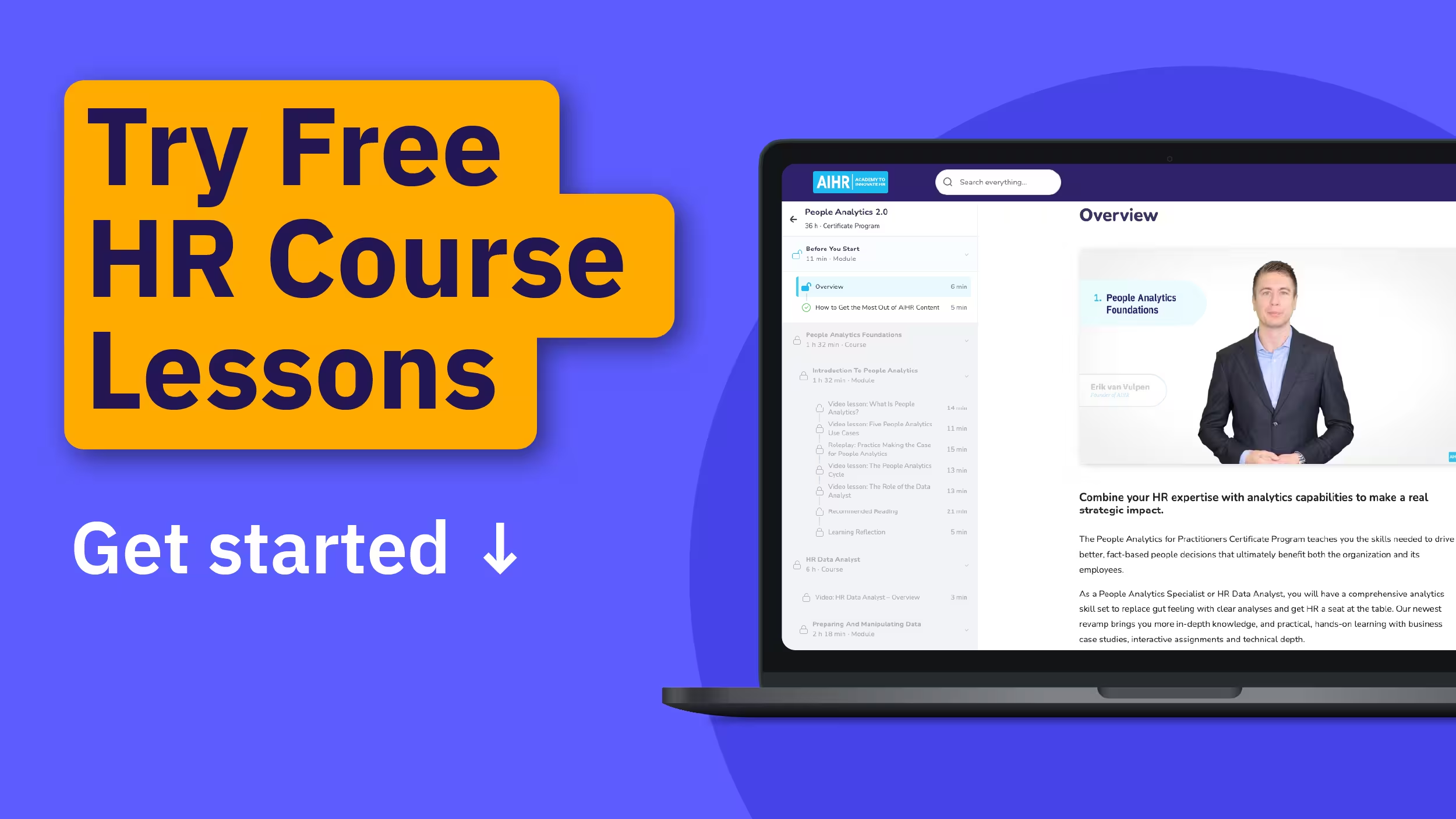
💡 Check out the AIHR Demo Portal for a clear idea of what the program’s lessons will be like.
Best HR Generalist certifications to consider
The right HR generalist certification depends on which skills gap you need to close. Start with the work you want to do next, then compare the learning and assessment requirements that support that goal.
This program suits you if you already handle HR work or expect to take it on soon. It gives you structured guidance and opportunities to practice core tasks.
HR Generalist Certificate Program (AIHR)
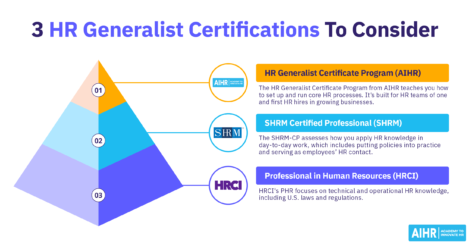
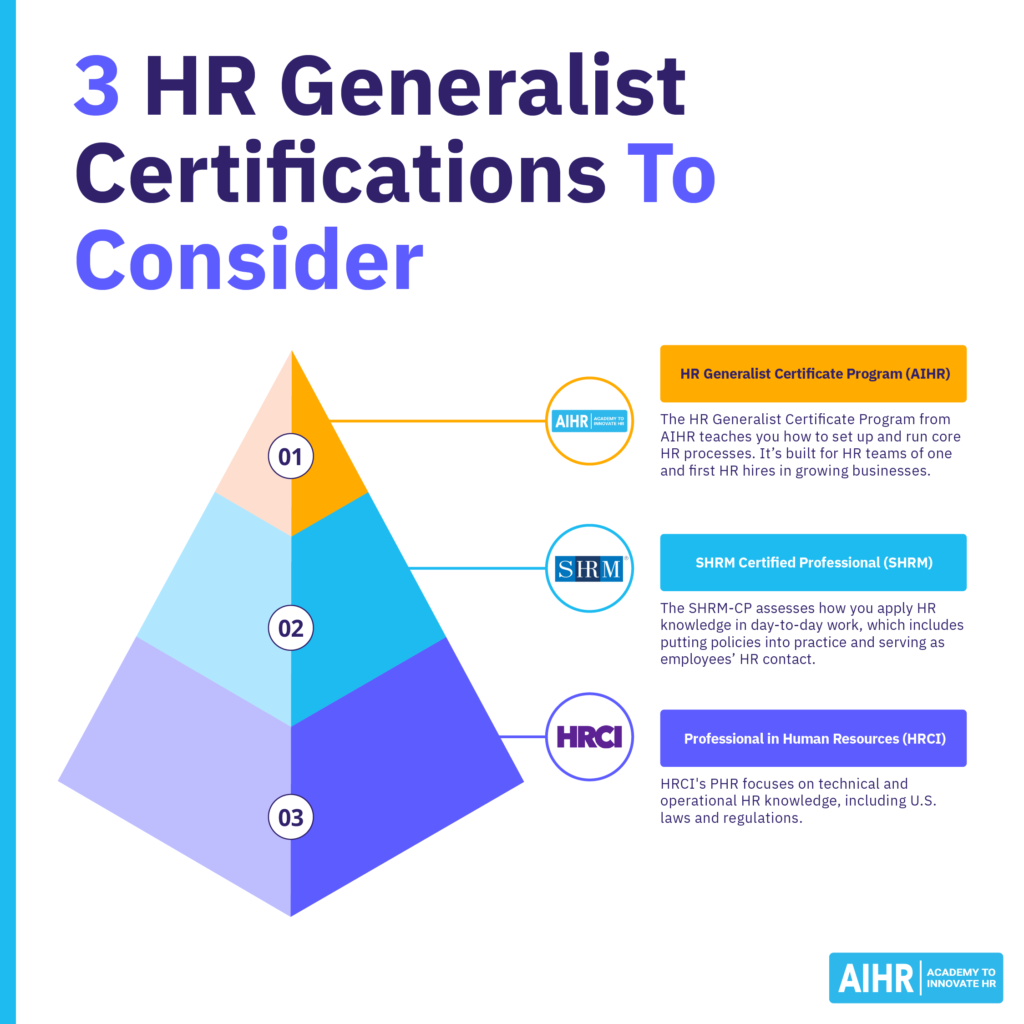
The HR Generalist Certificate Program from Academy to Innovate HR (AIHR) teaches you how to set up and run core HR processes. It’s built for HR teams of one and first HR hires in growing businesses.
The program ends with a capstone project. In the practical assignment, you step into an HR manager’s role at a growing hardware store chain, where you review employee culture survey results, advise leaders, set HR priorities and make hiring decisions. You earn your digital certificate by passing the capstone exam.
- Topics covered: HR strategy with the HR Canvas, measuring HR’s impact, policy frameworks, payroll, hiring and interviewing, onboarding, engagement, performance and reward, offboarding, HR budgeting, the HR operating model in a scaling business, difficult conversations, and AI tools for HR operations.
- Eligibility: No experience or degree required, so it’s suitable for beginners.
- Best for: New and working HR Generalists who want job-ready skills, especially solo HR professionals in growing businesses.
- Format and duration: 100% online and self-paced, 25–45 hours, with 12 months of access.
- Credits: AIHR is recognized by SHRM to offer Professional Development Credits (PDCs). The program also earns recertification credits with HRCI and HRPA.
- Cost: $1,125 for the Certificate Program plan, with a 30-day money-back guarantee. It’s also included in Full Academy Access for $1,850 per year. Prices are in USD and correct at the time of writing.
- What to consider: Choose this program if you want practical skills you can apply on the job right away. You’ll work through a capstone assignment that mirrors real HR decisions and leave with templates you can adapt immediately, and you can start without HR experience or a degree.
This certificate program builds modern, practical skills you can immediately apply on the job. AIHR has an average rating of 4.66 out of 5 from more than 12,000 verified reviews, and 97% of students recommend it.
Full Academy Access offers immediate access to all 16+ AIHR certificate programs, including HR Coordinator and HR Manager, plus 85+ courses and mini courses, 300+ templates, AIHR Copilot, personal coaching, and weekly expert webinars, all for $1,850 per year.
SHRM Certified Professional (SHRM)
The SHRM-CP assesses how you apply HR knowledge in day-to-day work, which includes putting policies into practice and serving as employees’ HR contact.
- Best for: Generalists who want a competency-based credential and a path toward the senior SHRM-SCP.
- Eligibility: No HR title, degree, or prior HR experience required, though SHRM recommends a basic working knowledge of HR.
- Format and duration: 134 multiple-choice questions that mix knowledge items with situational judgment scenarios. The exam lasts three hours and 40 minutes, and is held in person at a Prometric test center.
- Cost: $399 for SHRM members and $499 for non-members.
- What to consider: The exam measures what you know rather than teaching you how to do the work, so you’ll need to plan separate preparation and hands-on practice. You can also only test during SHRM’s two yearly windows, so be sure to check the SHRM website to determine when you can register.
Professional in Human Resources (HRCI)
HRCI’s PHR focuses on technical and operational HR knowledge, including U.S. laws and regulations.
- Best for: Experienced generalists whose work centers on compliance, employee relations, and HR administration.
- Eligibility: One year of professional-level HR experience with a master’s degree, two years with a bachelor’s degree, or four years with no degree.
- Format and duration: Two-hour exam; available year-round.
- Cost: $495, which includes a $100 application fee and a $395 exam fee.
- What to consider: You’ll need professional HR experience before you can apply, so the PHR isn’t an option if you’re new to HR.
HR Generalist certifications outside the U.S.
Be sure to check the geographic focus before enrolling. HRCI offers the PHRi, an international version of its PHR, at the same fees you’d pay for the PHR. The SHRM-CP also serves international candidates. Their exams may cover general employment law concepts rather than a specific country’s laws.
Professional bodies also vary by location. Examples include the Chartered Institute of Personnel and Development (CIPD) in the U.K. and Ireland. In Canada, explore Chartered Professionals in Human Resources (CPHR). Check local job postings to see which credentials employers request.
AIHR offers eligible learning for SHRM, HRCI, HRPA, CPHR, and the Association for Talent Development (ATD). Its CPD Certification Service-approved learning can count toward CIPD members’ continuing professional development (CPD). Check each body’s requirements. Earning professional development credits doesn’t award you that body’s qualification.
Which HR Generalist certification should you choose?
Which certification or certificate program to choose depends on which role you’re targeting next, or which area you want to improve in your current role. Match your priority or situation to the correct route below:
- You’re switching into HR: Start with AIHR’s HR Generalist Certificate Program to learn core processes and build a set of reusable templates. Add the PHR if your target employers ask for an exam credential.
- You’re an HR Coordinator or HR Assistant moving up: Use AIHR’s program to practice writing policies, planning payroll, and running onboarding, and consider the SHRM-CP if an exam credential supports your next move.
- You’re an HR team of one: Choose AIHR’s program if you need to set up HR processes in a growing business. Use resources such as its HR budget tool and onboarding checklist.
- You’re an experienced HR Generalist: Choose the PHR or SHRM-CP to validate your HR knowledge. Full Academy Access can help you build new skills while earning eligible recertification credits.
These routes can work together, but you don’t need every credential. AIHR’s eligible courses offer PDCs for SHRM-CP and SHRM-SCP recertification, plus HRCI recertification credits. Check your credential’s credit rules and reporting requirements before you plan your learning.
Next steps
Choose the HR Generalist certification that addresses your next career goal. A certificate program with practical projects helps you practice the work you’ll handle next, while an exam credential can validate your knowledge against a professional standard. Check employer preferences, entry requirements, and your budget before committing.
You can preview the HR Generalist Certificate Program for free on AIHR’s Demo Portal before you commit. It covers the employee life cycle through 45 hours of self-paced learning, and helps you build skills you can demonstrate, from managing payroll to guiding a difficult conversation. Full Academy Access includes all 16+ Certificate Programs for one annual fee of $1,850.