

Is an HR Generalist certification worth it? For many early- and mid-career HR professionals, it is, as long as you choose a certification that matches your goal. The right one can show employers you understand the full HR cycle, from hiring and onboarding to payroll and policy. Still, it won’t replace proof that you can do the work.
In this article, you’ll learn what an HR Generalist certification should cover, how much time and money to expect, and how certificate programs compare with exam-based credentials. You’ll also see which option fits your career stage, so you can invest in the one that helps you move forward.
Contents
Is an HR Generalist certification worth it?
What an HR Generalist certification should cover
What a certification can and can’t do for your career
Best HR Generalist certifications to consider
HR Generalist certification costs and duration
How to choose the right HR Generalist certification
Is an HR Generalist certification worth it?
An HR Generalist certification is worth it when it closes a clear gap between your current experience and the role you want. It can help if you’re moving into HR from another field, stepping up from an HR Coordinator role, or managing HR on your own in a growing company. It gives you a structure you may not get on the job.
Your career stage also determines whether such a certification is worth it, and how it might benefit you. Early on, a certification builds your foundation and shows commitment to the field. If you’re an experienced HR Generalist, the payoff comes from strategic skills that prepare you for a senior or HRBP role.
The term “HR Generalist certification” usually means one of two things:
- Certificate programs built for the HR Generalist role: AIHR’s HR Generalist Certificate Program, for example, teaches practical HR Generalist skills through relevant courses and modules, video lessons, and a capstone assignment and exam at the end.
- Exam-based HR credentials: The SHRM-CP and HRCI’s aPHR aren’t generalist-specific, but they test broad HR knowledge, which is why generalists often consider them.
Both can be worth it, depending on the problem you need to solve or the gap you need to fill.

What an HR Generalist certification should cover
The HR Generalist role is broad by design. In one day, you might draft a policy, answer a leave question, screen candidates, and prepare a turnover update for leadership. A certification is only worth your time if the curriculum matches that mix.
Use this checklist when you compare programs:
- ✔ Employee lifecycle processes: Recruitment, onboarding, engagement, performance, rewards, and offboarding.
- ✔ HR operations: Payroll, leave categories, HR budgets, and policy frameworks.
- ✔ Business and metrics skills: Setting HR KPIs and showing leaders how HR work supports business goals.
- ✔ Communication skills: Difficult conversations, active listening, and conflict management.
- ✔ AI skills: Using AI tools to handle routine employee questions and speed up repetitive documentation.
AIHR’s HR Generalist Certificate Program covers these areas across six courses. You’ll work through running payroll, building a policy framework, conducting competency-based interviews, and creating an HR budget.
An HR Generalist certification can help you turn broad HR knowledge into practical, job-ready skills. Develop expertise across core HR responsibilities, so you can be more versatile, and contribute more efficiently across the employee life cycle.
AIHR’s HR Generalist Certificate Program will help you to:
✅ Build and manage essential HR processes, from recruitment and payroll to performance and rewards
✅ Develop policy frameworks and organize HR operations effectively
✅ Navigate difficult conversations, manage conflict, and provide constructive feedback
✅ Connect HR priorities to business needs using relevant KPIs, stakeholder management, and HR strategy
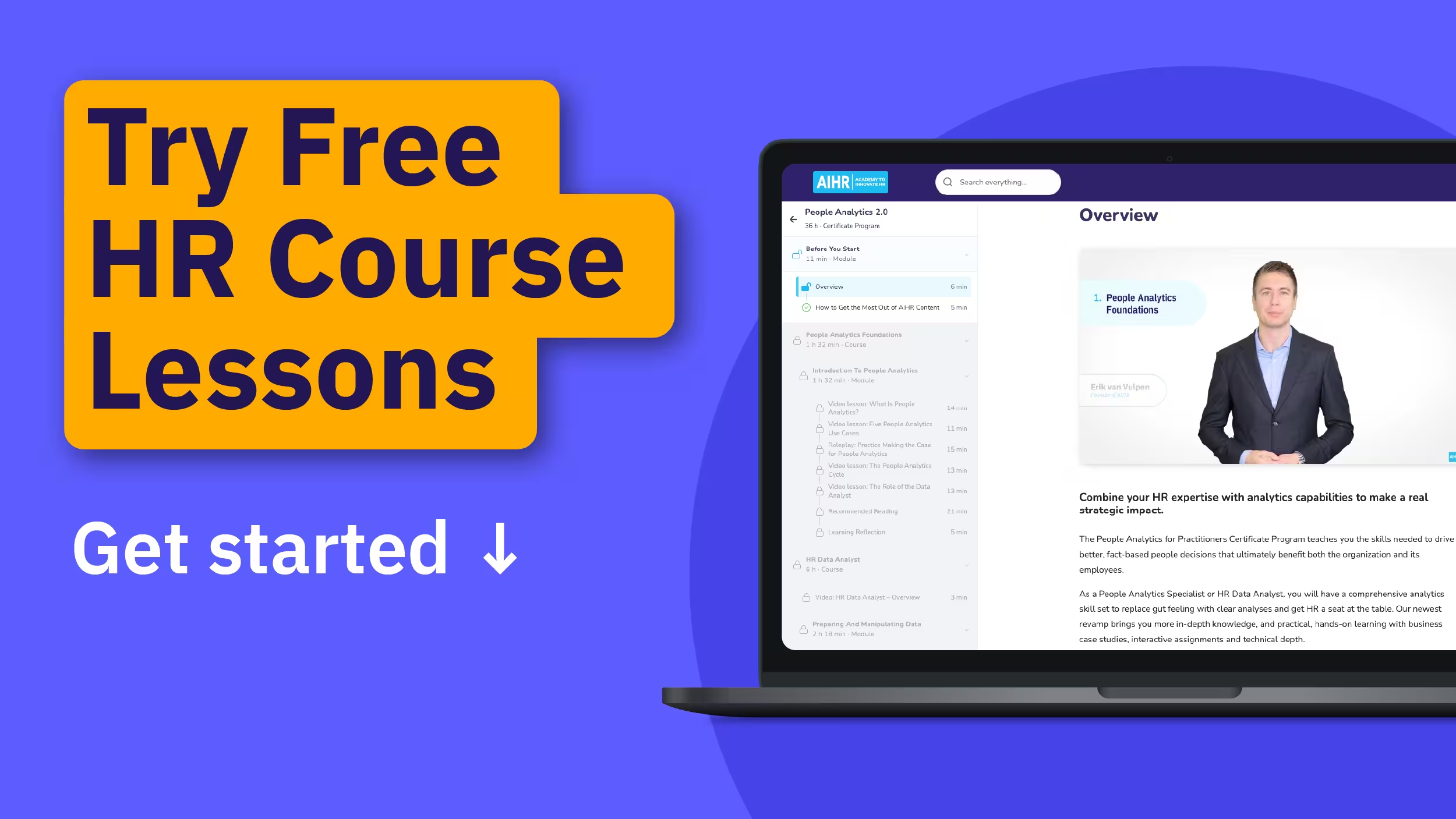
💡 Check out the AIHR Demo Portal for a clear idea of what the program’s lessons will be like.
What a certification can and can’t do for your career
A certification can change how employers read your resume. It can also help you feel more confident in the role. But it has limits, and knowing those limits helps you set realistic expectations.
What it can do
- Give career switchers a credible starting point: While you may have good transferable skills from your previous role, an HR Generalist certificate program or certification will show you’ve developed HR knowledge and skills to complement your existing skills.
- Stepping into an accidental HR role: Your employer may expect you to handle a broader range of HR tasks, particularly if you work for a smaller company. A structured program covers areas you may not have touched yet, such as budgeting or workforce metrics.
- Build strategic HR skills to advance your career: If you already know the fundamentals, look for training that teaches HR strategy and business acumen. AIHR’s program does this through the HR Canvas model, a strategic HR management tool. These skills are crucial for Senior HR Generalist or HRBP roles.
- Count toward other credentials: Programs approved for recertification credits can support a SHRM or HRCI credential you already hold or plan to earn.
What it can’t do
- Replace hands-on experience: Employers still want examples of real problems you’ve solved. A credential gets you noticed, but real-life examples can help you land the job.
- Guarantee a raise or promotion: Pay depends on your role, employer, location, and performance. Treat any salary premium as a correlation, not a promise.
Best HR Generalist certifications to consider
Next, decide what type of certification or program is best suited for you. Do you need an HR credential, or are you looking to learn practical skills you can immediately apply on the job? Let’s unpack the options:
Option | Format and duration | Eligibility | Cost | Best for |
HR Generalist Certificate Program (AIHR) | Online, self-paced; 45 hours of learning | Open to beginners and working HR professionals | $1,125 for one program, or $1,850 per year for all 16+ programs via Full Academy access | Career switchers, new HR Generalists, and HR teams of one who need job-ready skills |
SHRM-CP | Proctored exam; self-directed exam prep | No degree or HR experience required | $399 for SHRM members, $499 for non-members | Generalists who want broad, exam-based validation |
aPHR (HRCI) | Proctored exam; self-directed exam prep | No HR experience required | $400 ($100 application fee plus $300 exam fee) | Early-career professionals who want a foundational credential |
The main difference is how you prove what you know. With an exam-based credential, you study on your own and show your knowledge in the exam. With a certificate program, you are more likely to learn the work step by step. AIHR’s program ends with a capstone assignment based on a real-world HR Generalist case, which you must pass to earn your certificate.
Exam routes also require upkeep. SHRM-CP holders recertify every three years, while HRCI’s PHR requires professional-level HR experience to take the exam. You also need 60 recertification credits every three years to maintain it.
This is where the two options overlap. AIHR is recognized by SHRM to offer professional development credits (PDCs) for SHRM-CP or SHRM-SCP recertification activities. The HR Generalist Certificate Program is eligible for 34 SHRM PDCs and 34 HRCI recertification credits.
This is why a certificate program is often the stronger first step; it builds your skills, gives you work samples, and can still support an exam-based credential later.
HR Generalist certification costs and duration
The headline price rarely tells the full story. Before you commit, add up what you’ll pay, how long it takes, and what you’ll need to maintain the credential.
For AIHR’s HR Generalist Certificate Program, a single program costs $1,125 for 12 months of access, community support, and a 30-day money-back guarantee. The program takes about 45 hours to complete.
If you want access to more than one program, Full Academy Access costs $1,850 per year and starts immediately. It includes all 16+ AIHR certificate programs, 85+ courses, 300+ downloadable templates, weekly webinars, the AIHR Copilot, and personal coaching.
For exam-based credentials, budget for the exam fee, study materials, and recertification every three years. SHRM-CP fees range from $350 to $499, and the aPHR costs $400 in total. Your study time depends on how much of the material you already know.
If your employer has a learning budget, ask whether it covers your program. AIHR’s guide to expensing your membership can help you make the case.
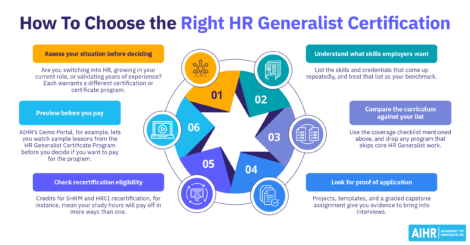
How to choose the right HR Generalist certification
With your profile in mind, the following checks can help you narrow your options quickly:
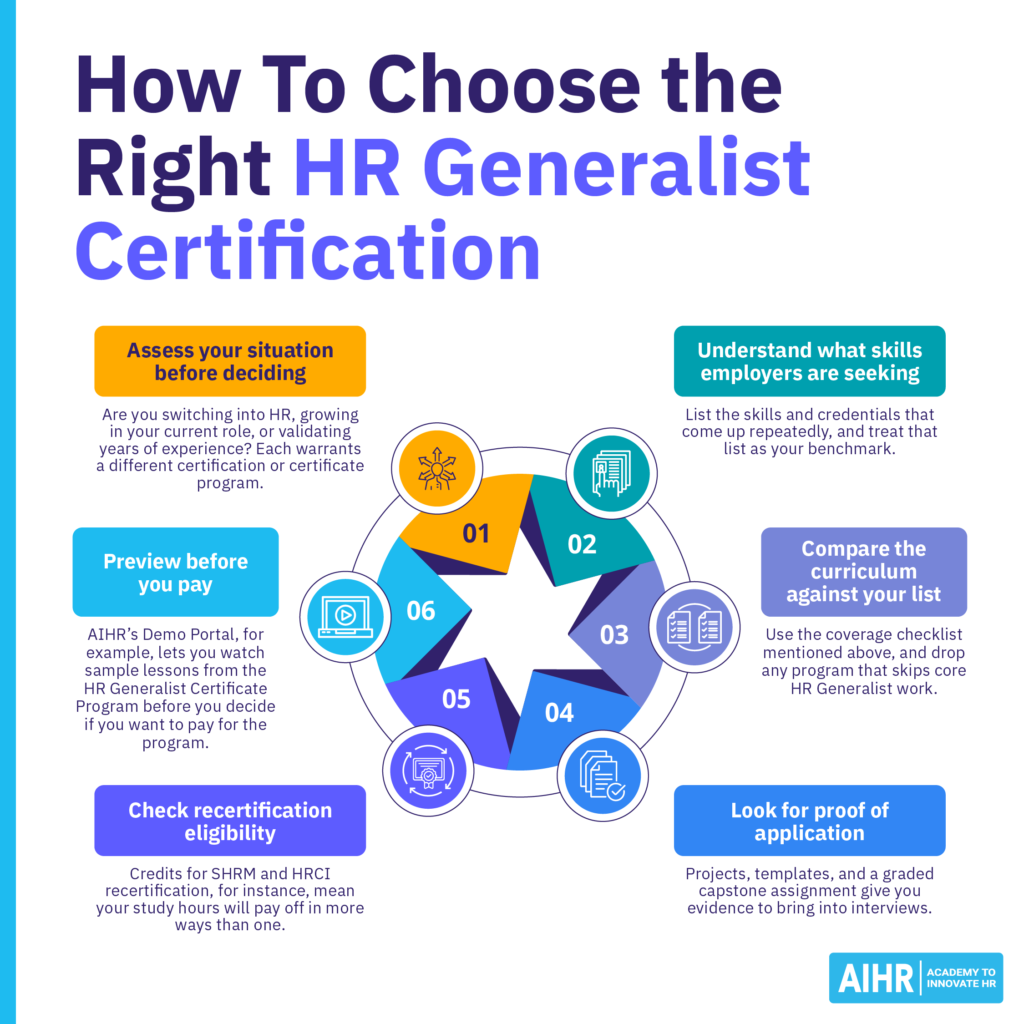
- Assess your situation before deciding: Are you switching into HR, growing in your current role, or validating years of experience? Each warrants a different certification or certificate program.
- Understand what skills employers are seeking: List the skills and credentials that come up repeatedly, and treat that list as your benchmark.
- Compare the curriculum against your list: Use a checklist of what an HR Generalist certification should cover, and drop any program that skips core HR Generalist work.
- Look for proof of application: Projects, templates, and a graded capstone assignment give you evidence to bring into interviews.
- Check recertification eligibility: Credits for SHRM and HRCI recertification, for instance, mean your study hours will pay off in more ways than one.
- Preview before you pay: AIHR’s Demo Portal, for example, lets you watch sample lessons from the HR Generalist Certificate Program before you decide if you want to pay for the program.
Next steps
An HR Generalist certification is worth it if it gives you skills you’ll use and proof you can show. If you’re early in your career, switching into HR, or running HR on your own, a practical certificate program is usually the smarter first investment.
AIHR’s HR Generalist Certificate Program helps you build the recruitment, payroll, policy, metrics, and communication skills the role demands. The program is also eligible for SHRM and HRCI recertification credits, so your learning can keep supporting your career after you’ve completed the program.