

Earning your SHRM-CP or SHRM-SCP certification is a significant milestone in your HR career, but keeping it active takes ongoing effort. Every three years, you need to demonstrate continued professional development to maintain your credential.
If you’re approaching your recertification window, or just want to understand how the process works, this guide covers everything: the requirements, the credit categories, where to find approved courses, and how to earn free PDCs.
Contents
SHRM recertification requirements
SHRM recertification credits (PDCs): What counts
SHRM recertification providers: What to look for
SHRM recertification courses to consider
How to earn free SHRM recertification credits
How to use the SHRM recertification portal
SHRM recertification fees
SHRM recertification requirements
SHRM offers two paths to recertification, and you only need to complete one to renew your credential for the next three years.
The two paths
- Option 1: Earn 60 Professional Development Credits (PDCs) within your three-year recertification cycle. This is the most common route. PDCs come from a wide range of activities: courses, conferences, work projects, volunteer work, and more.
- Option 2: Retake the certification exam within the last year of your recertification cycle. You must retest at your current credential level and pay the full exam fee. If you don’t pass, your credential is revoked immediately, and you won’t be able to fall back on the PDC route. For most people, earning PDCs is the lower-risk option.
How your SHRM recertification cycle works
Your three-year cycle ends on the last day of your birth month in year three. For example, if you passed the SHRM-CP in May 2025 and your birth month is July, your cycle runs until July 31, 2028.
You can recertify early. If you complete 60 PDCs before your end date, your new three-year cycle starts the day after you recertify, so you don’t lose any time.
If you miss your end date, SHRM gives you a 60-day grace period. You can still submit during this window, but the processing fee increases by $75. After that grace period, your credential is revoked.
Up to 20 carryover PDCs from one cycle can roll into the next, but only if you exceed 60 credits. These auto-populate into your new cycle under the Advance Your Education category.
SHRM recertification credits (PDCs): What counts
PDCs (Professional Development Credits) are the unit SHRM uses to measure continuing education. One PDC generally equals one hour of qualifying professional development activity, though the calculation varies by format (more on that below). You need 60 PDCs over your three-year cycle. Unlike HRCI certifications, SHRM does not require you to split credits across specific categories, which gives you considerable flexibility in how you build your total.
Credits fall into three categories.
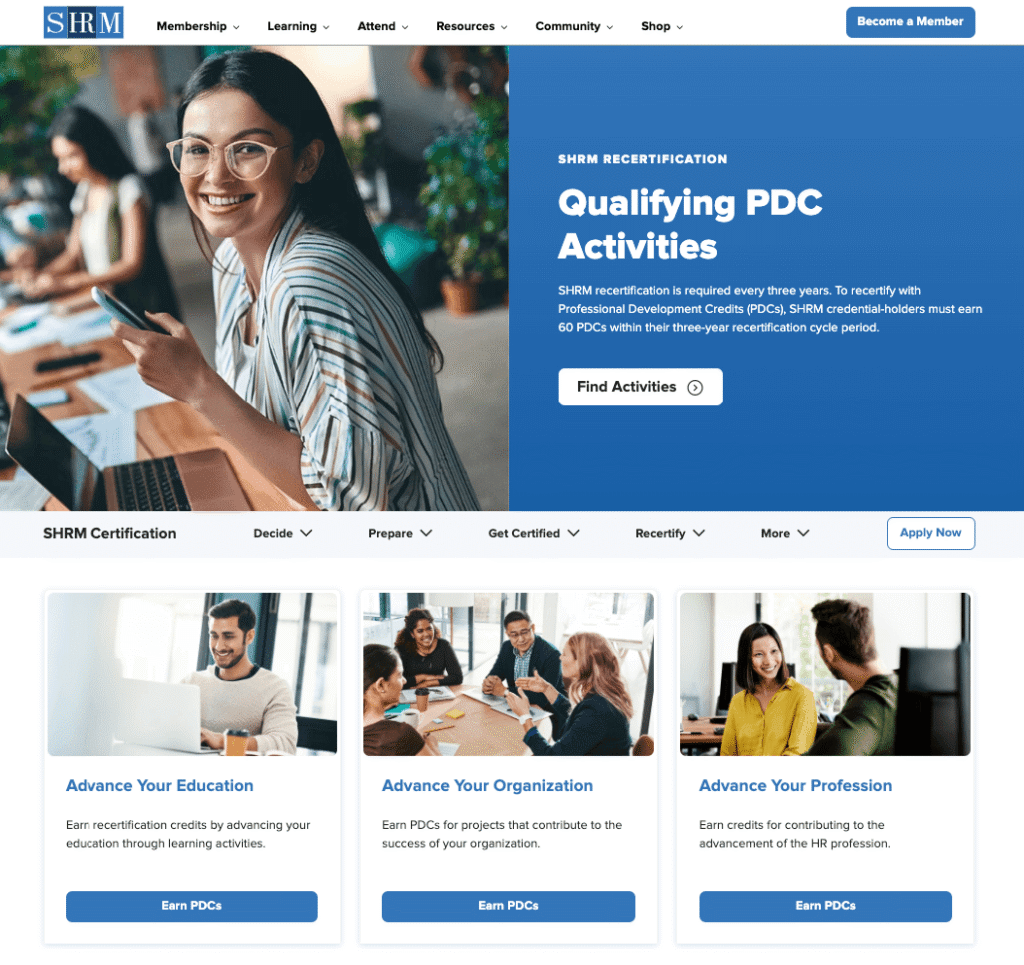
Advance Your Education
This is where most people earn the bulk of their PDCs. Qualifying activities include:
- In-person or virtual events such as conferences, seminars, and workshops. Every 15-minute increment earns 0.25 PDCs.
- E-learning, self-paced HR courses, webcasts. Same rate: 0.25 PDCs per 15 minutes.
- SHRM-approved books or e-books. Reading a qualifying book and submitting a summary earns 3 PDCs per book.
- University or graduate courses from accredited institutions (credit hours convert to PDCs depending on the semester system used).
There is no PDC cap on this category, so you can technically earn all 60 credits through education activities alone. Not all learning qualifies, though. Activities must come from a SHRM-recognized recertification provider or otherwise meet SHRM’s content standards by aligning with the SHRM Body of Applied Skills and Knowledge (SHRM BASK).
Advance Your Organization
This category rewards the HR work you do at your job. If you lead or manage an HR project at your organization, you can earn PDCs based on hours worked:
- 40+ hours: 10 PDCs
- 80+ hours: 20 PDCs
- 120+ hours: 30 PDCs
The cap for this category is 30 PDCs per cycle. You’ll need to submit a brief write-up via the SHRM certification portal explaining the project and how it relates to SHRM BASK competencies.
Advance Your Profession
This category covers contributions to the broader HR field: speaking at events, writing articles or white papers, volunteering for HR organizations, and serving on boards or committees. The cap is also 30 PDCs per cycle.
A few examples of what qualifies:
- Presenting at an HR event: 2 PDCs per hour of presentation time
- Authoring a published HR article: 10 PDCs
- Writing an HR blog post (750+ words, published by a third party): 1 PDC (up to 6 per cycle)
- Serving as an HR chapter leader: 5 PDCs per year
SHRM recertification providers: What to look for
A SHRM Recertification Provider is an organization that SHRM has reviewed and approved to award PDCs for its programs. When you complete a course or activity from an approved provider, you receive an activity code. You enter that code directly into the SHRM recertification portal, and no additional verification is needed on your end.
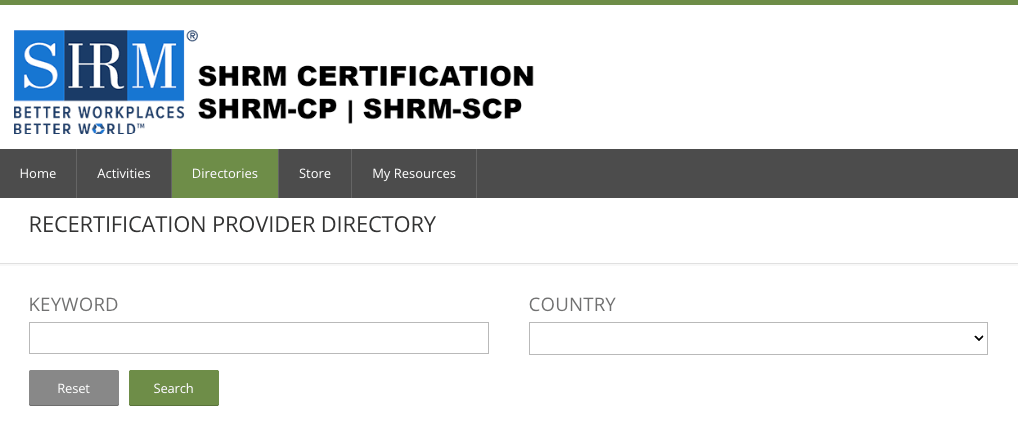
Approved general providers must offer HR programming that aligns with the SHRM Body of Applied Skills and Knowledge (SHRM BASK), have been operating for at least one year, and meet ongoing compliance requirements. SHRM lists approved providers in a searchable directory.
When evaluating a provider, check for:
- The SHRM Recertification Provider badge on their course pages
- The number of PDCs assigned to each program
- Whether the content aligns with where you want to develop (strategy, business partnering, analytics, etc.)
- Whether the format works for you: some providers offer live events, others self-paced courses, and others a mix of both
- Whether the provider appears in the SHRM Recertification Provider directory.
AIHR as a SHRM recertification provider
Academy to Innovate HR (AIHR) is an online HR learning platform that helps HR professionals build the practical, future-ready skills modern HR roles demand. It offers self-paced certificate programs and courses designed around the work HR teams do day to day, from core operations to strategic initiatives.
AIHR is recognized by SHRM to offer Professional Development Credits (PDCs) for SHRM-CP or SHRM-SCP recertification activities. That means completing an AIHR certificate program earns you verified PDCs that you can log directly in your SHRM recertification portal.
What makes AIHR a useful option is the breadth and depth of its certificate programs. Each program is online, self-paced, and built around applied HR skills in strategy, analytics, talent, organizational development, and more. The PDC value per program is substantial, so a single certificate can cover a significant portion of your 60-credit requirement.
SHRM recertification courses to consider
If you want to use your recertification window to build real HR capability rather than just tick a compliance box, AIHR’s certificate programs are worth looking at closely. Here’s a selection with their SHRM PDC values:
AIHR certificate program | SHRM PDCs |
HR Business Partner 2.0 | 33.5 |
People Analytics | 35 |
HR Consulting | 33.5 |
Artificial Intelligence for HR | 28 |
Organizational Development | 30 |
Compensation & Benefits | 27 |
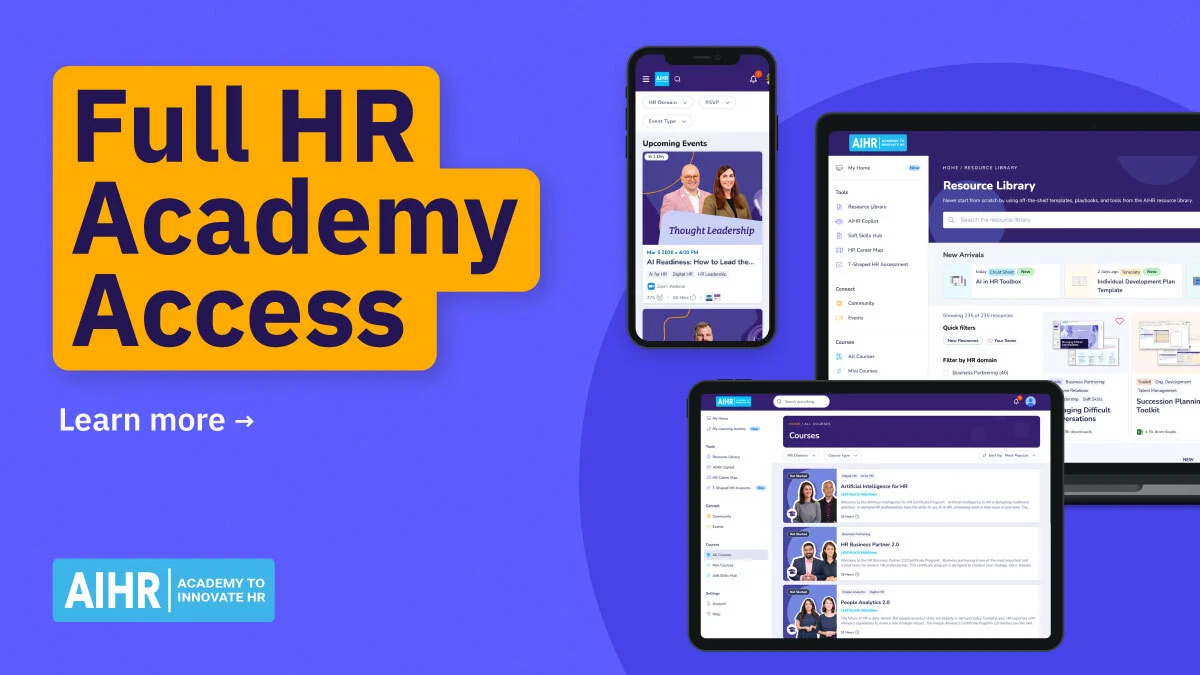
AIHR’s Full Academy Access unlocks all programs, meaning you can cover your entire 60-PDC requirement and build skills across multiple HR disciplines within a single membership. Members also get access to weekly live events, each worth 1 PDC, which adds up steadily over a three-year cycle.
Each certificate program takes roughly 30 to 40 hours to complete and covers both foundational knowledge and applied skills. The self-paced format means you can fit learning around your schedule rather than clearing a week for an HR event.
With the free Demo Portal, you can explore how AIHR helps you build practical, future-ready HR skills.
How to earn free SHRM recertification credits
Earning all 60 PDCs doesn’t have to be expensive. A significant portion of your credits can come from free or low-cost activities, as long as you know where to look.
SHRM member webinars and online resources
The paid SHRM membership includes access to free webinars throughout the year. These are pre-approved for PDCs and, if you use the same login for your membership and certification portal, credits auto-populate in your account. SHRM typically runs multiple free webinars each month on topics like compliance updates, employee relations, and workforce strategy.
If you’re already a SHRM member, these built-in resources are an easy starting point with no additional enrollment or payment required.
Third-party free webinars
Many HR vendors and industry organizations offer free webinars approved for SHRM PDCs. Platforms like HCI (Human Capital Institute), ADP, Workday, and UKG regularly host complimentary sessions on HR technology, compliance, and people strategy. Each typically earns 0.5 to 1 PDC.
These aren’t always listed in one place, so it’s worth checking provider websites and HR community newsletters periodically. Over a three-year cycle, attending a handful of these per quarter adds up quickly.
SHRM chapter events
Local SHRM chapters host educational events, including monthly meetings, workshops, and roundtables that qualify for PDCs. Attendance at a chapter meeting with a guest speaker often earns 1 to 2 PDCs per session. If you’re already involved in your local chapter, you may be accumulating credits without realizing it.
Chapter leadership roles earn additional credits: serving as a chapter officer earns 5 PDCs per year under the Advance Your Profession category.
Volunteer work and professional contributions
Volunteer HR work for nonprofit organizations can earn PDCs under the Advance Your Profession category. If you mentor another HR professional through a formal program, that earns 3 PDCs per activity. Writing an HR article published by a third party earns 10 PDCs for a full article, or up to 6 PDCs across the cycle for shorter blog posts.
Work projects
If you’re leading an HR initiative at your current role, such as rolling out a new performance management process, redesigning onboarding, or implementing a DEI program, that work likely qualifies under Advance Your Organization. With 40+ hours invested, that’s 10 PDCs at no additional cost beyond your normal job responsibilities.
How to use the SHRM recertification portal
All PDC tracking, submission, and payment happens through the SHRM Certification Portal. Here’s how it works in practice:
- Step 1: Log in using the same email address linked to your SHRM membership. If your certification and membership accounts use different emails, update them to match, as this is what enables PDCs from SHRM-sponsored activities to auto-populate.
- Step 2: Add your PDCs. Click “Add PDCs” and choose whether you have an activity code. If a provider gave you a code, enter it, and the activity details populate automatically. If not, select the relevant PDC category (Advance Your Education, Advance Your Organization, or Advance Your Profession) and enter the information manually.
- Step 3: Track your progress. The portal shows your running total and cycle end date. SHRM activities auto-populate as bold italicized entries in your record. Third-party provider activities need to be entered manually.
- Step 4: Submit your completed record. Once you’ve been in your cycle for at least one year and have logged 60 or more PDCs, SHRM will invite you to submit your completed recertification record. Pay the processing fee to finalize.
Keep documentation for each activity for at least six months after your cycle ends. SHRM conducts random verification reviews, and you’ll need to provide supporting evidence, such as certificates of completion, conference agendas, transcripts, or project write-ups, if selected.
SHRM recertification fees in 2026
Recertification fees vary depending on SHRM membership status. The membership reduces the cost by $45, which is worth factoring in if you’re not already a member. Fees are nonrefundable.
Fee type | Member | Nonmember |
Regular | $165 | $210 |
Late | $240 | $285 |
A final word
SHRM recertification is a three-year commitment, but it’s manageable when you plan ahead. Start by mapping out your 60 PDCs at the start of your cycle rather than scrambling in year three. Mix your categories: a certificate program for substantive skill-building, a few free webinars throughout the year, and whatever chapter or volunteer activities already fit your schedule.
If you want your recertification learning to move your HR career forward rather than just maintain your credential status, choosing programs that build applied, future-relevant skills is worth the investment. An AIHR certificate program can cover half your PDC requirement or more while giving you practical skills in areas like business partnering, people analytics, or organizational development that translate directly to your work.