

Performance review phrases are among the most searched HR resources for managers. But words alone won’t fix a system that’s failing to motivate employees. According to Gallup, only 2% of Fortune 500 CHROs strongly agree that their performance-management system actually inspires better performance. That tells us the issue isn’t the phrases. It’s the approach behind how they’re used.
The truth is, copy-and-paste feedback only works when it is (1) behavior-based, (2) used in a two-way conversation, and (3) followed by a clear next step. Without that, reviews turn into one-sided evaluations instead of genuine dialogue. And as frequent check-ins, coaching conversations, and continuous feedback loops become the norm, managers need language that feels intentional, human, and actionable throughout the year—not just at appraisal time.
Contents
What are performance review phrases?
192 performance review phrases and follow-up questions
Performance review phrases template [Free download]
How to use performance review phrases in a conversation
Performance review examples and scripts
How HR can coach managers to use performance review phrases effectively
Key takeaways
- Performance review phrases work best with a simple method. Impact comes from behavior-based feedback, open dialogue, and agreed next steps, not memorized scripts.
- Preparation ensures fairness and clarity. A 7-step prep method grounds feedback in real examples, reduces bias, and makes reviews more balanced.
- Reviews should be two-way. Asking open questions and exploring context builds trust and encourages engagement with feedback.
- Growth happens between reviews. Quick follow-ups, check-ins, and sharing wins or blockers make feedback continuous and meaningful throughout the year.
What are performance review phrases?
Performance review phrases are short, structured comments managers can use to describe an employee’s performance, behavior, skills, and growth areas during a performance appraisal. They help managers give feedback that is clear, specific, and balanced, rather than relying on vague comments like “good job” or “needs improvement.”
These phrases can be positive, constructive, or a mix of both. For example, a manager might use them to recognize strong communication skills, address missed deadlines, highlight leadership potential, or discuss areas where an employee needs more support.
The best performance review phrases are specific, behavior-based, and tied to outcomes. They help employees understand what they’re doing well, what they can improve, and what steps they can take next. For HR teams, they also give managers a consistent way to write fair, useful, and actionable performance review comments across the organization.

192 performance review phrases and follow-up questions
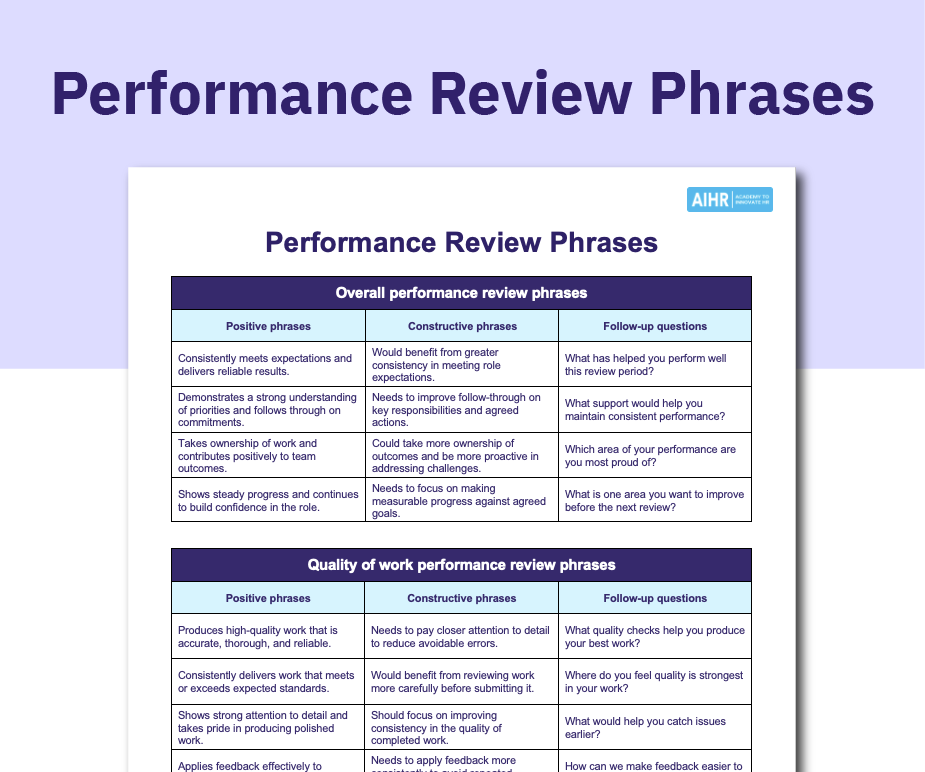
Use the following performance review phrases as starting points for clear, behavior-based feedback. Each category includes positive phrases, constructive phrases, and follow-up questions that managers can use to make the conversation more specific and actionable. Adapt each phrase with a real example from the employee’s work so the feedback feels relevant and fair.
Overall performance review phrases
Consistently meets expectations and delivers reliable results.
Would benefit from greater consistency in meeting role expectations.
What has helped you perform well this review period?
Demonstrates a strong understanding of priorities and follows through on commitments.
Needs to improve follow-through on key responsibilities and agreed actions.
What support would help you maintain consistent performance?
Takes ownership of work and contributes positively to team outcomes.
Could take more ownership of outcomes and be more proactive in addressing challenges.
Which area of your performance are you most proud of?
Shows steady progress and continues to build confidence in the role.
Needs to focus on making measurable progress against agreed goals.
What is one area you want to improve before the next review?
Quality of work performance review phrases
Produces high-quality work that is accurate, thorough, and reliable.
Needs to pay closer attention to detail to reduce avoidable errors.
What quality checks help you produce your best work?
Consistently delivers work that meets or exceeds expected standards.
Would benefit from reviewing work more carefully before submitting it.
Where do you feel quality is strongest in your work?
Shows strong attention to detail and takes pride in producing polished work.
Should focus on improving consistency in the quality of completed work.
What would help you catch issues earlier?
Applies feedback effectively to improve the quality of future work.
Needs to apply feedback more consistently to avoid repeated mistakes.
How can we make feedback easier to apply in your workflow?
Quantity of work performance review phrases
Maintains a steady output while balancing priorities and deadlines.
Needs to improve output consistency across projects or review periods.
What helps you maintain steady progress when workload increases?
Completes an appropriate volume of work without sacrificing quality.
Would benefit from setting clearer priorities to manage workload more effectively.
Which tasks or priorities have the biggest impact on your output?
Manages workload efficiently and keeps progress moving across key responsibilities.
Should communicate earlier when workload affects the amount of work completed.
What would help you flag workload challenges sooner?
Adjusts pace effectively during busy periods while staying focused on important tasks.
Needs support in planning work volume more realistically during peak periods.
What support would help you manage high-volume periods more effectively?
Job knowledge performance review phrases
Demonstrates strong knowledge of the role and applies it effectively in daily work.
Needs to continue building knowledge in key areas of the role.
Which skills or knowledge areas feel strongest right now?
Understands relevant processes, tools, and responsibilities well.
Would benefit from a deeper understanding of core processes or tools.
Where would more training or guidance be useful?
Shares knowledge with colleagues and helps others solve work-related questions.
Could be more proactive in seeking information before moving forward.
How can you continue building your expertise?
Quickly applies new information and adapts knowledge to different situations.
Needs more practice applying knowledge independently in unfamiliar situations.
What topics would help you feel more confident in your role?
Productivity performance review phrases
Completes work efficiently while maintaining a strong standard of quality.
Needs to improve output consistency and manage workload more effectively.
What helps you stay productive during busy periods?
Manages tasks well and delivers work within agreed timelines.
Would benefit from prioritizing tasks more clearly to avoid delays.
Which tasks take more time than expected?
Maintains focus and makes steady progress on important priorities.
Could improve by reducing distractions and focusing on high-impact work.
What would help you protect time for priority work?
Uses time and resources effectively to complete work.
Needs to better estimate the time required to complete tasks.
How can we improve planning around deadlines?
Dependability and reliability performance review phrases
Can be relied on to follow through on commitments and complete work as agreed.
Needs to improve consistency in following through on commitments.
What helps you stay on track with commitments?
Demonstrates reliability by meeting deadlines and keeping others informed.
Would benefit from communicating earlier when deadlines may be at risk.
What would make it easier to flag risks sooner?
Takes responsibility for assigned work and delivers without needing close supervision.
Could take more ownership of tasks without waiting for reminders.
Where do you feel most confident working independently?
Builds trust by being consistent, prepared, and responsive.
Needs to improve responsiveness and follow-up on agreed actions.
What systems or habits help you stay organized?
Attendance performance review phrases
Maintains a reliable attendance record and is consistently present when scheduled.
Needs to improve attendance consistency to better support team planning and workload coverage.
What would help you maintain more consistent attendance?
Arrives on time and is prepared to start work as expected.
Would benefit from improving punctuality and communicating delays earlier.
Are there any recurring challenges affecting your punctuality?
Gives advance notice when time away from work is needed.
Should communicate absences or schedule changes as early as possible.
What process would make it easier to flag scheduling issues in advance?
Shows respect for team commitments by being available and dependable.
Needs to be more mindful of how absences or late arrivals affect team priorities.
How can we better plan around availability and workload needs?
Time management performance review phrases
Manages time effectively and consistently meets deadlines.
Needs to improve time management to complete work within agreed timelines.
What helps you stay on track when managing multiple deadlines?
Prioritizes tasks well and focuses on the most important work first.
Would benefit from setting clearer priorities when workloads increase.
Which tasks tend to compete most for your time?
Plans work realistically and communicates timelines clearly.
Should improve planning to avoid last-minute delays or rushed work.
What would help you estimate timelines more accurately?
Stays organized and uses time productively throughout the review period.
Could improve by reducing time spent on lower-priority tasks.
What would help you protect time for high-priority work?
Communication performance review phrases
Communicates clearly and keeps stakeholders informed of progress, risks, and next steps.
Needs to communicate updates more consistently so others have the information they need.
What would help you communicate updates more clearly or consistently?
Adapts communication style well for different audiences and situations.
Would benefit from tailoring communication more carefully to the audience or context.
Which communication situations feel most challenging right now?
Listens actively and responds thoughtfully to questions or concerns.
Should work on listening more fully before responding or offering solutions.
What helps you understand another person’s perspective before responding?
Shares information in a timely way and helps prevent confusion or misalignment.
Could improve by sharing important information earlier in the process.
Where could earlier communication have improved an outcome?
Teamwork and collaboration performance review phrases
Works well with others and contributes positively to team goals.
Needs to collaborate more actively to support shared team outcomes.
What helps you collaborate effectively with others?
Builds strong working relationships and supports colleagues when needed.
Would benefit from offering support to colleagues more consistently.
Where could you contribute more to team success?
Shares information openly and helps the team stay aligned.
Should work on keeping teammates informed about progress, decisions, or blockers.
What information would be useful to share earlier with the team?
Contributes ideas respectfully and helps create productive team discussions.
Could improve by participating more constructively in team discussions.
How can you make your contributions more useful in group settings?
Customer service performance review phrases
Communicates with customers clearly, respectfully, and with empathy.
Needs to respond to customer concerns with greater clarity, empathy, or follow-through.
What helps you understand and respond to customer needs effectively?
Sets clear expectations with customers and follows through on agreed actions.
Would benefit from confirming expectations before making commitments to customers.
How can you make expectations clearer at the start of a customer interaction?
Handles customer challenges calmly and focuses on finding practical solutions.
Should work on staying calm and solution-focused when customer situations become difficult.
What support would help you handle challenging customer conversations more confidently?
Builds trust with customers by being responsive, reliable, and professional.
Needs to improve follow-up on unresolved customer issues to maintain trust.
What would help you track and resolve customer follow-ups more consistently?
Improving and managing employee performance requires a clear talent strategy, development opportunities, and systems that support growth at every level.
🎓 AIHR’s Talent Management & Succession Planning Certificate Program, will help you:
✅ Develop strategies to engage and retain employees
✅ Use data and talent reviews to guide better decision-making
✅ Take a proactive approach to succession planning to strengthen your talent pipeline
✅ Build an organizational culture that supports business goals.
Interpersonal skills performance review phrases
Builds respectful and productive relationships with colleagues and stakeholders.
Needs to strengthen working relationships by being more mindful of communication style and tone.
What helps you build trust with others at work?
Shows empathy and professionalism when working with different personalities.
Would benefit from showing more patience and empathy in challenging interactions.
Which interactions feel most difficult, and what support would help?
Handles workplace interactions with tact and respect.
Should work on responding more calmly and constructively in tense situations.
What strategies could help you manage difficult conversations more effectively?
Creates a positive experience for others by being approachable and cooperative.
Could improve by being more approachable and receptive to feedback from others.
How do you think others experience working with you?
Problem-solving performance review phrases
Approaches problems thoughtfully and identifies practical solutions.
Needs to take a more structured approach to solving problems.
What steps help you understand a problem before choosing a solution?
Breaks complex issues into manageable parts and works through them logically.
Would benefit from analyzing root causes more carefully before acting.
What do you think caused this issue?
Brings possible solutions rather than only raising problems.
Should focus on proposing options when bringing up challenges.
What options could you explore next time?
Stays calm when challenges arise and helps move work forward.
Could improve by staying focused on solutions when setbacks occur.
What helps you stay focused when a problem feels urgent or complex?
Decision-making and judgment performance review phrases
Makes thoughtful decisions based on relevant information and business priorities.
Needs to use available information more consistently before making decisions.
What information do you need before making this type of decision?
Shows sound judgment when balancing risks, timelines, and stakeholder needs.
Would benefit from considering risks and trade-offs more carefully.
What risks or trade-offs should we consider next time?
Knows when to make decisions independently and when to ask for input.
Should work on recognizing when to seek guidance before moving forward.
When would it be helpful to involve others earlier?
Makes decisions that support team goals and long-term outcomes.
Could improve by connecting decisions more clearly to team or business goals.
How does this decision support the broader goal?
Initiative performance review phrases
Takes initiative by identifying opportunities and acting without needing to be prompted.
Needs to be more proactive in identifying and acting on opportunities.
Where could you take more initiative in your current work?
Looks for ways to improve processes, solve issues, or support team goals.
Would benefit from suggesting improvements rather than waiting for direction.
What is one improvement you could suggest or test?
Takes ownership of tasks and follows through independently.
Should work on taking ownership earlier instead of waiting for reminders.
What would help you feel more confident taking ownership?
Shows curiosity and a willingness to learn beyond immediate responsibilities.
Could improve by seeking out learning opportunities more actively.
What skill or topic would you like to explore next?
Accountability performance review phrases
Takes responsibility for work outcomes and follows through on commitments.
Needs to take greater ownership of outcomes and agreed responsibilities.
What helps you stay accountable for your commitments?
Acknowledges mistakes and uses them as opportunities to improve.
Would benefit from taking responsibility for mistakes more quickly and constructively.
What did you learn from this situation?
Communicates progress, blockers, and risks in a timely way.
Should communicate blockers earlier so the team can respond before issues grow.
What would help you flag blockers sooner?
Follows through on agreed actions and keeps others informed.
Could improve by tracking and completing agreed actions more consistently.
What system would help you follow through more reliably?
Adaptability and flexibility performance review phrases
Adapts well to changing priorities and remains focused during periods of uncertainty.
Needs to be more open to adjusting plans when priorities change.
What helps you adapt when priorities shift unexpectedly?
Shows flexibility when responding to new information, feedback, or business needs.
Would benefit from responding to change with more openness and curiosity.
What would make it easier for you to adjust to change?
Stays calm and productive when plans or timelines change.
Could improve by staying solution-focused when changes create pressure.
What support would help you stay focused during change?
Adjusts approach based on feedback and applies new ways of working effectively.
Needs to apply feedback more consistently when adapting their approach.
How can we make feedback easier to put into action?
Work habits performance review phrases
Demonstrates strong work habits by staying organized, focused, and prepared.
Needs to develop more consistent work habits to support reliable performance.
Which habits help you do your best work?
Plans work effectively and follows through on daily responsibilities.
Would benefit from improving planning and follow-through on routine tasks.
What would help you stay more organized day to day?
Maintains focus and uses work time productively.
Could improve by reducing distractions and staying focused on priorities.
What tends to interrupt your focus?
Shows consistency in how they manage tasks, deadlines, and communication.
Needs to build more consistent routines for managing tasks and deadlines.
What routine would help you manage your work more effectively?
Attitude performance review phrases
Maintains a positive and constructive attitude, even during challenging periods.
Needs to be more mindful of how their attitude affects team morale.
What helps you stay constructive during difficult moments?
Approaches work with enthusiasm and a willingness to contribute.
Would benefit from showing more openness and engagement in daily work.
What would help you feel more engaged in your work?
Responds to feedback with openness and a desire to improve.
Could improve by responding to feedback more constructively.
What makes feedback easier for you to receive and apply?
Helps create a supportive and motivated team environment.
Should work on contributing more positively to team discussions and interactions.
How can you contribute to a more positive team environment?
Professionalism performance review phrases
Demonstrates professionalism through respectful communication and reliable follow-through.
Needs to show greater consistency in professional conduct and communication.
What does professionalism look like in your role?
Represents the team well in interactions with colleagues, customers, or stakeholders.
Would benefit from being more mindful of tone, timing, or approach in professional interactions.
How can you adapt your approach in sensitive situations?
Handles challenging situations with maturity and respect.
Could improve by staying composed and professional during difficult conversations.
What helps you stay calm in challenging interactions?
Follows workplace expectations and sets a positive example for others.
Needs to pay closer attention to workplace expectations, standards, or norms.
Which expectations would be useful to clarify?
Integrity performance review phrases
Acts with honesty and follows through on commitments.
Needs to build trust by being more consistent in words and actions.
What helps you follow through on commitments?
Demonstrates ethical judgment and makes decisions that align with organizational values.
Would benefit from considering company values more carefully when making decisions.
Which values should guide this type of decision?
Takes responsibility for mistakes and handles them transparently.
Could improve by acknowledging mistakes earlier and communicating them more openly.
What would make it easier to raise concerns or mistakes early?
Builds trust by being fair, respectful, and reliable.
Needs to strengthen trust by being more transparent in how they work with others.
How can you build more trust with colleagues or stakeholders?
Leadership performance review phrases
Provides clear direction and helps others understand priorities and expectations.
Needs to provide clearer direction so others understand expectations and next steps.
What would help you communicate priorities more clearly?
Supports team members by giving guidance, feedback, and encouragement.
Would benefit from offering more regular guidance or feedback to team members.
How can you support others more consistently?
Builds trust and motivates others to contribute their best work.
Could improve by creating more opportunities for team members to contribute and share ideas.
How can you create more space for others to contribute?
Makes thoughtful decisions and takes responsibility for team outcomes.
Needs to take greater ownership of team decisions and outcomes.
What support would help you lead through difficult decisions?
Safety performance review phrases
Follows safety procedures consistently and helps maintain a safe work environment.
Needs to follow safety procedures more consistently to reduce risk.
What helps you stay mindful of safety procedures?
Identifies potential safety concerns and raises them promptly.
Would benefit from reporting safety concerns earlier.
What would make it easier to raise safety concerns quickly?
Takes responsibility for personal safety and the safety of others.
Could improve by being more proactive in preventing safety risks.
Where do you see opportunities to improve safety?
Uses equipment, tools, or processes safely and responsibly.
Needs to pay closer attention when using equipment, tools, or safety-related processes.
What guidance or training would help reinforce safe practices?
Self-performance review phrases
Reflects thoughtfully on performance and identifies strengths and growth areas.
Needs to develop greater self-awareness when assessing performance.
What are you most proud of from this review period?
Takes ownership of development and looks for ways to improve.
Would benefit from taking a more proactive approach to personal development.
What skill would you like to develop next?
Uses feedback to improve performance and adjust approach.
Could improve by applying feedback more consistently.
What feedback has been most useful to you recently?
Sets meaningful goals and tracks progress over time.
Needs to set clearer goals and monitor progress more regularly.
What goal would help you grow before the next review?
How to use performance review phrases in a conversation
Performance review phrases are most useful when managers adapt them to the employee’s role, goals, and real work examples. The phrase should help start the conversation, not replace it. Here’s a simple process HR can share with managers:
Step 1: Start with the competency or expectation
Begin by grounding the conversation in the employee’s role expectations, competency framework, or performance goals. This helps managers avoid feedback based on personal preferences and keeps the review tied to shared standards.
For example, instead of saying, “You need to be more proactive,” the manager can connect the feedback to a specific competency, such as initiative, accountability, or problem-solving.
Encourage managers to ask themselves:
- Which competency or expectation does this feedback relate to?
- What does good performance look like for this role?
- Would another manager assess this behavior in the same way?
This gives the conversation a clearer foundation and helps employees understand how the feedback connects to their role.
Step 2: Prepare one or two concrete examples
Performance review phrases become much more effective when supported by evidence. HR can encourage managers to prepare one or two specific examples that illustrate the behavior behind the phrase.
These examples can come from project updates, goal progress, customer feedback, meeting notes, work samples, or performance data. The goal is to move from general impressions to specific moments that the employee can understand and discuss.
For instance, instead of saying, “Your communication has improved,” a manager could say:
“During the last project update, you summarized the risks clearly and helped the team agree on next steps.”
Encourage managers to include both strengths and development areas where relevant. This makes the review feel balanced and gives employees a clearer picture of their overall performance.
Step 3: Use the SBI model to structure the feedback
One of the biggest pitfalls in performance reviews is vague feedback like “You need to be more proactive” or “You handled that well.” It leaves employees guessing what, exactly, they did right or wrong — and managers frustrated when nothing changes.
That’s where the SBI model helps. It stands for Situation–Behavior–Impact, and it structures feedback so it’s anchored in facts, not feelings.
How it works:
“In last Thursday’s project update meeting…”
- Situation: Describe when and where the behavior occurred. Be specific so the employee can recall it.
- Behavior: State exactly what the person did or said, without adding interpretation or judgment.
“…you interrupted the client twice during their presentation…”
- Impact: Explain the effect the behavior had on results, others, or the team dynamic.
“…which made it hard for them to finish their point and created tension in the room.”
This approach removes guesswork and emotion from feedback. The person can see the pattern and its effect, rather than feeling attacked.
Share this template response with managers:
- “When [X happened], I noticed you [behavior], and it [impact]. What was your thinking at the time?”
- “During [situation], your [behavior] led to [impact]. I’d like to understand what you were aiming for.”
SBI mini example:
Situation: “In yesterday’s client update meeting…”
Behavior: “…you walked the group through the project risks using clear, plain language…
Impact: “…which helped the client understand the issues quickly and agree to next steps without delay.”
Step 4: Ask open follow-up questions
Performance reviews are more effective when they are two-way conversations. HR can equip managers with open-ended questions that help them understand the employee’s perspective and uncover any underlying challenges.
This is particularly important when performance issues are involved, as there may be factors the manager is not aware of, such as workload constraints, unclear priorities, or a lack of resources.
Useful follow-up questions include:
- What contributed to this result?
- What helped you succeed in this situation?
- What would you do differently next time?
- What support or resources would help you improve in this area?
- How can we build on this strength going forward?
- What should we repeat or scale next time?
These questions help employees reflect on their performance and take part in shaping the next steps.
Step 5: Turn feedback into clear, measurable next steps
A strong performance review conversation should end with clarity. HR can guide managers to work with employees to define one or two specific next steps based on the feedback discussed.
The next steps should describe visible behaviors, not vague intentions. For example, “communicate better” is too broad. A stronger next step would be:
“Before each project update, send a short summary of risks, blockers, and decisions needed so stakeholders can prepare.”
Managers can use prompts such as:
- What is one observable behavior you can try next time?
- What would good look like in this situation?
- How does this connect to your current goals or OKRs?
- What timeline feels realistic for this improvement?
Focusing on a small number of meaningful actions makes progress easier to track and reduces the risk of overwhelming the employee.
Step 6: Agree on the support the employee needs
Encourage managers to ask employees how they prefer to be helped and what resources would make the change sustainable. Then make the support plan explicit. This could take the form of training, coaching, peer shadowing, or providing time to practice new skills. This shared responsibility makes the process feel fair and collaborative.
HR can provide templates, coaching guides, or resource lists to make this step easy for managers to execute.
Examples of how to advise managers to offer support:
- Here’s how I can support you as you build this skill.
- Which resources or coaching would be most useful?
- Would pairing with a peer or mentor help for the first few tries?
- What would make this change easier to sustain?
HR can help by giving managers templates, coaching guides, and examples of development actions they can offer during review conversations.
Step 7: Schedule a follow-up to track progress
Finally, HR can encourage managers to treat performance reviews as part of an ongoing process rather than a one-time event. Scheduling a short follow-up conversation helps reinforce accountability and maintain momentum.
A 10 to 15-minute check-in a few weeks later gives both the manager and employee a chance to review progress, discuss what is working, and adjust the plan if needed.
Managers can say:
“Let’s schedule a 15-minute check-in in three to four weeks to review progress and see what support would be useful.”
This helps position feedback as part of continuous development and ensures that performance review phrases translate into real, observable improvement over time.
Performance review examples and scripts
HR can use the following performance review scripts to help managers structure feedback conversations. Each script combines a clear opener, a specific performance review phrase, a follow-up question, and a next step.
1. Positive performance review script
Use this script when a manager wants to recognize strong performance and encourage the employee to keep building on it.
- Conversation opener: “I want to highlight something that’s working well.”
- Performance review phrase: “You consistently [describe behavior], which has helped [describe impact].”
- Example: “You consistently explain project risks in a clear and practical way, which helps stakeholders make decisions faster.”
- Follow-up questions: “What contributed to this result?” “How can we repeat or build on this going forward?”
- Next step: “Let’s identify what worked well here and look for opportunities to apply the same approach in future projects.”
2. Constructive performance review script
Use this script when a manager needs to address a development area while keeping the conversation specific and supportive.
- Conversation opener: “I’d like to talk through one area where there’s an opportunity to improve.”
- Performance review phrase: “In [situation], I noticed [behavior], which led to [impact].”
- Example: “In the last project update, I noticed the risks were shared after the deadline had already shifted, which made it harder for the team to adjust priorities in time.”
- Follow-up questions: “What got in the way here?” “What would help you handle this differently next time?”
- Next step: “Over the next month, let’s focus on flagging risks earlier. We’ll review progress in our next one-on-one.”
3. Mixed performance review script
Use this script when an employee is performing well in some areas but needs to improve in others.
- Conversation opener: “I want to recognize what’s going well and also discuss one area where we can strengthen your impact.”
- Performance review phrase: “You’ve shown strength in [positive behavior], and the next opportunity is to improve [development area].”
- Example: “You’ve shown strong problem-solving skills by bringing practical solutions to client issues. The next opportunity is to explain the assumptions behind your recommendations so others can understand your thinking more clearly.”
- Follow-up questions: “What do you think helped you succeed in this area?” “What would make it easier to improve the next step?”
- Next step: “For the next few complex situations, try outlining your recommendation, the assumptions behind it, and how you would test them. Let’s check in next month to review how that’s working.”
4. Self-performance review script
Use this script to help managers discuss an employee’s self-review and compare it with observed performance.
- Conversation opener: “I’d like to start by hearing your view of your performance before I share my perspective.”
- Performance review phrase: “You identified [strength or development area], and I’ve also seen that show up in [specific example].”
- Example: “You identified communication as a strength, and I’ve seen that in how you summarize project updates and clarify next steps for the team.”
- Follow-up questions: “What are you most proud of from this review period?” “Where do you think you have the biggest opportunity to grow?” “What support would help you make progress?”
- Next step: “Let’s agree on one strength to keep building and one development area to focus on before the next review.”
How HR can coach managers to use performance review phrases effectively
Even the best performance review phrases fall flat if they’re not used in a proper context. Encourage managers to treat these phrases as conversation starters, not judgments. The phrases should encourage reflection, clarity, and growth. Here’s how to use them well.
Describe behavior, not personality
Feedback must focus on what the person did, not who they are. Describing behaviors keeps the conversation objective, specific, and open to change. Personality labels shut people down and make them defensive. Behavior-based language opens the door to improvement. Employees walk away knowing exactly what to continue, stop, or change.
Example 1:
- Weak: “You’re not a team player.”
- Strong: “In yesterday’s planning meeting, you moved ahead with the solution without checking with the rest of the team. It actually caused confusion and rework.”
- Follow-up: “What contributed to that approach? How might you involve others earlier next time?”
Example 2:
- Weak: “You dominate conversations.”
- Strong: “In our last retro, you spoke for most of the discussion, which limited others’ chance to contribute their perspectives.”
- Follow-up: “What’s one thing you could try next time to make more space for others?”
Anchor feedback to role expectations
Performance review phrases should clearly articulate agreed-upon expectations. They shouldn’t be based on personal opinion or comparisons with others. Anchoring feedback to a job description, competency rubric, goal, or OKR ensures the conversation remains fair and makes it easier for employees to take action.
When managers compare employees to one another (e.g., “He does this better than you”), feedback feels personal and subjective. Instead, compare performance to the role standard. Avoid comparing employees to one another.
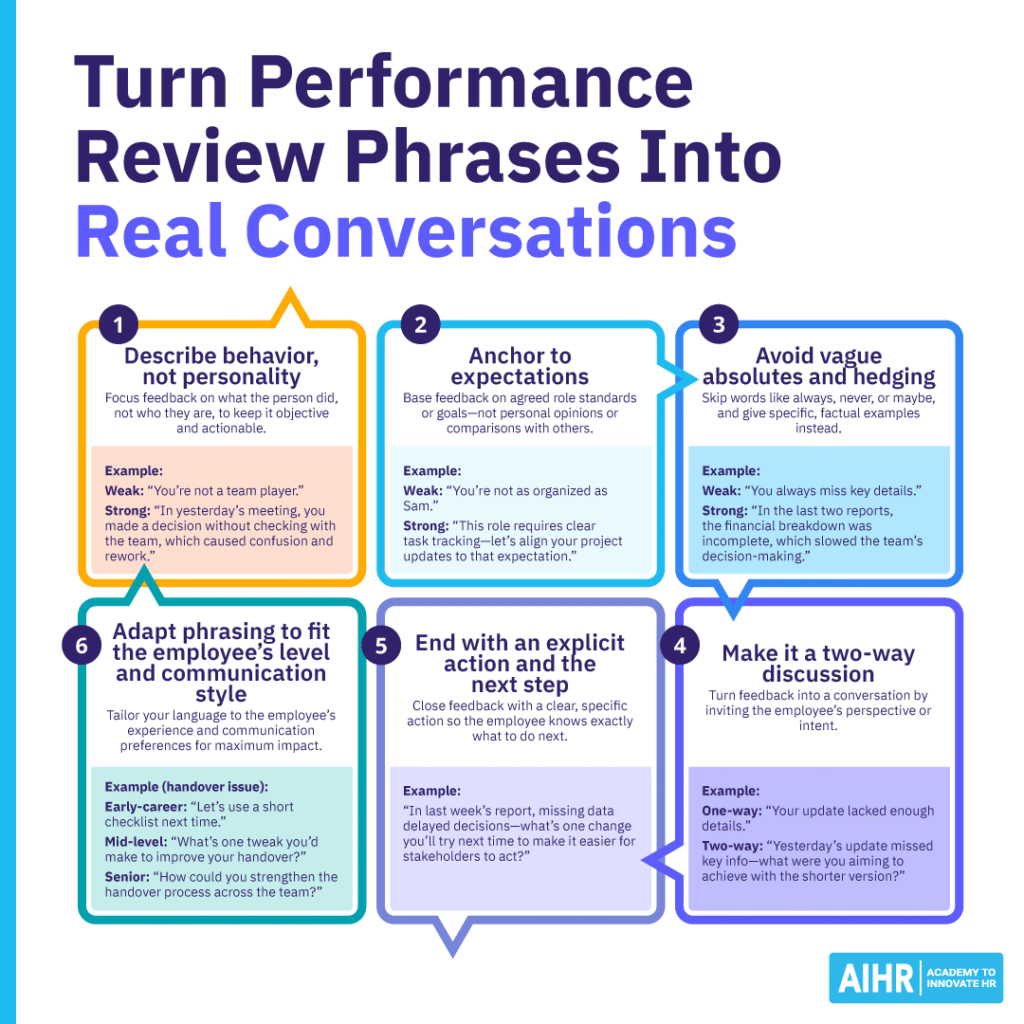
Avoid vague absolutes and hedging
Words like “always”, “never”, “kind of”, “maybe”, and “just” weaken feedback. They either exaggerate or soften the message to the point that it loses clarity. Absolutes trigger defensiveness (“I don’t always do that”). Meanwhile, hedging (using words and phrases like “might,” “could,” “probably,” and “it seems that”) makes feedback unclear and easy to dismiss.
Use specific observations or add a quick SBI to clarify statements. It also makes your point more actionable, even if you need to do so on the spot.
Example:
- Weak: “You always miss important details.”
- Stronger: “In the last two weekly reports, the financial breakdown section was incomplete, which made it harder for the team to finalize the forecast.”
- Follow-up (optional): “What would you do differently next time?”
Make it a two-way discussion
Performance reviews are most effective when they feel like a genuine conversation. Instead of delivering feedback as a monologue, invite the employee to share their opinions and their own assessment of the situation. The exchange fosters psychological safety, reduces defensiveness, and transforms feedback into a joint problem-solving process.
A simple way to do this is to add one intent inquiry or reflection question after your statement. This is especially helpful when the topic is sensitive, growth-focused, or could be misinterpreted.
Example:
- One-way: “Your update lacked enough details so that the team couldn’t move forward.”
- Two-way: “In yesterday’s update, the team didn’t have enough information to make a decision. What were you aiming to achieve with the shorter summary?”
End with an explicit action and the next step
Feedback should be straightforward so the employee understands what they should do next after exploring the situation and context together, and close with a clear, specific, and time-bound action. This turns the conversation into a growth plan, rather than just a review of what happened.
Tie the action to either a role expectation or competency, or an OKR/goal to reinforce performance management alignment.
Key question to shift from reflection → action:
- “What’s one specific step you’ll take next time?”
Example (reflection to action):
“In last week’s report, the data summary came without the supporting detail, which slowed the team’s decision-making. What’s one change you’ll try in the next report to make it easier for stakeholders to act?”
Adapt phrasing to fit the employee’s level and communication style
Not everyone processes feedback the same way. Consider experience level, communication preferences, cultural nuance, and seniority. The same phrase may motivate one person and overwhelm another.
General rule:
- Early-career talent benefits from clearer guidance and concrete examples
- Mid-level talent benefits from co-creation and autonomy
- Senior talent benefits from strategic framing and peer-level dialogue
Example: A handover lacked key details
- Early-career: “For next time, let’s use a short handover checklist to make sure all key steps are included. Want to try it together once?”
- Mid-level: “What’s one tweak you could make to your handover process to ensure continuity when you’re not available?”
- Senior-level: “How might you strengthen the handover process across the team so quality is consistent even when pace is high?”
To sum up
Performance reviews work best when they feel fair, transparent, and focused on growth. The right performance review phrases help, but managers also need to use them in honest, example-based conversations.
When feedback is clear and followed by a next step, employees are more likely to reflect, learn, and improve. As reviews become more frequent, managers need simple habits that make feedback honest, human, and helpful.
HR can support this by giving managers the tools and language to build trust year-round. AIHR’s Talent Management Certificate Program helps HR professionals design stronger talent strategies that support performance, development, and long-term growth.