

Setting HR team goals can significantly improve your team’s chances of achieving its common objectives. Clear, visible goals give team members a common direction and make it easier to track progress and hold one another accountable.
A study by Michigan State University showed that 76% of participants who wrote down their goals and actions and shared weekly progress with a friend successfully achieved their goals, compared to only 43% for those who didn’t do this. The same principle applies to teams: making goals explicit and reviewing progress regularly can strengthen accountability and follow-through.
In this article, we discuss what HR team goals are and why they matter. We also share HR team goals examples and tips on how you can best set your objectives.
Contents
What are HR team goals, and why set them?
HR team goals examples
How to set the right goals for your HR team
What are HR team goals, and why set them?
HR team goals are specific, measurable targets that guide HR teams towards outcomes that support both the organization’s people and business strategy.
HR team goals translate broader business priorities into actionable HR department targets. They differ from individual employee goals because their focus lies on team-wide outcomes across multiple areas of HR.
This can look as follows:
- The company’s goal is to improve its overall organizational performance by 10% over the next 12 months.
- For the HR department, this means that their goal is to increase employee productivity and engagement by 15% during that period. They aim to do this by enhancing their current performance management process and introducing bi-monthly check-ins and development plans for every employee.
- For the HR team in a specific location, this means that they need to ensure that by Q2, every line manager in the company has received training on how to give effective feedback, but also on goal alignment and goal-setting conversations.
Clearly defined HR team goals positively influence employees, the HR function, and the wider business by giving the team measurable outcomes to work toward. Tracking results against these goals allows HR to show, for example, how its work has improved retention, workforce capability, employee experience, or operational efficiency. This gives the team tangible evidence of its business value and can increase its credibility across the organization.

HR team goals examples
Let’s have a look at what HR team goals can look like in practice. As mentioned earlier, these goals can (and should) be related to different areas of HR, which is why we’ll explore various types of HR objectives. We’ll use the fictitious company Xylon Manufacturing to illustrate this.
Xylon Manufacturing is an international organization with 10,000 employees across 10 locations. The company has a central HR team, and its business objectives are:
- Increase production capacity by 12% while maintaining consistent quality and avoiding disruption across its manufacturing sites.
- Accelerate product and process innovation by increasing the number of new ideas implemented across departments by 25%.
- Improve operational productivity by 10% while maintaining a healthy and sustainable working environment for employees.
- Expand into two new international markets and strengthen the organization’s ability to serve an increasingly diverse customer base.
- Reduce operating costs by 8% by simplifying internal processes and improving how efficiently employees can access the support they need.
- Deliver a company-wide digital transformation program across all 10 locations within the next 18 months.
Here are HR team goals examples Xylon Manufacturing can set across several areas of Human Resources that contribute to those business objectives:
Talent acquisition and retention goals
Goals in this area focus on attracting the right people and keeping them in the organization. Strong retention can reduce recruitment costs while supporting productivity and employee engagement.
Example goal: Increase 90-day new hire retention for manufacturing employees from 77% to 85% by the end of Q4.
Why it’s relevant
Xylon needs enough experienced manufacturing employees to maintain output. Improving new-hire retention helps protect production capacity while reducing the cost and disruption associated with replacing employees.
Employee development and performance management goals
These goals focus on strengthening employee capabilities and performance over time. They can include skills development, learning participation, performance outcomes, career progression, and readiness for future roles.
Example goal: Create and implement an L&D program in core innovation skills that obtains at least 80% participation within the next 12 months.
Why it’s relevant
Innovation is crucial for companies to remain competitive. The good news is that it’s a muscle that can be trained when mastering the right skills.
Xylon wants to increase the number of new ideas implemented across the organization by 25%. Building employees’ creativity, critical thinking, and problem-solving skills through targeted L&D programs can help create the capabilities needed to generate, develop, and apply those ideas.
Employee wellbeing and engagement goals
Wellbeing and engagement goals help HR track how employees are experiencing work and whether initiatives are improving participation, motivation, and sustainable performance.
Example goal: Organize one wellbeing activity per month and reach at least an average company-wide participation rate of 50%.
Why it’s relevant
Xylon wants to improve operational productivity while maintaining a healthy and sustainable working environment. Increasing participation in wellbeing initiatives can support that objective, as studies show that higher employee wellbeing is associated with higher productivity.
DEI goals
DEI goals give HR clear measures for improving representation, inclusion, and fairness across areas such as hiring, development, advancement, and employee experience.
Example goal: Implement (or enhance existing) inclusive hiring practices to increase diverse candidate representation in shortlists by 33%.
Why it’s relevant
Xylon wants to expand into new international markets and better serve a more diverse customer base. Hiring diverse talent can broaden the range of perspectives, skills, and experiences across the workforce, while also supporting innovation, retention, and access to a wider talent pool.
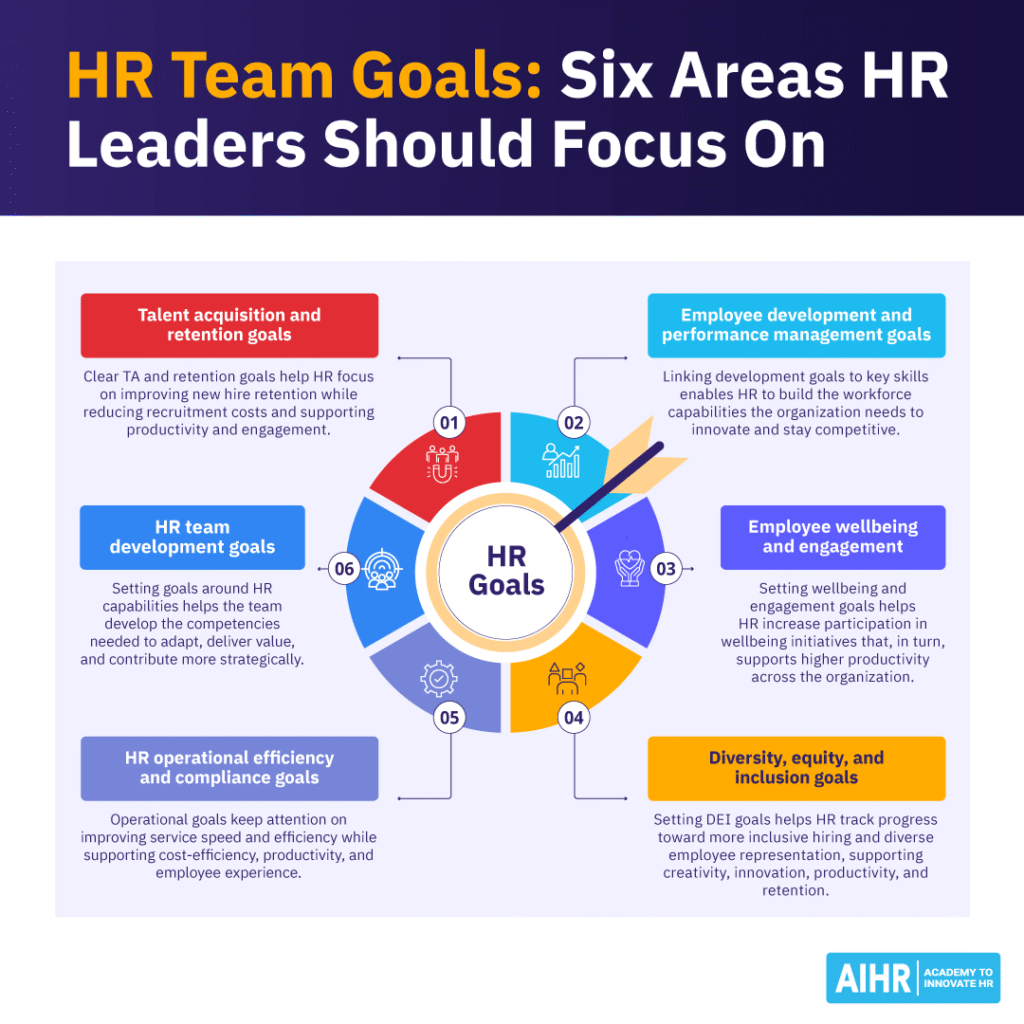
HR operational efficiency and compliance goals
This area focuses on how effectively HR delivers its services and manages its responsibilities. Goals may relate to response times, process efficiency, policy adherence, data accuracy, or compliance.
Example goal: Set up a tiered service model that enables employees to receive an adequate answer to their queries 30% faster within the next 12 months.
Why it’s relevant
Xylon wants to reduce operating costs and improve internal efficiency. Faster, more effective HR service delivery can reduce the time employees spend waiting for support, improve productivity and employee experience, and free up HR capacity for more strategic work.
HR team development goals
These goals focus on the capabilities of the HR function itself. They can cover competency development, digital and AI skills, business acumen, data literacy, or other areas the team needs to strengthen to support the organization.
Example goal: Assess the HR team against AIHR’s T-shaped HR Competency Model and upskill the team in the two highest-priority competencies by the end of the year.
Why it’s relevant
Xylon is undergoing significant business change, so its HR team needs the capabilities to support better workforce decisions, digital transformation, and execution across the organization.
AIHR’s T-shaped HR Competency Model identifies six core competencies:
Using the model as a benchmark helps Xylon identify the biggest capability gaps and focus development where it will best support the company’s business objectives.
How to set the right goals for your HR team
If you want to start setting effective goals for your HR team, or improve the way you go about this, here are nine actions to consider:
1. Align HR goals with the overall business strategy
Your main goal, as an HR department, is always to add value to the business. This is why you want to ensure your HR team’s goals are aligned with the broader business goals, as we’ve seen throughout this article.
To do this, and link each HR goal to at least one measurable business outcome. You can work with various frameworks, including:
- OKRs (Objectives and Key Results): HR OKRs provide a structure that enables HR teams to 1) set goals, 2) observe the key results related to these goals, and 3) achieve the strategic HR objectives that also impact organizational goals.
- Cascading goals: We’ve seen an example of this goal-setting framework earlier in this article. It starts with company-wide objectives that then ‘cascade’ into clear, measurable goals at every level across teams, all the way down to individual employees. It links everyone’s work to the broader business strategy, creating clarity about how teams and individuals contribute to the company’s success, hence also boosting engagement.
- HR value chain: The HR value chain model connects HR activities to organizational outcomes, demonstrating how HR contributes to business results. The model shows how HR activities lead to HR outcomes and how these then result in an impact on the organization’s objectives.
To get started with aligning your HR goals to wider business priorities, use AIHR’s HR OKR Playbook. It provides a practical structure for setting HR objectives and measurable key results that connect back to business outcomes.
2. Involve your HR team in the goal-setting process
Inclusive goal-setting leads to greater buy-in, accountability, and engagement among your HR team members.
Organize regular team meetings – for instance, every quarter – to set and re-evaluate your HR team goals. Consider combining these ‘goal meetings’ with a fun team bonding activity to blend the useful with the pleasant and make the most out of these sessions.
3. Prioritize goals that HR can directly influence
Set goals around outcomes or actions that sit within HR’s control, rather than business results that depend on many other factors.
Drawing on our earlier example, Xylon wants to increase production capacity by 12%. A poor HR goal would be: Increase manufacturing employee productivity by 10% by the end of the year.
HR can influence productivity through hiring, onboarding, development, engagement, and workforce planning, but productivity in a manufacturing environment also depends on factors such as equipment, processes, staffing levels, management, and supply availability.
A better example would be: Increase 90-day new hire retention for manufacturing employees from 77% to 85% by the end of Q4.
This is an outcome HR can influence much more directly through recruitment, onboarding, and early employee support, while still contributing to Xylon’s broader production capacity goal.
In short, the business owns the business outcome; HR owns the people-related contribution to it.
4. Choose the goal-setting framework with care
HR teams often need two layers of goal setting: one to connect HR priorities to business objectives, and another to turn those priorities into concrete, measurable actions.
Start with a strategic framework such as OKRs or the HR Value Chain to identify where HR can contribute to the organization’s broader goals. As discussed earlier, these frameworks help clarify the link between business priorities, workforce outcomes, and HR’s role in achieving them.
Once that alignment is clear, use a more operational framework, such as SMART goals, to define exactly what the team needs to achieve. SMART goals make objectives specific, measurable, achievable, relevant, and time-bound.
If you want to make your HR objectives even more dynamic, you can combine the SMART goals with another framework, such as the FAST goals. FAST stands for Frequent discussions, Ambitious, Specific, and Transparent.
For example, “Reduce time-to-hire by 25% by Q4” is a typical SMART goal; it’s specific, measurable, and time-bound. Now, you can bring this goal to life using the FAST methodology:
- Frequent discussions: Set up regular check-ins with your HR team to discuss progress and re-evaluate where needed.
- Ambitious: Motivate the team to give it their best to reach those objectives.
- Specific: Ensure your HR objectives remain clear and actionable at all times.
- Transparent: Share your HR team goals and progress openly with key stakeholders for accountability and to demonstrate HR’s impact on the business.
5. Determine how you’ll measure success
Goal-setting frameworks usually include a way to determine and measure success, as this is indispensable to assessing whether or not you’ve achieved a goal.
Elements to decide on are:
- Which metrics you’ll use
- After how much time
- Where you’ll track them (e.g., via a dashboard or reports)
6. Regularly review and adjust the goals
Coming back to Venus Williams’s success formula: keep re-evaluating your HR team goals and adjust them where needed. Business priorities, workforce conditions, budgets, and timelines can all change, so a goal that made sense at the start of the year may need to be revisited later.
Set up regular check-ins to review progress and ask whether the goal is still relevant, whether the target remains realistic, and whether the team’s current actions are producing the expected results. Look at both the outcome itself and the factors influencing it.
For example, if Xylon is making slower progress than expected on new hire retention, HR should investigate why before changing the target. The issue may be onboarding, manager support, job expectations, or another factor that the team can address. On the other hand, if the company changes its production plans or hiring needs, you may need to revise the goal itself.
The aim is to stay responsive without changing goals simply because they become difficult. Adjust them when the underlying business context or evidence changes, and document why any changes were made.
7. Share HR goal progress
Transparency around HR goal progress helps stakeholders understand what the team is working toward, how far it has come, and where additional support or decisions may be needed. It also gives HR a chance to show how its work contributes to wider business priorities.
The key is to tailor the communication to the audience. Different stakeholders need different levels of detail and context:
- The HR team needs regular, detailed updates on progress, blockers, responsibilities, and next steps so they can adjust their work.
- Business leaders need a concise view of whether the goal is on track, what business outcome it supports, and whether any action or support is required from them.
- Executive leadership or the board usually needs a higher-level summary focused on business impact, risks, trends, and whether HR’s efforts are contributing to strategic priorities.
Where possible, use the same reporting formats the organization already uses for business KPIs, such as dashboards, scorecards, or quarterly business reviews. This makes HR goals easier to compare with other priorities and reinforces that they are part of the broader business agenda.
For example, HR may discuss Xylon’s new hire retention goal in weekly team meetings using detailed retention data and action items. Leadership, on the other hand, may only need to see whether retention is improving, what that means for production capacity, and whether any risks could affect the target.
8. Build a culture of continuous improvement
Foster a culture of continuous improvement within your HR team where feedback is appreciated and innovation is encouraged.
For example, make HR team goals an integral part of your team meetings, and regularly host innovation brainstorming sessions or a hackathon to come up with fresh ideas on how to achieve the goals.
9. Celebrate victories with the team
This is perhaps the most important action on the list. Yes, it’s important to set ambitious team goals and work hard to achieve them. But taking a moment to celebrate victories (i.e., reaching those goals) with the entire HR team is just as significant. It recognizes people’s efforts, boosts morale and camaraderie, and strengthens the overall team bond.
Over to you
Well-defined HR team goals help HR focus on the priorities that matter most to the business. They create accountability, guide decision-making, and make HR’s contribution easier to measure and communicate.
The strongest goals stay connected to changing business needs. Review progress regularly, adjust where needed, and communicate results in a way that matters to each stakeholder group.
Venus Williams’s advice still applies: set realistic goals, keep re-evaluating, and be consistent. For HR leaders, that consistency can strengthen team focus and reinforce HR’s contribution to business performance.