

A professional development plan template streamlines the process of employee development, maintains fairness and consistency, and aligns individual goals with organizational objectives. As roles and required skills change, upskilling and a growth mindset have become essential for employees at all levels.
HR plays a key role in helping managers guide this process. With the right template, managers can help employees identify development goals, map practical next steps, and seek useful feedback, coaching, and mentorship. A consistent format also makes expectations clearer across teams and helps HR track development activity more effectively.
This article covers everything you need to know about professional development plans, including the key components of a PDP, ready to use templates and examples, and how to build and roll out the process across your organization.
Contents
What is a professional development plan?
Benefits of a professional development plan
What does a professional development plan template look like?
Professional development plan templates & examples
How to create a professional development plan
How to implement professional development plans across the organization
FAQ
What is a professional development plan?
A professional development plan (PDP) is a strategic tool HR professionals can use to help managers support employee career growth within an organization. It outlines clear, actionable steps for skill development and goal achievement, helping employees progress in a way that aligns their career goals with the company’s objectives.
A PDP acts like a roadmap. It helps identify an employee’s current skills, areas for improvement, and specific goals. From there, it details the steps and resources needed, such as training programs, mentorship, or practical experience, to support that growth.
For instance, a custom professional development plan for a Business Development Manager could focus on refining various skills and acquiring new knowledge to increase business opportunities and revenue. This individual might aim to enhance negotiation, networking, sales, and presentation skills by attending specialized workshops, conducting regular market research, and participating in relevant training programs over the next six months to a year. Measurable goals might include acquiring new clients, identifying new business opportunities, and increasing client acquisition rates.
To execute the plan, the manager would need time and financial resources from the organization, and would periodically review and adjust the plan with their supervisor to align with individual career aspirations and the company’s strategic objectives. Following their PDP helps them move forward toward that goal.

Benefits of a professional development plan
Professional development plans benefit employees and organizations alike. They foster career growth and boost overall employee performance, engagement, and retention. Let’s take a closer look.
- Career growth: PDPs provide employees with clear paths to develop their skills and progress in their careers. This clarity motivates individuals to take ownership of their development and work towards long-term goals.
- Improved performance: Employees can strengthen job-related skills in a structured way, leading to better overall performance. As employees become more capable, their productivity and ability to contribute to the organization increase.
- Employee engagement: When employees feel their growth is valued and prioritized, they are more likely to remain actively involved in their work.
- Retention: Investing in employee growth builds loyalty and long-term commitment to the organization. A strong focus on development can help employees feel more secure and appreciated, lowering the risk of them seeking opportunities elsewhere.
- Alignment with company values: Structured professional development plans ensure that development efforts are in line with organizational goals and culture. Employees understand how their growth contributes to the company’s broader mission, which builds a sense of purpose and connection to the organization.
AIHR’s Learning & Development Certificate Program teaches you to:
✅ Pinpoint crucial skills gaps and learning needs
✅ Design learning interventions that support employee development
✅ Build an L&D strategy aligned with business priorities
✅ Use learning analytics to measure the impact of development initiatives
💡 Check out the lessons in AIHR’s Demo Portal for a clear idea of what you’ll get.
What does a professional development plan template look like?
A PDP template gives HR a standardized framework for supporting employee growth across teams. It helps managers align employee development goals with organizational objectives, identify development needs, and track measurable progress over time.
A professional development plan (PDP) consists of several essential components that facilitate effective professional growth:
1. Professional goals
Professional goals are the heart of a PDP, as they set the direction and purpose of the entire plan, dictating what skills need to be learned, what competencies need to be acquired, and what milestones need to be achieved to progress.
They ensure that every learning opportunity, every skill acquired, and every task accomplished leads toward the desired career advancement and personal development. For instance, an employee might aspire to lead a team, gain expertise in a specific technology, or achieve a higher role within the organization, such as moving from a managerial to a directorial role.
Without clear goals, the journey of professional development can become unfocused and ineffective, diminishing the value and impact of the PDP.
2. Self-assessment
This requires individuals to reflect on their strengths and areas of improvement. For example, a person might realize they are excellent in analytical thinking but need to strengthen their communication skills. This assessment is critical for identifying the areas that require development and setting realistic and relevant goals.
Employees can create more realistic, relevant, and attainable professional goals by reflecting on their abilities, behaviors, and desires. Self-awareness and responsibility empower people to take ownership of their professional growth and align their development efforts more closely with their career aspirations and the organization’s needs.

3. Skill development
Identification of specific skills or knowledge areas to develop is crucial. A skills gap analysis allows for the creation of a tailored and effective PDP, ensuring that learning and development efforts are strategically directed toward acquiring the necessary knowledge and competencies.
By addressing these identified gaps, individuals can enhance their performance, contribute more effectively to organizational goals, and navigate their career paths more strategically, avoiding wasted time on irrelevant learning activities.
4. Performance goals
Setting SMART (Specific, Measurable, Achievable, Relevant, Time-bound) goals is crucial because it provides clear, focused, and measurable objectives that guide an individual’s professional growth and learning journey. For instance, an employee in sales might set a goal to increase sales by 15% in the next quarter through enhanced customer engagement strategies.
Creating a transparent and structured pathway that aligns employee aspirations with organizational objectives enables them to contribute more effectively to the organization’s success. Establishing performance goals within a PDP facilitates ongoing assessment and feedback and allows for a sense of accomplishment and motivation, as employees who can clearly see their progress and development experience greater job satisfaction and productivity.
5. Expected outcomes and KPIs
Expected results and key performance indicators (KPIs) provide clear benchmarks for success, enabling individuals to measure their progress accurately and objectively. Outcomes are the tangible results they hope to achieve, giving a clear direction to their efforts. Meanwhile, KPIs serve as quantifiable measures that help them track their advancement towards these outcomes, offering insights into areas of improvement and success.
Together, they create a framework for accountability and continuous improvement, allowing employees to adjust their efforts and strategies based on real, measurable data, ensuring that the development plan remains relevant and aligned with personal and organizational goals. This alignment helps maintain focus and motivation, as individuals can see the impact of their development efforts. A sense of accomplishment propels further learning and growth.
6. An action plan
An action plan outlines the steps to be taken to achieve the set goals. This could involve attending training sessions, undertaking additional responsibilities, or seeking mentorship. For example, an employee aiming to improve project management skills might plan to attend related workshops and actively participate in project planning sessions.
7. Feedback and evaluation
Regular feedback and evaluation are vital for assessing the progress of the PDP and making any necessary adjustments. It can involve discussions between the employee and the manager to review progress, address challenges, and refine goals and strategies as needed.
Professional development plan templates & examples
The right template depends on who it’s for, whether that’s one employee’s personalized plan, a standard format for a whole team, or a plan tied to a specific moment like onboarding or a leadership transition. Below are six templates you can download and customize for your team:
Professional development plan template
A PDP is a strategic document designed to help individuals identify and achieve their professional goals. The focus is on tailoring development to the individual’s needs and aspirations and taking a personalized approach to their progress within the organization.
It includes components like self-assessment, skill development, SMART goals, action plans, and regular evaluations to help employees grow in their careers.
Example: A marketing coordinator wants to grow into a senior marketing role within 18 months. Their PDP focuses on building campaign analytics and stakeholder presentation skills. They agree with their manager to complete a relevant certification, present campaign results in monthly meetings, and lead one full campaign independently by month 12.
The professional development plan template in Word below is ready to use and can also serve as a starting point for building a customized version for your organization.
Benefits
- Encourages continuous learning and skill development
- Aligns individual goals with organizational objectives
- Increases employee engagement and job satisfaction
- Enhances employee performance and productivity
- Helps in retaining top talent by fostering a growth-oriented environment.

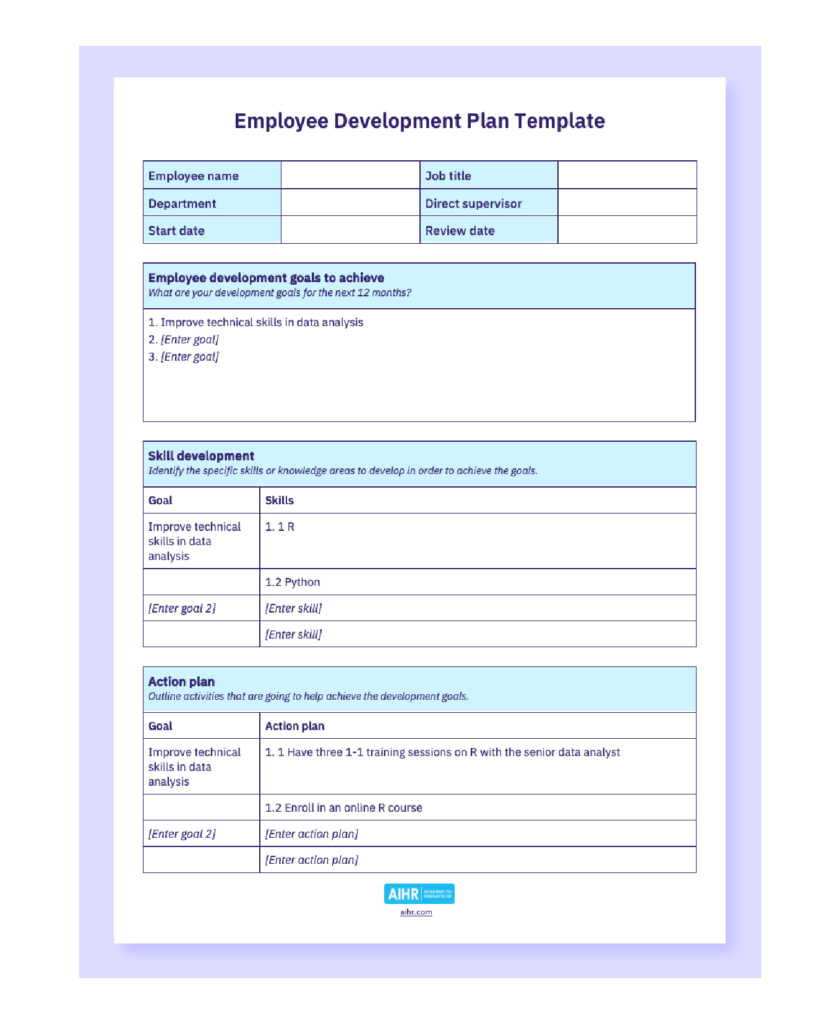
Employee development plan template
An employee development plan template covers one employee’s goals, the skills tied to each goal, and an action plan for building them. Compared to a personalized PDP, it usually starts from a business need, like a skills gap, rather than the employee’s own career goals.
Example: A data analyst on a team with a growing skills gap in Python might get a development plan built around that specific need, with a goal of improving technical skills in data analysis, R and Python listed as the skills to build, and action steps like one-on-one training with a senior analyst or an online course.
Benefits
- Ties development directly to a specific skills gap or business need
- Reduces the time managers spend building plans from scratch
- Keeps the format consistent across the team, even though each plan is individual
- Supports fair, comparable evaluation of progress across similar roles
Individual development plan (IDP) template
An individual development plan (IDP) is an employee led roadmap for longer-term career growth, not tied to a specific role or employer. Employees take the lead in building it, while managers provide feedback and help align it with organizational priorities.
zExample: An HR Generalist working toward an HR Manager role might list interpersonal communication as a current skill and strategic thinking as one to build, with success criteria like demonstrating strategic HR leadership, mastering stakeholder management, and gaining leadership experience.
Benefits
- Puts employees in the driver’s seat of their own career growth
- Supports internal mobility, succession planning, and retention
- Encourages proactive skill-building beyond the current role
- Gives managers a structured way to support long-term development

30-60-90 day plan template
The 30-60-90-day plan is used during the onboarding process of new employees. It breaks down the first 90 days of employment into three segments, each with distinct objectives and tasks, helping new hires understand their roles, responsibilities, and the company culture so they can integrate smoothly.
Example: A new Junior Sales Representative uses a 30-60-90 day plan to understand their role faster. In the first 30 days, they learn the sales process and product basics. By day 60, they start building relationships with decision makers in the UK market. By day 90, they manage a small group of prospects and contribute to the team’s market expansion goals.
Benefits
- Accelerated learning curve for new employees
- Clear expectations and goals from day one
- Enhanced productivity and performance from the outset
- Identifies potential issues and challenges early
- Enables a sense of accomplishment and job satisfaction.

Performance improvement plan (PIP) template
A performance improvement plan template (PIP) outlines specific areas where an employee needs to improve their performance. Unlike the other templates here, a PIP is reactive rather than proactive: it’s used to address a specific performance issue, not general skill-building. It sets clear expectations, measurable goals, and a timeline for achieving them, along with the support and resources to help employees meet those goals.
Example: An employee is regularly missing agreed response time targets. Their PIP sets a clear performance expectation, explains the gap, and outlines the support available. The employee agrees to use a daily priority tracker, attend weekly check-ins with their manager, and reach the agreed response time target within 60 days.
Benefits
- Offers structured support to underperforming employees
- Clarifies expectations and provides clear, attainable goals
- Encourages open communication between employees and management
- Identifies and addresses performance issues proactively
- Can lead to improved employee performance and productivity.

Leadership development plan template
This plan is focused on developing the skills and knowledge necessary for leadership roles. It’s tailored for current leaders and potential future leaders, emphasizing strategic thinking, people management, decision-making, and other leadership competencies.
Example: A high-potential employee is preparing for their first people management role. Their leadership development plan focuses on coaching skills. Over the next four to six months, they complete a mentoring course, shadow an experienced manager, and run monthly development conversations with two junior team members. Their manager reviews progress through feedback from those employees and observed coaching sessions.
Benefits
- Prepares employees for leadership roles, ensuring organizational continuity
- Enhances leadership skills, fostering better team management and decision-making
- Contributes to organizational success by developing effective leaders
- Strengthens the leadership pipeline, reducing the risks associated with leadership gaps
- Improves employee morale and organizational culture through effective leadership.

How to create a professional development plan
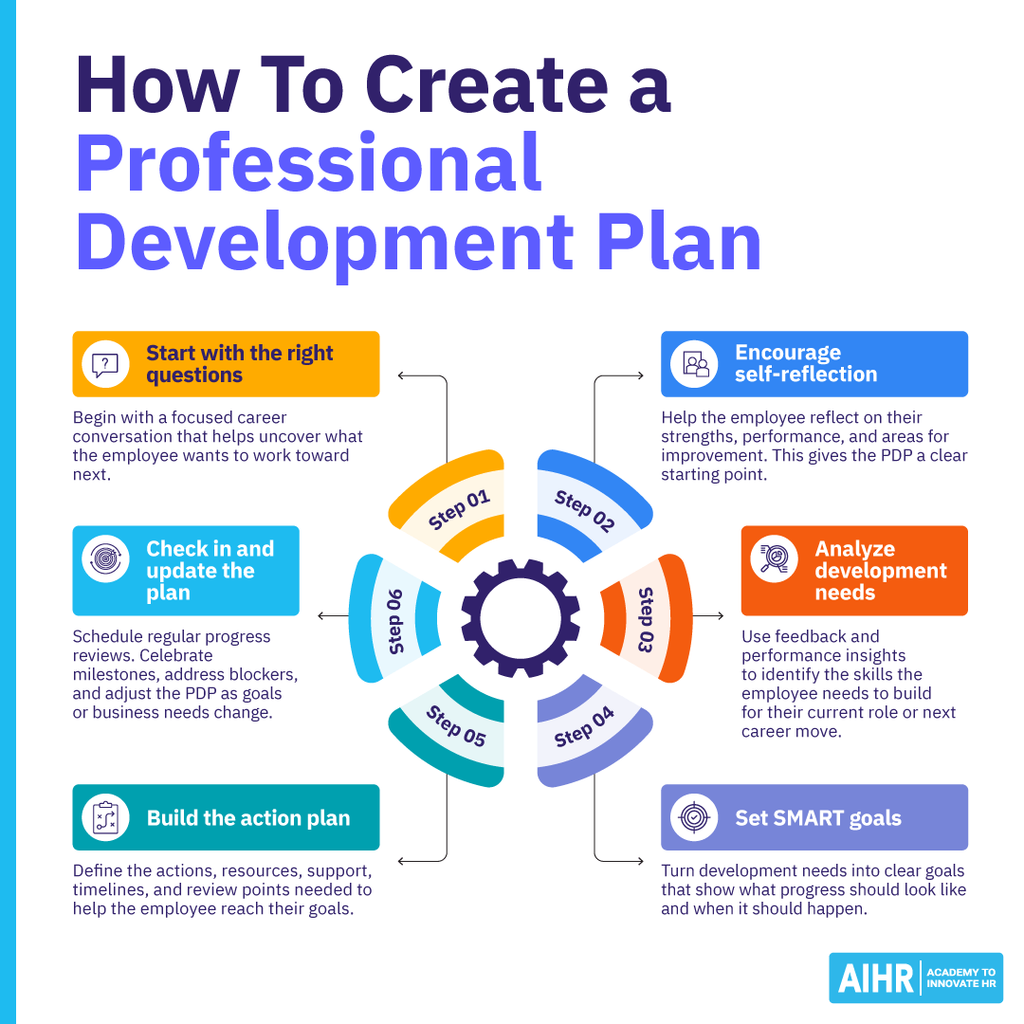
Creating an effective PDP requires a structured approach that aligns employee goals with organizational needs. HR professionals can use the steps below to guide managers through practical, impactful PDP conversations with their employees.
Step 1: Start with the right questions
Begin with a focused career conversation. The goal is to understand what the employee wants to work toward before choosing development actions.
Useful questions include:
- What future roles or projects interest you?
- Where do you see yourself in the next one to three years?
- What skills do you feel you need to develop?
- Which parts of your current role do you want to grow in?
Step 2: Encourage self-reflection
Invite the employee to reflect on their current strengths, areas for improvement, and job performance. A self-assessment helps them take ownership of their development and gives the PDP a clear starting point.
Step 3: Analyze development needs
Identify the skills and knowledge areas the employee needs to improve. Use inputs such as performance appraisals, peer feedback, manager feedback, and skills assessments to highlight specific competencies that require attention.
For example, an employee preparing for a team lead role may need to build skills in delegation, coaching, and conflict resolution.
Step 4: Set SMART goals
Turn development needs into SMART goals: Specific, measurable, achievable, relevant, and time-bound.
Instead of setting a broad goal like “improve leadership skills,” make it specific: “By the end of Q3, lead two project meetings and ask the project team for feedback on communication and facilitation.”
Step 5: Build the action plan
Break each goal into practical steps. The action plan should clarify what the employee will do, which resources or support they need, when each action should happen, and how progress will be reviewed. For example, if an employee wants to improve leadership skills, the plan could include completing a leadership course, shadowing a senior leader, and leading a team project.
Step 6: Check in on progress and update the plan
Schedule regular check-ins to review progress, celebrate milestones, and adjust the plan as needed. These conversations help keep the PDP relevant as the employee’s goals, role, and business priorities change. Development is an ongoing process, so the plan should evolve over time.
How to implement professional development plans across the organization
HR leads the rollout of PDPs across the organization, supporting managers with the frameworks, training, and resources they need to run them well.
Here’s how to implement PDPs across an organization:
- Gain leadership buy-in: Secure support from senior leaders by showing how PDPs can support employee performance, satisfaction, retention, and internal mobility. Leadership support helps position development as a business priority, not just an HR initiative.
- Develop a PDP framework: Create a structured but adaptable framework managers can use across roles and departments. Include key fields such as goals, skill gaps, development actions, timelines, resources, and review dates.
- Train managers: Provide training on how to run effective PDP conversations, set SMART goals, identify skill gaps, give constructive feedback, and follow up on progress.
- Communicate the initiative: Explain the purpose, process, and benefits of PDPs to employees. Make it clear that PDPs support career growth and skill development, rather than adding extra paperwork.
- Support individual plan creation: Help managers use performance feedback, career conversations, skills assessments, and competency models to create personalized PDPs for each employee.
- Provide development resources: Make relevant learning and development resources available, such as workshops, e-learning, mentoring, job shadowing, and stretch assignments.
- Track progress and refine the process: Encourage regular manager-employee check-ins, use KPIs and employee feedback to assess impact, recognize progress, and improve the PDP process over time.
HR tip
When rolling out PDPs, HR should help managers:
- Keep plans flexible enough to reflect changing employee goals, role requirements, and business priorities
- Create a supportive environment where employees feel comfortable discussing their development needs
- Connect individual PDPs to organizational goals, so development feels relevant to the employee and useful to the business
To sum up
A professional development plan template works best when it turns career goals into clear action. Start by helping managers define each employee’s development goals, connect them to business needs, and agree on practical next steps. Then, track progress regularly so development stays visible and achievable.
Building these skills can help you design stronger development plans, close skill gaps, and measure learning impact across your organization. To strengthen your approach, explore AIHR’s Learning & Development Certificate Program, which covers L&D strategy, skills gap analysis, learning design, and learning analytics.
FAQ
A professional development plan is a tool that helps people outline and plan their path for learning and growth in their jobs. It helps individuals set and achieve career goals by identifying the skills they need to develop and the steps they need to take. It’s a personal roadmap for gaining new knowledge, skills, and experiences in the workplace.
Key components of a professional development plan include identifying professional goals that an employee wants to achieve, assessing their current skills and knowledge, pinpointing the areas that need to be developed or improved, setting specific and measurable targets, outlining clear steps or actions to reach those targets, and scheduling regular reviews and updates to track progress and adjust the plan as needed.
Begin by discussing the employee’s career goals and identifying any skills they need to develop. Utilize a template to structure the plan, ensuring consistency and covering key areas like goals, skills, and timelines. Work together to set clear, actionable steps, create a timeline, and provide relevant resources like training or mentorship. Regularly review and adjust the plan to ensure progress and alignment with both personal and organizational goals.
Common professional development goals include learning a new skill, becoming certified in something relevant to the role, improving communication or leadership abilities, taking on a stretch project, or working toward a promotion.