

An employee retention plan template has become an essential tool for HR as organizations shift their focus from hiring to retaining their talent. The right template shows which roles need protection, why employees may leave, who owns each action, and how you’ll measure progress.
The urgency is real. Gallup found that 42% of voluntary leavers said their manager or organization could have done something to prevent their departure, and the Work Institute’s Retention Report warns that employees may stay longer out of caution, not confidence. This guide explains how to build an employee retention plan, and comes with a free template you can use to put your plan into practice.
Contents
What is an employee retention plan?
How to build your employee retention plan
Get your free employee retention plan template
FAQ
What is an employee retention plan?
An employee retention plan is a documented, time-bound action plan that outlines how an organization will improve employee retention over a set period. It includes retention goals, planned initiatives, owners, success measures, and review dates.
Unlike an employee retention strategy, which sets the organization’s long-term approach to attracting and retaining talent, an employee retention plan translates that strategy into specific actions.
For example, a strategy may prioritize career development to improve retention, but the plan makes that priority concrete. It may assign an owner to launch internal career pathways within 90 days, set a target to increase internal mobility by 15%, and track progress through quarterly reviews.
An effective employee retention plan typically includes:
- Clear retention objectives linked to business priorities
- Baseline metrics, such as voluntary turnover, regrettable attrition, or first-year attrition
- Specific initiatives with owners and deadlines
- KPIs to measure progress
- A review cadence to check results and adjust actions.
An employee retention plan is different from a Key Employee Retention Plan (KERP). A KERP is a legal and financial arrangement used during mergers, acquisitions, restructures, or bankruptcy proceedings. It usually helps retain critical executives or specialized employees through contractual retention bonuses.
An employee retention plan, by contrast, is a workforce planning document. You’d use it to improve retention across the broader workforce through career development, manager effectiveness, employee experience, compensation, and workplace flexibility.

How to build your employee retention plan
An employee retention plan works best when it focuses its effort where it will have the greatest business impact. That starts with a simple idea: Not all turnover is bad, and not every employee needs the same retention approach.
Some departures are expected or healthy. Others create knowledge gaps, disrupt teams, and increase hiring costs.
Work Institute’s report classified nearly 74.69% of all reasons for leaving as preventable and found that career remained the top reason at 19.2%, while work-life balance ranked second at 12.4%. For HR, this means retention planning should focus on clear career paths, manager capability, flexible work design, and the areas your data shows employees value most.
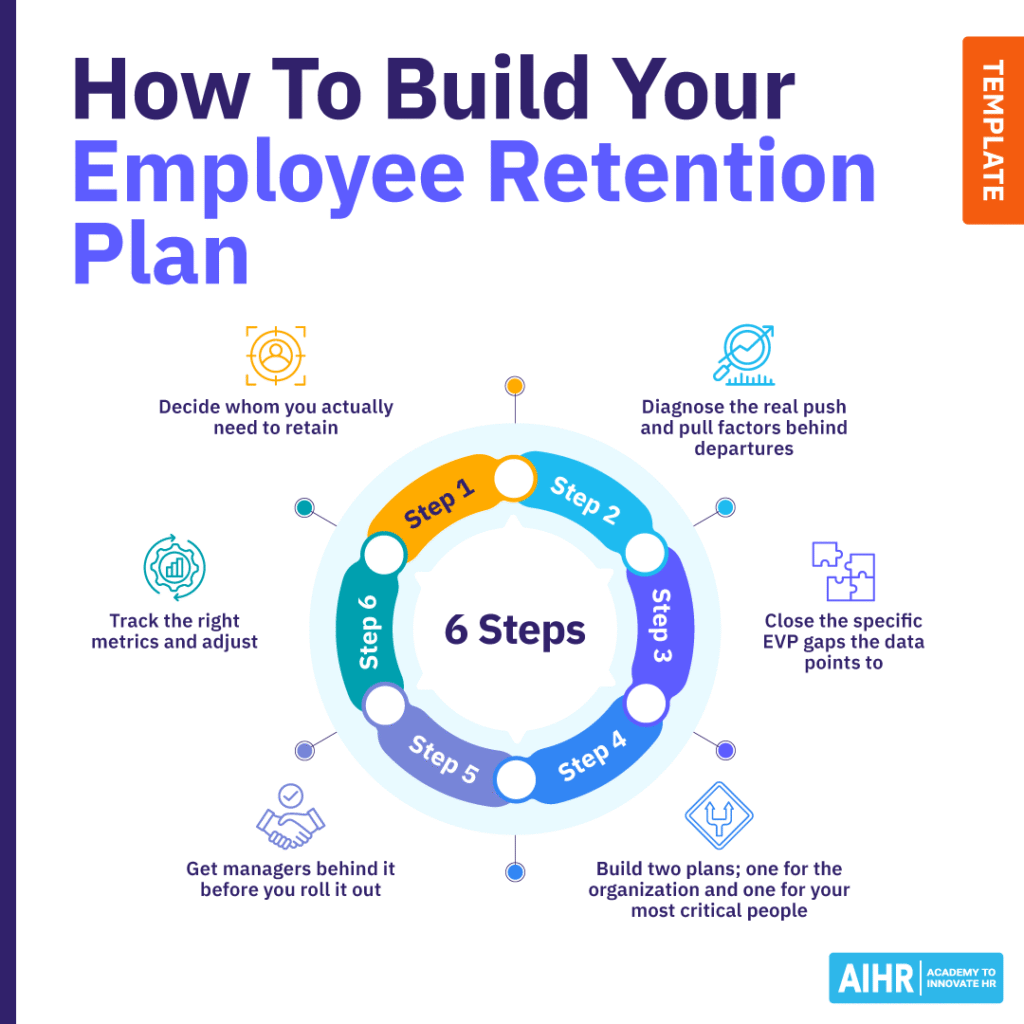
Creating an employee retention plan typically follows six steps:
Step 1: Decide who you actually need to retain
The goal of a retention plan is to reduce regrettable attrition. This means reducing the loss of employees the organization wants to keep, not eliminating turnover altogether.
Every organization experiences employee departures, and some may have little negative impact, especially when a consistently low-performing employee leaves or a role can be filled quickly. The bigger risk is losing employees with knowledge, performance, customer relationships, or specialist skills that are hard to replace.
Start by identifying the roles with the greatest effect on business performance. These often include roles with scarce technical expertise, leadership responsibility, regulatory knowledge, or strong customer ownership. Then, assess the employees in those roles using factors such as:
- Recent performance
- Succession readiness
- Tenure
- Promotion history
- External demand for their skills
- Known flight risk, meaning how likely they are to leave.
A simple way to focus retention efforts is to map employees on two dimensions: business criticality and flight risk. Employees who score highly on both should become the priority group for targeted retention actions. For example, a Senior Software Engineer leading a core platform migration may be a higher-retention priority than employees in roles you can fill within weeks.
An experienced Sales Manager who consistently exceeds targets but hasn’t received a promotion in several years also needs attention. They may be more at risk than a new hire who’s still developing in the role. You should also create a shortlist of the employees and roles your organization can least afford to lose over the next 12 months. This group will form the foundation for the rest of the employee retention plan.
An employee retention plan gives you a clear starting point for keeping valued employees engaged. Develop the right talent management skills to help you turn that plan into sustainable practices across the employee lifecycle.
AIHR’s Talent Management & Succession Planning Certificate Program teaches you how to:
✅ Identify and address flight risks before critical talent leaves
✅ Create career development and internal mobility practices that support retention
✅ Build a talent management strategy aligned with business priorities
✅ Use talent data to guide workforce, succession, and retention decisions
💡 Visit AIHR’s Demo Portal to preview lessons from the program, and explore what you can learn next.
Step 2: Diagnose the real push and pull factors behind departures
Employees rarely leave for just one reason. Most decisions come from a mix of push and pull factors. Push factors reduce satisfaction in the current role. These may include limited career progression, ineffective managers, heavy workloads, pay concerns, lack of recognition, or falling engagement.
Pull factors make another opportunity more attractive. These may include higher salaries, greater workplace flexibility, faster advancement, stronger learning opportunities, or more interesting work. Understanding the difference helps you solve the right problem.
If employees leave because competitors offer fully remote work, a new recognition program may not help. If employees leave due to poor management, increasing salaries may not fix the root cause.
Gather evidence from several sources. Exit interviews can show why people say they left, while stay interviews help you uncover concerns before employees start looking elsewhere. Turnover data can reveal patterns across departments, managers, locations, or tenure groups.
For example, “accepted another opportunity” describes what happened. If employees in the same business unit also mention delayed promotions, limited career progression, and few internal moves, the real driver is likely career development.
Gallup’s retention research shows why early conversations matter. It found that 42% of voluntary leavers said their exit could have been prevented, while 45% said no manager or leader had proactively discussed their job satisfaction, performance, or future with them in the three months before they left.
Helpful resources
AIHR has detailed resources on conducting effective stay interviews, employee turnover data analysis, and employee retention metrics that can help structure this stage.
Step 3: Close the specific EVP gaps the data points to
The data you collect in Step 2 should guide where you invest next. Don’t review every part of the employee value proposition (EVP) equally. The EVP is the full set of rewards, experiences, and opportunities employees receive in exchange for their work, so focus on the EVP gaps most directly linked to regrettable attrition.
If employees often cite below-market pay, a compensation review may be the priority. If career progression is the main issue, internal mobility, mentoring, or leadership pathways may have more impact than new benefits.
Employee expectations also change across the employee life cycle. For instance, new hires may value structured onboarding, learning opportunities, and early-career development, whereas mid-career employees may prioritize progression, meaningful work, flexibility, and recognition.
Instead of designing one EVP for everyone, compare patterns across employee groups. You may find that early-career employees need clearer development pathways, while experienced specialists care more about market pay and career progression. Those insights help HR target retention initiatives where they’re most likely to influence decisions to stay.
“It’s easy to assume a stronger EVP means adding more benefits. In reality, retention improves when organizations address the issues that consistently drive employees to leave. For example, if exit interviews keep pointing out that they leave because they don’t see growth opportunities, strengthening career development will have a bigger impact than adding another benefit.”

Step 4: Build two plans: one for the organization and one for your most critical people
Once your priorities are clear, turn them into two practical plans. The first should address organization-wide retention challenges. The second should focus on employees identified as the highest retention risk in Step 1. The organizational plan creates accountability by assigning owners, setting timelines, defining budgets, and specifying measurable outcomes. For instance:
Initiative | Owner | Target group | Timeline | Budget | Success metric |
Compensation benchmarking review | Total Rewards Lead | Engineering | Next three months | $15,000 (market data) | Pay-related exits fall below 10% of departures |
Manager 1:1 skills refresh | L&D Manager | People managers | Next six months | $8,000 (training) | eNPS score for ‘My manager supports my growth’ up 10 points |
Internal postings before external recruitment | Talent Acquisition Lead | Whole organization | Ongoing from next month | Minimal (process change) | 30% of vacancies filled internally within 12 months |
When several initiatives compete for a limited budget, use a simple scoring framework. Rate each initiative on three criteria:
- Business impact
- Cost and resource requirements
- Ease and speed of implementation.
Start with high-impact initiatives that need modest investment. Schedule lower-impact or resource-heavy projects for later phases. Alongside the organizational plan, create a short individual stay plan for employees whose departure would have a major business impact.
Senior Engineer, Platform Team
Promotion delayed; active recruiter contact confirmed
Fast-track promotion review; appoint as technical lead on upcoming product launch
Six weeks
Step 5: Get managers behind it before you roll it out
Managers are among the biggest influences on retention, as they shape the daily employee experience. Gallup estimates that they account for at least 70% of the variance in employee engagement scores across business units. They’re responsible for career conversations, workload management, coaching, recognition, and trust, making them central to any retention plan.
Gallup also found that when a manager has one meaningful conversation a week with each direct report, employees are four times as likely to be highly engaged. These conversations can focus on goals, priorities, recognition, collaboration, and strengths. Before you launch new initiatives, brief managers on three things:
- Which employee groups the organization prioritizes
- What evidence supports those decisions
- What actions managers need to take to provide support.
Managers also need a clear way to flag potential flight risks, rather than waiting until an employee resigns. Create a simple escalation process so managers can alert HR when they notice warning signs. These may include declining engagement, repeated discussions about promotions, increased recruiter activity, or changes in behavior.
For upcoming one-on-one meetings, managers can ask employees:
- “What part of your work has felt most motivating recently?”
- “Is anything making you consider opportunities outside the organization?”
- “What would make your next year here more rewarding?”
Step 6: Track the right metrics and adjust
Treat your retention plan as a living document instead of filing it away once implementation starts. Quarterly reviews usually work well, as they give initiatives enough time to influence behavior while still allowing HR to respond before turnover patterns become established.
Measure the outcomes your plan was designed to influence. These may include overall employee retention rate, employee Net Promoter Score (eNPS), and most importantly, regrettable attrition among the critical roles and flight-risk employees identified in Step 1. Track those groups separately for a clearer view of whether retention efforts are working.
If a metric doesn’t improve, revisit the assumptions behind the initiative to avoid repeating the same activity without checking the data. For example, compensation adjustments may have little effect on regrettable attrition if stay interviews continue to point to career progression. In that case, focus on internal mobility, succession planning, or leadership development.
Each quarterly review should answer three questions:
- Which initiatives are improving retention among our priority employees?
- Which actions are using resources without changing outcomes?
- What should we start, stop, or adjust before the next review cycle?
Get your free employee retention plan template
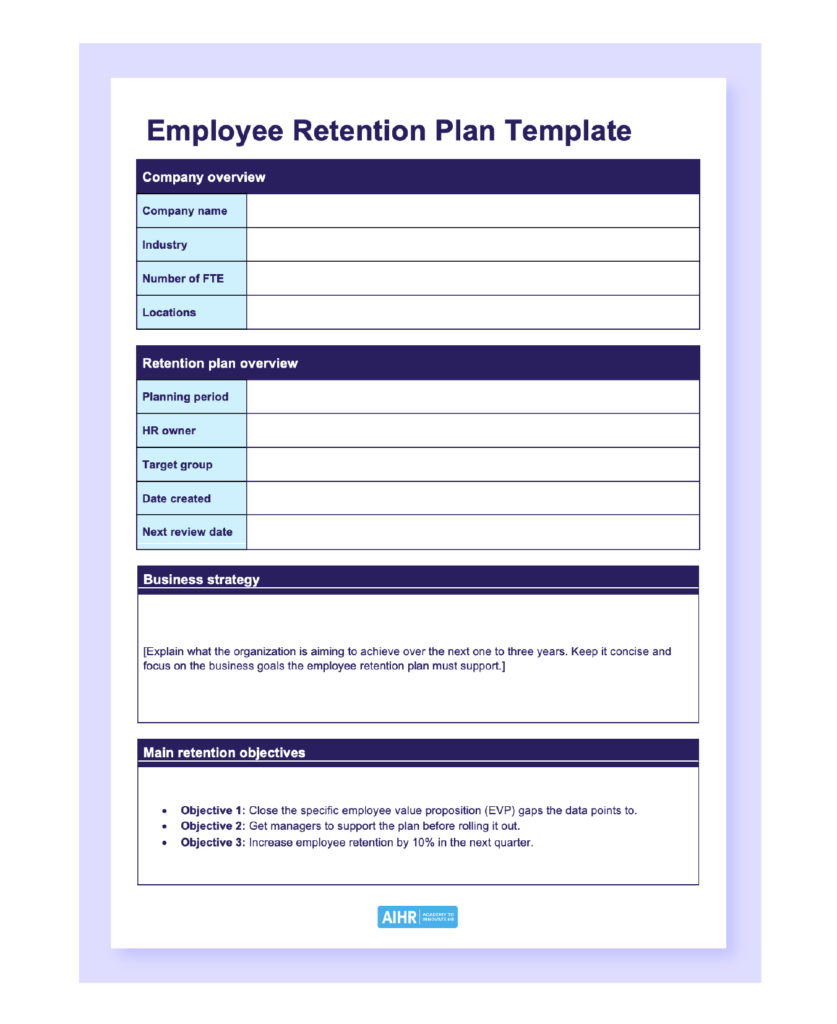
Instead of starting from a blank document, use AIHR’s structured employee retention plan template to structure your plan. The template is designed to help you document initiatives, assign owners, define target employee groups, set timelines and budgets, and establish success metrics. You can also use it to record specific risk factors, agree on targeted retention actions, and schedule follow-up conversations.
Next steps
An effective employee retention plan gives you a practical way to focus your efforts where they best protect the business. Start with the roles and people you can’t afford to lose, then use data to understand why they may leave. From there, prioritize the actions that managers and HR can deliver within the next quarter.
Retention also depends on how talent practices fit together. Harvard Business Review recently noted that lasting retention comes from coherent systems where hiring, compensation, advancement, and retention practices reinforce one another. To build that capability, explore AIHR’s Talent Management & Succession Planning Certificate Program, which covers talent pipelines and data, succession planning, and retention-focused talent management.
FAQ
The five Cs of employee retention are compensation, culture, connection, career, and contribution. They’re a simple way to group the factors that influence employee retention.
Slack uses this framework to describe retention across pay, work environment, relationships, growth, and meaningful work. Use the 5 C’s as a planning prompt, not a rigid model. They can help you check whether your retention plan addresses the most common reasons employees stay or leave.
There’s no single official set of four pillars. A practical four-pillar model for employee retention includes wellbeing, culture, career development, and rewards and recognition. Together, these pillars help HR assess whether the organization supports employees as people, provides room for growth, fosters a healthy work environment, and recognizes their contributions.
The three Rs of employee retention are respect, recognition, and reward. Respect means employees feel heard, trusted, and treated fairly, while recognition means managers and peers consistently acknowledge effort and results. Lastly, reward covers pay, benefits, incentives, development opportunities, and non-financial rewards. They work best when present in everyday management, not just annual programs.
An employee retention plan is a workforce strategy HR and business leaders use to improve retention across the broader organization. It identifies why employees leave, sets measurable retention goals, and outlines actions like career development, manager training, employee recognition, compensation reviews, flexible work, wellbeing programs, and succession planning.
A KERP is a legal and financial arrangement used to retain a small group of critical employees, usually executives or highly specialized staff, during major organizational change. Companies often use KERPs during mergers, acquisitions, restructures, bankruptcy proceedings, or other high-risk transitions.
For most organizations focused on reducing turnover and improving employee experience, an employee retention plan is the relevant tool. A KERP is a specialized mechanism for specific corporate or legal situations.