

The types of employee benefits an organization offers shape how well it attracts and keeps talent. Compensation on its own isn’t enough to engage employees or attract job seekers, who now expect more comprehensive rewards for their work.
Employers see the value of looking beyond health insurance, too. MetLife’s research found that 73% of employers say non-medical benefits, such as dental plans, financial wellness tools, disability insurance, and leave support, are the most cost-effective way to support employee well-being.
As an HR practitioner, you probably want to understand the full range of available benefit options so you can decide which ones best fit your workforce. Let’s look at the four major types of employee benefits, what U.S. employers are legally required to provide, and 25+ examples of how companies use benefits in their employee benefits strategy.
Contents
What are employee benefits?
Why are employee benefits important?
What are the 4 major types of employee benefits?
Legally required employee benefits in the U.S.
Types of employee benefits with examples
What to include in an employee benefits package
Free employee benefits template collection
Employee benefits best practices
FAQ

What are employee benefits?
Employee benefits, also called staff benefits, are an indirect form of compensation that organizations provide to employees in addition to their wages or salary. They’re delivered through programs, policies, or services. Typical examples include health insurance, paid time off, retirement plans, and life insurance.
The benefits an organization offers depend on its size, industry, and location. Some employee benefits are country-specific. For instance, health insurance is a key component of employee benefits packages in the U.S., while many employees in France receive restaurant vouchers for every workday.
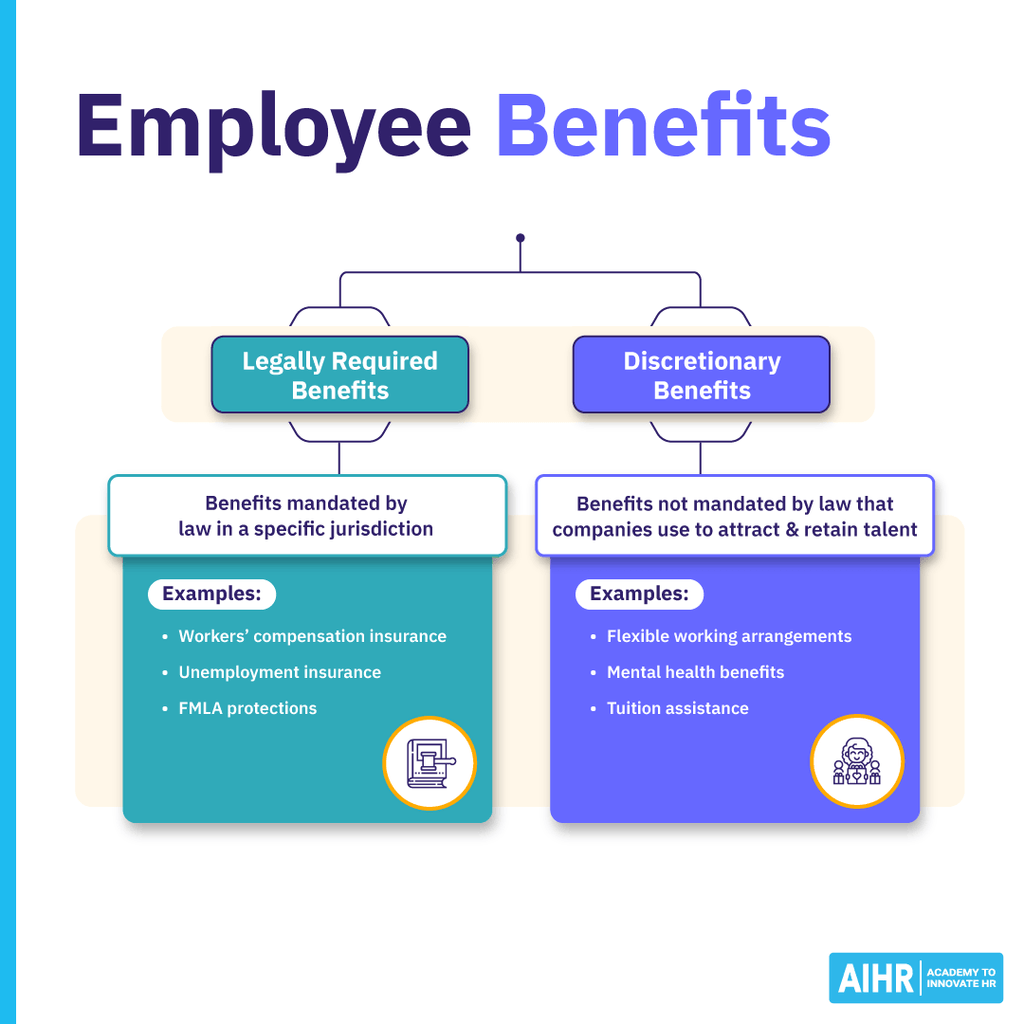
Employee benefits generally fall into three groups:
- Legally required benefits: Employers must provide these by law, which is why they’re also called statutory benefits. In the U.S., they include Social Security and Medicare contributions, unemployment insurance, and workers’ compensation.
- Discretionary benefits: Each employer decides which of these to offer. Common examples are retirement plans, tuition assistance, and health insurance at smaller companies.
- Voluntary benefits: These are benefits employers make available, but employees choose and usually pay for through payroll deductions, such as critical illness insurance or pet insurance.
Employee benefits are factored into total compensation and total rewards, so they play an important role in whether an employer meets employees’ and job candidates’ expectations.
Employee benefits vs. perks
Employee benefits are part of an employee’s total compensation, while perks are extras that make the workplace more enjoyable. Here are the key differences:
Definition
Indirect compensation that supports employees’ health, income, and financial security
Optional extras that improve daily work life and boost morale
Part of total compensation
Yes
No
Legally required
Some, depending on location, like workers’ compensation and unemployment insurance
No
Tax treatment
Many get favorable tax treatment, like employer health coverage and 401(k) plans
Often taxable, unless they’re small and occasional de minimis benefits
Examples
Health, dental, and vision insurance, retirement plans, PTO, parental leave, life and disability insurance
Free meals and snacks, gym memberships, company swag, team outings, event tickets, pet-friendly offices
Why are employee benefits important?
Most organizations will need to provide certain employee benefits to comply with legal regulations, but offering the bare minimum is not enough. When employers have a strong employee benefits package, it translates into the following advantages:
- Attracting talent: Two jobs may offer the same salary but vary greatly in benefits. Your benefits package can make your organization stand out as an employer. In an Indeed Hiring Lab survey, 49% of U.S. job seekers said they were looking for better benefits in a new job, second only to higher pay. Candidates weigh the value of benefits along with base salary to see which job puts them in the best financial position.
- Improving employee retention: Benefit offerings vary by organization, and some suit workers’ needs better than others. When their needs are met, employees are more likely to stay. WorldatWork’s State of Rewards research found that employees rank benefits among their top reasons for staying with an employer, after pay and flexibility.
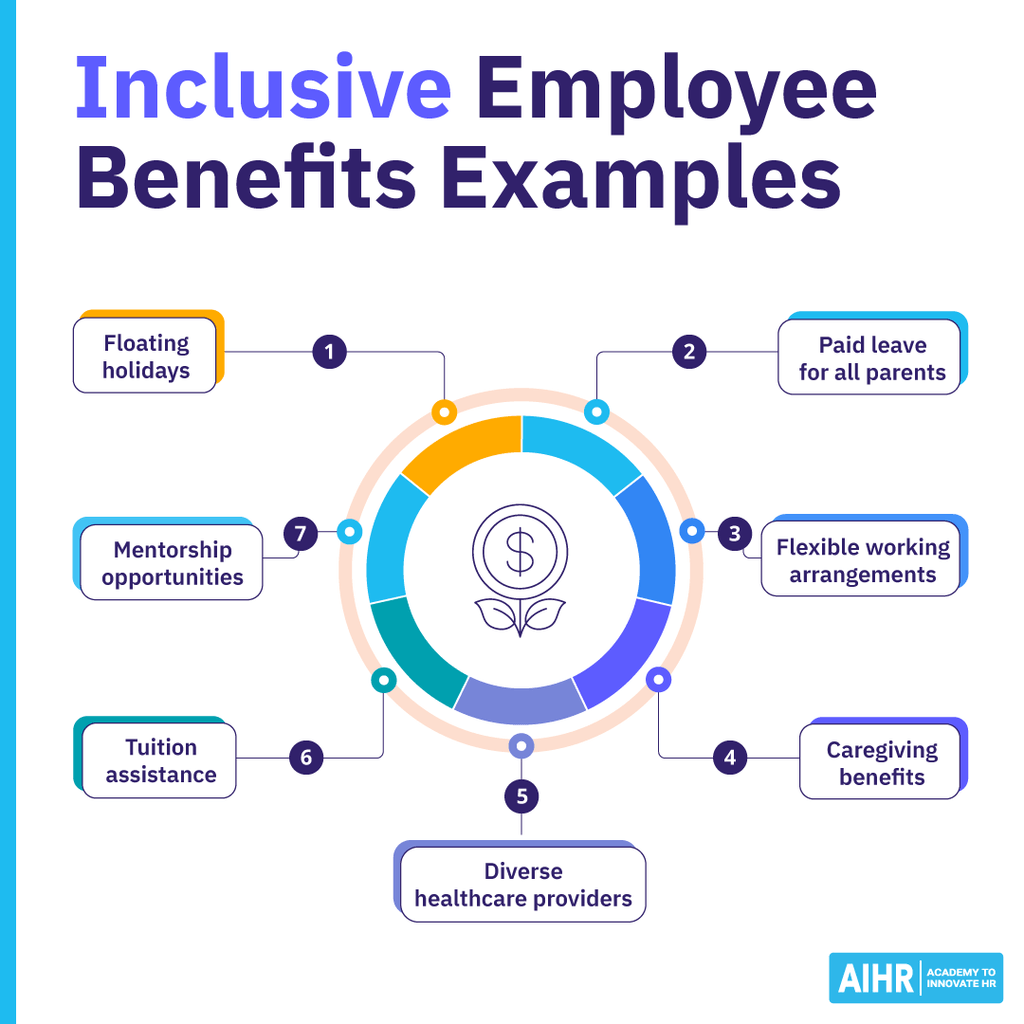
- Fostering inclusion at work: The right selection of benefits can help you promote inclusion in the workplace by showcasing your dedication to meeting the diverse needs and circumstances of your employees. Examples of inclusive benefits include parental leave for all parents, floating holidays, domestic partner benefits, and flexible scheduling.
- Promoting a healthy workforce: Many employee benefits support health and well-being. Access to medical care and wellness programs helps employees take better care of themselves. According to MetLife’s study, holistically healthy employees report being 25% more productive and loyal and take 10% fewer sick days.
- Increasing employee satisfaction and loyalty: Benefits are an investment in employees. When people feel their employer values them, they experience more fulfillment at work. In a Selerix survey of U.S. employees, 82% of those very likely to stay with their employer said they’re very satisfied with their benefits. This strengthens the overall employee experience.
Develop broader total rewards expertise that helps you select, structure, and evaluate benefits that meet employee needs and support business priorities.
AIHR’s Compensation & Benefits Certificate Program gives you the tools to:
✅ Design a total rewards strategy combining compensation, benefits, wellbeing, and recognition
✅ Assess external trends, internal priorities, and stakeholder needs when shaping your rewards philosophy
✅ Use benchmarking and C&B analytics to evaluate offerings and guide improvements
✅ Communicate your strategy, gain executive buy-in, and measure program success
🎯 Explore preview lessons and practical C&B resources in the AIHR Demo Portal.
What are the 4 major types of employee benefits?
Traditionally, employee benefits included medical insurance, life insurance, retirement plans, and disability insurance. Today’s benefit offerings have expanded well beyond this scope, but most benefits still fall into four major types.
- Insurance: This type includes all health insurance (medical, dental, and vision), as well as life insurance and disability insurance. Health insurance helps meet employees’ and their families’ ongoing needs, while life and disability insurance provide funds when unforeseen circumstances strike.
- Retirement plans: Retirement benefits let employees earn employer contributions or save and invest some of their wages for the future. Automatic enrollment and payroll deductions make it easier for employees to prepare for retirement.
- Additional compensation: Employees can earn money beyond their regular salary through commissions, bonuses, and performance awards. Profit-sharing and stock options also fall into this type.
- Time off: People need breaks from their regular work schedules, and competitive employers understand the value of paid time off. Holidays, sick leave, vacations, family leave, bereavement leave, and sabbaticals are all desirable to employees. Many countries and some U.S. states mandate paid leave, and employers that expand their types of leave beyond legal requirements have an attractive benefit to offer.
Legally required employee benefits in the U.S.
Legally required employee benefits, also called mandatory or statutory benefits, are the benefits employers must provide by law. Federal law sets a baseline, and many states add their own requirements.
Social Security and Medicare (FICA)
Retirement, disability, survivor, and health insurance funded through payroll taxes that employers and employees share
All employers
Unemployment insurance
Temporary income for workers who lose their jobs through no fault of their own, funded through federal and state employer taxes
Nearly all employers
Workers’ compensation
Medical care and partial wage replacement for work-related injuries and illnesses
Employers in every state except Texas, where it’s optional for most private employers
Family and Medical Leave Act (FMLA)
Up to 12 weeks of unpaid, job-protected leave per year for qualifying family and medical reasons
Private employers with 50 or more employees, public agencies, and schools
Affordable Care Act (ACA) employer mandate
Affordable health coverage for full-time employees and their dependents, or a potential penalty
Employers with 50 or more full-time or full-time equivalent employees
COBRA
The option to keep group health coverage for a limited time after leaving a job, usually at the employee’s cost
Employers with 20 or more employees that offer a group health plan
Many states go further than federal law, with requirements such as paid sick leave, paid family and medical leave, and short-term disability insurance.
Federal law doesn’t require paid vacation, paid holidays, paid sick leave, or retirement plans, and outside the ACA mandate, health insurance is optional. Since rules vary by state, city, and company size, check the U.S. Department of Labor and your state labor department for every location where you have employees.
Types of employee benefits with examples
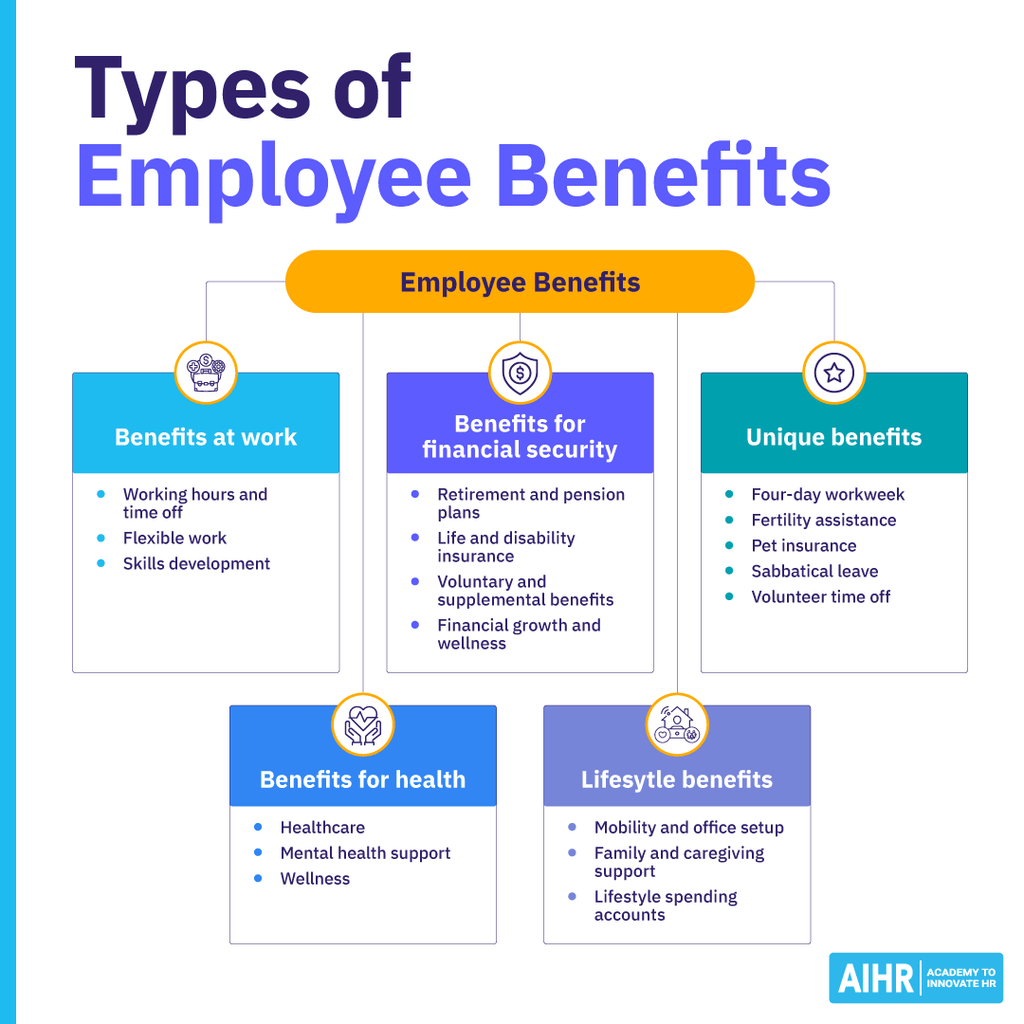
The four major types of employee benefits mentioned above cover the core of most benefits packages. But many of today’s benefits, like flexible work, wellness programs, and childcare support, don’t fit neatly into them. To cover the full range, the list below groups benefits by the role they play in employees’ lives.
- Benefits at work
- Benefits for health
- Benefits for financial security
- Lifestyle benefits
- Unique employee benefits
Let’s take a closer look at each group and the benefits it includes, followed by some unique employee benefits.
Benefits at work
Benefits at work relate directly to how employees experience their jobs, from when and where they work to how they grow in their roles.
Working hours and time off
Vacation, holidays, sick leave, parental leave, and other leave policies are important considerations for employees and job seekers. Paid parental leave, in particular, is growing. According to SHRM’s Employee Benefits Survey, paid parental leave rose to 46% of employers, up 7 percentage points from the previous year.
Unlimited paid time off is an emerging concept that’s gaining traction with innovative employers.
“People are looking for paid time off (PTO) policies that support work-life integration, and companies that encourage employees to take their PTO and don’t expect employees to ‘be on’ while on vacation or taking sick time. PTO is a company benefit, and employers who treat PTO as a time for employees to completely disconnect while out of the office have a competitive edge,” notes Eric Mochnacz, Senior HR Consultant at Red Clover HR.
Flexible work
Work schedules and situations are top considerations for most people. They want control over when and where they do their work.
If employees can work during times they feel most productive and have more control over their work-life balance, they will feel more job satisfaction. Favorable options such as flexible work schedules and remote or hybrid arrangements are now expected.
Skills development
Rapid technological developments make employees aware of how important skills development is, and employers are responding. According to SHRM, 55% of employers now offer leadership and managerial coaching, and employer-sponsored subscriptions to AI tools climbed to 33%.
Many workers look for employers that will support their continuing education endeavors. Benefits such as tuition funding, student loan assistance, or a budget for professional training and certifications do just that.
Benefits for health
Benefits for health support employees’ overall wellbeing at and outside of work, from medical care to mental and physical health.
Healthcare
Medical, dental, and vision insurance plans are traditional healthcare benefits and the foundation of most U.S. benefits packages. In SHRM’s Employee Benefits Survey, 88% of employers rated health-related benefits as very or extremely important.
Many employers also offer health savings accounts (HSAs) or flexible spending accounts (FSAs), which let employees set aside pre-tax money for medical costs. Some companies supplement these with specialized services such as physiotherapy and chiropractic sessions. Others are adding care navigation benefits, such as Garner Health, which uses doctor quality analytics to steer employees toward high-performing providers, helping lower costs while improving the care they receive.
One tech company has taken this a step further. Employees located at Apple’s major campuses have access to on-site doctors, nurses, dieticians, and acupuncturists.
Mental health support
More employers now treat mental health as part of core healthcare. Common benefits include therapy and counseling coverage, mental health apps, and employee assistance programs (EAPs). EAPs offer confidential, professional support for personal problems such as stress, dependent care, legal issues, or relationship challenges.
Wellness
Awareness of overall wellness has grown in recent years. More and more employers understand that supporting employees’ well-being must go beyond medical care, and they have implemented programs to address this. Examples of employee wellness programs vary from a simple gym membership to full-suite solutions that include physical, mental, and financial wellness.
Benefits for financial security
Benefits for financial security help employees plan for the future and prepare for economic challenges, from saving for retirement to handling unexpected costs.
Retirement and pension plans
Saving and investing money for the future can be difficult. Many people would rather participate in an employer-sponsored retirement plan than try to do it on their own.
In the U.S., few private-sector employers still offer a traditional pension plan. The 401(k) is now the most common employer-sponsored plan. It allows employees to invest part of their wages before taxes into the funds of their choice. Employers typically contribute to the employee’s account as well by matching a certain percentage of the employee’s contribution.
Life and disability insurance
In addition to health insurance, other insurance benefits help employees maintain financial stability in the event of adverse events.
Life insurance pays out funds to dependents if an employee passes away. Short-term and long-term disability insurance provide a percentage of wages to a worker who is sick or injured and unable to work for a brief period or indefinitely.
Voluntary and supplemental benefits
Voluntary benefits are offered through the employer, but employees choose whether to enroll and usually pay for them through payroll deductions. Common examples include critical illness, accident, and hospital indemnity insurance, legal plans, and identity theft protection. Some employers and insurers call these ancillary or supplemental benefits, a term that often also covers dental, vision, and life insurance.
Voluntary benefits allow employers to broaden their offerings at little extra cost, while employees gain access to group rates.
Financial growth and wellness
The potential for making extra money appeals to employees. Commissions, bonuses, and performance awards motivate people to work harder. Stock options, stock ownership, and profit-sharing plans help bolster employees’ wealth.
Grocery chain Publix is employee-owned and consistently named one of the best companies to work for. Eligible associates receive a number of stock shares at no cost and have the opportunity to purchase additional shares at certain points throughout the year.
Many employees also need help managing their money. Financial literacy programs, online tools, and one-on-one coaching provide employees with the knowledge and guidance they need to improve their financial situation. Earned wage access (EWA) programs allow employees to access some of their earned wages before payday, helping them handle financial emergencies.
Lifestyle benefits
Lifestyle benefits offer employees support that makes their day-to-day lives easier, from getting to work to caring for their families.
Mobility and office setup
Mobility benefits simplify commuting or working from home.
Commuter benefits include company vehicles and subsidies for public transportation or carpooling. In the U.S., many employers also offer pre-tax transit and parking programs, while commuter subsidies are common in countries like the Netherlands.
Remote work allowances help employees cover the costs of running an office, such as equipment and internet access. Buffer is a fully remote social media management software company. Its employees receive a laptop and $500 to set up their office, plus additional money for a co-working space.
Family and caregiving support
Employers who respect employees’ need to maintain their personal lives will cultivate a more positive employee-employer relationship. Many employees balance work with caring for children, aging parents, or other family members.
Employers can help with on-site childcare centers or subsidies to offset costs, backup care services, eldercare support, and dependent care FSAs that let employees pay for care with pre-tax money. Some employers also offer family stipends, an extra sum of money that helps employees cover family-related expenses like adoption fees, childcare, or household costs.
Lifestyle spending accounts
A lifestyle spending account (LSA) is an employer-funded account that reimburses employees for expenses the employer chooses, such as fitness classes, hobbies, travel, or pet care.
Employees decide how to use the funds, making LSAs a flexible way to meet different needs within a single budget. Unlike HSAs and FSAs, LSA reimbursements are generally taxable income for employees.
Unique employee benefits
Organizations can differentiate themselves from their competitors and become highly desirable places to work by offering unique employee benefits. Here are a few examples.
Four-day workweek
A four-day workweek gives employees an extra day off each week, either by compressing full-time hours into four longer days or by reducing hours to around 32 a week while keeping pay the same.
Employees get more time to rest and handle personal responsibilities, while employers gain a strong recruiting and retention tool, especially in roles where this benefit is still rare.
Fertility assistance
Fertility benefits help employees cover the cost of treatments such as IVF and egg freezing, as well as adoption and surrogacy support. These benefits are becoming more common.
According to the International Foundation of Employee Benefit Plans, 42% of U.S. employers offer fertility benefits. Companies like Uber, Pinterest, and Salesforce provide fertility benefits ranging from $10,000 to $50,000.
Pet insurance
Pet insurance helps employees cover veterinary costs for their pets. Most organizations offer it as a voluntary benefit, meaning employees pay for it but receive access to group rates.
Sabbatical leave
A sabbatical is an extended break from work, usually offered after several years of service. Many employers offer unpaid or partially paid sabbaticals, but fully paid sabbaticals are a rare benefit. Employees can use the time to rest, travel, study, or pursue personal projects, then return to their role. Sabbaticals reward long-term loyalty and help prevent burnout among experienced employees.
Volunteer time off
Volunteer time off (VTO) gives employees paid hours or days to volunteer for causes they care about. It lets employees give back without using their vacation days, and it helps organizations strengthen their community ties and culture.
What to include in an employee benefits package
An employee benefits package includes everything an employer offers beyond salary or hourly pay. A competitive package starts with the benefits employees value most, such as health insurance, retirement plans, and paid time off. From there, you can build a mix that fits your workforce, budget, and location.
A well-rounded offering often includes:
- Medical, dental, and vision coverage: Health insurance for employees and eligible dependents, with the employer covering most of the premium
- Retirement benefits: A 401(k) or similar retirement plan, often with an employer match on part of employee contributions
- Paid time off: Vacation days, paid sick leave, paid holidays, and paid parental leave
- Insurance protection: Basic life insurance, short-term disability coverage, and long-term disability coverage
- Flexible work options: Flexible schedules and remote or hybrid work, where the role allows
- Wellbeing support: An employee assistance program (EAP), mental health coverage, and a wellness stipend
- Learning and development: A learning budget, tuition assistance, or access to training programs
- Voluntary benefits: Optional employee-paid benefits, such as critical illness, accident, or pet insurance.
The right mix depends on what your employees need and what your organization can afford. Benefits account for about 30% of total compensation costs for U.S. civilian workers, according to the Bureau of Labor Statistics. Smaller employers don’t need to match every benefit a large company offers. You can still create value with lower-cost options, such as flexible schedules, extra paid time off, and voluntary benefits.
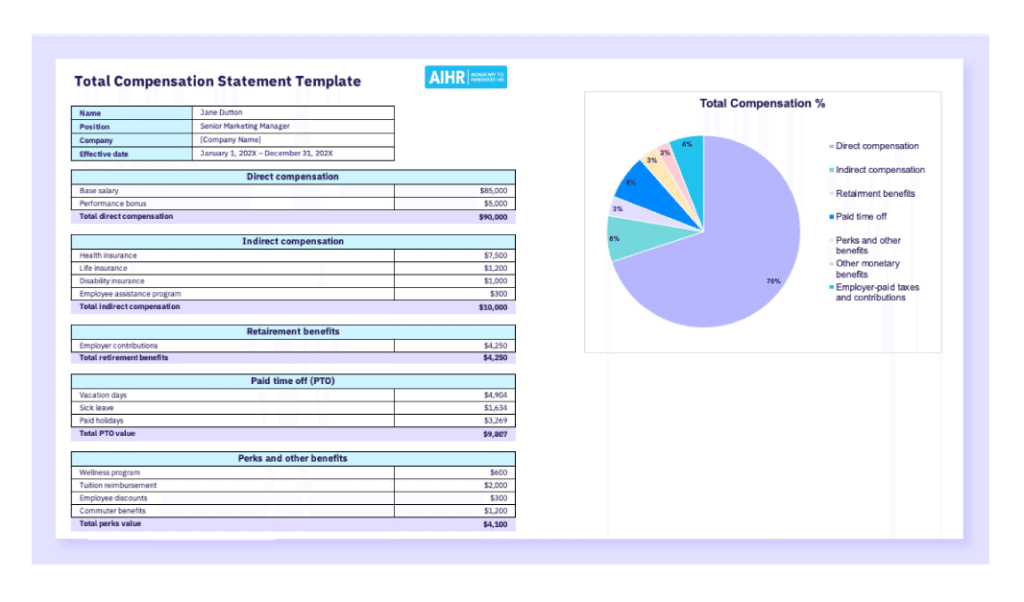
Use employee surveys and benchmarking data to decide what to prioritize. Then, share a total compensation statement so employees can see the full value of their pay and benefits package.
Free employee benefits template collection
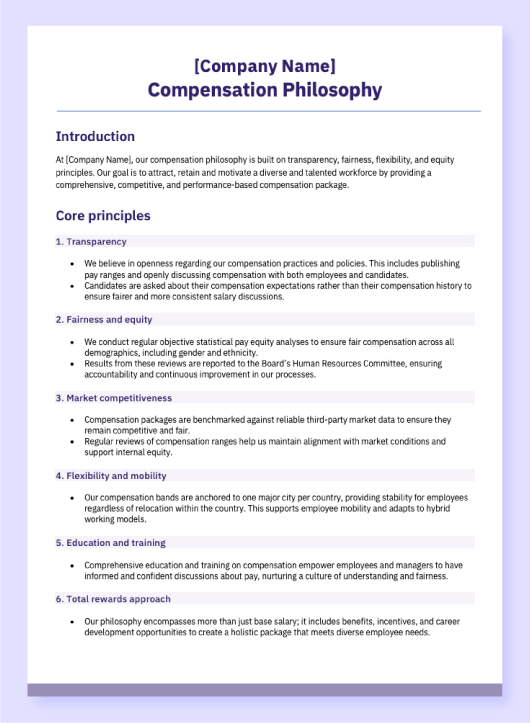
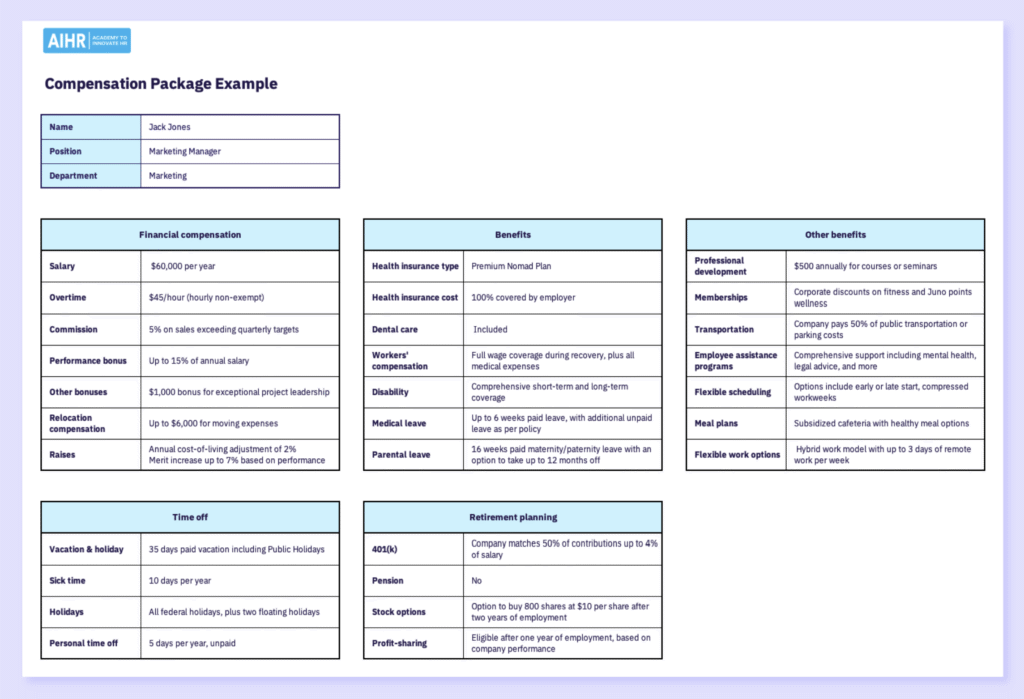
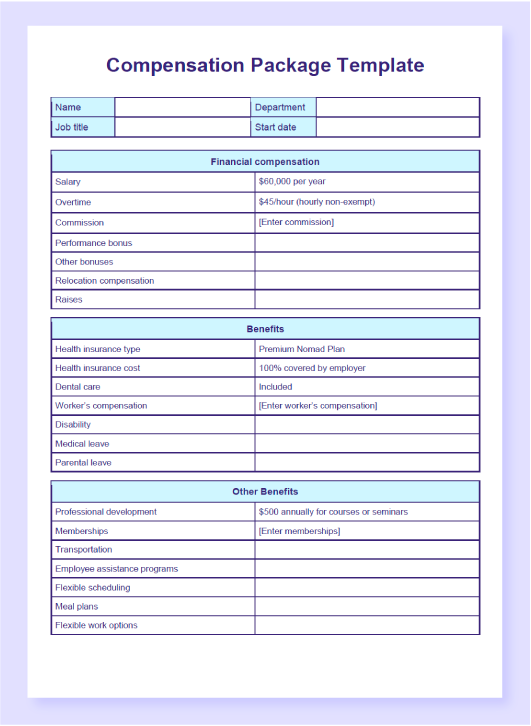
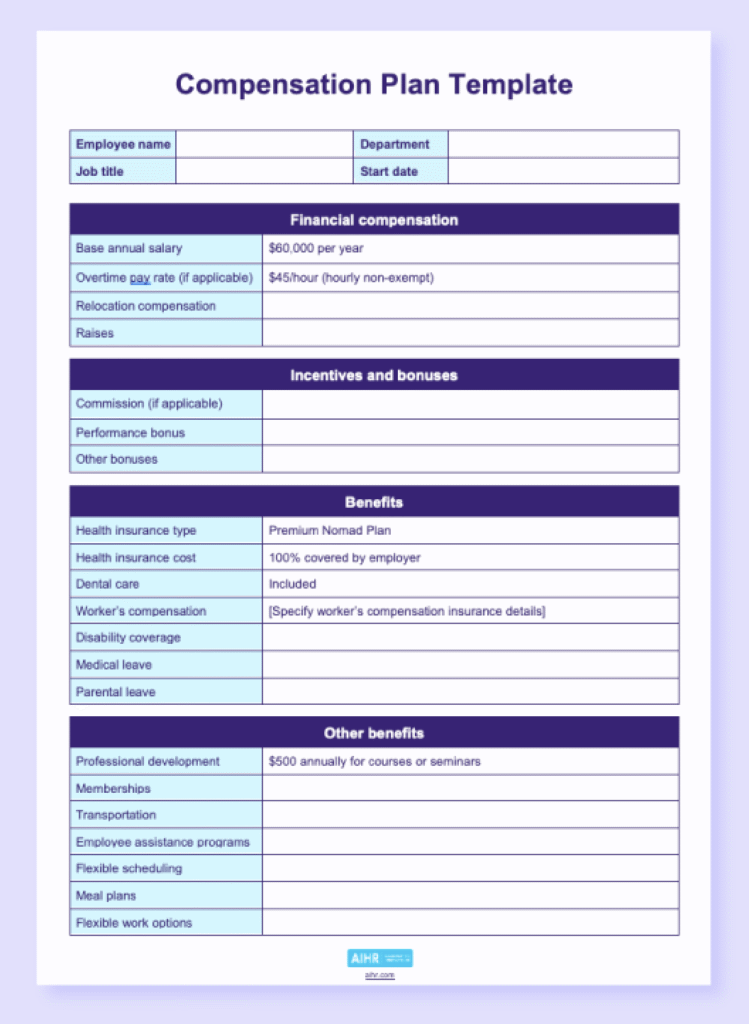
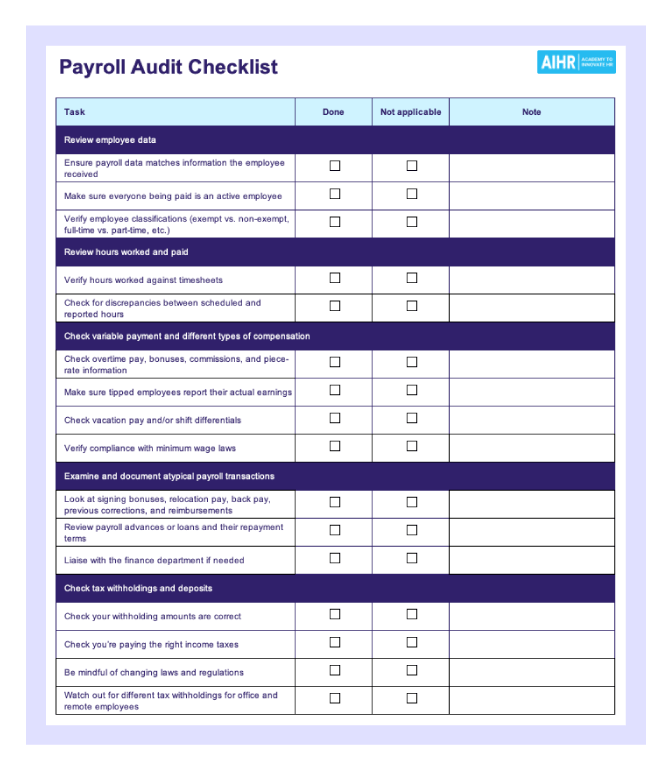
AIHR has assembled a free employee benefits template collection to support you in ensuring comprehensive, competitive employee benefits at your organization. Each template is free to download, customizable, and made to help streamline your compensation and benefits process. You can adapt them to suit your company’s culture and business goals.
Employee benefits best practices
A benefits program only creates value when employees understand, use, and trust it. Keep these best practices in mind:
- Collect employee feedback: Use surveys or focus groups to understand which benefits employees value, what they don’t use, and where the gaps are. Review the results by workforce segment where appropriate, such as role, location, or life stage.
- Build inclusion into your benefits: Review whether they support diverse employee needs, such as caregiving, parenting, family-building, and major life events. Floating holidays, domestic partner benefits, and family-building support can help make your offering more inclusive.
- Improve benefits communication. Employees can’t use benefits they don’t know about. Explain benefits clearly during onboarding, then remind employees throughout the year with one-pagers, emails, and Q&A sessions.
- Make benefits easy to personalize and use. Give employees a choice where possible. For example, a cafeteria plan lets employees choose from a menu of pre-tax benefits, while a lifestyle spending account gives them a set budget to spend on eligible wellbeing needs. Make sure your benefits platform is easy to search, understand, and use.
- Measure the uptake: Track how employees use benefits while protecting their privacy. Combine usage data with employee feedback to see which benefits need better communication, redesign, or removal.
Next steps
Employee benefits should help people stay healthy, feel supported, and manage work and life. Start by checking whether your current offering reflects what employees need, what the market provides, and what the law requires in each location.
To strengthen your approach, AIHR’s Compensation & Benefits Certificate Program helps you build practical skills in total rewards strategy, C&B analytics, benefits design, and stakeholder buy-in.
FAQ
Employee benefits are an indirect form of compensation that employers provide in addition to wages or salary. Common examples include health insurance, retirement plans, paid time off, and life insurance.
The four major types of employee benefits are insurance, retirement plans, additional compensation, and time off. Insurance covers health, life, and disability coverage, while additional compensation includes bonuses, commissions, and profit-sharing.
Health insurance, paid vacation, and paid sick days are among the benefits U.S. job seekers value most. Flexible work arrangements and retirement plans also rank highly.
Yes. Employees’ needs vary by demographics, lifestyle, location, and personal values, so letting them tailor their benefits helps them get the most value. However, all eligible employees must receive legally required benefits, and plans must follow nondiscrimination rules.