

Work ethic examples have changed. Long work hours and skipping paid time off (PTO) no longer indicate strong performance, and don’t guarantee better business results. They also contribute to burnout, which affects work ethic by lowering motivation and engagement. Additionally, Gallup found that global employee engagement fell to 20%, its lowest level in the last five years.
Engaged employees, on the other hand, are more likely to put in consistent effort and demonstrate behaviors associated with a strong work ethic. This article explains the importance of a good work ethic, looks at strong and weak work ethic examples, and provides useful tips on how to improve it at your workplace.
Contents
What is work ethic?
Why a strong work ethic matters in the workplace
30 strong work ethic examples
Poor work ethic examples and what they mean
How to assess work ethic during hiring and performance reviews
Tips for improving work ethic in your organization
What is work ethic?
Work ethic is the mindset, values, and habits that shape how someone approaches their responsibilities at work. You can see it in their everyday behaviors. For example, look at the quality of their work, how well they follow through on commitments, and how they manage time and respond to obstacles.
Work ethic isn’t about how many hours someone works or how busy they appear. An employee who regularly works late may have too much work or may need support when it comes to time management or prioritization.

Why a strong work ethic matters in the workplace
71% of employers look for examples of a good work ethic on candidates’ résumés. For HR, these behaviors also matter after someone joins the organization, because they affect individual, team, and business performance.
A weak work ethic can lead to more performance conversations and informal complaints. Team members may also become frustrated when they have to repeatedly cover for colleagues. Over time, this can affect morale and retention.
A good work ethic can reduce errors, rework, and escalations, as well as support productivity and more predictable delivery. These behaviors build trust between employees and managers, and can improve customer outcomes. They also help create a workplace where people can stay engaged, adapt, and grow.
Strong work ethic requires not just individual effort but support from HR as well. Build the skills you need to create the culture, development opportunities, and talent practices that drive long-term employee engagement and growth.
With AIHR’s Talent Management & Succession Planning Certificate Program, you’ll learn to:
✅ Build a strategic talent management approach that supports business priorities and long-term workforce needs
✅ Identify and develop critical talent through talent mapping, succession planning, and leadership talent pools
✅ Improve engagement and retention through career management and talent mobility practices
✅ Shape an organizational culture that supports employee performance, development, and business goals
🚀 Visit the AIHR Demo Portal to preview lessons and explore practical guides, templates, resources, and other learning tools.
30 strong work ethic examples
So, what does a good work ethic look like in practice? Here are 30 behaviors to look for:
Reliability
- Follows processes: They follow established workflows and suggest improvements that could reduce friction.
- Shows up prepared: They consistently take notes during meetings, understand the agenda, and come ready to contribute ideas.
- Keeps commitments: They treat commitments seriously, from updating an employee’s contract to completing a new talent management strategy.
Accountability
- Owns their mistakes: They tell their team and affected employees if they spot an error, such as a payroll mistake.
- Takes ownership of tasks and outcomes: They take responsibility for tasks and follow-up (e.g., writing a new job description for a vacancy, and using metrics to track how well it performs).
- Focuses on solutions: When something goes wrong, they focus on finding the root cause, fixing the problem, and learning from it, instead of assigning blame.
Punctuality and time management
- Consistently meets deadlines: They complete work on time and flag potential problems as early as possible.
- Manages time well in a remote/hybrid setting: They use tools (such as Google Calendar) to block time and prioritize important tasks.
- Shows up on time or early: They’re always ready for weekly team meetings and scheduled conversations with employees.
Initiative
- Continuously improves ways of working: For example, if managers need a performance review template and none exists, they create one.
- Experiments with and adopt new technology: They make time to explore AI tools. For instance, they might use one to categorize recruiting emails and draft replies.
- Offers help to team members: After completing priority tasks, they offer to help a colleague develop a new benefits package for software developers.
Attention to detail
- Documents their decision-making: They leave clear feedback in a draft remote work policy, so colleagues understand why they made certain edits.
- Thoroughly checks their work: They proofread emails before sending them to candidates during the hiring process.
- Consistently produces high-quality work: They apply the same care to employee questions, policies, and larger projects, such as a talent acquisition strategy.
Integrity
- Refuses shortcuts that compromise quality or ethics: They may use AI to support hiring decisions, but always review its recommendations and make the final decision themselves.
- Is always truthful: They give honest project updates, explain setbacks, and raise ethical concerns when necessary.
- Handles sensitive data responsibly: They protect access to the Human Resources information system (HRIS), employee data, and confidential discussions.
Collaboration
- Communicates effectively: When working with any department on creating a job description, for instance, they clearly explain the goal and target audience.
- Disagrees professionally: During a people strategy meeting, they use facts and real examples to offer a different perspective.
- Encourages inclusivity: During team discussions, they notice who hasn’t spoken and invite them to share their ideas.
Adaptability
- Remains calm amid uncertainty: If rising manufacturing costs are affecting profitability, they explore more cost-effective workforce options and seek clarity from the relevant parties in doing so
- Adapts to changing priorities: They stay engaged when their HR Manager changes talent priorities halfway through a strategy project.
- Embraces change: They explore how AI can reduce repetitive work, such as turning interview notes into easier-to-compare summaries.
Acting on feedback
- Responds positively to feedback: When new hires report unclear onboarding expectations, they identify and act on the changes needed.
- Puts feedback into action: They improve the clarity and tone of HR emails and policies after receiving employee or manager feedback.
- Follow-up: After changing the new-hire orientation, they ask managers and employees if the changes improved the experience.
Continuous learning
- Keeps their knowledge up to date: They read HR blogs, specialist newsletters, and expert commentary to stay updated on relevant industry developments.
- Builds skills where needed: They identify gaps based on their career goals and work to close them. For example, they may develop HR data and reporting skills.
- Learns from real situations: They reflect on a recent employee relations case, for instance, and apply those lessons when handling similar situations in the future.
Poor work ethic examples and what they mean
Poor work ethic means someone regularly struggles with several behaviors associated with good work ethic. For example, they may manage time poorly, ignore feedback, or fail to follow through on commitments.
However, weak work ethic is often a symptom of another problem. Unclear expectations, stress, burnout, role mismatch, excessive workloads, or a poor manager relationship can affect someone’s behavior at work.
Before you make negative assumptions about an employee’s work ethic, take time to understand what’s happening. This helps you address the actual cause, instead of misunderstanding the person. Here’s what poor work ethic can look like in the 10 areas discussed above:
Observable behaviors | Poor work ethic examples |
Reliability | – Allows deadlines to slip – Requires repeated reminders about tasks – Communicates delays or blockers too late or too close to deadlines. |
Accountability | – Doesn’t follow through with what they say they’ll do – Doesn’t take responsibility for their part in a task. |
Punctuality and time management | – Unable to manage several tasks or projects, or prioritize their workload well – Regularly misses deadlines – Lack of sufficient planning and/or follow-through. |
Initiative | – Completes the tasks on their list, but never offers to take on more – Overlooks clear issues or errors in tasks not assigned to them – Ignores process bottlenecks, instead of suggesting improvements. |
Attention to detail | – Doesn’t proofread or double-check their work before submitting it – Fails to spot errors in their own work – Consistently produces low-quality work. |
Integrity | – Often gossips about colleagues to other colleagues – Brings their personal issues into the workplace – Regularly takes shortcuts that affect their work quality – Tends to be dishonest or untruthful (e.g., they may tell a team member a different version of something they told their manager). |
Collaboration | – Struggles to communicate effectively and provide regular updates to their team and manager – Doesn’t work effectively within a team (doesn’t pull their weight, or takes over the entire project). |
Adaptability | – Resists new ways of working, processes, and technologies – Struggles to learn and implement any skills or knowledge – Doesn’t respond well to cross-functional training. |
Acting on feedback | – Treats all feedback as personal criticism – Defensive rather than curious – Hesitant to adjust their approach – The same areas for improvement are mentioned repeatedly in their performance reviews. |
Continuous learning | – Shows no interest in developing professionally or learning new skills – Doesn’t stay up-to-date with industry news or emerging trends – Remains stagnant in their performance. |
How to assess work ethic during hiring and performance reviews
You can assess work ethic at different stages of the employee life cycle. During hiring and performance reviews, focus on observable behaviors and specific evidence rather than assumptions about someone’s character.
Assessing work ethic in hiring
Write behavioral anchors for what strong and weak look like at each level
Work ethic looks different across roles. Before hiring begins, define the specific behaviors you expect to see. For example, reliability for a Recruiter could mean giving hiring managers regular updates and meeting candidate communication timelines. Clear behavioral anchors help interviewers assess candidates against the same expectations.
Ask for a specific past situation rather than a self-description
Avoid simply asking candidates whether they have a good work ethic, as most will expectably say yes. Instead, ask for at least one specific example of when they demonstrated a relevant behavior (e.g., taking ownership of a mistake, or solving a problem unprompted). A strong answer should describe the situation, the action they took, and the outcome.
Score immediately after each answer, rather than at the end of the panel
Score each answer while it’s still fresh in your mind. Waiting until the end of the interview makes it easier for general impressions to influence your assessment. Use the same scoring criteria for every candidate, and record brief evidence explaining each score. For example, note the specific behavior they described, instead of writing that they “seemed reliable”.
Assessing work ethic in performance reviews
Open with a key point
Use evidence, rather than relying on memory or general impressions of an employee’s performance. Review rework examples, relevant peer feedback, and other documented behaviors. Look for patterns across multiple situations, not a single positive or negative event. This gives employees concrete examples to work with, making the performance conversation more useful.
Separate work ethic from output
A strong performer working on a blocked project may achieve different results from someone with enough resources, direction, and support. Consider the conditions around their work, instead of judging their work ethic based on results alone. At the same time, assess behaviors like communication, follow-through, problem-solving, and accountability separately.
Add two process safeguards
Assess work ethic across the full review cycle. This means reviewing notes from regular check-ins and examples from different points in the cycle for a more balanced picture. Additionally, comparing evidence and ratings across managers can help teams apply expectations more consistently and identify cases where a rating needs further discussion.
Tips for improving work ethic in your organization
Here’s how to improve work ethic in your organization today.
Collect real examples from your workplace
Find and share real, positive examples of employees’ work ethic company-wide. This provides useful context for how others can do the same.
At the same time, work with managers to show employees what positive work ethic looks like in each role, and use specific behaviors to support this. For example, instead of saying the company “values reliability”, say: “Answer all social media comments within 24 hours. If you can’t, alert your manager, so they can reassign the task.”
Define positive behaviors in your competency descriptors
Define the behaviors linked to good work ethic in the core competencies for each role. You can do this across different proficiency levels. For example, you could show employees what elementary, intermediate, and expert performance look like in areas such as accountability or adaptability.
Build work ethic into the performance management cycle
Make desired behaviors and ways of working an explicit part of performance expectations. Use regular check-ins to reinforce positive behaviors and address gaps early, give specific, constructive feedback, and agree on clear next steps.
Additionally, you should recognize strong work ethic when you see it. Timely recognition shows employees which behaviors your organization values, and encourages them to repeat them.
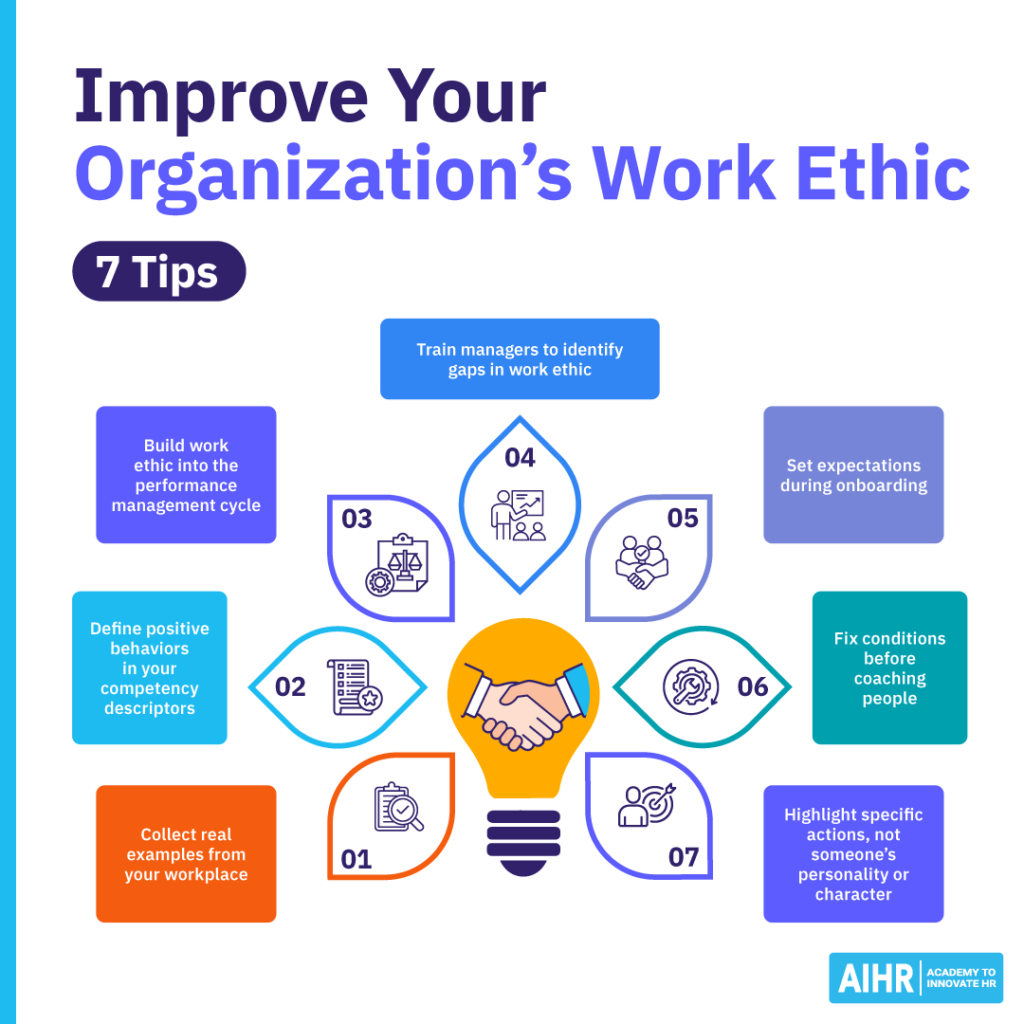
Train managers to identify gaps in work ethic
Train managers to spot behavioral gaps and discuss them constructively. They should know how to separate performance issues from assumptions about someone’s attitude or character.
You should also use development plans to document skills gaps and agreed-upon actions. Include training, mentoring, and learning resources that support the employee’s development and career goals.
Set expectations during onboarding
Show employees what good looks like from day one. Include expectations in onboarding materials, early manager conversations, and objectives, and use practical examples of what success looks like in their specific role. This creates a solid foundation that ensures employees understand your organization’s standards and are set up to thrive.
Fix conditions before coaching people
Workplace conditions can affect employee behavior. Unclear expectations, ineffective management, or an excessive workload can all hurt performance. Check for these conditions before assuming the employee has a poor work ethic, and ensure all staff have clear goals, realistic workloads, the right resources, and appropriate manager support.
Highlight specific actions, not someone’s personality or character
Keep conversations about work ethic focused on observable behavior. Instead of telling someone they’re “unreliable”, describe what happened. For example, you could say: “The last three reports were submitted after the deadline, and I didn’t receive an update beforehand.” Specific examples make feedback clearer and give employees something concrete to improve.
Next steps
A strong work ethic becomes easier to assess when you define it through observable behaviors. Use hiring, onboarding, performance reviews, and development conversations to reinforce those expectations consistently.
Building these skills is also part of effective talent management. AIHR’s Talent Management & Succession Planning Certificate Program covers talent strategy, development, succession planning, and creating an environment where talent can thrive.