

Talent acquisition innovation is becoming essential for organizations that want to stay competitive, because the talent market is changing fast. Technology evolves, skills expire and change, and working-age populations are slowly shrinking. 93% of talent acquisition (TA) professionals say they plan to increase their use of AI this year, according to LinkedIn. While that intention can certainly lead to more innovation in TA teams, using AI alone isn’t enough.
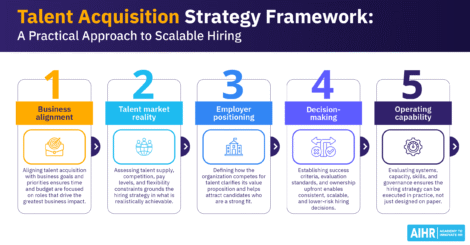
This article explores some of the key drivers of innovation in the talent acquisition space today. We also unpack various real-life examples of TA innovation in action and share a quick checklist for TA leaders to get started.
Contents
Key drivers of innovation in talent acquisition
6 examples of talent acquisition innovation
A TA leader’s checklist for successful talent acquisition innovation
Measuring the ROI of talent acquisition innovation initiatives
Key drivers of innovation in talent acquisition
Let’s unpack five major forces pushing organizations to rethink how they attract and hire talent:
AI
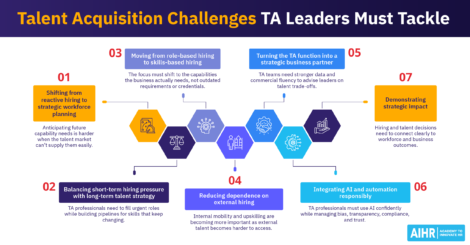
AI is undoubtedly the number one driver of innovation in talent acquisition. Recent research shows that AI adoption in talent acquisition has now officially moved from experimentation to execution at scale. In its research, the Josh Bersin Company identifies five AI-enabled talent acquisition trends, including:
- Leading organizations are replacing AI pilots with enterprise-wide talent architectures.
- The role of the recruiter is switching from processor to strategic orchestrator.
- Talent acquisition is moving from filling jobs to building long-term organizational capability.
- Business outcomes rather than operational hiring metrics are becoming the primary measure of success.
- Strategic workforce planning is becoming AI-driven, cross-functional, and data-connected.
Emerging skills
Research by Lightcast shows that 32% of skills in the average job changed in just three years. According to their report, three factors drive the pace of the skills change:
- Generative AI: As this technology has found its way into virtually every industry, it forces people in both technical and non-technical sectors to acquire new skills.
- Green technology: Like generative AI, this type of tech has also permeated almost every business area, creating a growing demand for sustainability skills. Surprisingly, this also affects unexpected roles, such as supply chain management, case workers, and data scientists.
- Cybersecurity: This is another example of a field that impacts virtually every industry today. The demand for cybersecurity skills has surged substantially, with some of the biggest rises in biomedical roles (over 570%) and amongst laboratory technicians (almost 400%).
Gig economy
The gig economy refers to work performed through short-term, project-based, freelance, or contract arrangements rather than traditional full-time employment. For TA leaders, its growth changes how organizations think about workforce capacity. Hiring no longer has to mean filling every skills gap with a permanent employee.
According to Business Research Insights, the global gig economy market size is currently around 674 billion USD, a number that rivals the GDP of countries like Saudi Arabia and Switzerland. By 2035, this market’s value is projected to reach 2,522 billion USD. Tapping into this market can be a great way for organizations to scale instantly, access specialized expertise easily, and meet candidate preferences.
Evolving candidate expectations
While some candidate expectations remain the same over time (e.g., transparency about salary and benefits), others change, influenced by, for instance, technological developments.
Communication is one such example. Candidates always wanted clear and timely messages from the company they applied to, but with the increasing use of AI in recruitment processes, they expect the communication to be human as well.
Expectations about how the hiring process works are changing, too. Research from Criteria Corp shows that 68% of job seekers are open to abandoning the resume altogether and prefer an application process based on skills assessments and interviews.
Focus on skills over roles
Developments such as those mentioned above, including emerging, fast-changing skills and evolving candidate expectations, push organizations to reconsider traditional role-based hiring and switch to skills-based hiring.
Role-based hiring has two main issues in today’s work environment; the first one is that companies often don’t know whether the requirements used to find the right candidate are actually predictive of performance. The second, and perhaps even more important one, is that by using criteria such as degrees, years of experience, and specific credentials, organizations may inadvertently filter out candidates who could have been great for the job.
Organizations that fail to innovate their talent acquisition processes risk falling behind their competitors and experiencing a negative impact on their business performance as well. Think, for instance, of:
- An increased time to hire and time to fill: Not meeting candidate expectations, such as clear, human communication and timely answers, will affect your time to hire and time to fill, as it will take you longer to find people willing to work for your organization.
- A growing skills gap: Sticking to role-based hiring in a time when new, in-demand skills keep popping up risks widening the skills gap in your workforce, affecting your organization’s productivity and its capacity to meet its business goals.
- Higher early employee turnover: Both of the elements mentioned just above (not meeting candidate expectations and sticking to role-based hiring) can lead to a higher turnover among new employees. For instance, because people have a different idea of what it means to work at your organization and become disappointed, or because they were hired based on credentials that aren’t predictive of their performance on the job, and don’t possess the skills the company actually needs.
- A less efficient talent acquisition team: Failing to use AI and automation to optimize your hiring practices will probably leave your team with a considerable amount of manual tasks to do, still, preventing it from becoming truly strategic and hence unable to increase its business impact.
6 examples of talent acquisition innovation
What does innovation in talent acquisition look like in real life? Let’s dive into some practical examples of TA innovation in action.
1. AI-powered sourcing and recruitment
Talent acquisition is one of the HR functions most actively experimenting with AI and automation. These technologies can help TA teams reduce manual work, personalize candidate communication, and move candidates through the hiring process faster.
Examples include:
- Sourcing: Companies use generative AI to, among other things, personalize job descriptions, remove bias, and curate personalized recruitment marketing content.
- Large-scale hiring: Walmart Mexico and Central America, which hires around 17,000 associates a year, replaced manual resume screening with skills-based assessments from AI hiring platform Vervoe. Time to hire dropped by half, from 14 days to 7, and attrition in its retail operations fell to single digits.
- Candidate engagement: Companies use chatbots and conversational AI assistants to be able to answer candidate questions in real time and 24/7, provide application updates, and personalize communication touch points to minimize candidate drop-off during the hiring process.
- Onboarding: HR tech firm OC Tanner partnered with an AI software platform, Enboarder, to streamline its pre- and onboarding processes across different departments. The results were strong; more than 150,000 USD saved in admin time annually, and an engagement rate of 70% among new hires and 68% among managers.
2. Skills-based hiring and assessment
Organizations are increasingly using skills-based hiring as part of their talent acquisition strategy. Put simply, this means designing the hiring process around the skills the organization needs to deliver business results.
These companies define work in terms of tasks and associated skills. This allows them to be more flexible and accurate when matching people with business outcomes.
AI and assessment technology can support this shift by helping organizations evaluate candidates based on demonstrated skills rather than resume signals alone.
3. Predictive talent analytics
Predictive analytics helps TA teams use existing data to make more proactive hiring decisions. Instead of reacting to vacancies as they appear, organizations can use predictive insights to anticipate workforce needs, build talent pipelines, and identify potential hiring risks earlier.
In practice, predictive analytics can help organizations:
- Anticipate future talent needs and build pipelines before vacancies open
- Identify employees who may be a flight risk and take action to retain them
- Standardize parts of the recruitment process using data-backed success indicators.
For example, Wells Fargo used a predictive analytics model to standardize its selection process. Assessments built around indicators of on-the-job success helped the company screen candidates and prioritize those most likely to perform and stay. This reportedly improved retention by 12% for personal bankers and 15% for tellers.
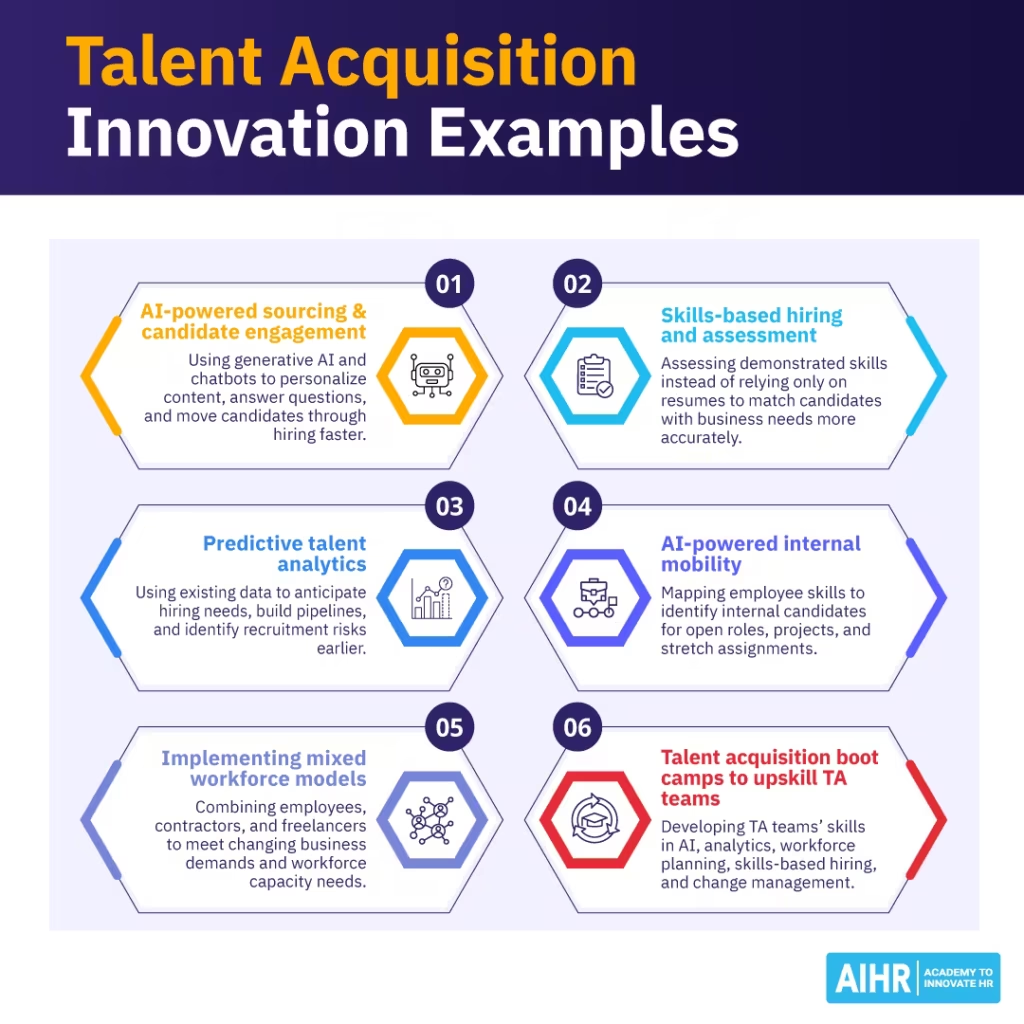
4. AI-powered internal talent marketplaces
Internal mobility becomes more strategic when organizations use AI to map employee skills and identify transferable capabilities.
AI-powered internal talent marketplaces can help TA teams uncover hidden talent pools inside the organization. Instead of looking externally by default, recruiters can identify employees who may be a strong fit for open roles, projects, or stretch assignments.
This reduces your dependence on external hiring, lowers your costs, improves employee engagement and retention, and helps you fill certain skill gaps faster.
5. Flexible workforce models
A successful talent acquisition strategy in today’s world of work should include a staffing model that integrates multiple types of workers to be as resilient as possible in meeting changing business demands. This includes full-time and part-time employees, contractors, and freelancers.
You can use AI tools to run different ‘what if’ scenarios to anticipate what capacity you’d need to respond and adapt to various possible changes. Then you can make informed decisions about when to hire, contract, redeploy, or reskill.
6. TA team capability building
Successful talent acquisition innovation requires a TA team that knows how to evaluate tools, interpret data, redesign processes, and influence hiring managers. That means innovation also depends on upskilling in areas such as AI in recruitment, skills-based hiring, talent analytics, workforce planning, and change management.
Organizations can support this by investing in structured team development opportunities, such as AIHR’s Talent Acquisition Boot Camp or AI for Talent Acquisition Boot Camp. This helps TA teams build a shared understanding of new tools, data, and hiring practices, so they can apply them consistently across the function.
A TA leader’s checklist for successful talent acquisition innovation
As we’ve just seen, innovation in talent acquisition can take many different shapes and forms, from implementing a new tool to structured team upskilling. But how do you get started?
Below is a quick checklist for TA leaders to use when they want to kickstart innovation in their own organization:
- We have defined the business problem TA innovation must solve.
- We have identified the hiring challenge or process gap we want to improve.
- We have mapped the current recruitment process end-to-end.
- We have identified the biggest friction points in the hiring funnel.
- We have involved key stakeholders outside the TA team, such as HR, IT, legal, finance, and hiring managers.
- We have chosen one focused pilot instead of trying to change the full process at once.
- We have set baseline metrics for speed, cost, quality, candidate experience, and adoption.
- We have defined what success will look like after the pilot.
- We have clarified who owns implementation, communication, training, and measurement.
- We have set up a feedback system to gather input from recruiters, hiring managers, candidates, and other users.
- We have a process to review results and decide whether to scale, adjust, or stop the initiative.
The success of your talent acquisition innovation initiatives also depends on whether your team has the capabilities to execute them. Download AIHR’s Talent Acquisition Capability-First Transformation Roadmap to structure your team’s development and build the skills needed to support hiring innovation at scale.
Measuring the ROI of talent acquisition innovation initiatives
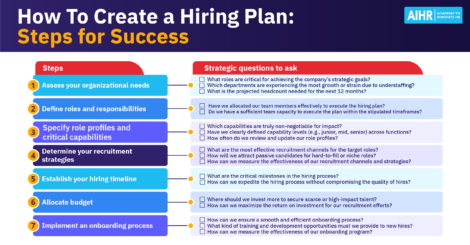
Talent acquisition innovation needs a clear business case before launch and a clear measurement plan after implementation. Leadership will want to know why the investment is needed, what it will improve, and how TA will prove impact over time.
This is especially important when innovation requires new technology, process redesign, or team upskilling. Even when the need for change is clear, TA leaders still need to show how the initiative supports business priorities.
Here’s how you can measure the return on investment (ROI) of TA innovation initiatives:
- Define the problem: Be specific about what the initiative is meant to solve. For example, are you trying to reduce time to hire, improve quality of hire, increase candidate engagement, lower recruiter admin time, or reduce external hiring costs?
- Set your benchmarks: Capture your current performance before introducing a new tool, process, or hiring model. These benchmarks create your “before” picture. For example, you could track current time to hire, cost per hire, candidate drop-off rates, recruiter admin hours, early turnover, or hiring manager satisfaction.
- Define KPIs to evaluate effectiveness: Choose a small set of metrics that match the initiative. Examples could be:
- Adoption rates
- Reduction in time to hire
- Saved admin time
- Cost per hire
- Quality-of-hire scores
- Retention rates
- Early employee turnover
- Candidate satisfaction ratings.
- Connect recruiting metrics to business outcomes: Explain how improvements in TA performance affect the business. For example, reducing time to hire can lower vacancy costs and help teams boost productivity faster. Improving the quality of hire can support team performance. Lowering early turnover can reduce replacement costs.
- Review results after implementation: Compare post-launch results against your benchmarks at set intervals, such as 30, 60, and 90 days. Use the findings to decide whether to scale, adjust, or stop the initiative.

A final word
Talent acquisition innovation – or lack thereof – can make or break your company’s TA strategy. In a world of work where new skills pop up constantly, (AI) tech developments go faster than ever, and candidate expectations are changing, innovation is a must.
Failing to try to innovate can have serious consequences for the business. Higher employee turnover, a longer time to hire, and lower productivity rates are just a few examples of what this may look like. Things don’t have to go perfectly right away; what matters is that you start innovating with your TA team and ‘do new things.’