
An HR annual calendar helps you turn a busy year of people priorities into a clear, manageable plan.
When each quarter and month has a clear theme, your HR team and managers know where to focus, and employees experience people programs that build on each other.
This guide gives you a theme for every quarter and month of 2027, the AIHR templates to put each one into practice, and the key events and observances to plan around. To get started faster, download our free HR annual calendar in Excel, along with every template in this guide, and adapt them to your organization’s yearly cycle.
Contents
What is an HR annual calendar?
Annual HR calendar: Themes by quarter and month
Free HR annual calendar template
How to create an HR annual calendar
What is an HR annual calendar?
An HR annual calendar is a 12-month plan of your organization’s key people activities and deadlines. It helps you see what needs to happen, when preparation should start, and how each activity connects to wider business priorities.
You may also hear it referred to as an HR calendar of activities or an HR planning calendar. Whatever the name, its purpose is the same: to help you coordinate HR work with the needs of the business and the people involved.
Most HR annual calendars include activities across four areas:
- Business and workforce planning: Hiring plans, HR budgets, and reviews of the skills and roles your organization needs.
- Talent and development: Goal setting, performance reviews, pay reviews, promotions, learning programs, and succession planning.
- Employee experience: Engagement surveys, wellbeing initiatives, recognition programs, and employee communications.
- Compliance and administration: Statutory reporting, policy reviews, payroll deadlines, mandatory training, and audits.
A useful calendar also shows how these activities fit together. For example, scheduling pay reviews after performance discussions gives managers time to use review outcomes in compensation decisions. Completing workforce planning before budget discussions also helps teams make clearer hiring and resourcing requests.
Giving each quarter and month a theme takes this a step further. Instead of treating goal setting, check-ins, and reviews as separate events, a theme connects them into one story that employees and managers can follow throughout the year.
An annual HR calendar helps you stay ahead of key deadlines, recurring activities, and shifting business priorities. Having the right tools and resources makes it easier to plan earlier and keep day-to-day HR work organized.
With AIHR’s Demo Portal and Resource Library, you can:
✅ Explore practical HR templates and planning resources
✅ Preview lessons across a range of HR topics
✅ Access tools and guides you can apply in your day-to-day work
✅ Discover learning that supports the priorities on your HR calendar
💡 Explore AIHR’s free resources and preview lessons to support your HR planning throughout the year.
Annual HR calendar: Themes by quarter and month
Planning your HR priorities for 2027? Use this calendar as a starting point. Each quarter has a broad workplace theme and a short checklist, and each month narrows that theme into one focus area, with templates you can use straight away and the key events and observances to plan around.
The themes follow a calendar-year business cycle, so shift them if your fiscal year starts at a different point. U.S. federal holidays are included, with dates adjusted where they fall on weekends. Add the public holidays, observances, and compliance deadlines that apply where your employees work.
Quarter | Theme | Monthly focus |
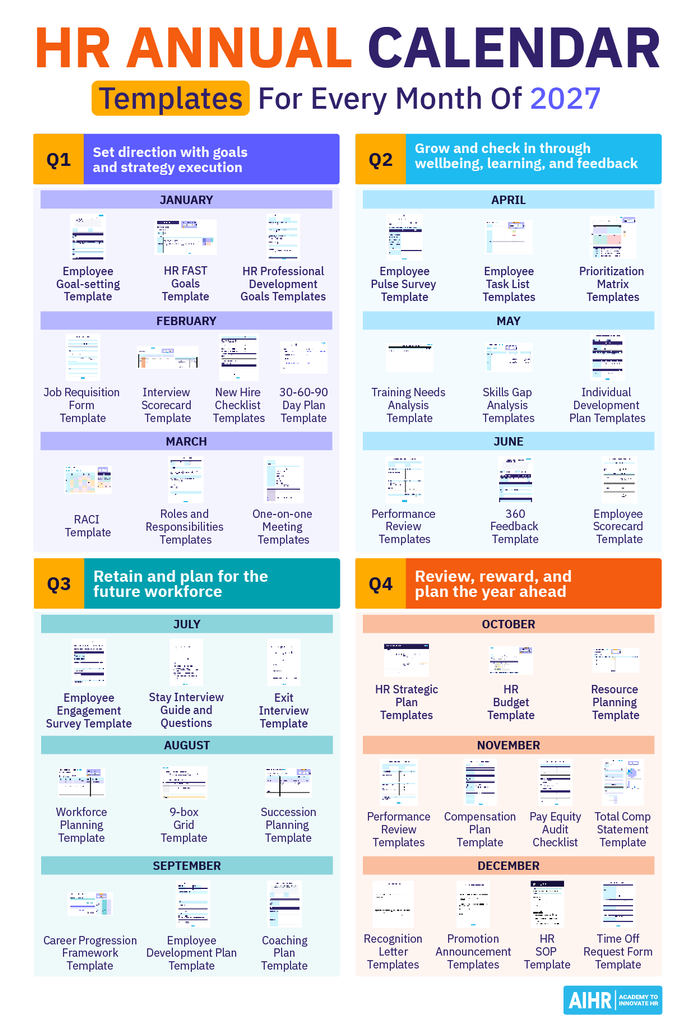
Q1 (January–March) | Set direction with goals and strategy execution | January: Goal setting and alignment February: Hiring and onboarding for the year ahead March: Roles, accountability, and team productivity |
Q2 (April–June) | Grow and check in through wellbeing, learning, and feedback | April: Workload, stress, and wellbeing May: Learning and skills development June: Mid-year check-ins and feedback |
Q3 (July–September) | Retain and plan for the future workforce | July: Engagement and retention August: Workforce and succession planning September: Career growth and internal mobility |
Q4 (October–December) | Review, reward, and plan the year ahead | October: HR strategy and budget for next year November: Performance reviews and rewards December: Recognition, reflection, and readiness for January |
Q1 (January–March): Set direction with goals and strategy execution
Q1 sets the tone for the whole year. When HR helps leaders turn strategy into clear goals, roles, and hiring plans early, employees spend the rest of the year working on what matters instead of guessing. Use this quarter to agree on priorities, cascade goals, and give managers the structure they need to start strong.
January
When employees start the year without clear goals, they fill their calendars with whatever feels urgent, and by March, it’s hard to tell whether their work moved the business forward. Use January to translate company priorities into team and individual goals, so everyone knows what success looks like this year. For HR, this is also the month to set your own team’s goals and start employee productivity planning with leaders.
Templates to use in January
- Use this employee goal-setting template to help employees set clear, measurable goals for the year and link each one to a team priority.
- Use this HR FAST goals template to set your HR team’s own goals and review them frequently throughout the year.
- Use these HR professional development goals templates to plan the skills your HR team will build this year.
Key events and observances in January
- [Holiday] Jan. 1: New Year’s Day (federal holiday). Share any policy or benefit changes that take effect in the new year.
- [Observance] Jan. 1–31: National Mentoring Month. Launch or relaunch a mentoring program and match mentors with mentees around their new goals.
- [Holiday] Jan. 18: Martin Luther King Jr. Day (federal holiday). Plan a day of service or a learning session on inclusion.
- [Observance] Jan. 28: Data Privacy Day. Remind employees how you handle their personal data and refresh data protection training.
February
Once goals are set, you can see which skills and roles the business needs to deliver them. February is the time to turn your hiring plan into open roles and make sure new hires become productive quickly, because the first few months shape how long people stay. Focus on a consistent interview process and an onboarding experience that runs well beyond the first week.
Templates to use in February
- Use this job requisition form template to document approved headcount and role requirements before roles go live.
- Use this interview scorecard template so every interviewer rates candidates against the same criteria.
- Use these new hire checklist templates to plan every step from offer acceptance to the end of the first month.
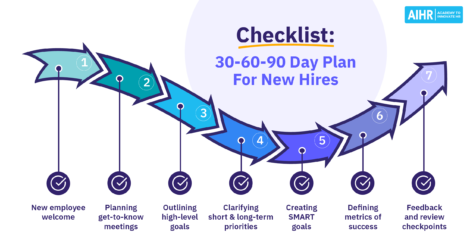
- Use this 30-60-90 day plan template to help managers set early goals and expectations with new hires.
Key events and observances in February
- [Observance] Feb. 1–28: Black History Month. Partner with employee resource groups on programming, and review representation in hiring and promotion.
- [Observance] Feb. 6: Lunar New Year. Accommodate time-off requests and avoid scheduling critical deadlines around the celebration.
- [Observance] Around Feb. 8: Ramadan begins (dates depend on moon sighting). Offer flexible scheduling, move team lunches and events where possible, and brief managers ahead of time.
- [Holiday] Feb. 15: Presidents’ Day (federal holiday). Many private employers stay open, so confirm that your holiday schedule has been communicated.
March
By March, the year’s plans are in motion, and gaps in ownership start to show up as missed handoffs and duplicated work. Use this month to clarify who owns what, especially in teams that have changed structure or taken on new goals, and give managers a regular rhythm for checking in on priorities. As Q1 closes, review progress on January’s goals and adjust any that no longer fit.
Templates to use in March
- Use this RACI template to clarify who is responsible, accountable, consulted, and informed on key projects.
- Use these roles and responsibilities templates to document expectations for new or changed roles.
- Use these one-on-one meeting templates to help managers run focused check-ins on goals, workload, and support.
Key events and observances in March
- [Observance] Mar. 1–31: Women’s History Month. Pair celebratory programming with a review of promotion and development data by gender.
- [Observance] Mar. 5: Employee Appreciation Day. Coordinate recognition across teams so no group is overlooked.
- [Observance] Mar. 8: International Women’s Day.
- [Observance] Mar. 20: International Day of Happiness. Use it as a prompt to ask teams what makes their working day better.
Q2 (April–June): Grow and check in through wellbeing, learning, and feedback
Q2 is when the year’s plans turn into day-to-day work, and when early signs of pressure start to show. Use this quarter to check how people are coping, invest in the skills they need, and hold honest mid-year conversations about progress. Feedback quality matters here, too. Gallup data shows that 80% of employees who report receiving meaningful feedback in the past week are fully engaged.
April
When workloads stay high for months, productivity drops and burnout follows, often in the teams delivering your most important goals. April is a good month to check how employees are coping, because you still have time to adjust priorities before mid-year. Ask employees about workload and support, then work with managers to pause or remove low-value work.
Templates to use in April
- Use this employee pulse survey template to run a short check-in on workload, stress, and support.
- Use these prioritization matrix templates to help managers and teams decide what to focus on and what to pause.
- Use these employee task list templates to help employees plan and track their weekly work.
Key events and observances in April
- [Observance] Apr. 1–30: Stress Awareness Month. Promote your Employee Assistance Program (EAP) and mental health resources, and review workload data for teams under sustained pressure.
- [Observance] Apr. 21: Administrative Professionals Day. Recognize administrative professionals and check they have the tools and development opportunities they need.
- [Observance] Apr. 22: Earth Day and Take Our Daughters and Sons to Work Day. Both fall on the same day in 2027, so coordinate facilities, safety briefings, and communications.
- [Observance] Apr. 28: World Day for Safety and Health at Work. Review incident trends and refresh safety training where needed.
May
As the business changes, the skills employees needed in January may not be the ones they need by the end of the year. Use May to identify skill gaps against your goals and turn them into targeted learning plans, so your L&D budget goes where it will have the most impact. Involve managers early, since they see skill gaps in daily work before they show up in performance data.
Templates to use in May
- Use this training needs analysis template to identify where learning will have the greatest impact.
- Use these skills gap analysis templates to compare current skills with the skills your goals require.
- Use these individual development plan templates to help employees turn skill gaps into personal learning goals.
Key events and observances in May
- [Observance] May 1–31: Mental Health Awareness Month. Remind employees of mental health coverage and EAP access, and equip managers to recognize signs of distress.
- [Observance] May 1–31: Asian American, Native Hawaiian, and Pacific Islander Heritage Month. Partner with employee resource groups on programming, and review representation in development programs.
- [Observance] May 21: World Day for Cultural Diversity for Dialogue and Development. Invite teams to share the perspectives and working styles they bring.
- [Holiday] May 31: Memorial Day (federal holiday).
June
Mid-year is your chance to course-correct while there’s still time to change the outcome. Instead of waiting for the year-end review, use June to help managers hold short, honest conversations about progress, priorities, and the support employees need. Revisit the goals employees set in January and update the ones that no longer reflect the business.
Templates to use in June
- Use these performance review templates, including the quarterly and self-review versions, to structure mid-year conversations.
- Use this 360 feedback template to gather input from peers and direct reports alongside the manager’s view.
- Use this employee scorecard template to track progress on goals and key metrics in one place.
Key events and observances in June
- [Observance] Jun. 1–30: Pride Month. Pair visibility with a review of benefits and policies for LGBTQ+ employees and their families.
- [Observance] Jun. 1–30: National Safety Month. Use it to complete any outstanding safety training before mid-year.
- [Holiday] Jun. 18: Juneteenth, observed (federal holiday). Jun. 19 falls on a Saturday, so the federal observance moves to Friday.
Q3 (July–September): Retain and plan for the future workforce
Q3 is the planning quarter for the year ahead. With half-year data in hand, you can see who is engaged, who may be thinking of leaving, and which roles the business will need next. Use this quarter to act on engagement findings, plan your future workforce, and give employees a clear view of where their careers can go, so you go into budget season with evidence rather than assumptions.
July
Summer is a common time for employees to rethink their jobs, especially after mid-year conversations. Use July to understand what keeps your people engaged and act visibly on what you hear, because employees stop answering surveys when nothing changes. Pay close attention to high performers and critical roles, where an unexpected resignation hurts most.
Templates to use in July
- Use this employee engagement survey template to measure engagement and identify the drivers to act on.
- Use this stay interview guide and questions to learn what keeps your top performers in their roles.
- Use this exit interview template to capture consistent insights from employees who leave.
Key events and observances in July
- [Observance] Jul. 1–31: Disability Pride Month. Review how accessible your workplace, tools, and career paths are for employees with disabilities.
- [Holiday] Jul. 5: Independence Day, observed (federal holiday). Jul. 4 falls on a Sunday, so the federal observance moves to Monday.
- [Observance] Jul. 25: National Hire a Veteran Day. Review veteran recruitment channels and support programs.
- [Observance] Jul. 29: National Intern Day. Recognize intern contributions and schedule conversion discussions for high performers.
August
Before budgets are set for next year, you need a clear picture of the roles, skills, and headcount the business will need. Use August to compare your current workforce with future needs and identify the critical roles that would hurt most if they were left empty. When you complete this work before budget discussions, HR walks in with a plan instead of reacting to requests.
Templates to use in August
- Use this workforce planning template to map current headcount and skills against future business needs.
- Use this 9-box grid template to assess performance and potential before succession discussions.
- Use this succession planning template to identify and develop successors for critical roles.
Key events and observances in August
- [Observance] Aug. 1–31: National Wellness Month. Encourage employees to take their vacation time and preview wellbeing benefits for the coming year.
- [Observance] Aug. 12: International Youth Day. Review your early-career hiring, internships, and apprenticeships.
- [Observance] Aug. 26: Women’s Equality Day.
September
When employees can’t see a future in your organization, they start looking for one elsewhere. Use September to show people where their careers can go through clear career paths, development plans, and regular coaching from their managers. This work also strengthens year-end reviews, because development conversations land better when employees already know their options.
Templates to use in September
- Use this career progression framework template to show employees the paths and skills needed to move up or across.
- Use this employee development plan template to help employees and managers agree on growth goals for the next 12 months.
- Use this coaching plan template to help managers coach employees toward their development goals.
Key events and observances in September
- [Holiday] Sep. 6: Labor Day (federal holiday).
- [Observance] Sep. 6–10: National Payroll Week. Recognize the payroll team ahead of the busiest part of their year.
- [Observance] Sep. 10: World Suicide Prevention Day (September is Suicide Prevention Awareness Month). Recirculate crisis resources and EAP details.
- [Observance] Sep. 15–Oct. 15: Hispanic Heritage Month. Partner with employee resource groups on programming, and connect events to career development work.
Q4 (October–December): Review, reward, and plan the year ahead
Q4 combines closing out the current year with planning the next. Year-end reviews, compensation decisions, open enrollment, and next year’s HR plan all compete for attention in a short period, so sequence them carefully. As you build next year’s plan, include a clear position on HR technology and AI. Gartner advises HR leaders to develop an HR-specific AI strategy that aligns with broader business goals.
October
When HR builds its plan alongside the business plan rather than after it, people priorities get funded instead of squeezed in. Use October to set next year’s HR strategy, link each initiative to a business goal, and agree on the budget and resources to deliver it. Draw on the workforce plan and engagement data you gathered in Q3, so every request rests on evidence.
Templates to use in October
- Use these HR strategic plan templates to set next year’s HR priorities and link them to business goals.
- Use this HR budget template to plan and justify next year’s people costs and investments.
- Use this resource planning template to match HR team capacity to the projects in next year’s plan.
Key events and observances in October
- [Observance] Oct. 1–31: National Disability Employment Awareness Month. Review accommodation processes and the accessibility of internal systems and communications.
- [Observance] Oct. 1–31: Global Diversity Awareness Month. Use it to check that next year’s plan includes clear inclusion goals.
- [Observance] Oct. 10: World Mental Health Day. It falls on a Sunday in 2027, so schedule activities for the surrounding week.
- [Holiday] Oct. 11: Columbus Day / Indigenous Peoples’ Day (federal holiday). Most private employers remain open, so confirm your policy.
- [Observance] Oct. 15: Boss’s Day, observed. Boss’s Day falls on Saturday, Oct. 16, so many workplaces observe it on Friday.
November
Year-end reviews and pay decisions shape how employees feel about the whole year, so fairness and clarity count. Use November to complete reviews and calibration before compensation decisions are locked, and check that pay outcomes are consistent across teams and groups. Then help managers explain decisions clearly, because a fair outcome communicated poorly still feels unfair.
Templates to use in November
- Use these performance review templates, including the annual and manager versions, to run consistent year-end reviews.
- Use this compensation plan template to set merit, promotion, and bonus guidelines for the cycle.
- Use this pay equity audit checklist to check for unexplained pay gaps before decisions are final.
- Use this total compensation statement template to show employees the full value of their pay and benefits.
Key events and observances in November
- [Observance] Nov. 1–30: National Career Development Month. Align development planning with year-end review conversations.
- [Observance] Nov. 3: International Stress Awareness Day. This coincides with peak review and planning workloads for many managers.
- [Holiday] Nov. 11: Veterans Day (federal holiday).
- [Observance] Nov. 19: International Men’s Day. Use it to encourage conversations about men’s mental health and wellbeing.
- [Holiday] Nov. 25: Thanksgiving Day (federal holiday). If your organization also observes Nov. 26, confirm coverage and communicate expectations early.
December
December is a natural moment to thank people for the year’s work and reflect on what you learned before the new year arrives. Recognize contributions specifically, share promotions, and help managers close the year with a conversation about what went well. Make sure policies, processes, and time-off arrangements are ready for January, so the year starts without avoidable confusion.
Templates to use in December
- Use these recognition letter templates to help managers thank employees for specific contributions.
- Use these promotion announcement templates to share year-end promotions with teams.
- Use this HR SOP template to document and update key HR processes before the new year.
- Use this time off request form template to manage holiday leave requests consistently.
Key events and observances in December
- [Observance] Dec. 3: International Day of Persons with Disabilities.
- [Holiday] Dec. 24: Christmas Day, observed (federal holiday). Dec. 25 falls on a Saturday, so the federal observance moves to Friday.
- [Observance] Dec. 24–Jan. 1: Hanukkah and Kwanzaa. Hanukkah begins at sundown on Dec. 24, and Kwanzaa runs from Dec. 26 to Jan. 1. Accommodate floating holiday requests and avoid assuming a single holiday calendar.
- [Holiday] Dec. 31: New Year’s Day, observed (federal holiday). Jan. 1, 2028, falls on a Saturday, so the federal observance moves to Friday.
Free HR annual calendar template
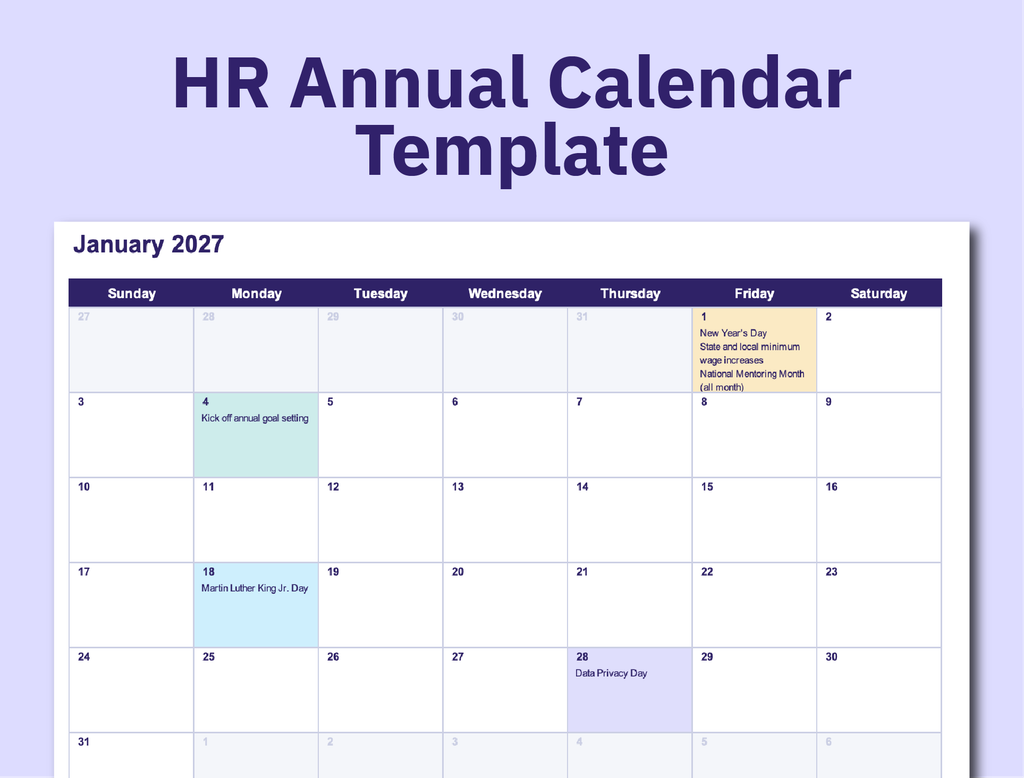
We’ve created a free HR calendar template in Excel to help you plan the year ahead, plus all the templates mentioned above bundled together. Add your quarterly themes, key dates, deadlines, and employee activities, then adjust them to suit your team.
How to create an HR annual calendar
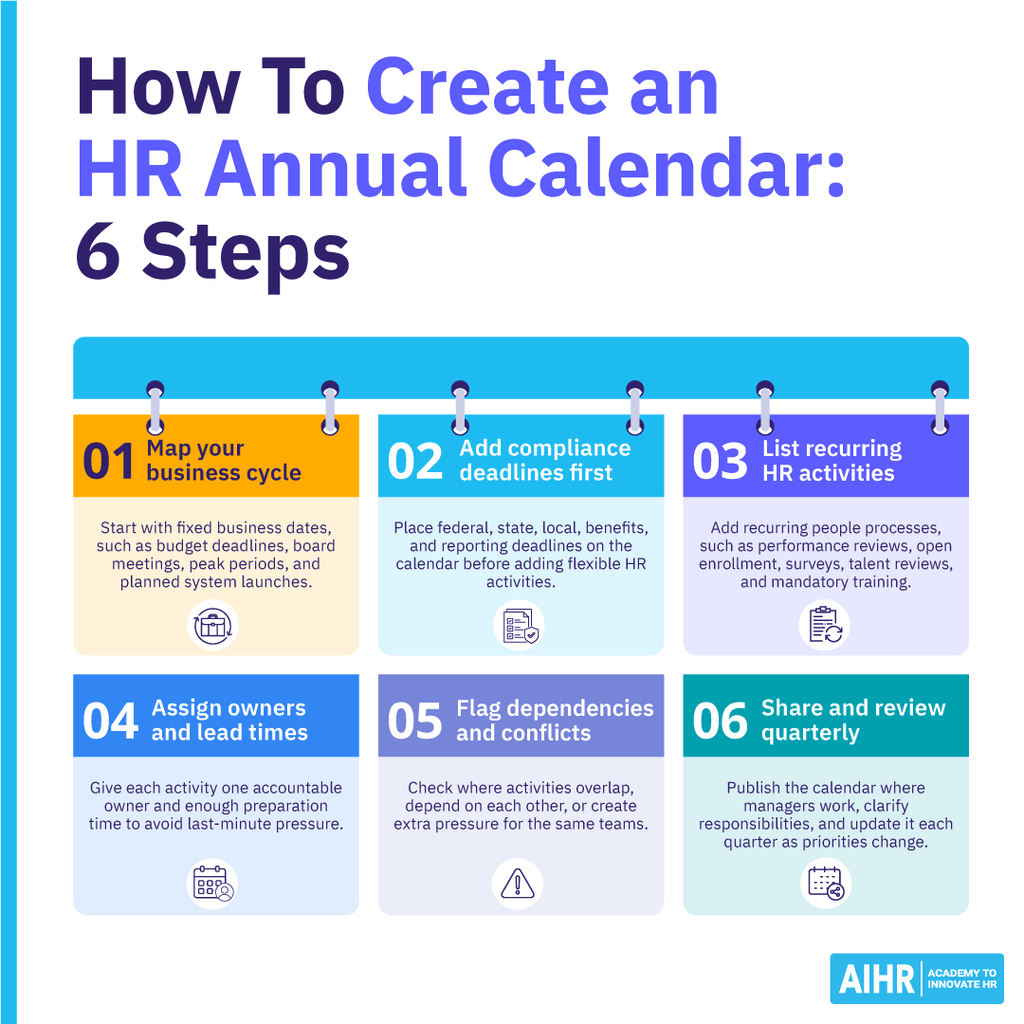
Use the themed calendar above as a starting point, then tailor it to your organization’s fiscal year, workforce footprint, compliance needs, and business peaks. Follow these six steps to build your own HR annual calendar.
Map your business cycle
Start with your organization’s operating rhythm: fiscal year, budget deadlines, board meetings, peak trading periods, and planned system launches. These fixed points shape when HR activities can happen.
For example, if compensation budgets are due to finance in October, you may need performance data by September. Deloitte research found that 7 in 10 business leaders see speed and agility as their primary competitive strategy, so flag business dates that may shift.
Add compliance deadlines first
Compliance obligations are date-specific and often non-negotiable, so add them before anything else. Our free Excel template includes key U.S. federal deadlines, such as payroll tax filings, W-2s, ACA reporting, Form 5500, and EEO-1. Add the state and local requirements, required postings, and benefits notices that apply where your employees work. Then set internal due dates two to four weeks before each statutory deadline.
List recurring HR activities by category
List every recurring people process, including performance reviews, merit cycles, open enrollment, surveys, talent reviews, and mandatory training.
For each activity, note how long it takes, who is involved, and what it depends on. This can help you spot activities that continue out of habit rather than clear business need.
Assign owners and lead times
Give each activity one accountable owner and a preparation start date. Typical lead times include:
- Open enrollment: 90–120 days
- Compensation cycles: 8–12 weeks
- Engagement surveys: 6–8 weeks
- Performance reviews: 4–6 weeks
Build in manager capacity, too. Gartner’s research found that 47% of managers say more is expected of them than a year ago, and only 41% of employees say their manager helps them prioritize their work.
Flag dependencies and conflicts
Map how activities depend on each other. Performance ratings may feed merit decisions, talent reviews may inform succession plans, and engagement results may shape action plans.
Before publishing the calendar, check for activities that run in the wrong order, overlap with business peaks, or create too much pressure for the same teams.
Share it and review it quarterly
Publish the calendar where managers already work, such as a shared calendar, HRIS, or planning tool. Walk managers through the periods that need their input, clarify ownership, and review the calendar each quarter against business conditions. Note what ran late, what clashed, and what no longer adds enough value, then rebuild the calendar annually alongside budget planning.

Next steps
Start by downloading the free HR annual calendar template and choosing a theme for each quarter. Then use the monthly templates to plan key people activities with managers, clarify responsibilities, and allow enough time to prepare. Review the calendar quarterly, so it stays useful as business priorities change.
As you build your calendar, think about the skills, templates, and tools your HR team needs to deliver the work. Explore AIHR’s Demo Portal to preview course lessons, browse HR templates and resources, and see how AIHR Copilot can support everyday HR questions.