

As author Roy Bennett said, “There is no better investment than investing in yourself.” That’s certainly true when it comes to investing in your HR career. And if your HR work crosses borders, a global or international HR certification shows you can handle employment law, mobility, and talent decisions outside your home market, which is what multinational employers screen for.
Studies have also shown that HR professionals with global Human Resources certifications typically earn more than those with local credentials. For instance, according to PayScale, the average base salary for GPHR holders in the U.S. is $114,000, compared to the $112,000 SPHR holders report. This article explores what global or international HR certifications are, why they matter, and which ones are worth pursuing.
Contents
What is a global or international HR certification?
Why is a global/international HR certification important?
15 best global and international HR certifications
How to get a global or international HR certification
What is a global or international HR certification?
A global or international HR certification is aimed at HR professionals outside a specific location, such as the U.S. Each HR certification provider uses either term slightly differently, but typically, global HR certifications (e.g., HRCI’s GPHR certification) are aimed at HR professionals who have multinational responsibilities, like developing a global strategy.
International HR certifications, on the other hand, are aimed at HR professionals in international locations and cover broad HR knowledge or skills within a specific HR domain (like AIHR’s Certificate Programs, for example).

Why is a global/international HR certification important?
Global and international HR certifications can enhance your credibility and help further your career goals by demonstrating your expertise in international HR complexities and capabilities in specific HR domains, which are relevant regardless of where you’re based in the world.
If you have multinational responsibilities, you need comprehensive knowledge of international labor laws and the ability to develop global and multicultural talent management strategies. While completing an HR certification or course through an internationally recognized HR training provider can help you develop a broad set of HR capabilities or skills, or focus on a specific HR domain, such as people analytics or HR business partnering.
Benefits of getting a global or international HR certification
Whether you choose to complete a global or international certification, there are several reasons why these types of HR certifications can benefit your career:
Benefits for HR professionals
- Career advancement: Furthering your expertise with a global or international HR certification can set you apart from other candidates. These certifications validate your expertise in handling international HR complexities, and develop a broad set of HR capabilities or practical skills in a specific HR domain.
- Increased earning potential: HR practitioners with a Global Professional in Human Resources (GPHR) certification have experienced pay increases of up to 16% post-qualification. Developing in-demand HR skills, like using AI in HR, also sets you apart in the market.
- Go beyond theory: You’ll also likely learn practical strategies on conflict resolution, navigating leadership challenges, and driving positive change from fellow HR professionals and instructors. This focus on human-centered learning has real-world applicability for equity, engagement, and effectiveness in your organization.
Benefits for the organization
- Competitive advantage: Hiring or promoting HR practitioners who are globally or internationally certified enables companies to run and expand their international operations with confidence and helps build the capabilities HR teams need to create greater business impact.
- Mitigated risks: A globally certified HR professional can ensure the organization adheres to international labor laws and best practices while avoiding costly legal issues.
- Build strategic capabilities: Equips your HR team with the skills and capabilities to contribute to strategic decisions within the business.
Global/international HR certifications can validate your expertise, but staying relevant also means continuously developing practical HR skills. Build knowledge beyond a single specialization to become a more well-rounded, impactful HR professional.
With AIHR’s Full Academy Access, you can:
✅ Develop practical expertise across areas like HR strategy, analytics, talent, digital HR, and org development
✅ Earn HR certificates while applying your learning through real-world projects, cases, and assignments
✅ Use practical templates, guides, and resources to translate new knowledge into your day-to-day HR work
✅ Keep expanding your HR skill set as your responsibilities, interests, and career goals evolve
💡 Explore the AIHR learning experience and discover what you can learn next in the Demo Portal.
15 best global/international HR certifications
There are several certifications available to build your expertise in an international workplace. Here’s a summary of the most prominent global/international HR certifications and their providers:
1. AIHR Certificate Programs
AIHR is a globally recognized HR training provider accredited by 15+ HR associations, with 85,000+ members across 180+ countries. Its 16+ Certificate Programs are fully online and self-paced, making it easy for you to complete one from anywhere in the world.
Certificate programs typically take 25 to 45 hours to complete, and members get 12 months of access, with a capstone project you have to pass to earn the certificate. Alternatively, you can access all 16+ programs for a year with Full Academy Access. These include:
- Artificial Intelligence for HR
- HR Business Partner 2.0
- People Analytics
- Learning & Development
- Organizational Development
- HR Generalist
- Compensation & Benefits
- Digital HR 2.0
- Diversity, Equity, Inclusion & Belonging
- HR Consulting
- HR Coordinator
- HR Manager
- People Data & Business Insights
- Sourcing & Recruitment
- Strategic Talent Acquisition
- Talent Management & Succession Planning
2. HR Generalist Certificate Program (AIHR)
Whatever market you work in, the core of the HR role is the same, making the HR Generalist Certificate Program a practical starting point for HR professionals building broad capability outside a single national framework, wherever they’re based.
- Format and duration: Fully online and self-paced, 45 hours, with 12 months of access and a capstone project.
- What you’ll learn: The full HR cycle, including recruitment and selection, employee relations, performance management, compensation and benefits, and HR data and reporting.
- Best for: HR professionals who want end-to-end capability rather than depth in one area, and career changers moving into HR.
- Cost: $1,125 for 12-month access, or included in Full Academy Access for $1,850 a year.
3. People Analytics Certificate Program (AIHR)
Working with people data and making data-driven decisions is no longer a nice-to-have, regardless of your location. Developing HR analytics skills will help you to drive evidence-backed decision-making throughout HR. The People Analytics Certificate Program teaches you how to analyze people data in Excel and build HR dashboards and reports in Microsoft PowerBI.
- Format and duration: Fully online and self-paced, 43 hours, with 12 months of access and a capstone project.
- What you’ll learn: How to build and interpret HR dashboards, run analyses that answer business questions, and turn people data into recommendations that leadership will act on.
- Best for: HR professionals who want to strengthen their analytical capability and move from reporting to insight.
- Cost: $1,125 for 12-month access, or included in Full Academy Access for $1,850 a year.
4. HR Business Partner 2.0 Certificate Program (AIHR)
Business partnering is the route from operational HR into strategic influence, and the expectations of the role are broadly consistent across multinational organizations. The HR Business Partner 2.0 Certificate Program will help prepare you for multinational HR responsibilities.
- Format and duration: Fully online and self-paced, 33 hours, with 12 months of access and a capstone project.
- What you’ll learn: Consulting skills, stakeholder management, data-driven decision making, and how to translate business strategy into people priorities.
- Best for: HRBPs and HR generalists moving toward a strategic advisory role.
- Cost: $1,125 for 12-month access, or included in Full Academy Access for $1,850 a year.
5. SHRM-CP (SHRM)
As one of the world’s largest HR associations, SHRM is recognized by multinational employers. The SHRM-CP, however, is built primarily around U.S. HR practice and as such, aimed mainly at U.S.-based HR professionals.
- Format and duration: 134 multiple-choice questions, four hours, in-person at a Prometric center.
- What you’ll learn: SHRM’s competency model, covering employee relations, talent, total rewards, and the behavioral competencies around them.
- Best for: Operational HR professionals, especially those working for U.S.-headquartered employers.
- Cost: $399 for members, $499 for non-members.
6. GPHR (HRCI)
The Global Professional in Human Resources (GPHR) is the only HRCI credential for HR that focuses on strategic global HR development, global talent management, and global mobility.
- Format and duration: Computer-based exam consisting of 100 questions, held at a Pearson VUE center or online via OnVUE over two hours 15 minutes. The credential is valid for three years, and renewal requires 45 HR and 15 global credits.
- What you’ll learn: Global strategy and development, global talent management, mobility, workplace culture, total rewards, and cross-border risk and compliance.
- Best for: HR leaders with multinational responsibility, and at least two years of professional HR experience with a master’s, three with a bachelor’s, or four with neither.
- Cost: $595 (made up of a $100 application fee and a $495 exam fee).
7. aPHRi (HRCI)
HRCI’s Associate Professional in Human Resources International (aPHRi) is designed for HR professionals working outside the U.S. The exam exclues U.S. employment law, and is also available in Arabic.
- Format and duration: Computer-based exam consisting of 65 questions, held over one hour and 45 minutes. The credential is valid for three years, and renewal requires 45 credits.
- What you’ll learn: HR operations, recruitment and selection, employee relations, compensation and benefits, health and safety, and development and retention.
- Best for: People entering HR outside the U.S., career changers, and managers without formal HR training.
- Cost: $400 (made up of a $100 application fee and $300 exam fee).
8. PHRi (HRCI)
The Professional in Human Resources International (PHRi), HRCI’s international practioner certification, is built for HR professionals running HR in markets outside the U.S., and is also offered in Spanish.
- Format and duration: Computer-based exam consisting of 90 questions, held over two hours 15 minutes. The credential is valid for three years, and renewal requires 60 credits.
- What you’ll learn: Operational HR applied in your local context, covering talent acquisition, employee relations, total rewards, learning and development, and HR information management outside the U.S.
- Best for: HR practitioners running day-to-day HR in a non-U.S. market. It requires one year of experience plus a master’s, two plus a bachelor’s, or four years with neither.
- Cost: $495 (made up of a $100 application fee and a $395 exam fee).
9. SPHRi (HRCI)
The Senior Professional in Human Resources International (SPHRi) is HRCI’s international senior-level certification. It’s meant for HR leaders outside the U.S. who set strategy, rather than run operations.
- Format and duration: Computer-based exam, held over two hours and 45 minutes at a Pearson VUE centre or online via OnVUE. The credential is valid for three years, and renewal requires 60 credits.
- What you’ll learn: Leadership and strategy, talent management, workforce planning, total rewards, HR information management, and safety and security, all at a strategic level.
- Best for: Senior HR professionals outside the U.S. Needs four years’ experience plus a master’s, five plus a bachelor’s, or seven years with neither, and HRCI expects documented knowledge of local employment law
- Cost: $595 (made up of a $100 application fee and a $495 exam fee).
10. CHRP (HRPA)
HRPA is Ontario’s HR regulatory body, so the Certified Human Resources Professional (CHRP) is a national rather than global designation. Canadian employers often expect it, and AIHR Certificate Programs earn you recertification credits toward it.
- Format and duration: Can be completed via part-time studies (12 to 22 months) or multi-part professional curricula (three to four years). The exam is held either as one-hour computer-based testing with open-book multiple-choice questions, or two-hour comprehensive subject challenge exams.
- What you’ll learn: Canadian employment law, HR practice, and professional ethics as applied in Ontario.
- Best for: HR professionals working in Canada, where the designation is often expected rather than optional.
- Cost: At least 695 CAD (350 CAD knowledge exam registration fee, 225 CAD employment law prep program, 120 to 141 CAD practice exams), plus an HRPA membership fee that varies by membership category.
11. Level 3 Foundation Certificate in People Practice (CIPD)
The U.K.-based CIPD’s qualifications are recognized across the U.K., Ireland, the Middle East, and parts of Asia. The Level 3 Foundation Certificate in People Practice is its entry-level HR certification, ideal for those new to HR or with minimal HR experience.
- Format and duration: Available 100% online (self-paced or live classes), part-time, or via evening classes. Typically takes eight to 12 months to complete.
- What you’ll learn: People practice fundamentals, covering business and culture in context, the principles of analytics, core behaviors for people professionals, and HR life cycle essentials.
- Best for: People new to HR, or those in an HR Administrator or HR Assistant role who want a recognized qualification without a postgraduate commitment. It leads to CIPD Foundation Membership.
- Cost: Between £1,300 and £2,300 (depending on the training provider and study format), plus CIPD membership (which varies by level).
12. Level 5 Associate Diploma in People Management (CIPD)
The Level 5 Associate Diploma in People Management is CIPD’s practitioner-level HR certification, and the most common entry point for HR professionals who already have experience behind them.
- Format and duration: Available 100% online (self-paced or structured), through live online classes, or part-time day/evening classes through approved training providers. Typically takes 12 to 18 months to complete.
- What you’ll learn: Organizational performance and culture in practice, evidence-based practice, professional behaviors, employment relationship management, talent management and workforce planning, and reward for performance and contribution.
- Best for: HR advisors, officers, and generalists in CIPD-recognized markets who want to move toward management, or who are building toward Level 7. It leads to CIPD Associate Membership.
- Cost: Between £1,600 and £3,600, (depending on the training provider and study format), plus CIPD membership (which varies by level).
13. Level 7 Advanced Diploma in Strategic People Management (CIPD)
The Level 7 Advanced Diploma in Strategic People Management is CIPD’s most senior qualification, recognized in the same markets its Level 3 and Level 5 diplomas are.
- Format and duration: Flexible online, hybrid, or classroom formats. Typically takes 16 to 24 months to complete (extendable up to 36 months for self-paced study).
- What you’ll learn: Strategic people management, organizational design and development, employment relations, and reward, at the postgraduate level.
- Best for: Senior HR professionals in the U.K., Ireland, the Middle East, and other CIPD-recognized markets. This is the level that leads toward Chartered Member status.
- Cost: Between £3,000 and £7,000, (depending on the training provider and study format), plus CIPD membership (which varies by level).
14. Global Remuneration Professional (WorldatWork)
The Global Remuneration Professional (GRP) is WorldatWork’s multi-country compensation and benefits certification, and is worth considering if your pay programs cross borders.
- Format and duration: Nine self-paced courses over one year, via flexible e-learning, virtual classes, or intensive regional fast-track pathways. Each course has its own exam (typically 80 questions each, with a two-hour time limit per exam).
- What you’ll learn: Designing and administering base and variable pay across multiple countries, job evaluation, pay structures, and the regional influences on reward design.
- Best for: Compensation and total rewards specialists whose programs span borders.
- Cost: $850 for members and $1,250 to $1,395 for non-members for each e-learning course and exam module.
15. Global Mobility Specialist (Worldwide ERC)
Worldwide ERC is the industry body for workforce mobility, and the Global Mobility Specialist (GMS) is the recognized credential for HR professionals responsible for moving employees between countries.
- Format and duration: 100% online via the Worldwide ERC Learning Portal, with comprehensive educational modules (including courses and quizzes). Typically requires approximately 25 hours of active study and coursework to complete, with a time limit of six months from first access.
- What you’ll learn: The mechanics of moving people between countries, including assignment structures, relocation policy, immigration and tax basics, and vendor management.
- Best for: HR and mobility professionals who own relocation or international assignment programs.
- Cost: $1,250 for members, $1,500 for non-members.
How to get a global/international HR certification
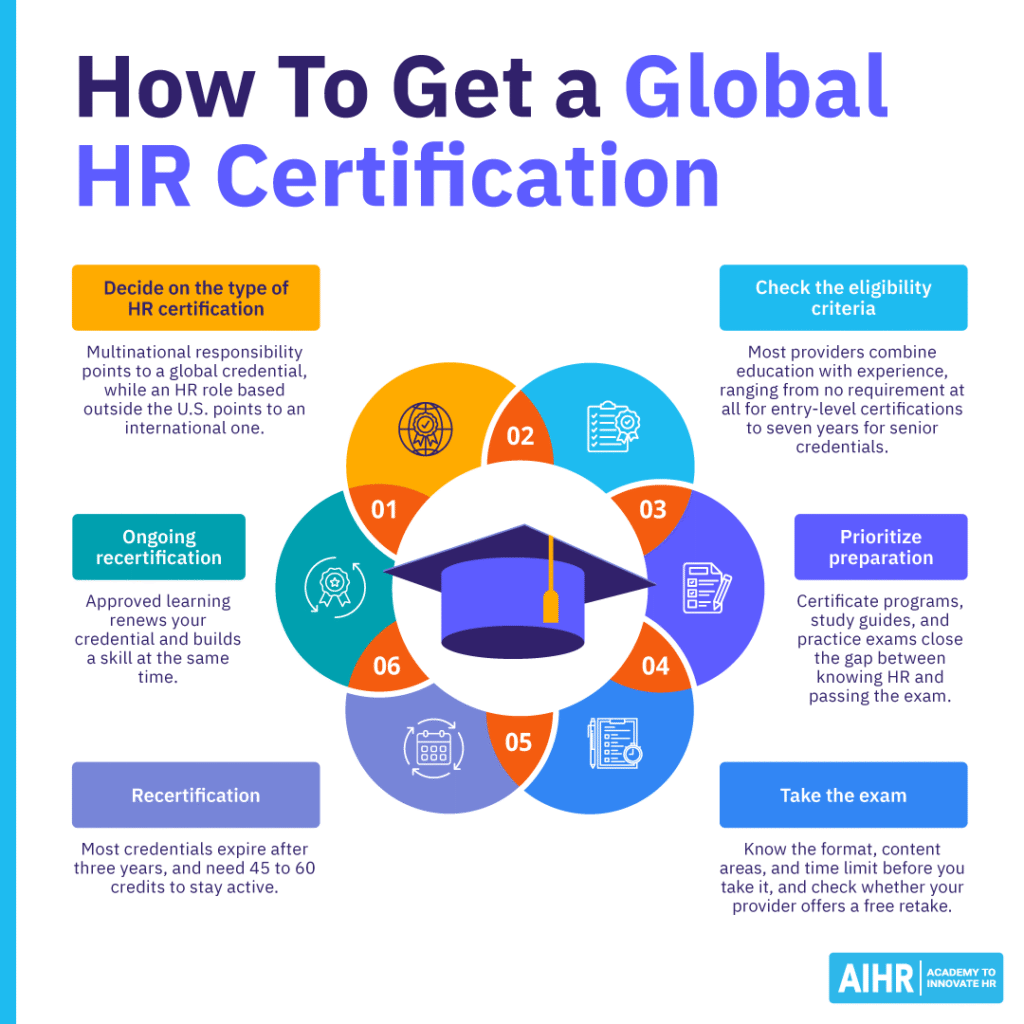
Follow these six steps to learn how to get a global or international HR certification:
Step 1: Decide on the type of HR certification
Start with your HR domain. If you have multinational responsibilities (e.g., developing global strategy across offices in different countries), a global certification like the GPHR is a good option. If you’re an HR professional based outside the U.S. who wants broad HR capabilities or depth in a specific domain like business partnering or people analytics, an international certification or a certificate program is a better fit.
Step 2: Check the eligibility criteria
Requirements vary among providers, and most combine education with experience. HRCI’s aPHRi is knowledge-based and asks for no HR experience at all, while CIPD entry requirements are set by the approved center and rise with each level. AIHR’s Certificate Programs have no eligibility requirements, so you can start building capability while you accumulate the experience senior credentials ask for.
Step 3: Prioritize preparation
While experience is crucial, adequate knowledge and preparation are key to acing the exam itself. Consider these resources to help you:
- Certificate programs: The Academy to Innovate HR (AIHR) offers Certificate Programs specifically designed to equip you with the knowledge you need to prepare for certain global HR certification exams. As an accredited HR program provider, you’ll also earn PDC credits when completing an AIHR Certificate Program.
- Self-study materials: Organizations that provide global HR certifications also tend to offer a wealth of self-study materials, including study guides, courses, and practice exams. Additionally, numerous online resources and textbooks are available to prepare you for exams.
Step 4: Take the exam
Global HR certification exams are typically computer-based and consist of multiple-choice questions. Be sure to understand the exam format of your chosen certification program, its content focus areas, and exam time limits beforehand. Sourcing sample exam papers from legitimate online sites can be very helpful in this regard.
Scheduling and fees vary depending on the provider. Some organizations, such as HRCI, offer free ‘second chance insurance’, which is an opportunity to retake the exam at no cost if your initial results are unsatisfactory.
Step 5: Recertification
Once you pass your global certification, it’s generally valid for a set period, after which it will lapse. For instance, the GPHR certification remains valid for three years after testing. To maintain your GPHR credentials, you must acquire 45 hours of HR training and 15 global recertification credits or retake the exam within the three-year period. AIHR is recognized by several major HR credentialing bodies, including HRCI, for recertification credits.
Step 6: Ongoing development
The HR profession is constantly changing. Continuing to build on your education through certificate programs and courses can help you stay ahead in your profession.
Consider programs like AIHR’s Certificate Programs, which are focused on related emerging fields, such as the application of Artificial Intelligence for HR. These programs can also help you develop crucial digital skills to manage data, identify insights, track trends, and automate aspects of HR. These specializations can significantly enhance your professional acumen and open doors to exciting career opportunities.
Next steps
Look at the job listings in the market you want to work in and note which certifications they name, then let your specific HR domain decide: multinational responsibility would benefit a global credential like the GPHR, while an HR role based outside the U.S. would benefit from an international one. Check eligibility before you decide, since application fees are usually non-refundable.
Do note that senior credentials usually require years of experience you may not have yet. However, you can start learning practical HR skills first. AIHR’s Full Academy Access opens access to all 16+ AIHR Certificate Programs and 85+ courses for a flat annual fee of $1,850, with no experience requirement and no exam to take. If you want to see what that looks like before committing, check out the AIHR Demo Portal.