


The right HR course for beginners does more than explain what HR is. It shows you how to do the work: write a policy, run onboarding, handle a difficult conversation, and keep employee data in order. That’s what hiring managers look for when you apply for your first HR role.
The challenge is that “beginner HR course” covers very different things. Some are short video introductions. Some are certification exams that test what you already know. Others are multi-month qualifications with written assignments. Each suits a different goal, budget, and timeline.
We compared nine popular options using publicly available information from each provider. We’ve taken AIHR’s own programs (that’s us), but not the others. For each, you’ll see who it’s best for and what to consider before you enroll.
Contents
Quick answer: Which HR course is best for beginners?
1. Academy to Innovate HR (AIHR)
2. SHRM Essentials of Human Resources
3. Human Resource Management: HR for People Managers (Coursera)
4. CIPD Level 3 Foundation Certificate in People Practice
5. HR Fundamentals (FutureLearn)
6. The Human Resources (HR) Mastery Bundle (Udemy)
7. Oxford Home Study Centre
8. Compliance Prime
How to choose an HR course as a beginner
Quick answer: Which HR course is best for beginners?
The best HR course for beginners combines four things: no prerequisites, hands-on practice with real HR tasks, recertification credits recognized by HR bodies, and a flexible online format you can fit around work.
- For your first HR job: AIHR’s HR Coordinator Certificate Program is built for people who are new to HR. You don’t need prior HR skills, and you practice real tasks such as writing a policy and creating a payroll schedule.
- If you’re your company’s first HR hire: AIHR’s HR Generalist Certificate Program teaches you to set up and run HR as a team of one, with templates you can use straight away.
- If you prefer a live class: SHRM Essentials of Human Resources is an instructor-led introduction for people new to HR.
- If you’re in the U.K. and want a CIPD route: The CIPD Level 3 Foundation Certificate in People Practice leads to CIPD Associate membership.
Many people start with a short introduction, then move on to a practical program once they know HR is for them.
Practical certificate programs
These programs teach you how to do HR work through structured lessons, hands-on assignments, and a final assessment.
1. Academy to Innovate HR (AIHR)

Best for: People who want to learn HR by doing it, online and at their own pace, with credits recognized by 15+ HR bodies.
Academy to Innovate HR (AIHR) is an online learning platform for HR professionals and teams. Its certificate programs are built by HR practitioners for HR practitioners and follow a Tell-Show-Do-Apply method: video lessons explain and demonstrate a skill, then assignments, roleplays, and case studies let you practice it. Each certificate program consists of modules and courses within the modules. A certificate program takes between 25 and 45 hours, is 100% online, and comes with 12 months of access. With Full Academy Access, you can also take standalone courses and mini courses, which typically take 2-10 hours or 2-3 hours, respectively.
Two programs are designed with beginners in mind:
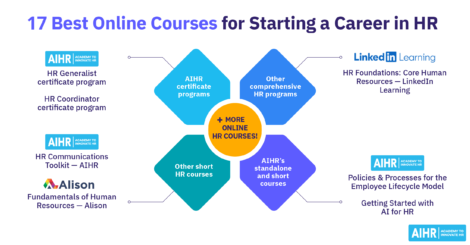
- HR Coordinator Certificate Program: For people who are new to HR or aiming for their first HR job. No previous HR skills are needed. You’ll cover the employee lifecycle, HR project management, HR communications, and using AI in daily HR operations. Practice includes an HR Inbox Task Simulation, writing your own policy, and creating a payroll schedule. The capstone puts you in the role of an HR Coordinator at a fictional technology company.
- HR Generalist Certificate Program: A good fit if you’ve just joined a growing business as its first HR hire or are moving into an HR role. You’ll learn to set up, run, and scale an HR department as a team of one. Templates include a 30-60-90 Day Plan, an Employee Onboarding Checklist, and an HR Budget Tool. The capstone casts you as an HR Manager at a growing hardware store chain.
Every certificate program ends with a capstone project. It has two parts: a self-reviewed capstone assignment where you apply what you’ve learned in a realistic scenario, and a capstone exam. Pass the exam (70%) to earn a digital certificate you can share and verify on LinkedIn. You can retake the exam as often as you need.
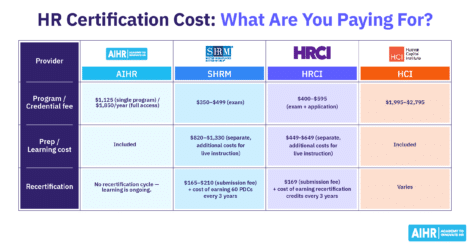
AIHR is recognized by SHRM to offer Professional Development Credits (PDCs) for SHRM-CP® or SHRM-SCP® recertification activities. Programs are also eligible for HRCI, HRPA, CPHR, and ATD credits, and AIHR is CPD-accredited by CPD UK, so CIPD members can record AIHR learning as verified CPD.
What to consider:
- Price: A Certificate Program costs $1,125 for 12 months with a 30-day money-back guarantee. Full Academy Access costs $1,850 a year (60-day money-back guarantee) and includes all 16+ certificate programs, 85+ courses and mini courses, 300+ templates, weekly webinars, and personal coaching. That’s useful if you want to explore several HR areas before you specialize. Prices are in USD and correct at the time of writing. See AIHR pricing for local currencies.
- Credential type: An AIHR certificate shows you’ve built practical skills. It isn’t a professional certification such as the aPHR or SHRM-CP, and it doesn’t replace one. The two work well together.
AIHR learners rate the platform 4.66 out of 5 from 12,000+ verified reviews, and 97% of students recommend AIHR. More than 85,000 HR professionals have trained with AIHR.

Courses from HR associations, universities, and training providers
These structured introductory courses come from established HR and academic institutions. They’re credible and well organized, with varying amounts of hands-on HR practice.
2. SHRM Essentials of Human Resources

Best for: Beginners who prefer a live, instructor-led class.
SHRM Essentials of Human Resources is a live online, instructor-led seminar for people who are new to HR or want a structured refresher. It covers talent acquisition and onboarding; compensation, benefits, and payroll; employment law and workplace compliance; performance management and employee relations; and HR’s role in supporting business strategy. You work through real scenarios, and the seminar includes access to an online companion course. It earns 15 SHRM PDCs.
What to consider:
- Schedule: The seminar runs live on set dates, so you’ll fit your learning around SHRM’s timetable.
- Cost: $1,890, with SHRM members saving $325.
- Depth: It’s a broad overview of core HR topics in a single seminar. SHRM positions it as preparation for more advanced HR training.
3. Human Resource Management: HR for People Managers (Coursera)
Best for: A college-level overview of HR from a manager’s point of view.
This five-course specialization from the University of Minnesota covers preparing to manage HR; recruiting, hiring, and onboarding; managing employee performance; and managing compensation. A final capstone has you identify HR challenges in a workplace, which can be your own, and build an action plan to address them. It’s rated beginner level, needs no prior experience, and takes about two months at 10 hours a week. You earn a shareable certificate from the University of Minnesota.
What to consider:
- Written for people managers: As the title suggests, it’s built around managing people. It’s also open to people considering an HR career, but it isn’t designed around the day-to-day tasks of an HR coordinator or generalist.
- Academic style: Coursera describes it as college-level, so expect a more academic approach.
- Cost: You need a paid enrollment or a Coursera Plus subscription ($239 a year). Financial aid may be available.
- Credits: The certificate doesn’t carry university credit, and the course page doesn’t mention HR recertification credits.

Formal HR qualifications
4. CIPD Level 3 Foundation Certificate in People Practice

Best for: People in the U.K. who want a CIPD qualification and Associate membership.
The CIPD Foundation Certificate gives you a grounding in all areas of HR. It covers business, culture, and change in context; principles of analytics; core behaviors for people professionals; and essentials of people practice. It suits HR administrators, people moving into HR, and non-HR managers with people responsibilities. It leads to CIPD Associate membership.
What to consider:
- Time and assessment: It’s an academic qualification assessed through written assignments. One U.K. college, for example, runs it over eight months with three to four hours of study a week.
- Cost: At that college, the course costs £1,300, plus a £40 CIPD joining fee and a £99 student membership fee. Prices vary by provider.
- Entry requirements: Some providers ask for GCSEs or relevant work experience.
- Global fit: It’s most valued by U.K. employers. If you’re a CIPD member, you can also record AIHR learning as verified CPD.
Short introductory courses
These are low-cost ways to test your interest in HR before you commit to a longer program.
5. HR Fundamentals (FutureLearn)

Best for: Testing whether HR is right for you.
Created by the CIPD and hosted on FutureLearn, this self-paced course runs about five weeks at around three hours a week. It covers what HR is, HR professionalism, people and strategy, recruitment and retention, and performance, engagement, and reward.
What to consider: Free access is limited, and you pay to keep access and earn a certificate. It’s an introduction, so plan a next step if you want job-ready skills.
6. The Human Resources (HR) Mastery Bundle

Best for: A video-based overview of a wide range of HR topics.
Created by Expert Academy and Lahcen Bouya, this Udemy bundle of 10 courses covers HR fundamentals and workforce planning, job descriptions, hiring, remote onboarding, talent management, cross-cultural communication, supporting neurodiversity, performance management, employee retention and workplace culture, and using AI in HR. It runs to 100 video lectures (8 hours 52 minutes). The only stated requirement is an open mind, so you don’t need prior HR knowledge. Learners rate it 4.6 out of 5 from 1,148 ratings.
What to consider: It’s built around video lectures, so plan how you’ll practice what you learn. Check the current price on Udemy before you enroll.
7. Oxford Home Study Centre

Best for: Free, self-paced introductions to HR topics.
Oxford Home Study Center offers free online HR courses, including HR Management, Recruitment Skills, HR and AI, and Talent Acquisition Management. Each takes about 20 hours, is self-paced, and includes tutor support through a learning portal. Topics include HR fundamentals, recruitment and selection, staff development, and HR automation.
What to consider: Enrolling is free, but certificates are paid extras. Paid certificates are either CPD-accredited by the CPD Standards Office or endorsed by the Quality License Scheme, and they aren’t Ofqual-regulated qualifications.
Webinars and continuing education
8. Compliance Prime

Best for: Staying current on specific compliance topics.
U.S.-based Compliance Prime runs live and on-demand webinars across HR, payroll, and other compliance areas, typically 60 to 90 minutes long. Upcoming HR sessions cover topics such as multi-state employment law, ADA accommodation requests, and Form I-9 compliance. Webinars earn continuing education credits, including SHRM and HRCI, and come with a certificate of participation.
What to consider:
- Cost: Memberships cost $799 for six months or $999 for a year, or you can buy a 10-webinar pack for $699.
- Focus: Webinars are single-topic sessions, mostly on U.S. compliance. They work best as a supplement once you have a structured foundation, rather than as your first step into HR.
How to choose an HR course as a beginner
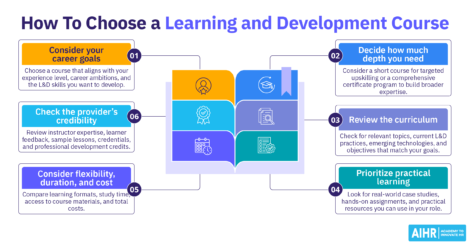
Use these six questions to compare any option, including the ones on this list.
- Can you start without HR experience? Check entry requirements. Some courses assume working knowledge of HR, and some qualifications ask for prior education.
- Will you practice the work, or only learn about it? Look for assignments, case studies, simulations, and templates. Video lectures and reading build understanding. Applying them is what builds confidence on the job.
- Is it recognized by HR bodies? Recertification credits from organizations such as SHRM, HRCI, HRPA, CPHR, ATD, and CPD UK signal that the content meets professional standards.
- Does the format fit your life? Self-paced online learning works around a job. Scheduled classes, set start dates, and live webinars need more planning.
- What’s the total cost? Add up course fees, membership fees, and subscription costs.
- Can you explore different HR areas? Many beginners don’t yet know whether they’ll specialize in recruitment, people analytics, or learning and development. Access to more than one HR domain helps you find your fit.
Before you go
If you’re looking to get into HR, HR courses for beginners are a great first step to building foundational HR knowledge and expertise. These courses provide essential insights and skills that help you start a rewarding career in the evolving field of Human Resources. Look for programs that include practical aspects such as case studies, real-world scenarios, and interactive exercises. This will allow you to apply your learning and gain hands-on experience in HR practices.
A combination of theoretical knowledge and practical application equips you with the confidence and competence to successfully navigate the complexities of the HR function.
FAQ
The best HR course for beginners has no prerequisites, includes hands-on practice, carries recertification credits from HR bodies, and fits around your schedule. AIHR’s HR Coordinator Certificate Program meets all four and is designed for people new to HR. If you’d rather learn in a live class, SHRM Essentials of Human Resources is an instructor-led introduction for people new to HR.
Good online options include AIHR’s HR Coordinator and HR Generalist Certificate Programs for practical, self-paced skill-building; SHRM Essentials of Human Resources for an instructor-led introduction; the University of Minnesota’s HR for People Managers on Coursera for a college-level overview; the CIPD Foundation Certificate for a U.K. qualification; and FutureLearn’s HR Fundamentals for a short introduction.
Yes. Many entry-level roles, such as HR coordinator or HR assistant, don’t require prior HR experience. A beginner course that includes realistic practice, such as drafting a policy or managing onboarding, gives you concrete examples to share with employers.
It varies by type. Introductory courses can take a few weeks. AIHR certificate programs take 25 to 45 hours, self-paced over 12 months of access. Formal qualifications such as the CIPD Level 3 can take several months.