

Thinking about leveling up your HR knowledge or entering the profession? Considering which HR certifications are most respected is a good place to start before you choose. But to get to the right answer, you will need to first decide which HR certifications matter most in your country or location, what you want to get from the HR certification, and why.
For example, a respected HR certification from the U.S. might not be applicable if you are based in the U.K., or maybe you’re not looking for an HR accreditation, but rather to learn practical skills you can apply on the job from a respected HR training provider. We’ve selected 12 of the most respected HR certifications to help you choose the best one for you.
Contents
What actually makes an HR certification “respected”?
The most respected HR certifications, compared
12 most respected HR certifications
How to weigh HR certifications’ reputation against the right fit for you
What actually makes an HR certification “respected”?
A few factors can help you determine this:
- A credible issuer with real requirements. Some HRCI and SHRM credentials, like PHR, SPHR, and SHRM-SCP, require professional HR work experience before you can sit the exam. Entry-level credentials like aPHR and SHRM-CP don’t require experience, but all of them require a proctored exam. CIPD in the U.K. requires structured study and formal assessment for its qualifications. AIHR follows the same principle at the certificate level: its programs require passing a capstone project or exam before you receive the certificate, and if you don’t pass on the first try, you can resubmit, but you still have to demonstrate the skills before AIHR issues the credential.
- Recertification. Employment law and HR practices change over time. Certifications that require continuing education to maintain stay useful longer than those you earn once and never revisit.
- Recognition from established bodies. Some providers support certifications indirectly through recertification credits rather than issuing the certification itself. AIHR is recognized by SHRM to offer professional development credits (PDCs) for SHRM-CP or SHRM-SCP recertification, and it’s an approved provider with HRCI for recertification credits. It also holds regional recognition through bodies like HRPA and CPHR in Canada, and CPD U.K. in the U.K.
- Independence. A certification tied to one company’s software or consulting services has a built-in conflict of interest, since that company benefits when more people pass. Certifications from neutral, independent bodies avoid this problem.
- Verifiable reputation. A certification is easier to trust when there’s evidence you can check yourself, such as reviews, pass rates, or public recognition from other organizations, rather than claims you have to take on faith.

The most respected HR certifications, compared
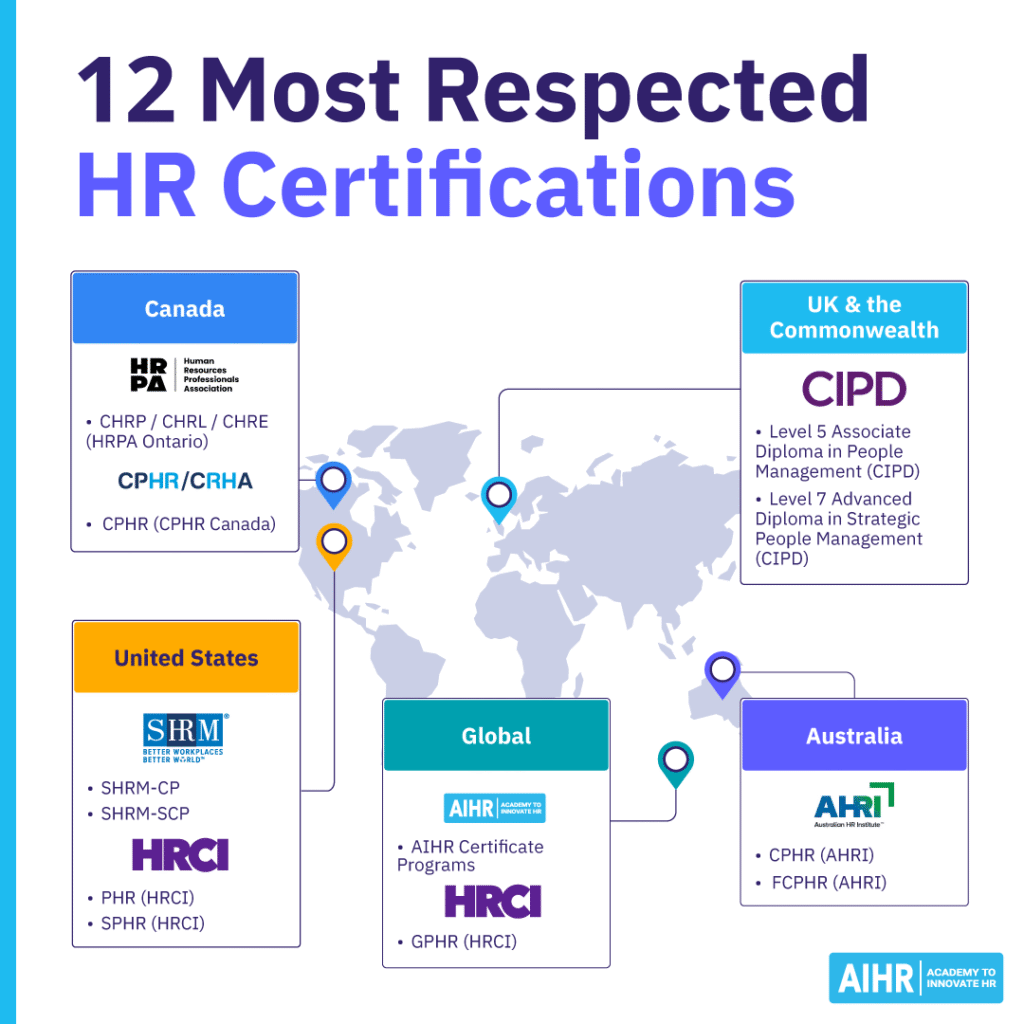
Here’s a condensed view of the 12 certifications above, by body, tier, and where their recognition is strongest.
Certification | Body / tier | Strongest market | Recognition |
AIHR Certificate Programs | AIHR / applied | Global | Recertification-recognized by SHRM, HRCI, HRPA, CPHR; 420+ organizations, 85,000+ trained |
GPHR | HRCI / Global | Global | Built for multinational Human Resources responsibilities |
SHRM-CP | SHRM / Entry-mid | U.S. | Broad U.S. employer recognition, operational HR focus, SHRM BASK-based exam |
SHRM-SCP | SHRM / Senior | U.S. | Strategic HR recognition for senior-level HR work |
PHR | HRCI / Mid | U.S. | Technical, operational, and U.S. compliance-focused HR knowledge |
SPHR | HRCI / Senior | U.S. | Strategic and policy-level U.S. HR recognition |
CHRP/CHRL/CHRE | HRPA / Mid to senior | Ontario, Canada | HRPA-regulated designation system for Ontario-based HR professionals |
CPHR | CPHR Canada / Mid to senior | Canada (outside Ontario, Quebec) | National designation across most Canadian provinces |
Level 5 Associate Diploma in People Management | CIPD / Mid | U.K. and the Commonwealth | Leads to Associate Membership, shown as Associate CIPD |
Level 7 Advanced Diploma in Strategic People Management | CIPD / Senior | U.K. and the Commonwealth | Senior strategic qualification with a path to Chartered Membership |
CPHR (AHRI) | AHRI / mid to senior | Australia | Benchmarked against CIPD and IHRP; endorsed by National Certification Council. |
FCPHR (AHRI) | AHRI / Fellow | Australia | AHRI’s top recognition tier, above the CPHR |
12 most respected HR certifications
In this section, we’ll list 12 respected HR certifications to explore, grouped by the locations where they’re the most recognized.
Global
1. AIHR Certificate Programs
- Why it’s respected: AIHR holds CPD accreditation from CPD U.K., and AIHR Certificate Programs are recognized by several HR associations, including SHRM, HRCI, HRPA, and CPHR, for recertification credits. Each HR certificate program ends in a capstone project or exam that you must pass to receive the certificate. AIHR has trained 85,000+ HR professionals across 180+ countries, is used by 420+ organizations, and holds a combined 12,000+ reviews across Trustpilot and Reviews.io.
- Eligibility: No prior HR certification, degree, or experience required.
- Cost: Individual Certificate Programs are priced at $1,125 each or available as part of Full Academy Access for $1,850 per year.
- Best for: HR professionals who want an HR certificate that proves applied, modern skills, and carries recertification value across multiple regional bodies at once.
2. GPHR (HRCI)
- Why it’s respected: The Global Professional in Human Resources (GPHR) validates specialized HR expertise in managing cross-border workforces, international labor laws, global mobility, and multinational corporate strategies.
- Eligibility: Two years of experience with a master’s degree, three with a bachelor’s, or four without any degree.
- Cost: $595 ($495 exam fee plus $100 application fee).
- Best for: HR professionals who are responsible for HR strategy or policy across multiple countries.
United States
3. SHRM-CP
- Why it’s respected: The SHRM-CP as an employer-recognized credential, earned by passing a proctored exam that assesses candidates using scenario-based questions from the SHRM Body of Applied Skills and Knowledge (SHRM BASK).
- Eligibility: No degree or HR experience required, since SHRM has removed its prior experience requirement.
- Cost: $399 for members and $499 for non-members.
- Best for: HR professionals doing operational, day-to-day HR work who want a broadly recognized U.S. credential.
4. SHRM-SCP
- Why it’s respected: The SHRM-SCP is SHRM’s senior-level credential, earned by passing an exam that assesses candidates on strategic and behavioral competencies rather than the operational focus of the SHRM-CP.
- Eligibility: About three years of strategic HR experience; no degree required.
- Cost: $399 for members and $499 for non-members.
- Best for: HR professionals operating at a strategic or leadership level in U.S.-based organizations.
5. PHR (HRCI)
- Why it’s respected: The Professional in Human Resources (PHR) focuses on U.S. employment law and day-to-day compliance, which matters most in government, healthcare, and other compliance-heavy industries. Holding it shows your HR knowledge has already been tested and verified.
- Eligibility: One year of professional HR experience with a master’s degree, two years with a bachelor’s, or four years without a degree.
- Cost: $495 ($395 exam fee plus $100 application fee).
- Best for: HR generalists and specialists who want a credential focused on technical, compliance-heavy HR knowledge.
6. SPHR (HRCI)
- Why it’s respected: The Senior Professional in Human Resources (SPHR) is HRCI’s senior generalist credential, testing strategic, policy-level HR judgment rather than day-to-day operations.
- Eligibility: Four years of experience with a master’s degree, five with a bachelor’s, or seven without one.
- Cost: $595 ($495 exam fee plus $100 application fee).
- Best for: Senior HR professionals doing strategic, policy-level work who want HRCI’s most senior generalist credential.
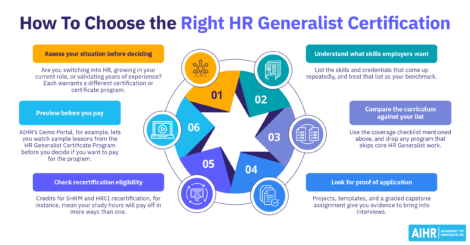
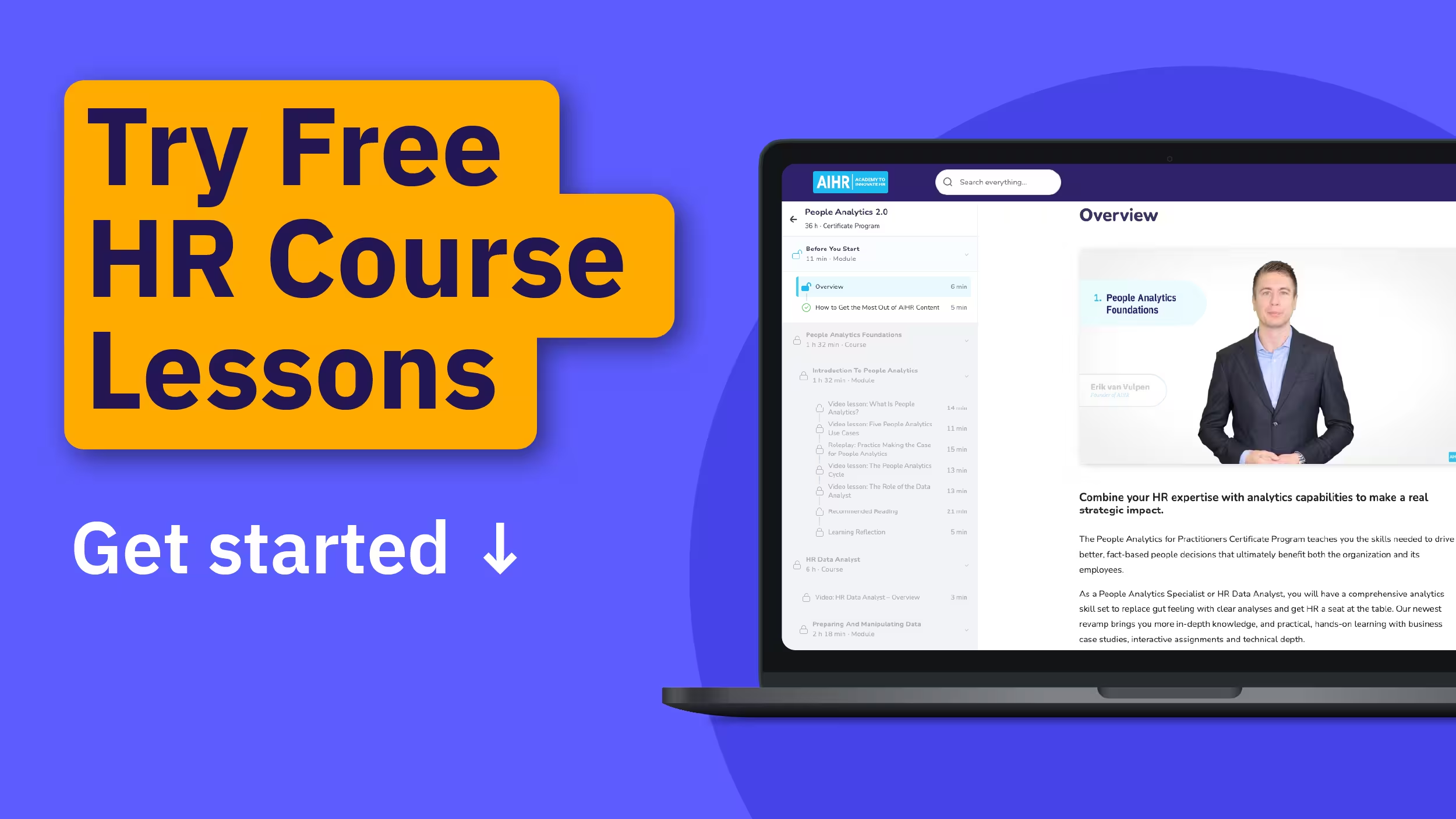
Choosing an online HR course is an important step in your professional development. Before you enroll, it helps to see how the learning experience supports practical skill-building and continuous growth.
AIHR’s Demo Portal gives you a preview of what learning with AIHR looks like:
✅ Watch sample lessons from AIHR’s HR courses and certificate programs
✅ Explore practical guides, templates, and resources you can apply in your HR work
✅ See how bite-sized online learning fits around your schedule and career goals
✅ Discover learning paths that help you choose the right next step for your HR development
💡 Visit the Demo Portal to explore the platform and find the learning experience that fits your goals.
Canada
7. CHRP / CHRL / CHRE (HRPA Ontario)
- Why it’s respected: The Certified HR Professional (CHRP), Certified HR Leader (CHRL), and Certified HR Executive (CHRE) are regulated, recognized designations in Ontario.
- Eligibility: Active HRPA membership, approved coursework or equivalent experience, and passing the relevant Knowledge Exam.
- Cost: C$1,040 to C$1,385 for the CHRP (depending on whether you take the optional exam prep programs), C$1,800 for the CHRL, and C$,070 for the CHRE.
- Best for: HR professionals working in Ontario specifically, where the designation is legally protected.
8. CPHR (CPHR Canada)
- Why it’s respected: The Chartered Professional in Human Resources (CPHR) is the national HR designation used across every Canadian province except Ontario and Quebec, and is widely recognized by employers outside Ontario.
- Eligibility: Three to eight years of HR experience depending on the pathway, plus a National Knowledge Exam and validation of experience.
- Cost: C$1,300 to C$1,800 (varying slightly by provincial association).
- Best for: HR professionals working in Canadian provinces outside Ontario and Quebec.
United Kingdom and the Commonwealth
9. Level 5 Associate Diploma in People Management (CIPD)
- Why it’s respected: CIPD’s Level 5 Associate Diploma in People Management is part of its Associate Membership. It sits at a recognized Level 5 on the national framework, assessed through workplace assignments rather than a single exam.
- Eligibility: Typically suited to HR professionals with some experience or a related degree. The delivering study center, not CIPD, sets specific entry requirements.
- Cost: Roughly £1,600 to £3,600 in course fees, plus separate CIPD membership fees.
- Best for: Mid-level HR professionals in the U.K. or CIPD-led markets who need a locally recognized qualification.
10. Level 7 Advanced Diploma in Strategic People Management (CIPD)
- Why it’s respected: The Level 7 Advanced Diploma in Strategic People Management leads to Chartered Membership (Chartered MCIPD), a well-regarded form of professional recognition in HR and L&D.
- Eligibility: Postgraduate-level qualification for professionals with significant HR experience or an HR degree. Chartered status also requires at least one year of experience at the Chartered Member level.
- Cost: Approximately £3,000 to £7,500 in course fees, plus CIPD membership.
- Best for: Senior HR professionals in the U.K. or Commonwealth markets aiming for HR Director or strategic HRBP roles.
Australia
11. CPHR (AHRI)
- Why it’s respected: The Certified Practitioner HR (CPHR) program is benchmarked against CIPD in the U.K., and endorsed by AHRI’s independent National Certification Council.
- Eligibility: Completion of five AHRCF micro-credentials plus AHRI’s HR Certification Assessment, aimed at emerging to senior HR practitioners.
- Cost: A$749 for direct HR Certification Assessment, A$880 per unit for self-led micro-credentials or A$1,499 per unit for facilitator-led micro-credentials, and A$470 for annual Certified CPHR membership.
- Best for: HR professionals working in or hiring for the Australian market.
12. FCPHR (AHRI)
- Why it’s respected: The Fellow Certified Practitioner HR (FCPHR) is reserved for CPHR holders who’ve demonstrated sustained excellence and contribution to the HR profession.
- Eligibility: Existing CPHR certification, plus an application demonstrating advanced practice and contribution to the profession.
- Cost: A$470 for annual membership; costs for upgrades to or assessments for Fellowship status through senior leader routes vary based on the chosen application and case study submission path.
- Best for: Senior Australian HR leaders who’ve already earned the CPHR and want to reach the additional recognition tier above it.
How to weigh HR certifications’ reputation against the right fit for you
Chasing a single “most respected” certification without determining how well it fits with your plans and goals can lead to wasted time and money. A few questions can help you choose the right one:
Are you looking for accreditation or practical skills?
Formal accreditation from a body like SHRM, HRCI, CIPD, HRPA, CPHR, or AHRI shows you’ve cleared a recognized bar, but that recognition is usually tied to one country or region. If your career is anchored in one market, match the certification to where employers already recognize it: CIPD in the U.K., AHRI in Australia, HRPA or CPHR in Canada, SHRM or HRCI in the U.S.
If you’re prioritizing practical, in-demand skills you can apply on the job rather than formal accreditation, AIHR’s Certificate Programs can help you gain skills you can immediately apply in your role.
Do you want to enter the HR profession or advance your HR career?
If you’re entering the HR profession, an aPHR or SHRM-CP demonstrates foundational credibility without requiring prior HR experience. If you’re advancing an existing HR career, SPHR, SHRM-SCP, CIPD Level 7 Chartered status, and AHRI’s FCPHR are suitable options.
AIHR also offers beginner Certificate Programs, such as the HR Coordinator Certificate Program, that help you build practical skills you can use to better prepare yourself for entering the field of HR.
Do you intend to transition into an HR role?
Are you transitioning into a specialism? Then choose an HR certification that helps you develop these expertise. For example, AIHR’s Certificate Programs not only help you to build the base of core competencies all HR professionals need, but also help you to develop deep expertise in your chosen specialization.
If you’re weighing options against your own budget, timeline, and career stage rather than employer perception alone, AIHR’s comparison of the best HR certifications walks through cost, format, and fit in more depth.
Next steps
Once you’ve pinpointed the most suitable HR certifications, check reviews and pricing before you commit. Independent reviews can tell you if a provider delivers on what it promises. For instance, you can read reviews of AIHR’s Certificate Programs on Trustpilot and Reviews.io. Comparing pricing across your shortlist also helps you find the best option that for your budget.
If you want to see what skills-based HR learning looks like alongside a formal certification, you can preview AIHR’s lesson content through the Demo Portal before committing to a certificate program.