

HR certifications have become an increasingly popular way for HR professionals to advance their careers, building and showcasing up-to-date knowledge of HR best practices. Let’s look at twelve HR certifications and help you choose the right HR certification program for you!
Contents
Why get an HR certification?
What HR certification should you get first?
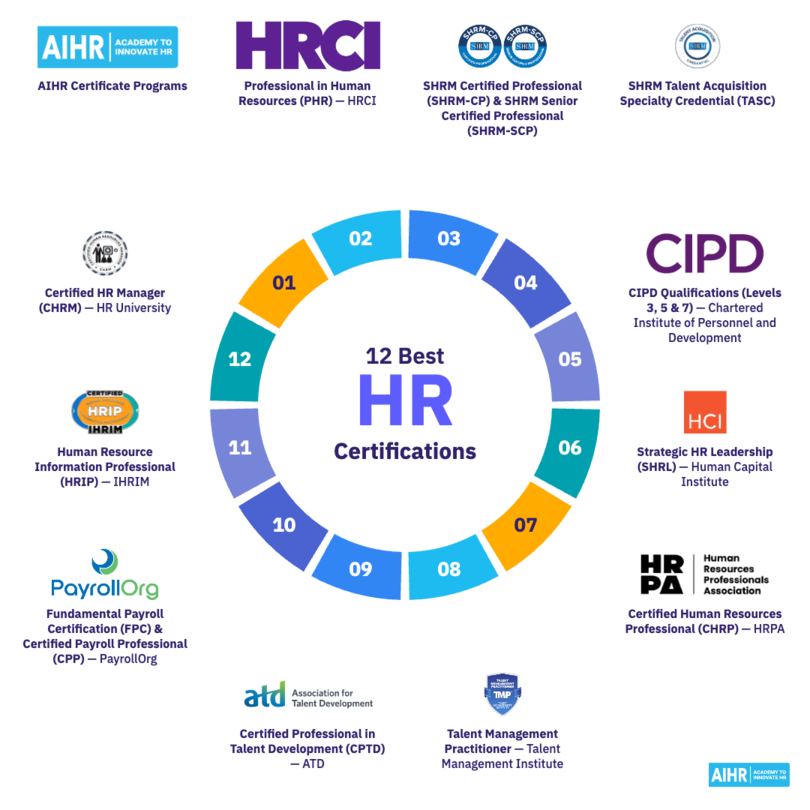
12 best HR certifications
Cost, eligibility, and recertification
FAQ
Why get an HR certification?
More than experience and formal education, Human Resources is a field in which it’s critical to demonstrate how knowledgeable you are to employers. Staying up to date on employment laws and HR best practices can be challenging, yet it’s vital to staying relevant in the world of HR.
HR certification can support your long-term career success. SHRM reports that professionals who hold its certification earn salaries 14% to 15% higher than peers without the credential. If you’re starting a new career or venturing into a new specialty as an HR professional, an HR certification can help you get a head start.

Here are the key benefits of an HR certification:
- Improvement of knowledge, skills, and experience level
- Better job performance with the use of new skills
- Showcasing commitment and up-to-date knowledge to current and future employers
- Creating a competitive edge, increasing your value in the job market
- Building a future-proof career in HR.
The good news is that there are many ways to become HR certified, including the convenience of HR certification programs online. In this article, we’ve included HR certifications accessible to HR professionals worldwide.

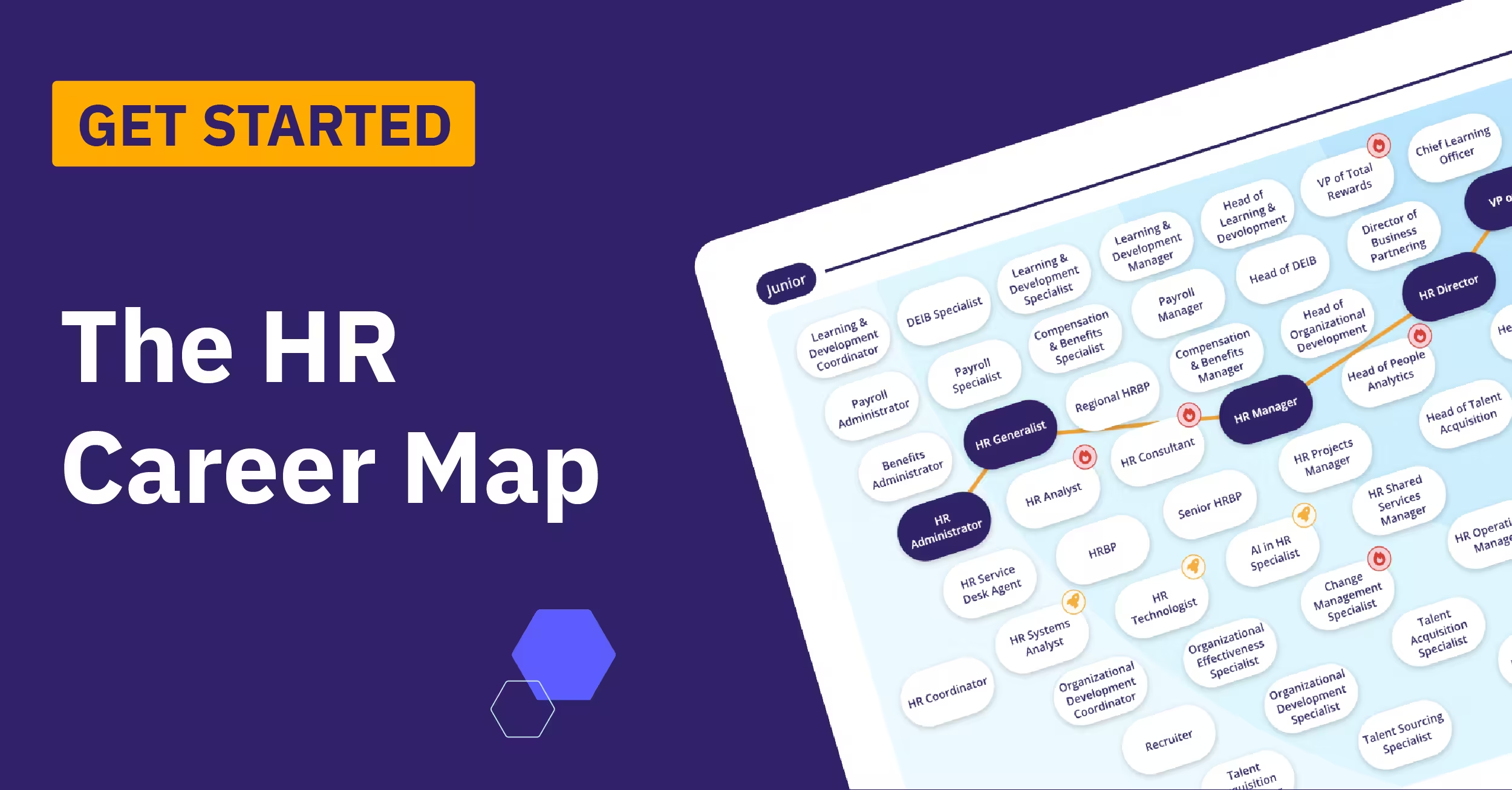
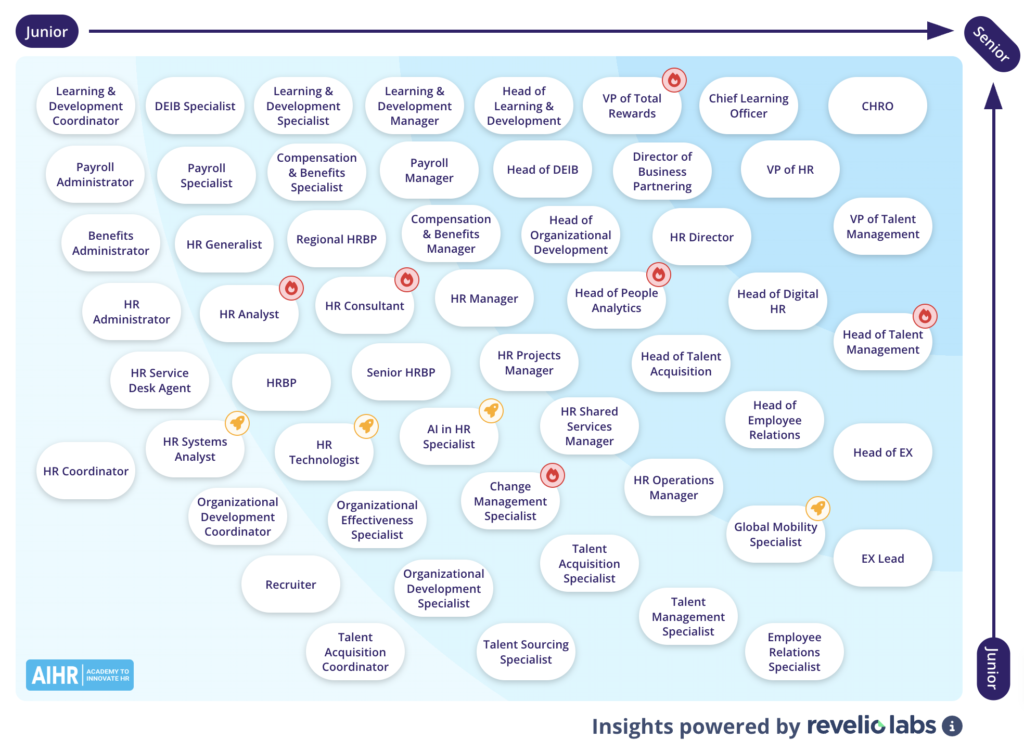
Want to plan your next career move before picking a certification? Use AIHR’s HR Career Map to determine the best HR roles, how much you can earn, and the skills you need to get there.
What HR certification should you get first?
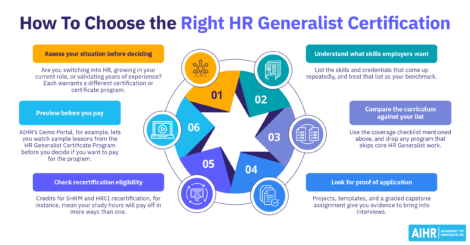
The best HR certification to start with depends on where you are in your career, not on which credential is most prestigious. A certification that opens doors for a senior HR leader can be the wrong first move for someone two years into the field. Use the stages below to find the credential that matches your experience now, then plan the next one as your role grows.
Entry level (0 to two years in HR)
If you’re new to HR or moving in from another field, start with a credential that does not require years of HR experience. HRCI’s aPHR has no experience requirement, which makes it a practical first step for recent graduates and career changers. The SHRM-CP is also open to you, since SHRM does not require a fixed experience minimum to take the exam. Either one signals foundational knowledge to employers while you build a track record.
Mid-level (two to five years in HR)
At this stage, you’re running HR processes and advising managers, so the two strongest options are the PHR and the SHRM-CP. Choose the PHR if your work is operational and US compliance sits at the center of your role. Choose the SHRM-CP if you want a competency-based credential with broad international recognition. Both carry similar weight with most employers, so let your day-to-day focus decide.
Senior level (five or more years in HR)
If you shape strategy, lead a function, or sit close to the executive team, move to a senior credential. The SPHR from HRCI and the SHRM-SCP from SHRM are both built for strategic HR work, and both are widely recognized for director-level and above roles. These are the credentials that tend to appear in senior HR job postings, so they support the move into leadership pay bands.
AIHR’s Demo Portal helps you explore your options by allowing you to:
✅ Preview lessons from different HR certificate programs
✅ Explore practical HR guides, templates, and resources
✅ Discover tools and playbooks across key HR domains
✅ Try AIHR Copilot and see how it can support your HR learning
🎓 Use the Demo Portal for a closer look at AIHR learning that can support your next HR career move.
12 best HR certifications
Ready to pursue a coveted certificate in Human Resources? Here’s a rundown of the top HR certifications to consider.
Please note that this list is compiled based on publicly available information. We have not tried the certifications or certificate programs ourselves, except for AIHR’s certificate programs.
1. Academy to Innovate HR (AIHR) Certificate Programs
AIHR Certificate Programs are designed to help you build practical HR skills and capabilities you can apply to your role immediately. The programs:
- Are 100% online and self-paced: You decide when to study and how many hours to commit per week.
- Offer 12 months of access: This starts the day you enroll, and covers lessons, assignments, and the capstone project.
- Take 30-40 hours to complete: Depending on the certificate program you choose, you can expect a 30-40 hour time investment.
- Offer foundational, intermediate, and advanced levels: This helps you choose programs that match your current experience.
- Practice with hands-on labs and capstone projects: AIHR programs include practical assignments that help you apply concepts to real HR scenarios. In hands-on labs, you may build tools like HR dashboards or draft workplace policies. In programs with a capstone project, you’ll solve a realistic business problem using what you’ve learned. Passing the capstone is required to earn your digital certificate and PDC credits, and learners can retake it once.
You can enroll in the Academy for the full experience and earn multiple certificates, or choose to focus on one area of interest at a time.
The 16 HR certificate programs cover:
- Artificial Intelligence for HR
- HR Business Partner 2.0
- People Analytics
- Learning and Development
- Organizational Development
- HR Generalist
- Compensation & Benefits
- Digital HR 2.0
- Diversity, Equity, Inclusion & Belonging
- HR Consulting
- HR Coordinator
- HR Manager
- People Data & Business Insights
- Sourcing & Recruitment
- Strategic Talent Acquisition
- Talent Management & Succession Planning
The certificate programs aim to help you become a T-shaped HR professional by building the core HR competencies of:
With Full Academy Access, you can also take standalone courses, such as Claude for HR and High-Impact Performance Management, helping you develop specific skills in a short time.
2. Professional in Human Resources (HRCI)
The HR Certification Institute (HRCI) is a well-known resource for continued education for HR professionals. Their most sought-after certification is the Professional in Human Resources (PHR). With certification levels in the senior and global areas of HR management careers, it’s possible to start your journey and earn advanced certification as you gain on-the-job experience and increased levels of responsibility.
Candidates can sit for the associate level certification (aPHR), then advance to the PHR, SPHR, and GPHR. There is also an internet-only version of this certification, complete with a digital badge, with the exams proctored by Pearson. Most students study for six to nine months before taking the exams.
- Whom it’s for: HR professionals at any career stage who want a credential that matches their level of experience, from entry-level to senior.
- Eligibility requirements: A Master’s degree with one year of experience, a Bachelor’s degree with two years of experience, or four years of experience without a degree.
- Cost: $495 (including a $100 application fee).
3. SHRM Certified Professional (SHRM-CP), SHRM Senior Certified Professional (SHRM-SCP)
The Society for Human Resource Management (SHRM) offers competency-based HR certifications, based on the core knowledge of SHRM Body of Applied Skills & Knowledge (SHRM BASK). This supports the career goals of HR professionals to achieve their personal best in HR. The course and exams focus on leadership success as well as organizational strategy.
Also offering specialty areas, SHRM focuses on the HR department of one, immigration laws, workplace investigations, talent acquisition, inclusive culture, and people analytics. California HR professionals can also find certification specific to their region. Most students study for six months before taking the exam.
- Whom it’s for: HR professionals who want a widely recognized U.S. credential and formal validation.
- Eligibility requirements: None for SHRM-CP; at least three years of strategic-level HR experience for SHRM-SCP.
- Cost: $350 to $499, depending on membership status and timing. The official prep system is priced separately at $820 to $1,330.
4. Talent Acquisition Specialty Credential (SHRM)
SHRM offers the Talent Acquisition Specialty Credential (TASC) as a focused alternative to its full SHRM-CP and SHRM-SCP certifications. Rather than a broad HR exam, it concentrates on the recruiting lifecycle, covering sourcing and engagement strategy, employer branding, candidate experience, global hiring, and inclusive recruiting practices.
The credential is designed to validate specialist expertise for people who spend most of their time on hiring. It complements, rather than replaces, a foundational HR certification, and stays valid for three years. You don’t need to be SHRM-certified to earn it, but if you already hold the SHRM-CP or SHRM-SCP, completing it automatically adds 22 professional development credits (PDCs) toward your recertification.
- Whom it’s for: Recruiters, talent acquisition specialists, and HR generalists who want to formalize and deepen their hiring expertise.
- Eligibility requirements: None. SHRM certification is not required to enroll, though holders earn 22 PDCs toward recertification.
- Cost: Around $995 for SHRM members and $1,335 for non-members for the full credential package.
5. CIPD Qualifications (Levels 3, 5, and 7)
The Chartered Institute of Personnel and Development (CIPD) is the leading professional body for HR and people development, and its qualifications are the recognized standard across the U.K. and much of Europe. They’re structured across three levels that match different career stages: Level 3 (Foundation Certificate) for those starting out, Level 5 (Associate Diploma) for mid-level practitioners, and Level 7 (Advanced Diploma) for senior and strategic roles.
Unlike a single exam, you complete CIPD qualifications through coursework and assignments that accredited study centers deliver, with most learners studying online over a few months to two years (depending on the level). You study through approved providers rather than CIPD directly, so each center sets tuition. You also need an active CIPD student membership throughout your studies. Completing Level 7 makes you eligible for Chartered Membership.
- Whom it’s for: HR and L&D professionals in the U.K., Europe, and international markets who want a globally portable, academically structured credential matched to their career stage.
- Eligibility requirements: None for Level 3. Level 5 suits those with some HR experience or a relevant degree, and Level 7 is aimed at experienced professionals in or moving toward senior roles. Active CIPD student membership is required while studying.
- Cost: Roughly £1,300 to £2,500 for Level 3, £1,650 to £4,000 for Level 5, and £6,700 to £7,500 for Level 7 (depending on provider and study format), plus CIPD membership and a one-off joining fee.
6. Strategic HR Leadership (HCI)
The Human Capital Institute (HCI) is known for centering human capital and business strategy alignment, typically focusing on HR leaders and their business impact. HCI offers access to Strategic HR Leadership (SHRL) and several other competency-based HR certification programs, while HCI Academy provides participant materials, guides, practice tests, and mentor support.
You can participate in two-day programs or the virtual series in half-day sessions for up to four weeks. Learners must pass the online exam to earn the certification.
- Whom it’s for: Those who are new to HR leadership roles, want to be people leaders, or need to improve their team’s performance.
- Eligibility requirements: None. However, to earn the certificate, students must attend all sessions, participate in group discussions, complete all classwork, submit an evaluation, and pass the final exam.
- Cost: $1,995
7. Certified Human Resources Professional (HRPA)
The Human Resources Professionals Association (HRPA) offers the exclusive Certified Human Resources Professional (CHRP) credential, which is internationally recognized and validates an HR practitioner’s foundational knowledge, workplace readiness, and ethical standards.
Students must complete a series of nine HR-related subject areas by taking courses through a network of colleges and universities in Canada, then sit for challenge exams. There’s also a workforce readiness program to support those who wish to pursue a career in HR.
- Whom it’s for: Early-career HR professionals handling essential, day-to-day HR tasks.
- Eligibility requirements: Relevant higher education, completion of specific coursework in core HR subject areas, passing a rigorous knowledge and employment law exam, and verified professional HR work experience.
- Cost: $845 to $1,130. This includes a $240 to $300 membership fee (depending on the month and province), a $220 CHRP Knowledge Exam (CHRP-KE) fee, and a $185 CHRP Employment Law Exam fee.
8. Talent Management Practitioner (TMI)
The Talent Management Practitioner certification offered by the Talent Management Institute is a foundational credential for those breaking into talent management, built on TMI’s Universal Knowledge Framework (TMI-UKF). It covers the core knowledge a new talent management professional needs, including the principles of talent management, succession planning, talent acquisition, and HR technology and talent analytics.
The TMP is the first rung of TMI’s three-level ladder, followed by the Senior Talent Management Practitioner (STMP) for mid-career professionals and the Global Talent Management Leader (GTML) for senior global roles. It comes with a shareable digital badge, and every learner receives the TMI Resource Box, which includes the institute’s practitioner handbook as the main study reference.
- Whom it’s for: Early-career HR professionals, recent HR graduates, and students who want a foundational, globally portable credential to move into talent management.
- Eligibility requirements: Typically, a bachelor’s degree in HRM, business, management, or a related field, plus roughly six months to two years of experience in an HR sub-function (more if your degree is unrelated). An accelerated pathway (QualiFly) is available for holders of recognized HR qualifications.
- Cost: Around $675 for the exam and resource materials.
9. Certified Professional in Talent Development (ATD)
Known for its leading training in areas of professional development, the Association for Talent Development (ATD) provides the comprehensive Certified Professional in Talent Development (CPTD) certification. It covers various topics relating to talent development across multiple skill sets and aptitudes.
The program can be accessed in-person, online, or through weekend workshops; you may also self-study using ATD resources. The exam is rigorous, and students are advised to prepare well in advance. In fact, many report taking six to nine months to study.
- Whom it’s for: HR and talent development professionals who want to continue building their talent development capabilities.
- Eligibility requirements: Must have five years of related work experience and deep knowledge of employee talent development principles.
- Cost: $975 exam fee and $1,695 preparation course for members, $1,350 exam fee and $1,945 preparation course for non-members.
10. Fundamental Payroll Certification and Certified Payroll Professional (PayrollOrg)
PayrollOrg (formerly the American Payroll Association) offers the two leading payroll credentials in the U.S. The Fundamental Payroll Certification (FPC) is an entry-level certification that covers core paycheck calculation, federal tax compliance, and payroll systems and processes. The Certified Payroll Professional (CPP) is the advanced credential for experienced HR practitioners, testing extensive expertise in compliance, administration, accounting, and payroll management.
Both are exam-based and recognized as the standard for payroll roles within and adjacent to HR. Both credentials are valid for three years and require recertification credit hours to maintain.
- Whom it’s for: Payroll specialists, compensation professionals, and HR generalists who handle payroll and want a dedicated credential in the field.
- Eligibility requirements: None for the FPC, but the CPP requires meeting one of PayrollOrg’s experience criteria (e.g., three years of payroll work in the preceding five years).
- Cost: The FPC exam is $359 for PayrollOrg members and $459 for non-members. The CPP exam is $419 for members and $609 for non-members. PayrollOrg membership is not required to sit for either exam.
11. Human Resource Information Professional (IHRIM)
The International Association for Human Resource Information Management (IHRIM) offers several options for continuing education, including the full-fledged Human Resources Information Professional (HRIP) certification program. This certification focuses on HR professionals’ generalized competencies, as well as their understanding of HR information management. Learners can take the exam via live online proctoring.
- Whom it’s for: The HRIP program is recommended for (but not strictly limited to) HR professionals with three to five years of working experience, a post-secondary degree, other formally recognized HR training, or professionals who want a deeper understanding of HRIS or the technologies they work with daily.
- Eligibility requirements: None.
- Cost: $445 for the exam only, $1,100 for the full package of learning materials, new member fee, and the exam.
12. Certified HR Manager (HR University)
HR University offers the Certified HR Manager (CHRM) as an online, self-paced certification aimed at building practical, manager-level HR skills. Delivered as an on-demand course of more than 90 video lessons, it covers the full HR management remit (e.g., strategic HRM, HR analytics, DEI, employment law, recruitment and selection, talent development, performance management, C&B, employee relations, and global HR.
The program uses a practical application, with 30-plus case studies, analytical activities, quizzes, and interviews with working HR professionals, and is structured to be completed at roughly four hours a week over about 10 weeks. On finishing, you complete a certification test and receive a digital badge and e-certificate with a verification link. SHRM also recognizes HR University to offer PDCs for SHRM-CP or SHRM-SCP recertification.
- Whom it’s for: Aspiring and current HR managers, career changers, and HR professionals who want a practical, flexible credential covering the fundamentals of HR management.
- Eligibility requirements: None.
- Cost: $199 for the single CHRM certificate program, or $499 for full access to HR University’s six certificate programs. A 30-day money-back guarantee applies.
Cost, eligibility, and recertification
Before you commit to a certification, it helps to see the full picture: what you pay upfront, whether you qualify, and what it takes to keep the credential active. Certifications are not a one-time cost. Most require renewal every three years, so factor in the ongoing commitment alongside the exam fee.
What the major certifications cost
HRCI uses flat pricing with no member or non-member split. The PHR costs $495 in total, made up of a $100 application fee and a $395 exam fee, and the SPHR costs $595.
SHRM prices its exams by membership status and registration window. The SHRM-CP starts at $420 for members and $520 for non-members at the early-bird rate, and the SHRM-SCP starts at $520 for members and $620 for non-members. Standard-deadline rates are higher, so applying early saves money.
Eligibility at a glance
HRCI ‘aPHR has no HR experience requirement, which is why it works as a first credential. The PHR requires one to four years of professional HR experience, depending on your education, and the SPHR requires four to seven years on the same education-based sliding scale. SHRM does not impose a fixed experience minimum to sit the SHRM-CP, though the SHRM-SCP is aimed at professionals already doing strategic-level work. Always confirm the current criteria on the certifying body’s site before you apply, since requirements change.
Recertification: The ongoing cost
Both bodies require renewal every three years. SHRM requires 60 professional development credits (PDCs) and a recertification fee, currently around $100. HRCI requires recertification credits that vary by credential, 45 for the aPHR and 60 for the PHR and SPHR, with a recertification fee in the range of about $150 to $170. With either body, you can usually earn these credits through approved learning activities rather than retaking the exam.
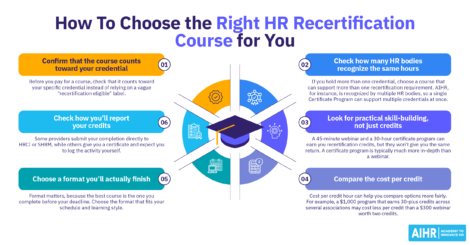
This is where ongoing education fits in. AIHR is recognized by SHRM to offer Professional Development Credits (PDCs) for SHRM-CP or SHRM-SCP recertification activities, and its certificate programs can also support recertification activities with HRCI. That lets you maintain your credentials and build practical, current HR skills at the same time, rather than treating renewal as a box-ticking exercise.
It’s also important to remember that investing in your career doesn’t always have to come out of your own pocket. Continuous learning and certifications are often excellent investments for your company. Some companies might have a policy already for a learning and development budget, so inquire with your manager about what your company offers. If your company doesn’t have anything specific, there are a few steps you can take to start discussing your employer sponsoring your new certification.
Next steps
Choosing a certification is a decision about where you want your HR career to go next, and the right path depends on your stage, your role, and whether you need to validate what you know, build new skills, or both. Use the comparison above to shortlist one or two credentials, check the eligibility and recertification commitment, and map them against where you want to be in the next few years.
If part of that goal is building practical, in-demand skills that complement a SHRM or HRCI credential, the best next step is to see how AIHR’s certificate programs work before you commit. You can head to AIHR’s Demo Portal to explore the curriculum, sample lessons, and platform features at your own pace, and see how the programs help you build capabilities you can apply at work right away.
FAQ
Have questions? We’ve got answers about HR certification programs! Before you enroll in any program, here is what you need to know.
HR certification helps you gain new knowledge, skills, and experience through courses, assignments, and exams, and demonstrate this to your (potential) employer. It is a popular way of career advancement for HR professionals.
While earning one or more of these HR credentials is no substitute for work experience and a college degree, HR certification proves to others that you are dedicated to the field of Human Resources and continuous learning.
Earning an HR certification through any of these organizations speaks volumes in that you are interested in developing skills and competencies to become more effective in your career. The value of a certification varies, depending on if an accredited educational institute issues it and if it’s approved for learner credits.
The goal of learning for the sake of learning is always a great attitude to have when thinking about career development. However, when certification is involved, this can help set you apart from others in your organization or other candidates you might be running against.
What’s more, HR certifications can also help boost your pay and earn promotions.
The most common HR certifications include the SHRM Certified Professional (SHRM-CP) and the SHRM Senior Certified Professional (SHRM-SCP) by the Society for Human Resource Management (SHRM) and the Professional in Human Resources (PHR) and Senior Professional in Human Resources (SPHR) offered by the HR Certification Institute (HRCI).
As you grow into your career and find areas you want to learn more about or expand your knowledge on, specialized certifications like those from AIHR become increasingly beneficial; think of areas of HR like People Analytics, DEIB, and Talent Acquisition.
What the best HR certification is for you depends on your individual needs and career objectives. There’s no one-size-fits-all for all Human Resources professionals.
Here are some recommendations on how to decide on the best HR certification for you: Starting, you may want a certification that can lead to skills that will help you land your first HR job. This extra effort will position you well for any career in HR. Once you get more experience, an advanced HR certification can greatly benefit your professional growth and income. Keep in mind that HR certification is much more convenient to earn today through online learning.
That depends on the course you’re taking. For example, if a course is 40 hours long and you dedicate four hours a week, you’ll be done in 10 weeks. However, getting some HR certifications might take a couple of months or even years. Decide what you can commit to before selecting an HR certification program.
When you decide to get an HR certification, make sure to commit to studying. You can block time off your calendar or set progress milestones for yourself.