



As an HR professional, your job isn’t done once a candidate accepts an offer and signs their contract. In a survey of U.S. employees who had started a new job in the past year, 42% said the experience overwhelmed them with too much content at once. While 68% felt prepared for success, 39% had second thoughts about their role during onboarding.
This shows why a structured onboarding process is essential. Done well, it helps new hires understand their role, build relationships, and start contributing with confidence. This article looks at 20 employee onboarding process examples that can inspire your strategy.
Contents
What is the onboarding process?
Why is a good onboarding process important?
20 best onboarding process examples for HR
Onboarding program examples from leading companies
Best practices to optimize the onboarding process
What is the onboarding process?
The onboarding process is how an organization welcomes new hires and helps them settle into their roles, teams, and company culture. Good onboarding gets new employees operational and ready to succeed as quickly as possible.
It also familiarizes them with their managers, colleagues, and company policies. Along the way, an effective onboarding experience lays the foundation for their professional relationships and leaves a positive, lasting first impression. By the end of the program, employees should feel fully integrated into their teams and able to do their jobs effectively and independently.
The process usually runs across five stages of employee onboarding: preboarding, the first day, the first week, the first 90 days, and the first year. HR designs what happens at each stage, from welcome emails and systems access to training, buddy pairings, and check-ins. It handles the paperwork and legal requirements, refines the process as feedback comes in, and supports managers throughout the process.

Why is a good onboarding process important?
A good onboarding process matters because it shapes whether new hires stay, engage, and perform. The early weeks decide how quickly someone finds their footing and starts adding value.
A strong start sets the foundation for engagement and helps people contribute quickly. When they feel welcomed and valued, they report higher job satisfaction and are less likely to leave. A good process also reduces early mistakes and improves productivity from day one. Structured training and clear resources help new hires transition smoothly into their roles and teams, and stay aligned with your organization’s goals.
A good onboarding process helps you:
- Boost new hire engagement and job satisfaction
- Improve retention and reduce early turnover
- Speed up productivity and time to competence
- Deliver a consistent, positive onboarding experience.
Good onboarding examples can spark ideas, but delivering a consistent experience requires well-designed HR processes across the employee life cycle. Build a solid HR foundation that will help you structure onboarding so new hires know what to expect.
AIHR’s HR Generalist Certificate Program covers how to:
✅ Build onboarding into a structured employee lifecycle
✅ Develop HR policies and processes that support new employees
✅ Coordinate key activities involved in bringing people into the organization
✅ Apply practical HR frameworks across everyday operations
💡 Visit the AIHR Demo Portal to preview lessons and get a closer look at the AIHR learning experience.
20 best onboarding process examples for HR
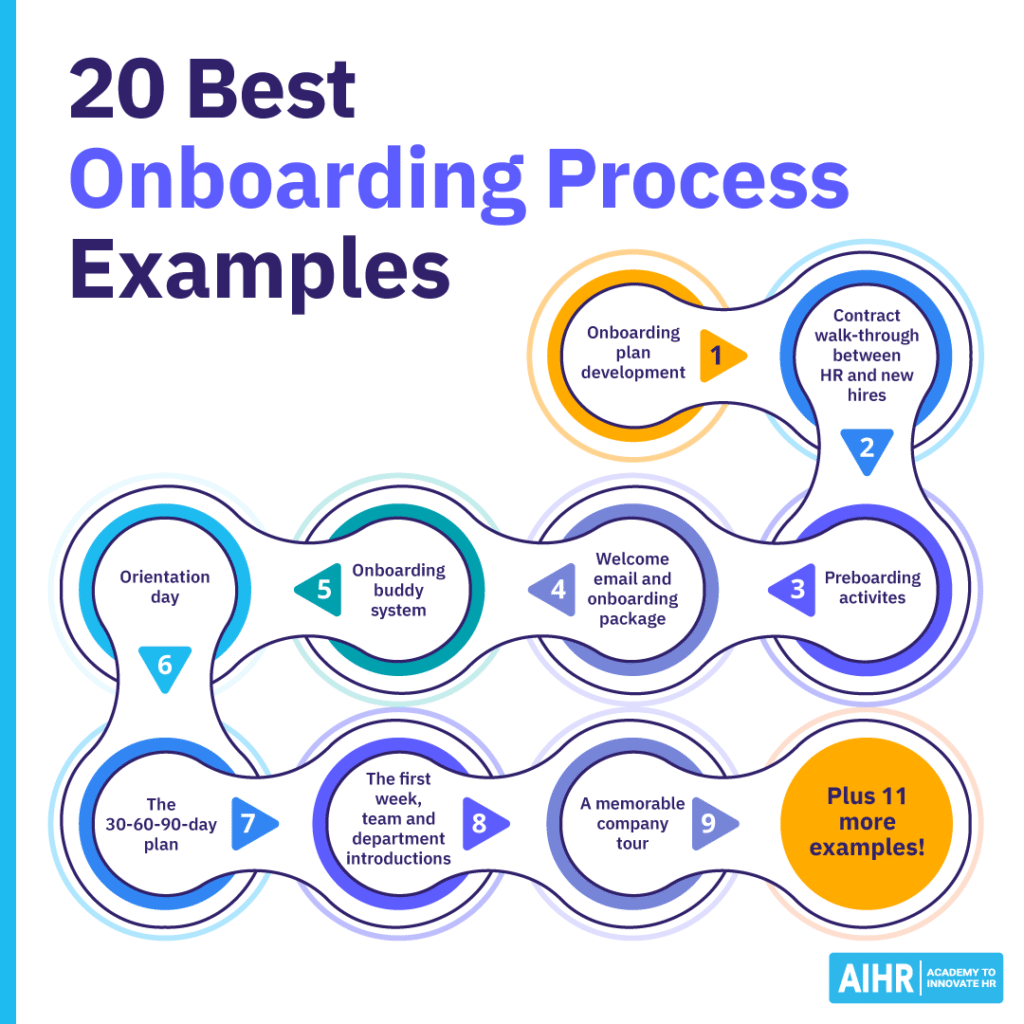
Each example below covers a different stage of the process and is grouped into four themes for easy navigation. Use them to build a new approach or sharpen the one you have.
Building the onboarding plan
Example 1: Onboarding plan development
An onboarding plan gives employees and their managers a clear structure for the first year. Ideally, HR provides the framework, while the new hire’s manager tailors it to the role, team, and business priorities.
An onboarding plan typically includes the following stages:
- Preboarding
- First day
- First week
- First 90 days
- First year.
Example 2: The 30-60-90 day plan
A well-designed 30-60-90 day plan helps new employees and their managers navigate the onboarding period. It provides structure and clarity around company culture and job expectations to prepare them well for their first three months at the organization. Consider the following aspects of the plan:
- First 30 days: The first month is about helping the new hire settle into their role and get to know the company better.
- Next 30 days: By the end of the second month, the employee should be an actively contributing team member and have a more thorough understanding of the business’s fundamentals, including its pain points.
- Last 30 days: The employee should be fully onboarded, adding value to the business, and integrated into the team and the culture.
AIHR has created a downloadable template for a 30-60-90 day plan you can use to help you build a similar plan for your organization and its new hires.

Example 3: Onboarding documents
Onboarding documents typically include company policies, an employee handbook, and legal paperwork (such as the new hire’s employment contract and role-specific information).
A simple way to handle this paperwork is to create a document checklist. You can divide it into stages: preboarding, first day, and any additional forms new hires need to complete.
For a ready-made example, AIHR offers a must-have onboarding documents checklist, along with downloadable templates for many of the documents it covers.
Example 4: Onboarding checklists
Alongside software that automates and structures your onboarding process, a good checklist helps you make sure every new hire gets a consistent, thorough start.
You can create different versions for different needs, with separate ones for the hiring manager, HR, IT, and the new hire.
AIHR has created checklist templates that you can download for free.

Example 5: Create a sample onboarding schedule
A clear schedule tells new hires what to expect and when, so they are not left guessing on day one. Lay out their first days and weeks as a simple timeline and share it before they start.
A sample onboarding schedule might include:
- Day 1: Welcome, equipment setup, team introductions, and a manager one-on-one
- Week 1: System and tool training, a role overview, and buddy check-ins
- Weeks 2 to 4: First projects, department introductions, and regular manager catch-ups
- Days 30, 60, and 90: Progress reviews against the 30-60-90 day plan
Keep the schedule flexible and adjust the pace to the role. For example, a frontline hire and a head-office hire will need different timelines and onboarding activities.
Example 6: Map the onboarding journey
A journey map lays out every touchpoint a new hire experiences, from the offer letter to their first performance review. Mapping it helps you spot gaps and design a more consistent experience.
Walk through each stage in order: preboarding, first day, first week, first 90 days, and first year. At each one, note the key moments, who owns them, and how the new hire is likely to feel, then fix the weak spots first. Treat the map as a living document and update it as roles and tools change.
Example 7: Set onboarding goals and measure success
Clear goals turn onboarding from a checklist into a process you can improve. Decide what good looks like, then track it.
Useful onboarding goals and metrics include:
- Time to productivity, or how long until a new hire works independently
- 90-day and one-year retention rates for new hires
- New hire satisfaction, measured with a short survey
- Completion rates for onboarding tasks and training.
Set a target for each, review them every quarter, and use the results to refine your approach.
A strong onboarding process helps new hires understand their role, connect with their team, and start contributing sooner. HR needs practical skills to make each step clear, consistent, and connected to the wider employee life cycle.
AIHR’s HR Generalist Certificate Program teaches you to:
✅ Set up HR processes across recruitment, onboarding, performance management, and employee engagement
✅ Create policy frameworks that help HR work stay consistent
✅ Use the HR Canvas to clarify how HR supports the business
✅ Plan and organize HR work so daily operations run more smoothly
💡 Check out the lessons in AIHR’s Demo Portal for a clear idea of what you’ll get.
Preboarding and first days
Example 8: Contract walk-through between HR and new hires
The preboarding process should start as soon as a new hire signs their employment contract. The first thing to do is have someone from the People Team walk them through their contract to explain key details and answer any questions they may have.
Arrange a meeting with them shortly after they’ve signed and submitted the contract. The meeting can take place virtually or in person, depending on the new employee’s location and personal preference.
Example 9: Preboarding activities
A strong preboarding process keeps new hires engaged between signing and their first day. Recent employee onboarding statistics show that 84% of new hires found pre- and post-day one communications helpful for building relationships at work. Early engagement like this also lowers the risk of non-starters, people who accept an offer but never show up.
Preboarding has two main goals. First, to keep new hires engaged and excited to start their new role from the moment they sign their contracts. Second, it aims to provide them with the necessary information to prepare them for their first day (e.g., their manager’s contact details, admin forms they must complete, etc.).
Follow these tips for a successful preboarding:
- Ensure the new hire receives a welcome email
- Send them the necessary employment paperwork
- Remind their manager to inform the team about them
- Stay available and keep in touch
- Ask their buddy to reach out if your company uses an onboarding buddy system.
Real-life example
GitLab regularly hosts a preboarding call for new hires. It gives them the chance to ask questions ahead of their first day and meet their future colleagues. These bi-monthly calls are open to all current employees and hiring managers.
Example 10: Welcome email and onboarding package
The welcome email and starter package are essential parts of the employee onboarding process. They can set a positive tone and provide the new hire with essential information before their first day.
Send a personalized welcome email and a thoughtfully prepared packet that includes the organization’s mission, vision, and values, and an overview of the new hire’s orientation day or week. Be sure to also include relevant contact information and a copy of the employee handbook.
Example 11: Orientation day
Orientation day centers around new employee orientation (NEO), which focuses on familiarizing new hires with their work environment, processes, and relationships during their first day or week.
The main goal of effective NEO is to reduce new hires’ stress and provide clarity on what they can expect in the coming weeks and months. Some NEO best practices to consider include:
- Ensuring the new hire’s work environment and equipment are fully ready before they arrive
- Introducing them to their new colleagues and manager
- Using detailed checklists to ensure you complete all NEO tasks
- Discussing expectations with them clearly and answering their questions
- Gathering feedback from them to continuously improve your NEO.
Real-life example
Here’s what a typical morning at AIHR looks like on a new hire’s first day:
- The new employee arrives at the office and meets with their manager, who gives them an office tour and introduces them to the rest of the team.
- IT sets them up with their work equipment (an Apple laptop, keyboard and mouse) and provides instructions on how to log into the company’s internal platforms.
- After setting up, their manager introduces them to their personalized 30-60-90 day onboarding plan and discusses it with them to set expectations.
- They now have some time to ask their manager and IT any questions they may have, and take a moment to themself.
- Finally, they break for lunch (prepared by AIHR’s in-house chef) with their team, giving them a chance to get to know their colleagues better.
Connection and culture
Example 12: Onboarding buddy system
A buddy system at work can be a brilliant way to make a strong first impression on new hires and help them feel welcome and supported. Using an onboarding buddy system has multiple benefits, such as:
- Faster integration of new hires into organizational culture
- More casual learning through socialization
- Increased employee retention
- Improved employee engagement.
When developing an onboarding buddy system, start by setting the criteria for selecting buddies and pairing them with new hires (e.g., similar roles or backgrounds). Ensure the buddies you select receive training and a checklist of tasks to prepare them for their roles.
Once they start working with the new hires, check in with both parties regularly to gather feedback and provide support where necessary.
Real-life example
For each new hire, Buffer has what the company calls an Onboarding Dream Team consisting of the relevant hiring manager and two buddies. The hiring manager is responsible for coordinating the new hire’s 30-60-90 day onboarding roadmap, and selecting the role buddy.
The role buddy is usually a peer on the new employee’s team who arranges a Zoom meeting with them once or twice weekly. They are supposed to answer any role- and task-related questions the new employee may have.
The second buddy is called the culture buddy, who typically is on a different team from the new hire. They chat weekly with the new employee and provide additional context about the company’s history, norms, and culture.
Example 13: The first week, team and department introductions
The first week continues the momentum of day one. New hires are still learning their role, team, and tools, so build the week around people and systems rather than paperwork.
During the first week:
- Set up one-on-ones with each team member, and make sure the hiring manager is there on day one to welcome them
- Walk them through the systems and tools they will use, including payroll and leave requests
- Schedule regular check-ins with their direct manager and hiring manager
- Share their profile with the wider company on your internal communication platform.
Once they have settled in with their own team, introduce them to other departments. This helps them learn who does what and whom to contact. Arrange short sessions with a representative from each relevant department, and keep them to about two a week so they do not overwhelm them.
For fully remote hires, ask their team to run these introductions over video and to create an equally warm welcome tradition.
Example 14: A memorable company tour
A company tour lends itself well to creativity and interactive elements. Ideally, you want a charismatic team member or the new hire’s onboarding buddy to do this so they can share interesting anecdotes about the company. Enhance the experience by including a swag bag with company-branded useful items like a coffee mug, stationery, or a USB stick.
For new hires who work on-site or under a hybrid arrangement, showcase the office facilities (break rooms, recreational areas, etc.) and facilitate interactions with different departments.
For fully remote employees, you can employ interactive 360-degree video tours for an immersive experience, and introduce them to the remote collaboration and communication tools your company uses. Be sure to also arrange virtual meetings between them and their managers and team members.
HR tip
Onboarding activities for a new hire can include:
- A welcome lunch or coffee break with their team
- An interactive tour of the workplace
- A welcome video message from the company founder(s)
- An introduction to their 30-60-90 day onboarding plan with their manager
- An engaging orientation program.
Example 15: A ‘meet the executives’ session
A ‘meet the executives’ session can significantly influence how employees evaluate their overall onboarding experience. Organize this session in a relaxed, informal setting where new hires can have an open dialogue with the organization’s executives.
Some tips to keep in mind:
- Encourage new hires to submit questions or bring up topics they are curious about beforehand
- Encourage executives to share lessons learned during their careers and personal experiences
- Use a simple activity, like a coffee or tea break or a shared lunch, to further ease the atmosphere.
The onboarding process should be built around the desired experience we want to create for employees. It is often overly focused on just driving efficiency, losing sight of its overall aim and the impact it has on employees. Efficiency in the process does not lead to productivity. Fostering a connection and engagement ensures they are equipped and enabled to contribute.

Training and ongoing support
Example 16: Remote onboarding
Remote onboarding presents various challenges for organizations and HR professionals. These include establishing strong connections and communications with team members and managers, as well as smooth integration with the company culture. To set remote hires up well, be sure to:
- Connect them with their buddies virtually to open a reliable communication channel, so they know whom to contact and how.
- Provide crucial IT support. The relevant staff should be able to advise you on how best to set up remote hires and what technology they need.
Real-life example
Verisys supports its new remote hires with its tutorial videos to help them set up their work computers at home and create a conducive home office. The organization delivers this equipment to the homes of its new hires, together with decorations and a company swag bag.
Example 17: Role-specific training
According to the 70-20-10 model for learning and development, 70% of learning is work-based and informal. For a new hire, this process of ‘learning by doing’ occurs during new tasks, actual projects, and interactions with more experienced colleagues.
Rather than having new employees watch hours of training videos or sit through long lectures, getting them involved in actual work tasks during their onboarding will help them understand their role better through active participation.
The following tips will help you support this training:
- Pair new hires with a more experienced colleague (this can also be their onboarding buddies)
- Make sure the role-specific training is as relevant and practical as possible
- Consider digital tools to switch things up and make learning more dynamic.
Example 18: Regular manager-employee sit-downs
Active manager involvement is essential to a new hire’s success. One way to achieve this is through regular manager-employee sit-downs. A new hire and their manager should have weekly or bi-weekly catch-ups throughout their onboarding process. Remember to also ensure new hires know whom in HR to contact if they have issues with their manager.
Example 19: Regularly gathering feedback
Regularly ask new hires for feedback about their onboarding experience so you know what worked well for them and what needs improvement.
It’s good practice to check in at specific points: after preboarding, and again at the first week, first month, and third month. Make sure they also know where to send spontaneous suggestions from the moment they start.
Example 20: Training managers to onboard well
Onboarding is a skill, and it’s not something that (newly appointed) managers instinctively know how to do well. HR can provide the framework and handle the administrative, legal, and compliance side, but much of the rest depends on the hiring manager.
Think of the new hire’s integration into the team, drafting the 30-60-90 day plan, collecting feedback, and spotting issues early. Teaching managers to treat this as a core skill is crucial to their team’s success.
Factors to take into account:
- Make it clear where managers can find the general onboarding resources
- Encourage them to involve their teams in welcoming new starters
- Ensure hiring managers can always come to the People Team for guidance.
Onboarding program examples from leading companies
The strongest onboarding programs come from companies that treat the first few weeks as a strategic investment, not paperwork. These examples show what that looks like in practice, and what you can borrow.
Google takes a data-driven approach to onboarding its new hires, or “Nooglers.” It surveys them at 30, 90, and 365 days to see how they are settling in, then uses the results to keep improving the experience. The survey tracks three things: whether new hires have the tools they need, whether they feel productive, and whether they feel their background is valued.
Acting on that feedback, Google strengthened the link between its first-week orientation and the department-level onboarding that follows, which it sees as the connection most likely to affect how quickly a Noogler becomes productive. Measure how new hires experience their first year, then fix what the data flags.
Zappos
Zappos became known for a policy called “The Offer”. After about a week on the job, new employees were given a choice: stay, or quit and be paid to go. The logic was that anyone willing to take the money obviously lacked the commitment the company wanted. It was a deliberate filter. The people who stayed had actively chosen the culture, and Zappos was happy to part ways early with those who had not.
Netflix
Netflix builds onboarding around its “freedom and responsibility” culture, first set out in a 2009 culture deck and refreshed in its Culture Memo. New hires receive this memo directly, so it doubles as an onboarding tool that sets expectations from day one. Instead of sitting through a long, passive orientation, they get real context and meaningful work early, on the assumption that capable people do their best when trusted with ownership from the start.
Zapier
Zapier has been fully remote since day one, so its remote onboarding is async and documentation-first. Every new hire is assigned a “Zap Pal,” a buddy who reaches out in the first week, sets up at least one video call, and keeps checking in through the first month. In a distributed team, a named buddy and clear written guidance do the work that hallway chats and desk-side questions handle in an office.
Best practices to optimize the onboarding process
Onboarding best practices are the habits that consistently help new hires feel supported and reach full productivity sooner. The examples above point to six that make the biggest difference.
- Start onboarding before day one: Preboarding keeps new hires engaged between signing and their first day. Send a welcome email, share the key details they need, and set up their equipment early so day one feels prepared rather than chaotic.
- Personalize the first 90 days: A 30-60-90 day plan gives each new hire clear goals for their first three months. It aligns their work with team priorities and shows them what good looks like at each stage.
- Assign every new hire a buddy: Pairing new hires with an experienced colleague speeds up cultural integration and gives them a safe person to ask the small questions. Choose buddies deliberately and give them a simple checklist so they know what to cover.
- Involve and equip managers: The process works best when managers actively welcome and guide new hires. Give them the prompts and tools they need to do it well, and gather their feedback too. As Marna van der Merwe, Lead Global HR Insights Lead at AIHR, puts it: “Just as we ask new hires for feedback on the onboarding process, it’s useful to also get feedback from managers so we can understand how to equip them better as key players in the process.”
- Make it a shared responsibility: Welcoming a new hire is not HR’s job alone. It works best as a collaboration between HR, the hiring manager, and the new hire’s team, each owning a clear part of the experience.
- Gather feedback and tailor to your workforce: Check in with new hires after preboarding, the first week, and 90 days, then use what you learn to adapt. One approach rarely fits everyone, so keep the experience consistent but adjust how you deliver it. AIHR’s Marna van der Merwe adds: “A good onboarding process is unlikely to be ‘one size fits all’, unless the workforce is not very diverse. The onboarding experience should be consistent, but the process for delivering it might differ depending on the workforce’s needs. For example, onboarding for frontline workers would be very different from that for head office employees.”
Next steps
A great onboarding process rarely comes together by accident. It takes clear steps, the right templates, and the confidence to run each stage well.
If you want to build that skill set, AIHR’s HR Generalist Certificate Program walks you through onboarding as part of the wider employee life cycle, with a practical onboarding module, a ready-to-use 30-60-90 day plan template, and an employee onboarding checklist you can apply right away. The program is online and self-paced, so you can learn around your schedule and put each new skill to work as you go.


 POPULAR: 3,687 DOWNLOADS