
Most conversations about AI at work start with productivity, and at the task level, the gains have materialized. In a study of more than 5,000 customer support agents, access to a generative AI assistant raised productivity by 14% on average and by 34% for novice and low-skilled workers. However, when looking beyond the task level, employees describe something else. In a survey by the Upwork Research Institute, 77% of employees using AI said it had increased their workload and that time saved was being spent on new activities such as checking, verifying, and evaluating AI outputs.
A new term has been coined to describe this reality. AI fatigue refers to the growing mental and operational strain employees experience as they adapt to, manage, and work alongside AI. While the technology promises to reduce workload, it can also introduce new demands through verification, correction, coordination, and the expectation of increased output.
In many cases, the problem lies in how work has been organized around the technology. AI can intensify work when existing roles, responsibilities, and decision-making processes stay the same, even as the nature and volume of work evolve. So while AI fatigue can look like employees struggling to keep up with new technology, it’s often a consequence of organizations failing to redesign work with AI in mind as it becomes an increasingly important part of the workforce.
In this article, we argue that HR should be leading the work redesign to ensure that AI fatigue is minimized, while also providing a realistic perspective on how unlocked capacity should be spent.
Contents
What work design issues AI is exposing
How AI creates the capacity illusion
Where overload hides
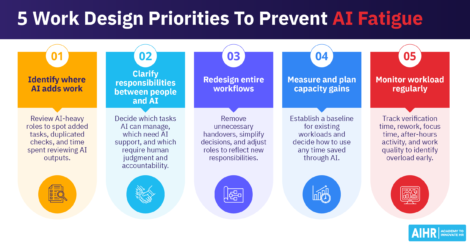
How to prevent AI fatigue: 5 priorities for leaders and HR
The mandate is often that we need to be 30 or 40% more efficient without additional headcount, and that AI is going to drive that. But when AI frees up time and the team doesn’t have the capacity to use it in the right way, people just keep getting more and more overloaded.


What work design issues AI is exposing
Many organizations have approached AI by introducing the technology into existing ways of working, without reconsidering if work should be reorganized when integrating AI into processes and workflows. As a result, AI gets layered onto the existing organizational design, which often makes its inefficiencies more visible.
This is the same mistake businesses made in the past. When factories first adopted electricity, many simply replaced their steam engines with large electric motors while retaining the same machinery layouts and production processes. The initial productivity gains were limited and did not justify the large investments firms made at the time. The real benefits only emerged over subsequent decades as factories were redesigned to take advantage of electric power, including the use of individual motors and more flexible production layouts.
The lesson for AI is similar. Introducing new technology into existing ways of working does not necessarily change how value is created. The greater opportunity lies in redesigning work around what the technology makes possible. When a European telecom’s customer service operation added AI to existing workflows, it lifted productivity by 5%, while redesigning the work around it subsequently boosted it by 30%. Even though the gains are obvious, only one in four organizations have redesigned a core workflow around AI. The rest continue to fall into the trap of bolting AI onto existing work.
We discussed AI fatigue with Amy Margolies, Founder of Sunshine Theory, a company that helps organizations design effective performance architectures. Watch the full interview below:
How AI creates the capacity illusion
Leaders see the time AI saves on a task, but they often lack insight into where the effort went or what new work has been created. In a study of 25,000 Danish workers, AI chatbots saved users around 3% of their time but created new tasks for 8.4% of workers, including some who don’t use the tools themselves. More than 80% of the time saved was reinvested in other work. ActivTrak’s analysis of 443 million work hours found that once people started using AI, their time on email, messaging, and chat more than doubled, while focused work time fell by 9%.
Most leaders are continuously monitoring six to eight input streams on top of all their open decisions, and AI is often what added the seventh and eighth. Every AI copilot generates alerts and outputs that need their attention. That architecture is broken, and that’s what needs to be addressed.
Much of that new work is verification. In an Upwork survey, 39% of employees said they now spend more time reviewing or moderating AI-produced content. Researchers at Stanford and BetterUp found that 40% of U.S. employees had received low-quality AI output from a colleague in the past month, and that each instance took nearly two hours to deal with. The effort moved further down the workflow, to people whose roles were never designed to absorb it.
When AI creates additional capacity, organizations need to decide how that capacity will be used. At AIHR, we identified three possible approaches.
Extraction
Reduces costs, often through headcount reductions
Can contribute to AI fatigue when remaining employees have to absorb responsibilities that others previously held
Amplification
Increases output with the existing workforce
Poses a particular risk of increasing workload and contributing to AI fatigue
Reinvestment
Redirects the time saved toward activities that build longer-term value, such as work redesign, learning, and tasks requiring human judgment
Builds longer-term workforce capacity
Extraction and amplification may deliver short-term benefits, potentially at the expense of longer-term workforce capacity. They can still be the right choice in some situations, as long as organizations understand the implications and make these decisions deliberately.
In practice, employees often make these decisions themselves. An eight-month study at a U.S. technology company found that employees using AI worked faster, took on more varied tasks, and extended their working hours, often without being asked to do so. As AI made additional work feel more manageable, they took it on voluntarily, which is, in effect, amplification that no one in leadership decided on.
This has important implications for work design. Without clear decisions about how to use additional capacity, AI may simply create the expectation that people can do more. Managing how new work enters the system therefore becomes as important as deciding which existing tasks AI can automate or support.
What’s needed is cognitive load management that keeps pace with the multiplying decisions, and leaders’ own capacity being measured, rather than assumed, so it’s clear whether they have the fuel to take on all this additional work. In fast-scaling teams, it isn’t the hard work that’s depleting people. It’s that these companies systematically eliminate every structural condition required for capacity to rebuild.
Where overload hides
Most organizations have limited visibility into how AI is changing the distribution of work. Workflows are often poorly documented, and even where documentation exists, it rarely keeps pace with changes in how work is done. Across AIHR’s research and advisory work, four areas consistently stand out where additional workload and overload tend to emerge:
- Roles that accumulate work: AI-related tasks get added to roles, and nothing is taken away. The job description stays the same while the job expands, without anyone intentionally making this decision.
- Decision rights concentrated with managers: When AI output needs sign-off and no one close to the work is trusted to give it, review flows up to managers, who become the bottleneck.
- Handoffs that multiply checking: Each handoff is another point where the same output gets checked again. The more handoffs there are, the less of the original gain survives.
- Open-ended work intake: When AI makes work faster to start, managers and employees start more of it. Without prioritization, freed capacity is used up as soon as it appears, often on experiments that add little value.
These areas of overload are largely the result of how work is designed, making them a leadership responsibility. HR has an important role to play in addressing them, given its expertise in organization design, role architecture, decision-making structures, and workforce analytics. As the CHRO’s mandate increasingly expands towards that of a work architect, redesigning work to improve both organizational performance and employee experience should become a central priority.
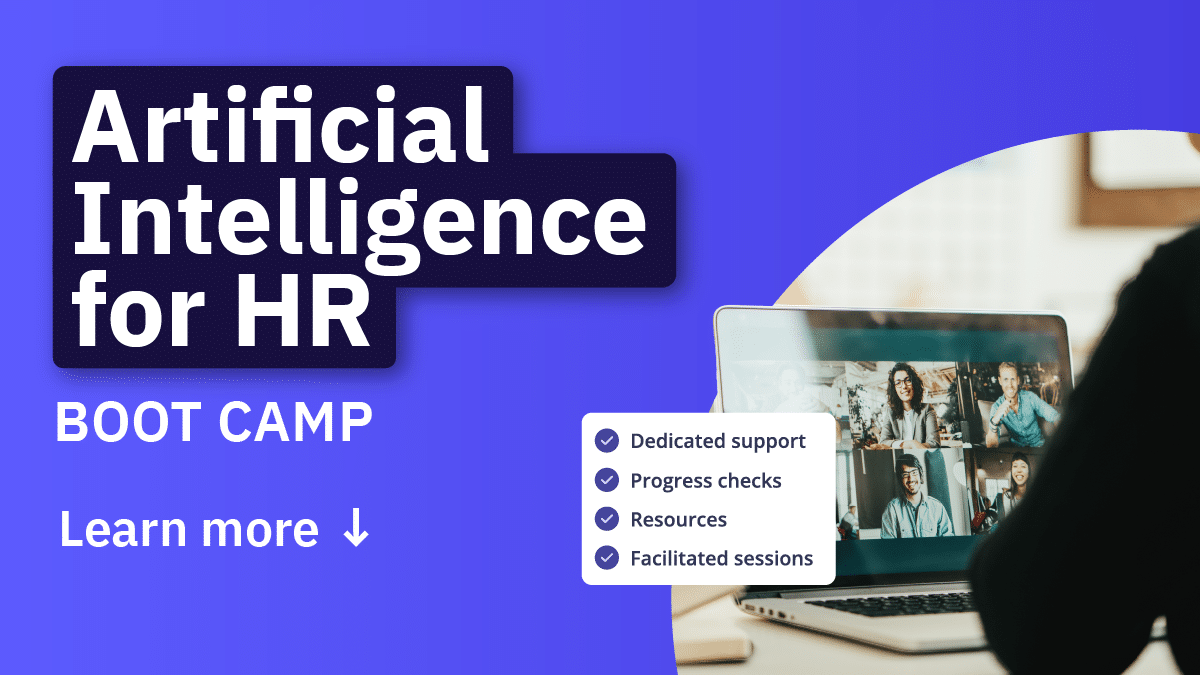
AI is changing work, and HR needs the skills to redesign it well. AIHR’s AI for HR Boot Camp prepares HR teams to shape AI-enabled ways of working across HR and the business:
✅ Identify where AI can improve HR workflows and work design
✅ Redesign HR processes with AI to reduce manual work and improve efficiency
✅ Evaluate use cases based on business value, feasibility, and risk
✅ Build shared practices for responsible, coordinated AI adoption
💡 Equip HR to make AI work better for people.
How to prevent AI fatigue: 5 priorities for leaders and HR
Organizations that prioritize work design are twice as likely to exceed their AI ROI expectations, according to Deloitte. Yet HR is often brought in after the design decisions are made, and spends its time managing the consequences related to AI fatigue, or, in worst cases, employee disengagement and burnout.
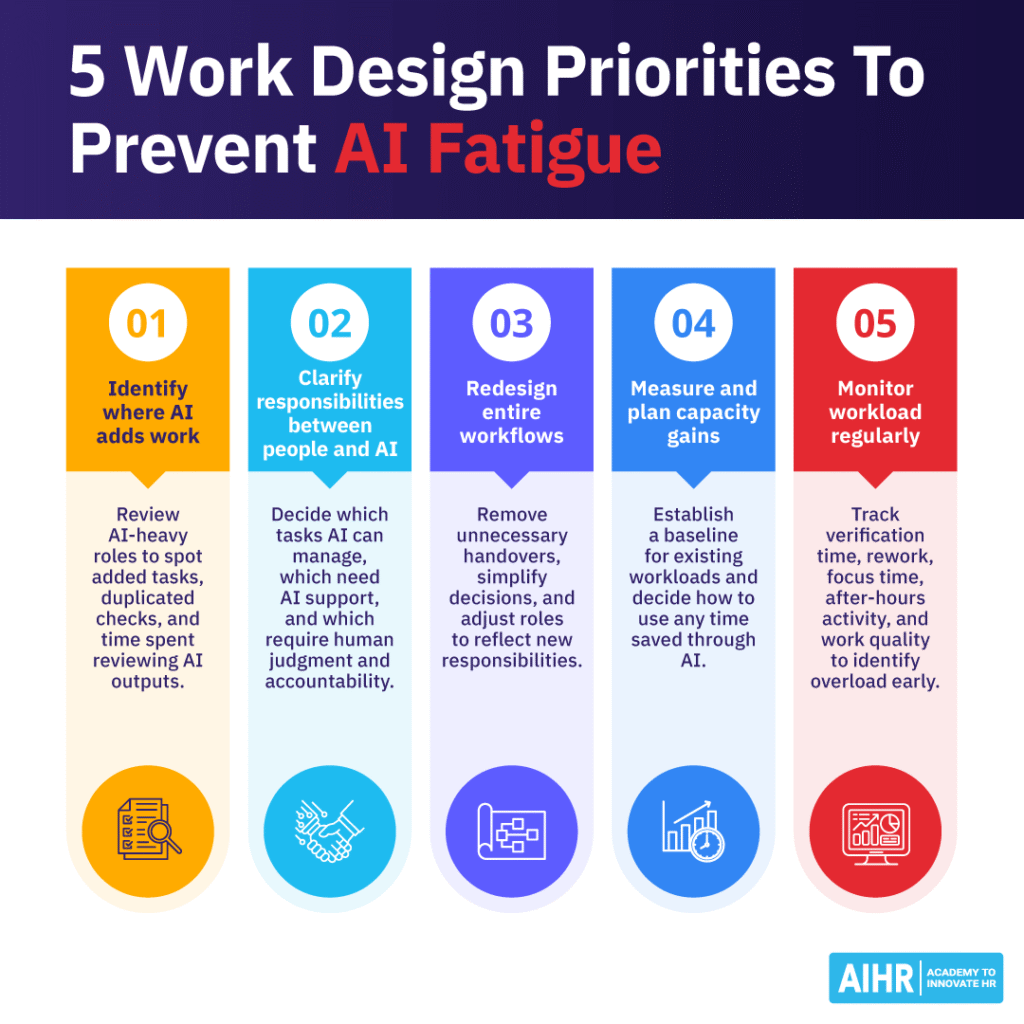
HR needs to work with leaders to prioritize five actions as organizations redesign work around AI and human collaboration for the future:
Priority 1: Understand where AI is adding to the workload
Start by examining roles where AI is already widely used, focusing on the four areas of overload mentioned earlier. Look at how work has changed, particularly which activities have been added and which have been removed. Pay attention to the time spent reviewing AI outputs, duplicated checks, and the continuous addition of new tasks without reconsidering existing priorities. HR can lead this through a focused job analysis of a few high-use roles, working with managers to map where AI has added tasks and where review work tends to queue up.
Priority 2: Be deliberate about the division of work between people and AI
Not every task should be automated. Some can be managed by AI with appropriate quality controls, others benefit from AI support, while those requiring human judgment, relationships, and accountability should remain with people. The important consideration is to establish clear ownership of tasks, decisions, and quality assurance.
Managers are best placed to sort the tasks in their teams into these three categories, with HR providing a shared framework so decisions on ownership and sign-off stay consistent across the organization. Without this clarity, AI tends to add extra layers of work.
Priority 3: Redesign workflows rather than individual tasks
Choose a workflow where AI can make a meaningful difference and reconsider how the work should be done from beginning to end. This includes removing unnecessary handovers, simplifying decision-making, and adjusting roles to reflect new responsibilities. AI fluency should be developed through this process, enabling employees to build their competencies as they apply AI to their work.
Priority 4: Establish a baseline and decide how capacity gains will be used
AIHR’s research found that only 18% of HR teams have defined what successful AI adoption looks like and how they will measure it.
Before introducing AI, understand how much time existing work requires, including coordination, review, and rework. Organizations should also decide how they intend to use any capacity released, whether to improve performance, reinvest in higher-value activities, or reduce workload. Without these decisions, efficiency gains can quickly be absorbed by additional demands.
Priority 5: Monitor workload as part of operational performance
Traditional engagement surveys often identify overload only once it has become a problem. Organizations need more immediate indicators, including time spent verifying outputs, rework, uninterrupted focus time, after-hours activity, and work quality. These should form part of regular performance discussions with managers. When verification increases, or employees have less time for focused work, the response should be to reconsider how work is designed, rather than relying on additional wellbeing interventions.
Ultimately, the opportunity is not simply to use AI to do more work, but to rethink how work is organized so that technology improves organizational performance and the experience of work while not sacrificing human wellbeing.
You see people sacrificing. You see stress, and stress takes a toll on so many things, from your body to how you work. If that’s the way you’re working, your ceiling has a limit, and you’re just going to grind yourself down. Over the last year or two especially, I’ve seen more and more very senior people leave because they’ve hit that ceiling and are maxed out.
Final words
AI has the potential to create significant capacity for organizations and individuals, but how that capacity is used will determine whether employees experience the benefits. This requires organizations to reconsider not only which activities AI can take over, but also what work should stop, how responsibilities change, and where people should focus their time.
AI fatigue should therefore be understood as more than an employee wellbeing concern. It raises important questions about how organizations are managing the introduction of AI and whether their approach to work design is keeping pace with technological change.
The real opportunity for HR is to help organizations move beyond simply making existing work more efficient, towards designing work that is more productive, sustainable, and meaningful for people.