

73% of Gen Z employees say they’ll leave a job if they don’t get regular feedback from their manager, according to a StaffCircle survey. Yet fewer than 20% of employees feel inspired by the reviews they actually receive. For HR, this creates a clear challenge: Managers need the right structure and language to make feedback useful.
The right performance review examples can help your managers give clearer, more specific feedback. This article provides sample comments for different ratings, roles, and review cycles, along with performance review summaries and self-review examples, and a free template you can adapt to your own process.
Contents
What is a performance review?
How to write a performance review
Performance review examples by competency
Performance review examples by role
Performance review examples by timeframe
Free performance review examples template (PDF)
Performance review goals examples
Performance review summary examples
What is a performance review?
A performance review is a structured assessment of an employee’s work over a set period, measured against their core responsibilities and goals. It highlights strengths, progress, and areas for improvement, then sets clear expectations for what comes next.
Most reviews cover a few common elements. These include overall performance, specific competencies, progress against targets, and a development plan. Managers usually lead the review, while HR provides guidelines, examples, performance metrics, and rating scales to ensure it is fair, consistent, and free of bias.

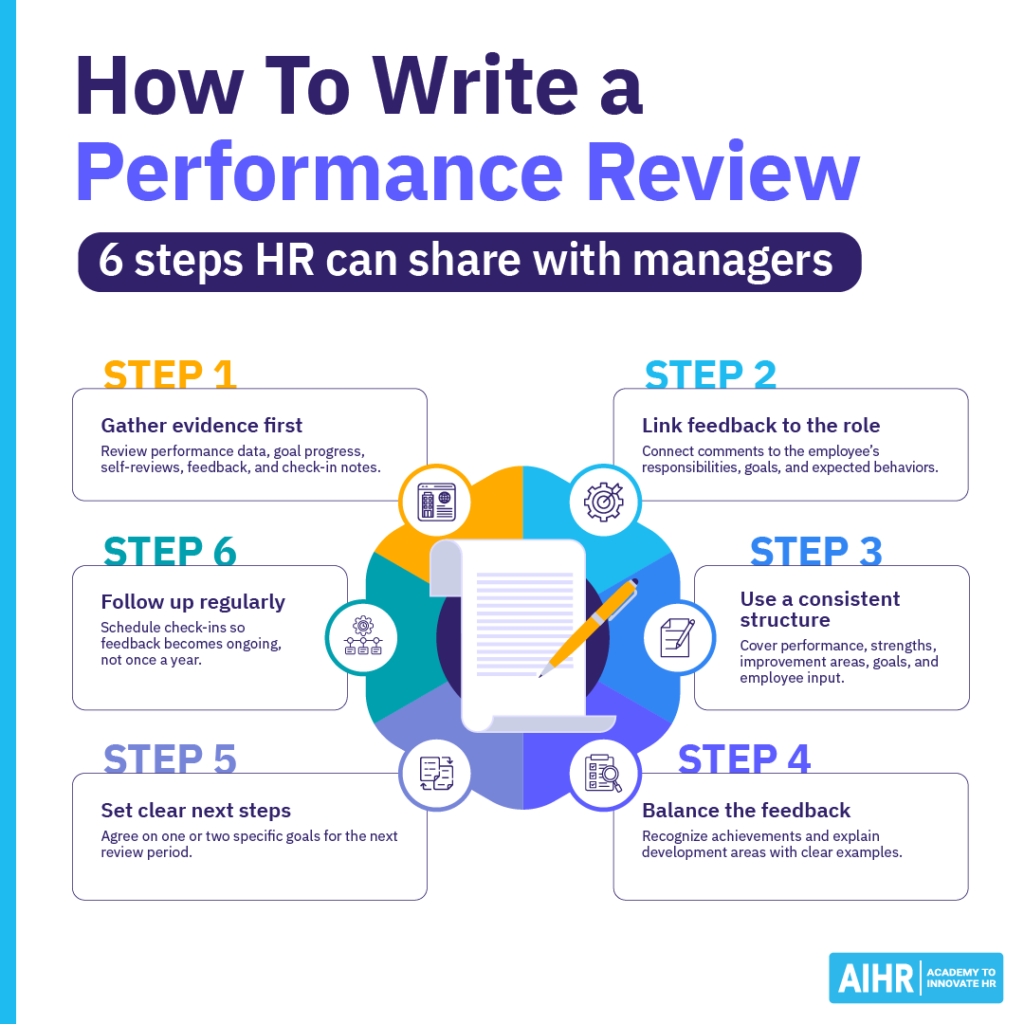
How to write a performance review: 6 steps HR can share with managers
A good review is prepared, specific, and forward-looking. As an HR professional, your role is to give the process enough structure so feedback stays fair, useful, and focused on employee growth. The six steps below can help you turn review guidance into clear, practical feedback across teams.
- Gather your evidence first: Ask reviewers to gather performance data, progress against targets, 360-degree feedback, the employee’s self-review, and any notes from informal check-ins. They should decide what the conversation needs to focus on before they start writing.
- Ground the review in role expectations: Guide managers to tie feedback to the job description, competency framework, or priorities set at the start of the period. This keeps the review objective and helps the employee see how the feedback connects to their role.
- Follow a consistent structure: Use the same format across reviews. Cover overall performance, key strengths, areas for improvement, focus areas for the next period, and space for the employee to respond and ask questions. A consistent format also helps you compare themes across teams and spot where extra support may be needed.
- Give balanced, specific feedback: Ask reviewers to recognize what the employee does well before discussing development areas. Each point should include a concrete example and clear performance review phrases that make the message easy to understand. Drawing on input from several colleagues can also reduce personal bias.
- End with clear goals and next steps: Each review should close with one or two actions the employee can work on before the next check-in. Goals should be specific, observable, and linked to the employee’s development.
- Follow-up between reviews: Performance reviews should not be the only time employees receive feedback. Encourage managers to schedule short check-ins between formal reviews. Regular follow-ups help the employee stay on track and make the next review easier to write.
Expert insight
Chloë de Jonge, People Business Partner at AIHR, shares what makes performance reviews work in practice:
- “A review should never contain surprises. If it does, something went wrong during your regular 1:1s. Feedback needs to be continuous throughout the year, not saved up for an annual conversation.”
- “Capture feedback as it happens. Use your performance management system’s continuous feedback feature to log achievements, or keep a simple running document. You’ll have a much stronger evidence base at review time.”
- “Recognition deserves as much attention as improvement. Name the strengths and positive behaviors you want the employee to keep doing, alongside the areas for development.”
Common mistakes to help managers avoid
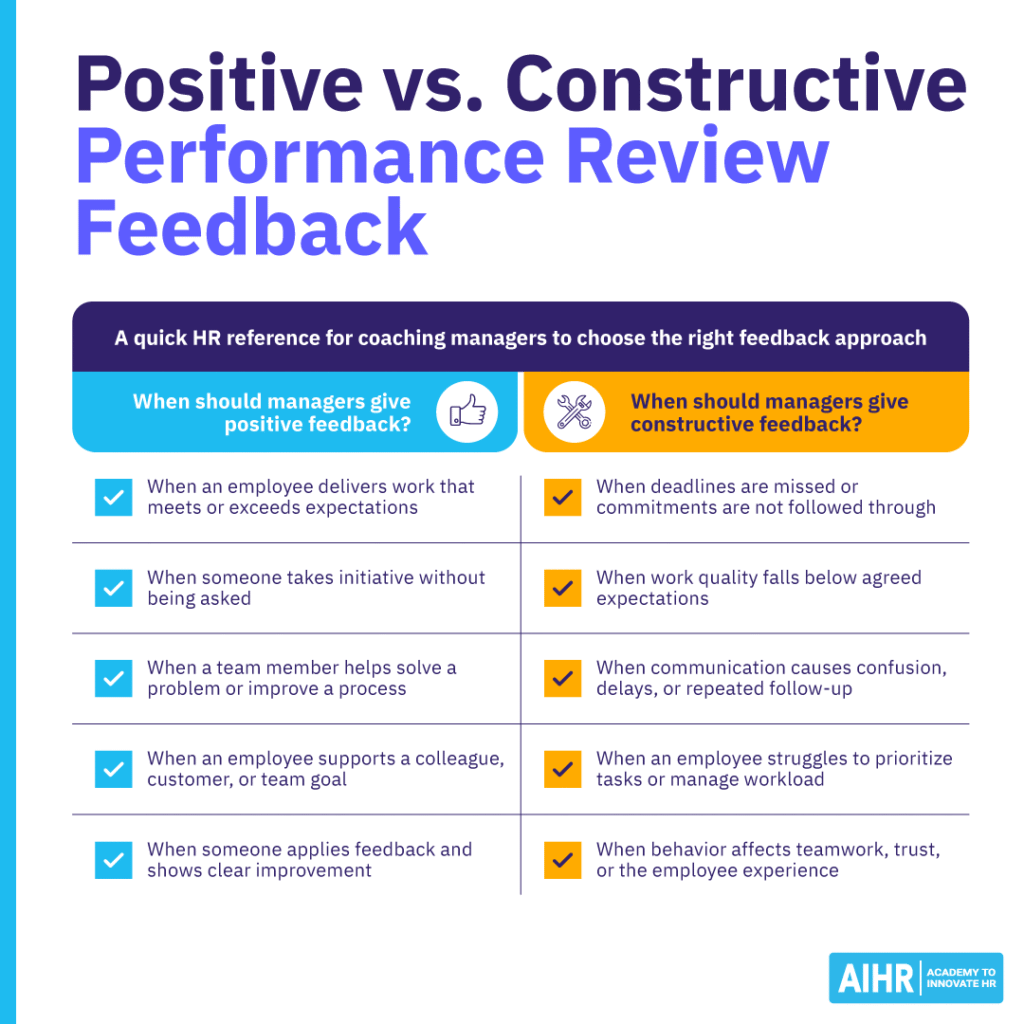
- Don’t focus on the negatives: Ultimately, the review should give the employee something to work toward. Help managers focus more on how employees can improve instead of only what they’ve done wrong.
- Don’t be vague: Reviewers should give concrete, specific examples to support their feedback, so the employee knows exactly what they’ve done well and where they need to improve.
- Don’t ambush employees: HR should establish a performance review schedule and ensure managers inform employees in advance. This gives them time to prepare and reduces unnecessary stress and anxiety.
- Don’t stop at the review: Remind reviewers to follow up regularly, such as monthly, on the goals set during the review. Ongoing feedback helps employees develop further.
Performance review examples by competency
The examples below are grouped by the skills most often assessed in performance reviews. Give managers these examples as starting points, then ask them to add one detail from the employee’s work to make the feedback more accurate.
Communication performance review examples
Communication covers how clearly someone shares information, listens, and keeps others informed.
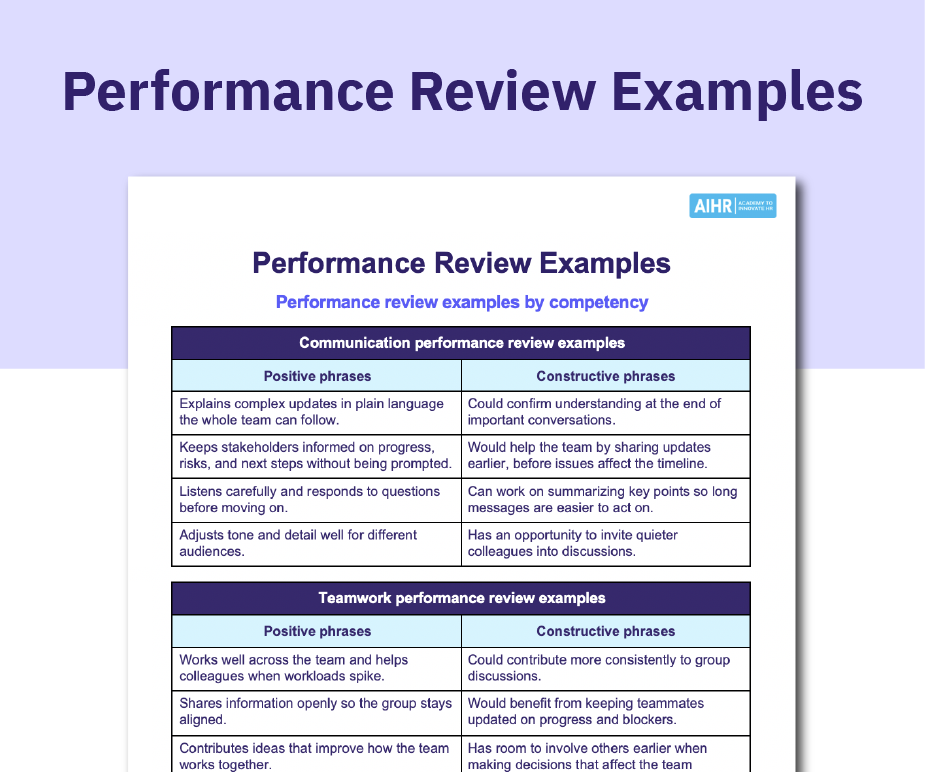
- Explains complex updates in plain language the whole team can follow.
- Keeps stakeholders informed on progress, risks, and next steps without being prompted.
- Listens carefully and responds to questions before moving on.
- Adjusts tone and detail well for different audiences.
- Could confirm understanding at the end of important conversations.
- Would help the team by sharing updates earlier, before issues affect the timeline.
- Can work on summarizing key points so long messages are easier to act on.
- Has an opportunity to invite quieter colleagues into discussions.
Example comment: During the Q3 launch, you kept every stakeholder updated with a short weekly summary, which cut confusion and kept the project on track. A practical next move is to flag risks as soon as they appear rather than at the weekly update, so the team can react sooner.
Teamwork performance review examples
Teamwork looks at how well someone collaborates, supports colleagues, and contributes to shared goals.
- Works well across the team and helps colleagues when workloads spike.
- Shares information openly so the group stays aligned.
- Contributes ideas that improve how the team works together.
- Steps in to support shared goals without being asked.
- Could contribute more consistently to group discussions.
- Would benefit from keeping teammates updated on progress and blockers.
- Has room to involve others earlier when making decisions that affect the team.
- Can work on balancing individual tasks with shared priorities.
Example comment: “You played a real part in the team hitting its goals this quarter, especially by covering onboarding tasks when we were short-staffed. For the next review period, keep teammates looped in earlier on your projects, so handovers stay smooth when priorities shift.”
Job knowledge performance review examples
Job knowledge measures how well someone understands their role, tools, and processes, and applies that knowledge.
- Shows strong command of the role and applies it well in daily work.
- Understands the tools and processes the job depends on.
- Shares knowledge with colleagues and helps solve work-related questions.
- Applies new information quickly to unfamiliar situations.
- Could continue building depth in a few key areas of the role.
- Would benefit from a stronger grasp of core processes or systems.
- Has an opportunity to seek information before moving ahead on unfamiliar tasks.
- Can work on applying knowledge independently with less guidance.
Example comment: “Your product knowledge has become a genuine asset, and colleagues regularly come to you with questions. To keep growing, focus on the two newer systems we rolled out this year, so you can support the team on those as confidently as you do the rest.”
Productivity and quality of work performance review examples
This competency covers how much someone gets done and how accurate and reliable that work is.
- Delivers a steady volume of work while keeping quality high.
- Produces accurate, thorough work that rarely needs rework.
- Manages time and priorities well to meet deadlines.
- Applies feedback to raise the quality of later work.
- Could improve consistency in output across busier periods.
- Would benefit from an extra review step to catch avoidable errors.
- Has room to prioritize higher-impact work when the workload grows.
- Can work on estimating timelines more accurately.
Example comment: “You kept output steady through a demanding Q4 and still met your deadlines, which the whole team relied on. To lift quality further, a quick self-review before submitting reports will help catch the small data errors we saw in a couple of the monthly summaries.”
Initiative performance review examples
Initiative looks at whether someone spots opportunities and acts on them without waiting to be told.
- Identifies opportunities and acts on them without prompting.
- Suggests improvements to processes rather than waiting for direction.
- Takes ownership of tasks and follows them through independently.
- Looks for ways to learn beyond immediate responsibilities.
- Could be more proactive in spotting and acting on opportunities.
- Would benefit from suggesting improvements instead of waiting for guidance.
- Has room to take ownership earlier, without reminders.
- Can work on seeking out new challenges more actively.
Example comment: “You took the newsletter on without being asked and grew its open rate from 18% to 26%, freeing up senior time for campaign work. To take this further, bring that same initiative to one cross-team project this year, where your ideas would have a wider impact.”
Problem-solving performance review examples
Problem-solving looks at how someone breaks down issues, weighs options, and reaches workable solutions.
- Breaks complex problems into clear, manageable steps.
- Weighs the options and explains the reasoning behind a decision.
- Stays calm under pressure and keeps work moving toward a solution.
- Brings solutions to the table, not just problems.
- Could gather a bit more information before settling on a solution.
- Would benefit from involving the right people earlier in tricky decisions.
- Has room to consider a wider range of options before deciding.
- Could document how a problem was solved so others can learn from it.
Example comment: When the billing system failed mid-launch, [name] worked through the issue methodically and had a fix in place within hours. To build on this, sharing the steps they took would help the wider team handle similar problems independently.
Performance reviews are most useful when they go beyond rating past work and help shape what comes next. HR can use them to guide development, support career growth, and connect employee performance to wider talent priorities.
AIHR’s Talent Management & Succession Planning Certificate Program teaches you to:
✅ Build a strategic talent management practice aligned with business priorities
✅ Use talent reviews to support better development and succession decisions
✅ Connect career management and mobility to employee growth
✅ Use talent data to support workforce and succession planning
💡 Check out the lessons in AIHR’s Demo Portal for a clear idea of what you’ll get.
Adaptability performance review examples
Adaptability covers how well someone adjusts to change, shifting priorities, and new ways of working.
- Adjusts quickly and stays focused when priorities change.
- Responds to new tools and processes with an open mind.
- Keeps a steady output during periods of uncertainty.
- Supports the team in adapting to change rather than resisting it.
- Could stay more solution-focused when plans change at short notice.
- Would benefit from being more open to new approaches before ruling them out.
- Has room to manage stress more steadily during busy periods of change.
- Could adapt communication more when working with different teams.
Example comment: “[Name] adapted well when the project scope shifted twice this quarter and kept their work on track throughout. The next step is helping newer team members stay steady through change, since they handle it well themselves.”
Leadership performance review examples
Leadership covers how someone sets direction, supports others, and takes responsibility for outcomes.
- Gives clear direction so the team understands priorities and expectations.
- Supports team members with guidance, feedback, and encouragement.
- Builds trust and motivates others to do their best work.
- Takes responsibility for team decisions and outcomes.
- Could set direction more clearly so expectations are easy to follow.
- Would benefit from giving feedback to the team more regularly.
- Has an opportunity to create more space for others to contribute.
- Can work on delegating routine work to focus on coaching.
Example comment: “Your team consistently knows what’s expected and speaks highly of your support. To strengthen your leadership further, delegate more of the routine reporting, which will free you up to coach the two newer team members through their development goals.”
Attitude performance review examples
Attitude looks at how someone approaches their work and how their outlook affects the people around them.
- Brings a positive, constructive attitude, even during demanding periods.
- Approaches new tasks with energy and a willingness to contribute.
- Responds to feedback openly and acts on it.
- Helps create a supportive, motivated team environment.
- Could be more mindful of how their tone affects team morale.
- Would benefit from staying constructive when discussing setbacks.
- Has room to engage more openly in team discussions.
- Could approach feedback with more openness to change.
Example comment: “[Name] brings steady, positive energy that lifts the team, especially when deadlines are tight. Going forward, staying just as constructive when raising concerns will help keep team discussions solution-focused.”
Accountability performance review examples
Accountability measures whether someone takes ownership of their work, commitments, and mistakes.
- Takes responsibility for outcomes and follows through on commitments.
- Acknowledges mistakes and uses them to improve.
- Communicates progress, blockers, and risks in good time.
- Completes agreed actions and keeps others informed.
- Could take firmer ownership of agreed responsibilities.
- Would benefit from flagging blockers earlier so the team can respond.
- Has room to acknowledge and correct mistakes more quickly.
- Can work on tracking agreed actions through to completion.
Example comment: “When the billing error surfaced, you owned it straight away and had a fix in place within a day, which kept the client’s trust. Carrying that same habit into flagging risks earlier, before they escalate, will make you even more dependable to the team.”
Safety performance review examples
Safety looks at how consistently someone follows procedures, raises concerns, and helps keep the workplace safe.
- Follows safety procedures consistently and helps keep the workspace safe.
- Raises potential safety concerns promptly rather than waiting.
- Uses equipment and tools correctly and responsibly.
- Takes responsibility for their own safety and that of colleagues.
- Could follow safety procedures more consistently to reduce risk.
- Would benefit from reporting hazards as soon as they appear.
- Has room to be more careful when using equipment or tools.
- Could take a more active role in preventing safety issues.
Example comment: “You consistently follow our safety procedures and were quick to report the faulty equipment last quarter, which prevented a possible injury. To strengthen this, raising smaller hazards just as promptly will help keep the whole floor safe.”
Self-performance review examples
Self-reviews ask employees to assess their own performance before the manager’s review. This encourages reflection and makes the conversation two-way. Use the examples below to help employees write self-assessments that are specific, evidence-based, and easier to review.
- I met my deadlines throughout the year, including during the Q4 launch.
- I supported two new team members and helped them get up to speed on our tools.
- I acted on my last review and now lead our monthly campaign updates.
- I stepped in to help the team when priorities shifted, without being asked.
- I aim to set clearer personal goals and track my progress more regularly.
- I want to flag project risks earlier, so the team has more time to adjust.
- I plan to strengthen my reporting skills so I rely less on support for data analysis.
- I’d like to speak up more in cross-team meetings to share my ideas.
Example comment: “This year, I focused on delivering reliable work and supporting my team. I met my deadlines through the Q4 launch and helped two new hires get up to speed on our tools. My main focus for the next period is to set clearer priorities, track my progress more regularly, and flag project risks earlier.”
Expert insight
“Engaging in constructive feedback is a skill that must be honed. Often, we focus so much on enabling line managers to give feedback that we fail to enable employees to engage in the process meaningfully. Employees must know how to prepare for feedback conversations, listen with intent, and turn feedback into constructive action.”
— Dr Marna van der Merwe, Research & Insights Lead at AIHR
Performance review examples by role
The same feedback rarely fits every job, so examples work best when the language matches the role. HR can share the role-specific examples below with managers, who can then swap in the employee’s real results.
Manager performance review examples
For managers and team leads, HR should guide reviewers to focus on direction, coaching, delegation, and team outcomes rather than individual task work.
- Sets clear priorities so the team always knows what’s expected.
- Coaches team members through challenges instead of stepping in to fix things.
- Adjusts plans calmly when priorities shift, and keeps the team steady.
- Could delegate more routine work to free up time for coaching.
- Would benefit from giving feedback more regularly, not just at review time.
- Has an opportunity to involve the team earlier in decisions that affect them.
Example comment: “As a team lead, [name] gives clear direction, and their reports consistently know what’s expected of them. The next step is to delegate more routine reporting, freeing up time to coach the two newer team members on their development goals.”
Customer service performance review examples
For customer-facing roles, guide managers to focus on resolution, empathy, responsiveness, and follow-through.
- Handles difficult customer conversations calmly and resolves most issues on first contact.
- Communicates with customers clearly and with genuine empathy.
- Sets clear expectations and follows through on what was promised.
- Could improve follow-up on unresolved tickets to keep customers informed.
- Would benefit from confirming expectations before committing to a resolution.
- Has room to stay solution-focused when conversations get tense.
Example comment: “[Name] handles difficult customer conversations calmly, and satisfaction scores for their queue rose steadily this year. To build on that, faster follow-up on open tickets will keep customers informed and make the experience even stronger.”
Sales performance review examples
For sales roles, HR can help managers focus feedback on targets, pipeline management, relationships, and forecasting accuracy.
- Exceeded the annual sales target and built strong relationships with key accounts.
- Keeps deals moving with consistent, well-timed follow-up.
- Shares what’s working with the wider team, which lifts everyone’s results.
- Could keep the CRM current so forecasting stays accurate.
- Would benefit from updating pipeline stages more consistently.
- Has room to plan earlier for renewal conversations.
Example comment: “[Name] exceeded the annual target by 12% and built strong relationships with several key accounts. Pipeline updates are sometimes late, which makes forecasting harder, so keeping the CRM current each week will help the whole team plan.”
Performance review examples by timeframe
The cycle shapes the tone and focus. A 30- or 90-day check-in reads very differently from a full annual review. Help managers match the example to where the employee is in the review year.
90-day performance review examples
A 90-day review checks how a new hire is settling in after probation. Encourage the reviewers to focus on ramp-up, fit, and early wins rather than long-term results.
- Picked up our tools and processes quickly during the first three months.
- Built good working relationships across the team early on.
- Asks thoughtful questions and applies the answers to their work.
- Already contributing to team tasks ahead of what we expected at this stage.
- Could take more ownership of their own accounts as they settle in.
- Would benefit from asking questions earlier when priorities are unclear.
- Has room to build confidence working independently on routine tasks.
- Could set a few clear goals for the rest of the first six months.
Example comment: “In your first 90 days, you’ve learned our systems quickly and built strong relationships across the team. For the next quarter, focus on taking the lead on your own accounts, and keep asking questions early when anything is unclear.”
Mid-year performance review examples
A mid-year review tracks progress against annual goals and adjusts course where needed. HR can support managers in focusing on what’s on track and what needs support before year-end.
- On track with two of three annual goals at the halfway point.
- Applied feedback from the last review and improved response times.
- Took on an unplanned project and still kept core work moving.
- Communicates progress clearly, so there are no surprises at check-ins.
- Needs support to get the third goal back on track before year-end.
- Could set clearer milestones for the second half of the year.
- Would benefit from focusing on fewer priorities at once.
- Has room to raise blockers sooner rather than at the mid-year point.
Example comment: “You’re on track with two of your three annual priorities, and your work on response times has paid off. Let’s talk through the support you need on the remaining focus area so you can close the gap before year-end.”
Annual performance review examples
An annual or end-of-year review summarizes the year and sets targets for the next one. Companies often use it for pay, promotion, and development decisions.
- Delivered consistently across the year and grew into more responsibility.
- Met or exceeded most goals set at the start of the review period.
- Became a go-to person others rely on for support and knowledge.
- Improved steadily on the development areas from last year’s review.
- Could raise risks earlier so the team has time to adjust.
- Would benefit from taking the lead on a full project next year.
- Has room to turn strong ideas into consistent follow-through.
- Could set more ambitious goals for the year ahead.
Example comment: “This was a strong year overall. You delivered reliable work, grew the newsletter’s reach, and became someone the team counts on. For next year, taking the lead on a full campaign and flagging risks earlier will set you up to move toward an “exceeds expectations” rating.”
Free performance review examples template (PDF)
Download the free performance review examples PDF to give your managers a ready-to-use set of comments, ratings, and summary examples they can adapt for any review.
Performance review goals examples
Performance reviews should end with clear goals for the next period, not just a look back. Each example below follows the SMART approach, so progress is easy to track at the next review. These examples will help your managers and employees turn broad actions into specific, measurable next steps
Goals a manager might set:
- Complete the advanced Excel course and apply it to the monthly report by the end of Q2.
- Reduce average customer response time from 24 hours to 8 hours within two quarters.
- Lead one full campaign from planning to reporting before the next annual review.
Goals for an employee’s self-review:
- I will flag project risks at the weekly check-in rather than waiting until issues arise.
- I will take ownership of the newsletter and grow its open rate by 5 points this year.
- I will complete one leadership course and mentor a new team member by year-end.
HR tip
Encourage managers to agree no more than two or three goals per review. A short list of specific, measurable actions is easier to act on and track than a long list of general intentions.
Performance review summary examples
A performance review summary is the short overall paragraph that captures an employee’s whole review period in a few sentences. It sits at the top or bottom of the review and gives a balanced verdict, rather than commenting on a single behavior. The examples below can help managers write review summaries that reflect the same level of detail as the rest of the review.
Summary for a strong performer
“[Name] had an excellent year and consistently performed above expectations. They led the email program independently and grew open rates from 18% to 26%, while supporting newer team members throughout. Their judgment and reliability make them ready for more responsibility. The focus for the next period is a stretch project that builds their leadership experience.”
Summary for a solid performer
“[Name] met expectations across the year and was a dependable member of the team. They delivered their core work on time and responded well to feedback. Their main opportunity is to take more initiative on projects rather than waiting for direction. With that step, they are well placed to grow into a wider role next year.”
Summary for a mixed performer
“[Name] showed real strengths this period, particularly in problem-solving and client work. At the same time, missed deadlines on two projects affected the team’s planning. They respond well to feedback, which is a good foundation for improvement. The priority for the next period is consistent delivery, supported by clearer weekly planning and earlier flagging of risks.”
Summary for an underperformer
“[Name] has not consistently met the expectations of the role this period, particularly around [area]. This affected [impact], despite feedback and support during the year. They have shown willingness to improve, which is encouraging. We will put a structured plan in place, with specific targets and regular check-ins to support progress over the next quarter.”
Year-end summary example
“This year, [name] delivered steady results and grew into a more senior contributor. They met all but one of their annual goals and took ownership of the newsletter without being asked. The one area to develop is raising risks earlier, so the team has time to adjust. For the year ahead, the focus is on leading a full campaign and communicating blockers sooner.”
HR tip
Instruct managers to keep the summary aligned with the ratings and comments in the rest of the review. A summary that praises an employee while the detailed sections flag problems creates confusion and weakens trust in the process.
Next steps
Use these performance review examples to help managers give clearer, more consistent feedback. Then, connect each review to specific goals, development actions, and regular follow-up conversations.
To strengthen your approach, explore AIHR’s Talent Management and Succession Planning Certificate Program. It helps HR professionals build talent strategies, plan for future workforce needs, and improve succession planning.