




Progressive discipline is a structured, fair process that holds employees accountable while giving them a real chance to explain their side and improve. Done well, it protects your people and your organization at the same time.
That fairness rests on employees feeling heard, and many workplaces come up short. In fact, 78% of family business leaders admit they aren’t very advanced at letting employees appeal management decisions, and 63% of employees say their bosses rarely encourage them to speak up. A progressive discipline policy closes that gap. It sets clear expectations, builds transparency and trust, and creates the consistent documentation you’ll rely on if a decision is ever challenged.
This guide walks you through the progressive discipline process step by step. You’ll get real examples, a free policy template, and answers to the most common HR questions.
Contents
What is progressive discipline?
Why is progressive discipline important?
Progressive discipline process: 4 steps
Progressive discipline examples
Developing an effective progressive discipline policy: 6 steps
Progressive discipline policy template
Alternatives to progressive discipline
FAQ
What is progressive discipline?
Progressive discipline is a structured, step-by-step approach HR uses to address employee misconduct or poor performance. Each step gives the employee a clear chance to improve, and repeated failure leads to stricter disciplinary action, up to dismissal.
The process keeps treatment consistent, so employees who commit similar offenses face similar consequences. Careful documentation at each step supports fairness and protects the company if a decision is ever challenged.

Why is progressive discipline important?
Progressive discipline matters because it makes discipline fair, consistent, and defensible. Here are five benefits of using it in the workplace:
- Positive workplace culture: Applying workplace policies equally to all employees minimizes favoritism and, therefore, resentment. It also creates accountability by showing employees what needs to change and what happens next.
- Clear communication of expectations and consequences: This approach reinforces company policies by setting improvement standards. Employees perform better when there’s no confusion about how they can thrive.
- Protection from wrongful termination claims: Proper documentation of incidents, warnings, and actions shows that the organization followed a clear and fair termination process. This reduces the risk of legal disputes against the company.
- Better employee accountability: Employees get room to correct mistakes and take ownership of real change. That tends to lift engagement and performance.
- Reduced turnover: A clear disciplinary process shows a real commitment to fairness, which builds trust and can help reduce employee turnover.
Progressive discipline process: 4 steps
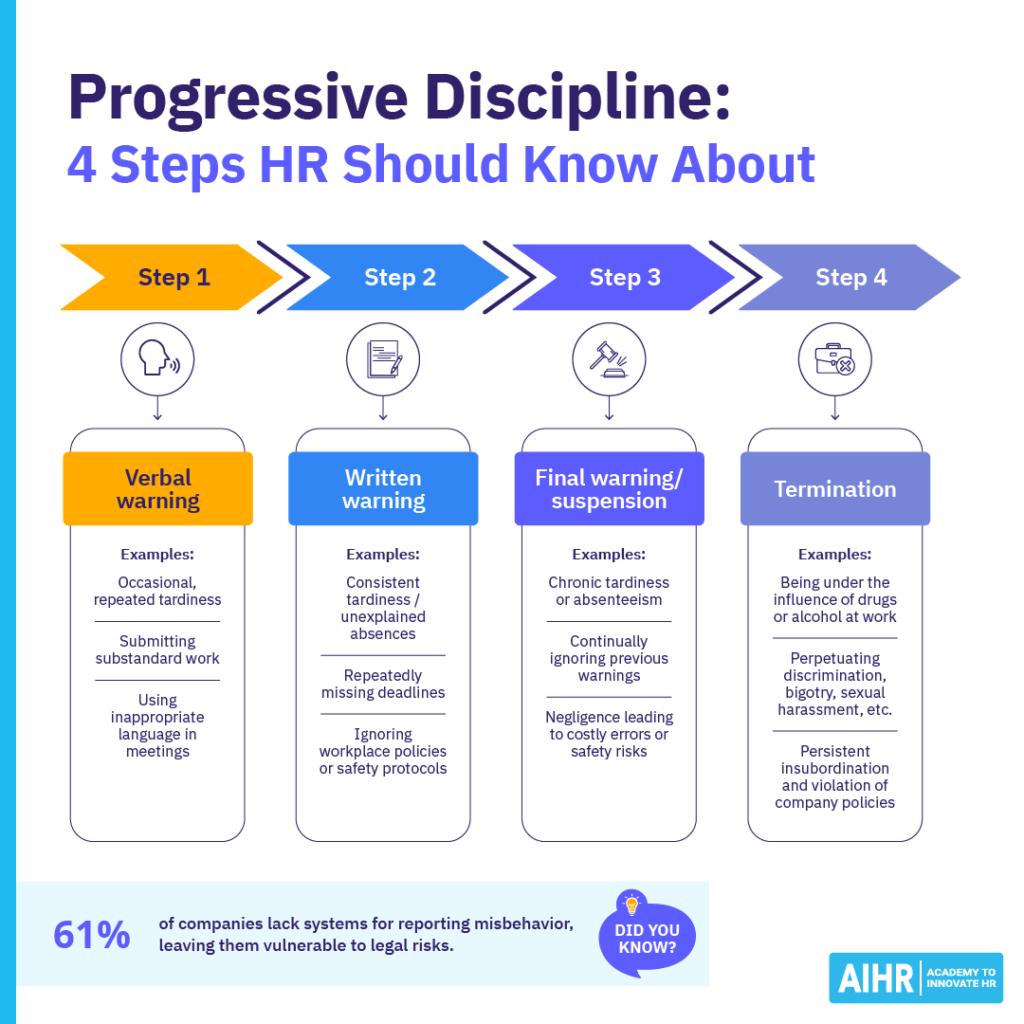
Most progressive discipline frameworks include four stages. Use this table as a quick reference, then read on for how to handle each stage.
Verbal warning
Minor or first-time issues, like occasional lateness or a small dip in work quality
An informal, documented conversation about the issue and what needs to change
Manager, with HR notified
Written warning
Repeated issues, or more serious concerns after a verbal warning
A formal written notice stating the problem, the policy breached, and required improvements
Manager and HR
Final warning or suspension
Ongoing problems despite earlier warnings
A final notice, or paid or unpaid suspension, making clear termination is next
HR leads, with the manager
Termination
Severe violations, or when earlier steps haven’t worked
Ending employment, with all prior steps documented
HR, manager, and sometimes legal
Step 1: Verbal warning
This step addresses minor infractions or first-time offenses informally, though HR normally documents them. A verbal warning usually fits minor, first-time issues such as:
- Arriving late to work or meetings occasionally without informing the manager
- Submitting incomplete or substandard work
- Using an inappropriate tone or language during a team discussion (non-threatening or non-offensive)
A verbal warning requires clearly explaining the behavioral or performance issue and the steps involved in progressive discipline. The manager typically speaks to the employee privately and provides them with resources to help them resolve the problem. Document the date, time, and conversation for future reference.
Step 2: Written warning
At this step, the company issues a formal notice about recurring issues or more serious concerns. The notice also outlines the consequences if the situation continues or worsens. Situations that typically call for a written warning include:
- Consistently arriving late to work or meetings despite receiving a prior verbal warning
- Repeatedly failing to meet deadlines or produce work of acceptable quality
- Ignoring workplace policies, such as using unauthorized devices in restricted areas or disregarding safety protocols
When preparing a written warning, remind the employee of the company’s progressive discipline policy. Collaborate with the employee’s manager to provide a comprehensive description of the issue (including dates, times, and specific actions or behaviors) and state the specific company policies or standards the employee has violated. Explain the improvement needed, set goals for achieving it, and inform the employee of potential disciplinary action if they repeat the offense. Have the employee sign the warning to confirm receiving it.
Use professional and neutral language to avoid escalation. Allow the employee to explain themselves and include their comments in your documentation. Finally, provide them with a copy of the warning and keep one in the company database. You can also use a disciplinary action form or send the employee a disciplinary action letter.
Step 3: Final warning or suspension
For ongoing problems, a final written warning or a temporary suspension may be necessary. Behaviors that may lead to a final warning or suspension include:
- Chronic tardiness or absenteeism that negatively affects operations and continues despite prior warnings
- Continuous failure to follow company policies despite previous warnings, such as attendance policies, safety procedures, or IT security protocols
- Negligence in job responsibilities that leads to costly errors, missed opportunities, or safety risks.
Recap the previous warning and explain that this is the last step before possible termination. Outline the progressive discipline plan and provide a timeline for corrective action, stating explicitly that failure to improve will result in termination. If necessary, suspend the employee with or without pay for a specified period and use this time to investigate the issue further.
Meet with the employee privately, together with their manager, to discuss the issue and document the final warning or suspension (including reasons and possible outcomes). If appropriate, provide the employee with relevant resources or support.
Step 4: Termination
Termination is a last resort, reserved for the most severe policy or legal violations or for cases where all other steps have failed. Examples of employee behaviors that merit termination are:
- Being under the influence of drugs or alcohol at work, particularly in roles where safety is a priority
- Engaging in behavior such as sexual harassment, using racial slurs, or other discriminatory acts that violate workplace policies and laws
- Persistent insubordination, especially when it affects operations.
When terminating an employee, make sure you’ve documented all previous warnings and actions and that they’re consistent with the progressive discipline process. Follow employment laws and company procedures to reduce legal risks and inform the employee of the decision in a professional manner.
Explain the termination process to the employee, including final pay, benefits, and exit procedures. Conduct the termination meeting privately and respectfully, with an HR representative present. If appropriate, offer support, such as outplacement services or a reference letter.
Scaling the model to 5, 6, or 7 steps
Four steps cover most situations, but some organizations use a more granular model. Stricter or highly regulated workplaces may add a coaching conversation before the verbal warning, a formal performance improvement plan between the written and final warnings, or a demotion before termination.
Progressive discipline depends on clear policies, consistent processes, and careful conversations. HR needs practical skills to guide managers, document issues, and support fair decisions across the employee life cycle.
AIHR’s HR Generalist Certificate Program teaches you to:
✅ Set up policy frameworks that support consistent HR processes
✅ Work with performance and employee engagement processes across the employee lifecycle
✅ Navigate difficult conversations with employees and managers
✅ Use communication, conflict management, and feedback skills in sensitive situations
💡 Check out the lessons in AIHR’s Demo Portal for a clear idea of what you’ll get.
Progressive discipline examples
The examples below show progressive discipline in action, including cases that don’t start at step one.
Example 1: Chronic lateness
A customer service rep starts arriving 15 to 20 minutes late several times a week.
- Verbal warning: The manager meets privately, explains the impact on shift coverage, and agrees on a clear expectation to arrive on time. HR notes the date and summary.
- Written warning: The lateness continues. HR issues a written warning that documents the specific dates, restates the attendance policy, and sets a 30-day improvement window.
- Final warning: After a brief improvement, the pattern returns. A final warning makes it obvious that any further lapse will result in termination.
- Termination: The behavior persists past the deadline, so the company ends employment, with all prior steps documented.
Example 2: Ongoing performance issues
A marketing coordinator repeatedly misses deadlines and submits work that needs heavy revision.
- Verbal warning: The manager outlines where the work falls short and points to specific standards and resources.
- Written warning: Quality does not improve. The written warning is paired with a performance improvement plan that sets measurable goals and check-in dates.
- Final warning or reassignment: If the plan is missed, the company issues a final warning or, where appropriate, considers a role change before termination.
Example 3: Serious misconduct (non-linear)
A warehouse associate disregards safety protocols and operates equipment without required checks, posing a real injury risk.
Because the conduct is serious, the process does not start with a verbal warning. HR moves directly to a suspension pending investigation, then to a final warning or termination based on the findings. This shows an important point: progressive discipline is the default path, but the starting step should match the severity of the behavior.
HR tip
Progressive discipline doesn’t always need to start with a verbal warning. The right starting point depends on two things: how serious the issue is and whether it has happened before.
- Verbal warning: Minor, first-time issues, such as occasional lateness or a small drop in work quality
- Written warning: Repeated problems or issues that have already been addressed informally
- Suspension or termination: Gross misconduct, such as violence, theft, harassment, or a major safety violation
Developing an effective progressive discipline policy: 6 steps
Follow these steps to create a progressive discipline policy that works for your organization and treats all employees fairly.
1. Define key objectives
Start by explaining the purpose of progressive discipline in your organization. Define how it promotes fairness, encourages improvement, and aligns with company values, and make clear that the goal is to correct issues, not to punish. Spell out how the policy reduces risks, such as wrongful termination claims.
For example, you can state: “This policy aims to address performance and behavioral concerns constructively, ensuring fairness while supporting employees in meeting organizational standards.”
2. Outline the process
Detail each step of the process, from verbal warning to termination, and match common issues to the likely response. Group typical problems, such as tardiness, misconduct, or policy violations, and show which step each one tends to trigger.
Then explain how and when discipline escalates, and be specific. For instance: “Three instances of tardiness in a month may result in a written warning.”
3. Set documentation standards
Reliable documentation is what makes progressive discipline hold up if a decision is challenged. For every step, record the date, the specific behavior or performance issue, the policy involved, the action taken, and the employee’s response. Note who was present, along with any agreed follow-up and deadline.
Store these records securely and limit access in line with data protection laws. Good documentation also helps you spot patterns across teams and adjust policies before small issues spread.
4. Ensure legal compliance
Review federal, state, and local laws on employee rights, wrongful termination, and workplace discrimination, and confirm your policy aligns with each. It should reflect due process, equal treatment, and proper documentation, and your legal team should review it before rollout.
Update the policy whenever legislation changes. Include anti-retaliation clauses to protect employees who raise concerns about the process.
5. Train managers
Equip managers to apply the policy correctly. Cover the steps of progressive discipline, documentation requirements, and conflict resolution, and use realistic scenarios so they can practice delivering warnings and handling pushback.
Add implicit bias training to reduce unconscious bias in disciplinary decisions, and schedule refreshers whenever the policy or relevant laws change.
6. Communicate the policy
Publish the policy in the employee handbook and share it with the whole workforce. Invite questions and feedback, and refine the policy where it helps. Involving employees builds familiarity and trust in the process.
Bring new hires up to speed, too. During orientation and onboarding, walk through the steps and expectations and answer any questions.
Progressive discipline policy template
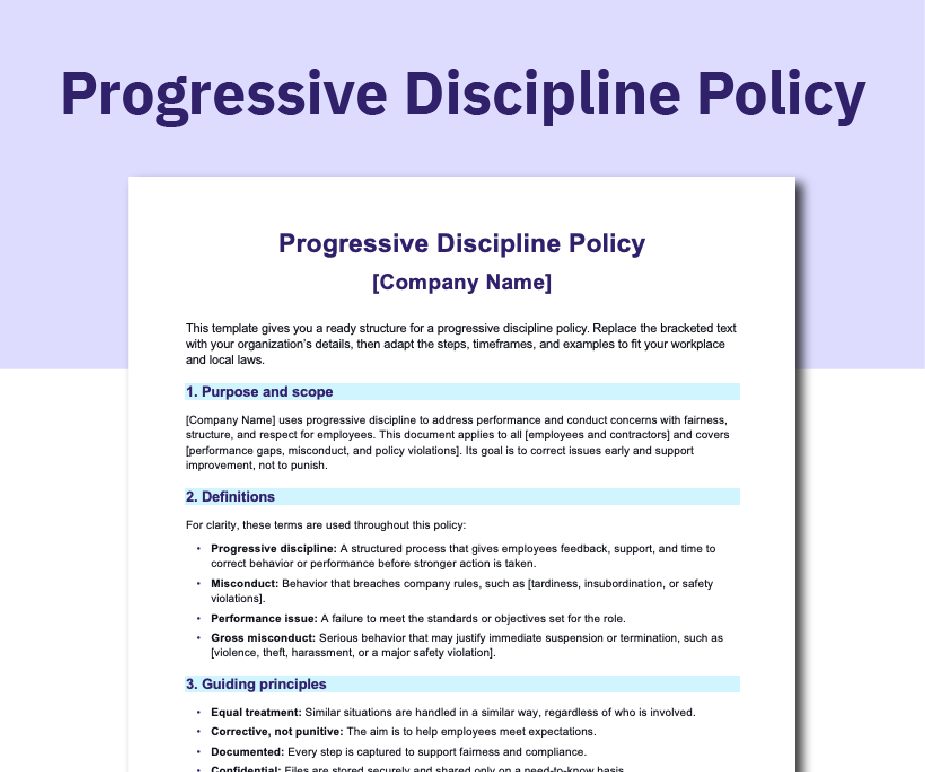
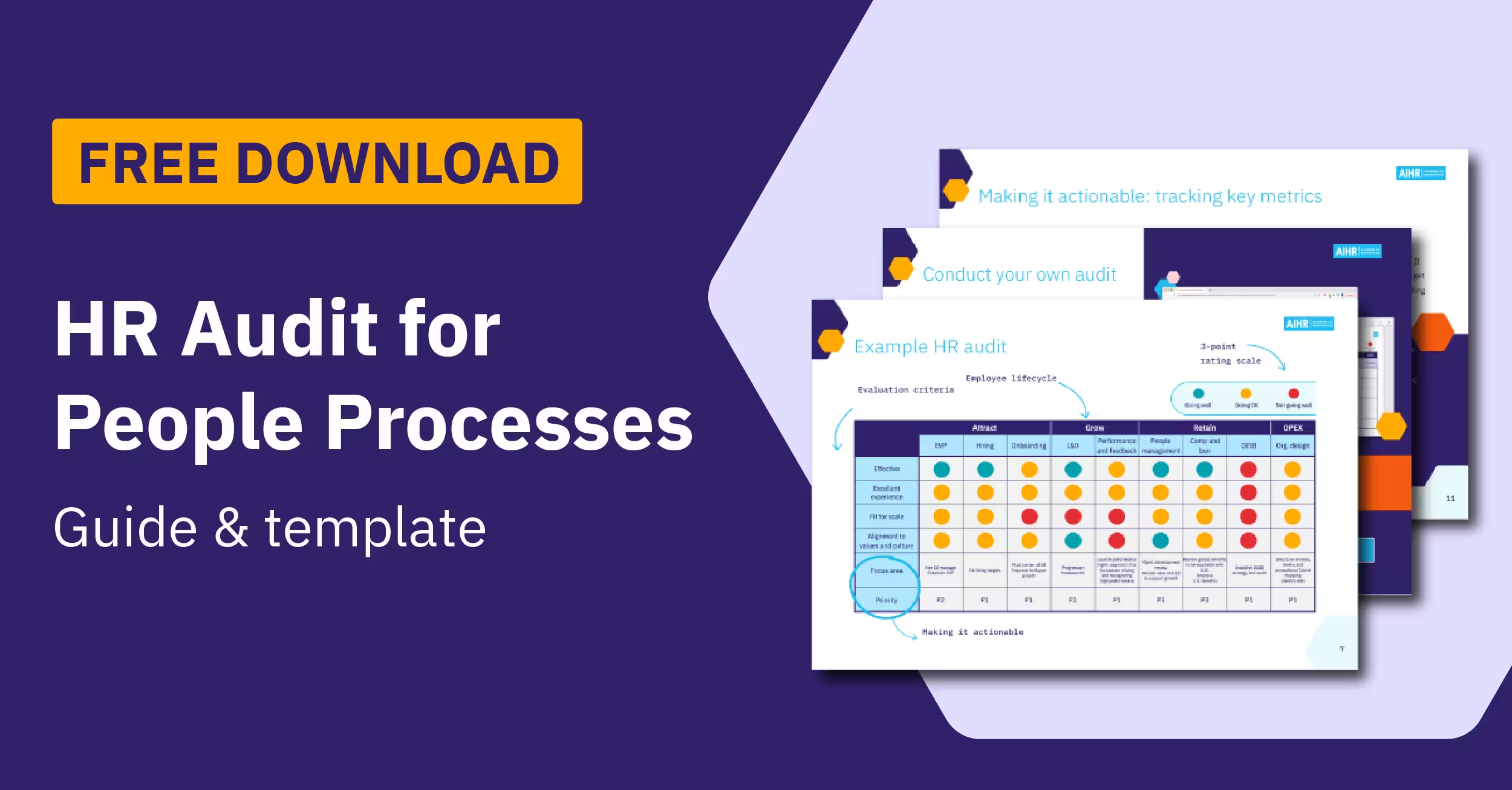
A policy gives managers and teams a shared framework for handling disciplinary issues. Use the free progressive discipline policy template below, available in Word and PDF, as a starting point. Then adapt the language to fit your organization, industry, and local laws.
Once your policy is in place, you’ll need a structured way to record each action. Pair the policy with a disciplinary action form so that every warning and step is documented consistently.
Alternatives to progressive discipline
Progressive discipline is the most common framework, but it isn’t the only option. Some organizations use these alternatives on their own, though many blend them with a step-based process rather than replacing it entirely.
- Positive (non-punitive) discipline: This approach swaps escalating penalties for coaching conversations and a shared commitment to change. Instead of a suspension, the employee may get a paid day to decide whether they can meet expectations. It suits cultures that want accountability without the adversarial feel of formal warnings.
- Coaching and continuous feedback: Regular, informal feedback catches small issues before they need formal action. Managers address concerns as they arise, which can prevent many problems from ever reaching a disciplinary step. This works best in teams with a strong feedback culture and capable managers.
- Performance improvement plans: These plans target performance gaps with specific goals, resources, and a set timeline. They fit underperformance more than misconduct, and they often run alongside progressive discipline rather than instead of it.
- Restorative practices: Restorative approaches focus on repairing harm and rebuilding trust, usually through a facilitated conversation between the people affected. They can be useful for interpersonal conflict or one-off incidents where the goal is resolution, not punishment.
No single approach fits every situation. Many organizations use progressive discipline as the backbone, then draw on coaching, a performance plan, or a restorative conversation, depending on whether the issue is performance, conduct, or a relationship that needs repair.
Next steps
Progressive discipline works best when HR turns the policy into a consistent process managers can follow. That means clear steps, strong documentation, fair conversations, and regular manager training.
To handle sensitive processes with more structure and confidence, build your core HR skills. AIHR’s HR Generalist Certificate Program covers policy frameworks, employee life cycle support, and practical HR tools and templates you can apply in everyday HR work.
FAQ
Progressive discipline is a structured, step-by-step process for addressing employee misconduct or poor performance. Each step, from a verbal warning through to termination, gives the employee a clear chance to improve, and each is documented so treatment stays consistent and fair.
It usually begins with a verbal warning, an informal but documented conversation about the issue and what needs to change. The main exception is serious misconduct, such as violence, theft, or a major safety violation, which can move straight to suspension or termination.
Most progressive discipline models use four steps: verbal warning, written warning, final warning or suspension, and termination. Some organizations describe it in three broad phases (informal, formal, and termination), while stricter or regulated workplaces expand it to five, six, or seven steps. The number matters less than the principle: each step escalates, and each is documented.
In most U.S. workplaces, no. Employment is generally at-will, so a step-based process is usually a best practice rather than a legal requirement. That said, a union contract, employee handbook, or specific state or local rules can create binding obligations, so it’s worth having your legal team confirm what applies to you.



 POPULAR: 3,687 DOWNLOADS