

For decades, we’ve treated employee engagement as the managers’ responsibility. Research confirms this direction: the quality of the manager-employee relationship accounts for up to 80% of employee engagement.
Yet this framing overlooks a crucial reality. Managers do not create engagement in isolation. Their ability to build engaged teams is shaped by the HR policies, processes, and systems that define how they lead. When those systems create unnecessary friction, even exceptional managers struggle to deliver the engagement they’re held accountable for.
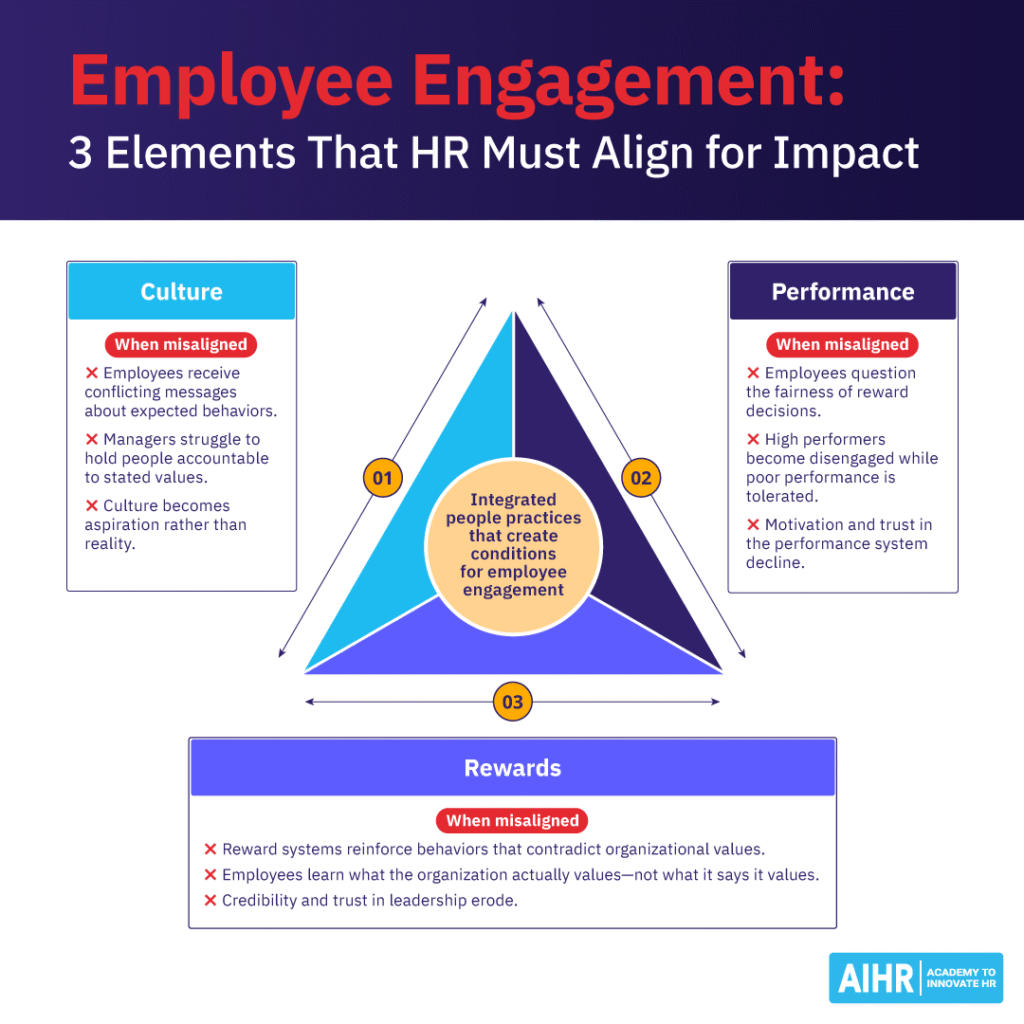
This article examines how three elements – culture, performance, and rewards – must work together to create the conditions for sustainable employee engagement. It offers a six-step approach for HR leaders who want to deliberately address the disconnect.
Contents
The root cause of the disconnect between culture, rewards, and performance
The business impact of misaligned people practices
How HR can align rewards, culture, and performance in 6 steps

The root cause of the disconnect between culture, rewards, and performance
Culture programs, performance frameworks, and reward structures are each created with specific goals in mind and designed to solve a recognized organizational problem. The challenge is that they are usually built separately by different teams at different times, with different outcomes in mind. That gap plays out in three ways.
Problem 1: No shared philosophy anchors the practices
Without a clear, shared philosophy on the kind of employer the organization aims to be, each practice tends to optimize for its own specific logic. Culture promotes one set of values, performance measures another, and rewards reinforce something else entirely.
Bowen and Ostroff’s research argued that HR practices influence employee outcomes only when they send clear, consistent, and credible signals about what the organization values. When people practices are designed independently rather than anchored in a shared philosophy, those signals become fragmented. Managers are forced to reconcile conflicting messages, while employees struggle to understand what the organization truly expects and rewards. The result is confusion, inconsistency, and ultimately, disengagement.
Problem 2: HR designs around functions instead of the employee
HR has historically designed its work from a functional perspective, rather than an employee-centric one. While a compensation team designs reward structures, a talent team builds performance processes, and a culture team defines values—each making sense in its own silo—employees don’t experience them that way. Instead, they view these as a single, continuous signal of what the organization truly values.
When these signals contradict one another, trust begins to erode. Managers lose credibility when explaining decisions they had no part in making, while employees lose confidence in the system’s fairness and consistency. Gallup’s recent State of the Global Workplace report found that U.S. employee engagement had fallen to 20%, highlighting the growing challenge organizations face in creating meaningful engagement.
Too often, engagement is treated as the responsibility of managers or HR in isolation, rather than the outcome of a coherent people system. Siloed design creates siloed ownership, and siloed ownership produces disengagement.
I have a core belief that the majority of leaders, managers, and employees really want to do great work and be great leaders, but I think there’s a lot of friction that gets in the way of achieving that. So, I’ve always tried to think about how we can remove that friction and help people do the thing that they probably innately want to do.

Leaders either start by thinking about performance through our performance management systems, and then they pretty quickly realize that those semi-annual ratings don’t necessarily add up to a culture of high performance. And then you also have leaders who think that performance cultures are those that consistently hit targets, but that’s an outcome, that’s not a culture.
Problem 3: The practices mature at different speeds
The practices of culture, performance, and rewards rarely mature at the same pace. An organization may invest heavily in performance management while its reward philosophy lags behind. Or it may articulate a compelling set of cultural values without establishing meaningful consequences for ignoring those values through performance management. The result is a people system in which one practice reinforces behaviors that another unintentionally undermines.
SHRM found that organizations with more mature HR functions are significantly more likely to exceed their financial objectives. The implication is important: value comes not from the existence of individual HR practices, but from their collective maturity and ability to reinforce one another. When one practice advances while others lag behind, even well-designed interventions struggle to deliver their intended impact.
The business impact of misaligned people practices
Employees rarely read HR policy documents. They experience HR through the decisions that affect them directly, such as how their performance is assessed, what gets rewarded, and whether the culture they are told to embody is reflected in what the organization actually accepts and celebrates. When these signals conflict, the impact is immediate and personal.
Employees perceive unfairness
The most common consequence is a sense of unfairness. Employees notice when a collaborative culture is undermined by incentive structures that reward only individual performance. They spot the contradiction when team-based goals are set, but bonuses remain individual, or when innovation is championed as a core value, yet the performance system penalizes the inevitable failures that innovation requires. Each mismatch sends the same clear message that the organization’s words don’t match its actions.
When employees perceive people decisions as unfair or inconsistent, trust erodes first, and disengagement follows. The cost is measurable. Gallup’s meta-analysis of more than 180,000 business units found that the most engaged teams are 18% more productive than the least engaged, with lower absenteeism and turnover.
Managers bear the cost of misalignment
Managers experience this disconnect more than anyone else. They are expected to translate HR into action, yet they rarely control the design of the policies, processes, or systems they are asked to implement.
When those practices send conflicting signals, managers become interpreters rather than leaders. Eventually, they stop trying to make the system coherent and instead create informal workarounds, make exceptions, or ignore HR processes altogether. What begins as pragmatism gradually becomes the norm, eroding the very consistency that effective people management depends on.
The damage compounds over time
The consequences of misaligned people practices build over time. As confidence in HR practices erodes, consistency gives way to discretion. Managers lose faith in the tools they’re expected to use, employees become increasingly skeptical of the messages they’re hearing, and the gap between what the organization says and what people actually experience grows wider. Every performance conversation, reward decision, and culture initiative either reinforces trust or weakens it further.
We saw that organizations that consistently achieve those dimensions are focused on both employee engagement and performance simultaneously, rather than treating them as competing priorities. You often hear people say that either you have an engaged workforce or you have a performing workforce, but you can’t have both.
How HR can align rewards, culture, and performance in 6 steps
Diagnosing and fixing the disconnect between culture, performance, and rewards is not a single project with a defined end date. It is an ongoing discipline.
The six steps below give HR leaders a practical path to deliberately build alignment, starting with understanding what currently exists before attempting to change anything.
Step 1: Diagnose the current state of all three systems
Before redesigning any practice, HR needs a picture of what each system is currently producing in terms of actual employee behavior, not intended outcomes. This means looking at culture, performance, and rewards not in isolation, but through the lens of what they collectively signal to employees and managers on the ground.
The diagnosis should surface where the three practices reinforce each other and where they contradict each other.
Making it practical: Diagnosing the mismatch
The diagnosis works best as a structured conversation with senior leaders and HR business partners, not a formal audit. The goal is to build an honest picture of the current state.
The questions below are designed to surface tensions, challenge assumptions, and expose the gap between how each practice was intended to work and how it actually lands.
- If you asked a frontline manager to describe what this organization actually rewards, would their answer align with the culture we say we are building?
- When an employee is recognized or promoted, what behaviors or outcomes drove that decision, and are those the same behaviors our performance system is designed to measure?
- Where in the last twelve months has a manager had to explain or defend a people decision they did not agree with or could not justify, and which practice produced that decision?
- If you mapped the last three performance cycles against reward outcomes, would the distribution of rewards reflect the values and priorities stated in the culture framework?
- Which of the three practices — culture, performance, or rewards — is most likely to be ignored or worked around by managers in practice, and what does that tell us about where the credibility gap is largest?
Treat diverging answers as data. Where leaders and managers describe the same practice in fundamentally different ways, that difference highlights a disconnect.
Step 2: Align on shared principles
Once you have a solid understanding of the current state, the next step is not to redesign individual practices but to agree on the principles that should govern all three.
- What kind of employer does the organization want to be?
- What behaviors should you consistently encourage, recognize, and hold to account across every HR process?
These principles serve as a common reference point against which each practice is designed and evaluated. Without this step, redesigning any one practice in isolation simply shifts where the contradiction sits rather than resolving it.
Step 3: Translate the principles into design criteria
Shared principles only create alignment when they are embedded into the mechanics of each practice. This means reviewing how you define and reinforce culture, how you measure and manage performance, and how you distribute and structure rewards.
At each point, you should ask whether the design choices reflect the agreed principles or undermine them. Where a gap exists, it needs to be closed through deliberate redesign rather than communication campaigns.
Telling employees that the organization values collaboration while the reward system pays for individual results is a problem that no amount of messaging will fix. If you are unwilling to fix the practice design, you will spend more time managing the fallout.
We discussed building a high-performance culture with Amy Lavoie, VP, People Science at Culture Amp. Watch the full interview below:
Step 4: Assign shared ownership across the three systems
One structural cause of misalignment is that each practice has a separate owner and mandate. Alignment requires a governance structure that cuts across these boundaries.
This does not mean merging functions or creating new committees for their own sake. You need to establish a shared accountability mechanism in which the owners of culture, performance, and rewards regularly meet to review whether the three practices are producing consistent outcomes and make joint decisions when they are not.
Step 5: Create a shared narrative across the three practices
Managers are the primary translators of HR practice. They set performance goals, give feedback, allocate rewards, and model cultural expectations every day. For them to do this credibly, they need a coherent story that connects all three practices into a single, consistent message. HR’s role is to develop that narrative and equip managers to use it.
The narrative doesn’t need to be complicated. It needs to answer one question clearly: what does this organization value, and how does each people practice reflect that? When managers can confidently answer that question, the disconnect employees feel begins to close.
Step 6: Build in a periodic drift check
Alignment is never permanent. Leadership changes, business priorities evolve, and hundreds of small decisions gradually pull culture, performance, and rewards out of sync. This often happens so slowly that no one notices until the consequences become visible.
A regular review cadence, ideally aligned with the annual performance cycle, provides HR with a structured opportunity to assess whether these practices continue to reinforce the same organizational priorities.
This doesn’t require a formal audit. Instead, regularly review whether employees are receiving the signals the organization intended, and adjust before small gaps harden into real misalignment.
Final thoughts
The conversation about employee engagement has long centered on the manager. The relationship between a manager and their team remains the most direct lever organizations have for influencing how people experience their work. But a lever is only useful when the environment allows it to be pulled.
Culture, performance, and rewards set the conditions for managers to drive engagement. When aligned, they give managers the authority, clarity, and credibility to lead engagement consistently and sustainably. When they are not, even the most capable manager is working against the practices meant to enable them.
HR’s role is to build and maintain that enabling environment, not as separate functions optimizing for separate outcomes, but as a connected system that sends a single, coherent message to every employee and every manager every day.