


OKRs and KPIs for HR: Cheat Sheet Collection
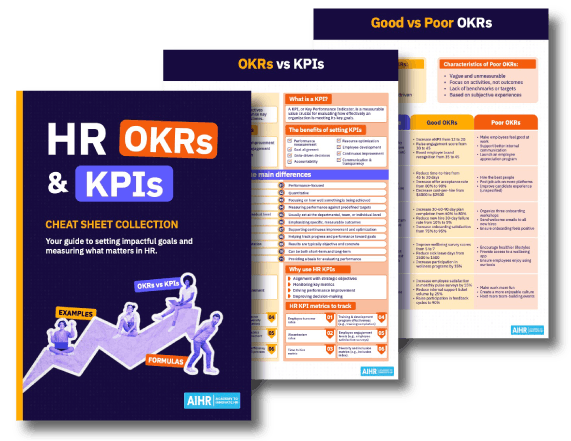
Eight cheat sheets to help you set the right OKRs and KPIs for HR, connect them to business goals, and report on HR's impact with confidence.




HR professionals


Most HR teams already track data, but it’s harder to turn that data into business impact. This cheat sheet collection helps you set meaningful HR OKRs and KPIs to align goals, track performance, and measure what matters.
What you’ll get with the HR OKRs and KPIs cheat sheets
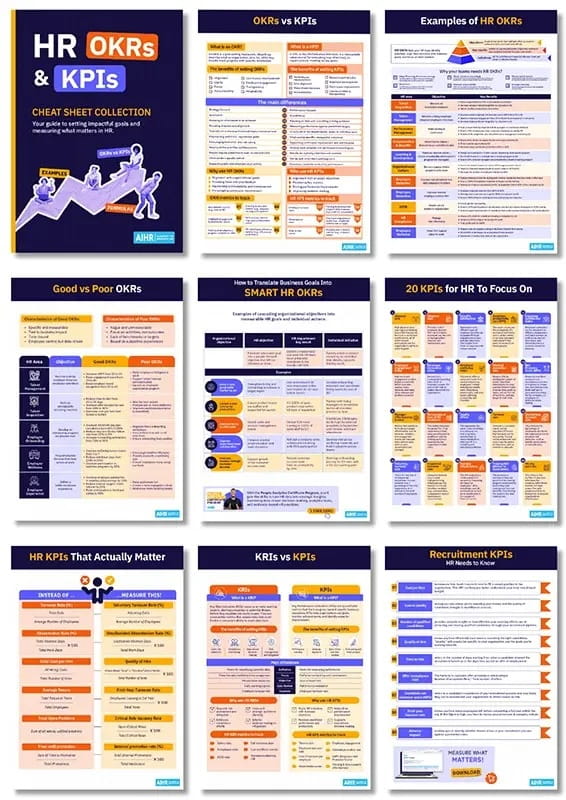
These eight cheat sheets give you clear frameworks, real examples, and actionable guidance you can apply immediately:
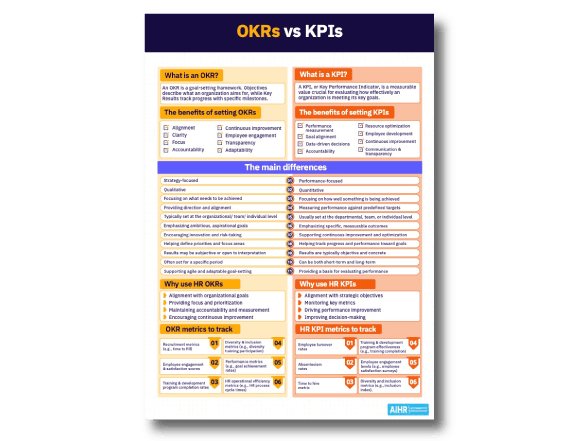
- OKRs vs. KPIs: understand why using Objectives and Key Results (OKRs) alongside Key Performance Indicators (KPIs) gives you a clear picture of HR performance.
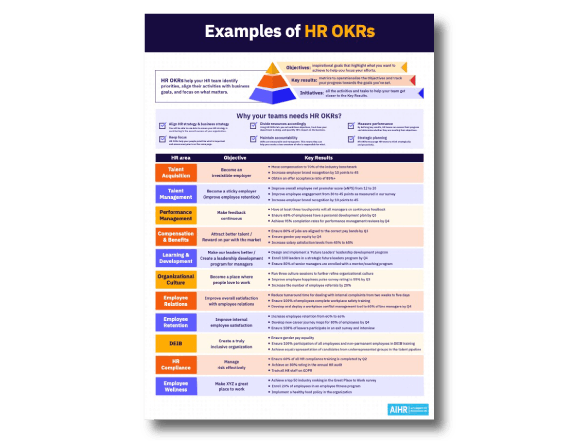
- Examples of HR OKRs: explore OKRs across 11 HR areas to help you align HR goals with business priorities.
- Good vs poor OKRs: learn the difference and how to make OKRs tied to business impact.
- How to translate business goals into SMART HR OKRs: stop setting HR goals in isolation and start turning business priorities into specific, measurable HR outcomes.
- 20 KPIs for HR to focus on: prioritize the KPIs that truly reflect how your workforce is performing, changing, and contributing to business goals.
- HR KPIs that actually matter: replace broad HR metrics with strategic KPIs that show real business impact.
- KRIs vs KPIs: use KPIs to track performance and Key Risk Indicators (KRIs) to spot risks, before they become costly problems.
- Recruitment KPIs HR needs to know: track the metrics that show whether your hiring process is working.
OKRs and KPIs for HR: What’s the difference?
HR OKRs and KPIs both help you measure progress, but they serve different purposes.
HR OKRs, or Objectives and Key Results, define what HR wants to achieve and how it will measure progress toward that goal. They help you focus on strategic priorities such as improving retention or building a better candidate experience.
HR KPIs, or Key Performance Indicators, track how specific HR activities are performing over time. Examples include turnover rate, time to hire, and absenteeism rate. They tell you whether the day-to-day work is bringing results.
Essentially, OKRs set the direction, while KPIs monitor the journey. Understanding how they work together helps you demonstrate business impact.
HR OKR and KPI examples to measure HR effectiveness
If your goal is to improve retention, define it as:
- Objective: Become a more attractive place to work
- Key results: Increase employee engagement scores and reduce voluntary turnover
- HR KPIs: Employee engagement score and voluntary turnover rate
The same approach applies to recruitment:
- Objective: Attract better talent
- Key results: Reduce time to hire, improve quality of hire, and increase candidate Net Promoter Score
- HR KPIs: Time to hire, quality of hire, and candidate Net Promoter Score