

How to measure hiring effectiveness is a question more organizations are asking, but fewer are successfully answering. According to SHRM’s recent Recruiting Executives Benchmarking Report, only 20% of organizations track quality of hire, compared to 27% in 2022. That means only one in five organizations knows whether their new hires are actually working out.
This gap matters because hiring effectiveness, not hiring speed, determines whether your recruitment investment pays off. A fast, cheap hiring process means little if new hires underperform or leave within months.
This article breaks down what hiring effectiveness really means and why it matters. You’ll also learn how to start measuring and improving it in your own organization.
Contents
What is hiring effectiveness?
Why measuring hiring effectiveness matters
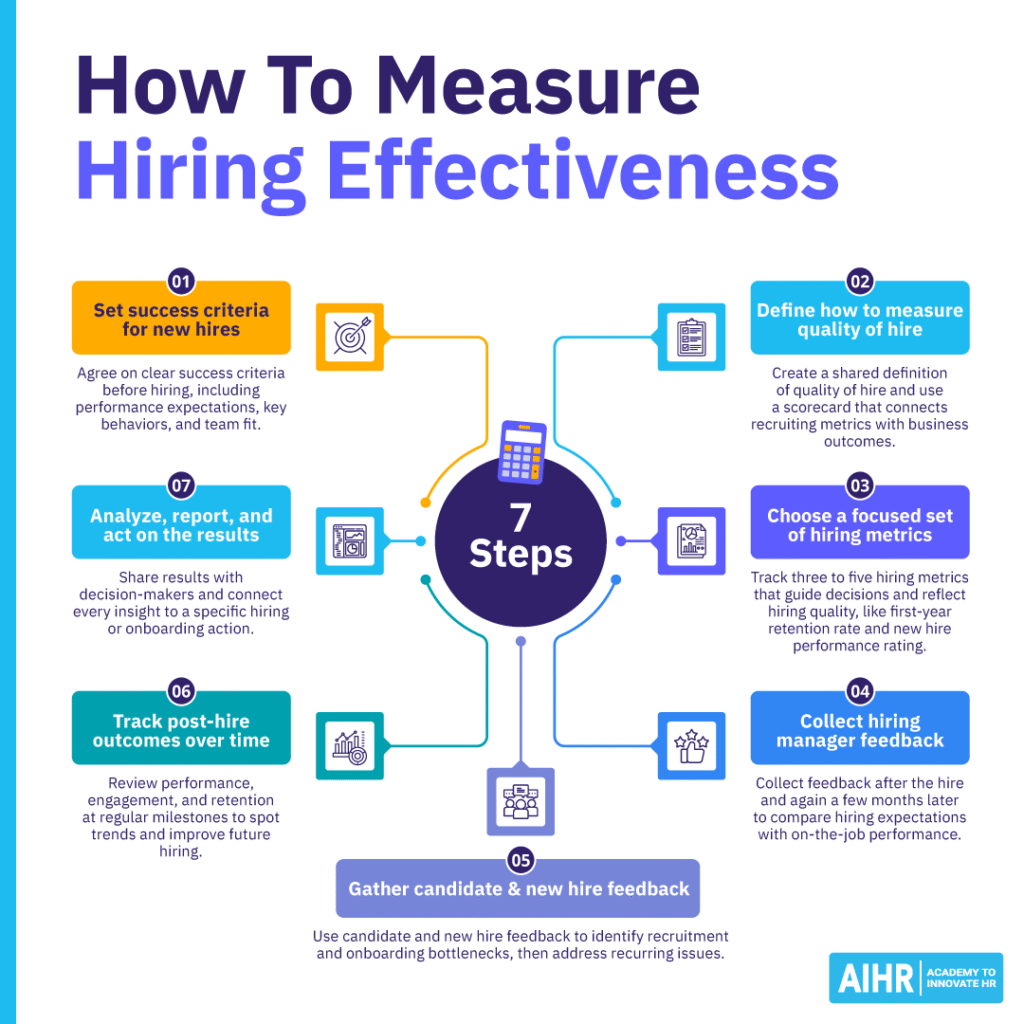
How to measure hiring effectiveness in 7 steps
How to improve quality of hire and hiring effectiveness
Common mistakes when measuring hiring effectiveness
What is hiring effectiveness?
Hiring effectiveness measures how well your new hires perform and stay after they join your organization. It focuses on the value a hire delivers on the job: strong performance, long-term retention, and hiring manager satisfaction.
You can’t measure hiring effectiveness by counting interviews, roles posted, or offers extended, because it depends on a different metric – the quality of hire. Are the new hires performing well? Do they become long-term employees?
It’s important to distinguish between hiring effectiveness and hiring efficiency. Efficiency focuses on the recruiting process, on how fast and cost-effectively it is. Effectiveness is what happens after making the hiring decision. Performance, retention, and hiring manager satisfaction determine whether a hire was effective.
Most hiring metrics fall into one of two buckets:
Time to fill
Post-hire performance
Cost per hire
12-month retention
Offer acceptance rate
Manager satisfaction
Efficiency-focused recruitment metrics still play an important role. They show how well your process runs and keep hiring on schedule and on budget.
These numbers give you part of the picture. On their own, they can’t tell you whether a hire will succeed. A fast, cheap hire who leaves in four months ends up costing more. You pay again to source, hire, and train a replacement.
The goal is to pair efficiency with effectiveness. Use efficiency metrics to run a strong process, and use effectiveness measures to confirm that the process brings in the right people.

Why measuring hiring effectiveness matters
Measurement turns talent acquisition from a service function into a strategic partner.
Let’s start with the cost of getting it wrong. Mishires cost organizations in recruitment expenses, lost productivity, and team disruption. In fact, Gallup reports that:
- Replacing a leader or manager costs around 200% of their salary
- Replacing a professional in a technical role costs 80% of their salary
- Replacing a frontline employee costs 40% of their salary.
Those numbers get attention in budget conversations. Talent acquisition metrics tied to outcomes give TA leaders a seat in workforce planning conversations. Credibility opens the door. But ongoing measurement is what earns TA leaders influence.
Measuring your own hiring efforts allows for improvement. You can’t fix sourcing, screening, or interviewing if you don’t know which stage produces weak outcomes. For example, say quality of hire data shows candidates from a certain job board consistently underperform after six months. That’s a clear signal to cut the channel and reallocate the budget.
How to measure hiring effectiveness in 7 steps
Measuring hiring effectiveness comes down to seven concrete steps you can build into your existing hiring process.
1. Define what a successful hire looks like
Before any measurement, agree with hiring managers on the success criteria for each role. This includes performance expectations at 90 days and one year, key behaviors, and team-fit signals. For example, for an SDR employee, success might mean achieving 80% of their sales quota within six months.
Practical tips
- Capture this in the intake meeting and write it down. It becomes the benchmark that every later measurement refers to.
- Separate must-have criteria from nice-to-have ones. This keeps the bar consistent even when hiring pressure builds, and it’s tempting to lower it.
2. Define how to measure quality of hire
Quality of hire is a metric that captures the value a new hire adds to your company, specifically how much they contribute to your long-term success. At its narrowest, it compares a new employee’s performance against the expectations you set before hiring. Most working definitions go further and factor in retention and business impact. Measuring quality of hire tells you whether you’re choosing the right people for the roles that move the organization forward.
Practical tips
- Agree on how you define quality of hire with the talent acquisition and HR team, hiring managers, and Finance. A definition set by TA alone can miss what matters most to the business.
- Develop a quality of hire scorecard that reflects your business values and strategy. SHRM benchmarking research found that many organizations already collect useful data during the performance review process, including performance evaluations, retention rates, talent scorecards, and 360-degree feedback scores. The key is to connect that data to your recruiting metrics instead of using it just for performance management. That gives you a solid starting point for your scorecard.
3. Choose a focused set of hiring metrics
Limit yourself to 3-5 hiring metrics you’ll actually use. Choose ones tied to decisions that really reflect the quality of candidates you hire. Skip anything that just looks good on a dashboard.
A focused set usually pulls from metrics like these:
- New hire performance rating at 6 or 12 months, which tells you whether your selection process predicts on-the-job success.
- First-year retention rate, which indicates whether new hires stay long enough to deliver value.
- Hiring manager satisfaction, measured a few months in, shows whether new hires are performing the way their managers expected.
- Time to productivity, or how long a new hire takes to reach full performance, points to gaps in selection or onboarding.
- Quality-of-hire score, your composite measure that typically combines performance, retention, and fit into one number.
Practical tips
- For each metric, name the action a bad result would trigger. If a 6-month check-in shows managers aren’t satisfied with how recent hires are performing, you’d recalibrate on what “good” looks like before the next search.
- Revisit your metrics every quarter. Retire the ones that stopped driving action, and add new ones as hiring priorities shift.
✅ Measure candidate quality alongside employer branding and candidate experience
✅ Build stronger partnerships with business stakeholders using talent intelligence
✅ Integrate talent acquisition with business priorities and HR processes
✅ Develop a more strategic talent acquisition practice using recruitment data.
💡 Visit AIHR’s Demo Portal to sample lessons and experience the practical learning included in this program.
4. Conduct a hiring manager satisfaction survey
A hiring manager satisfaction survey captures how the manager felt about the recruitment process: the quality of the shortlist, communication, and how quickly the role was filled. Run right after the hire, it tells you how well recruiting served its internal customers. Strong scores tend to mean lower recruiting costs and less rework on open roles.
To turn the survey into an effectiveness measure, run it a second time a few months in. Ask the same manager how the new hire is actually performing against the expectations set before hiring. The first survey reflects on the process. The follow-up is about the hires, and that’s the signal that ties back to quality of hire.
Practical tips
- Keep it short. In the post-hire survey, ask about shortlist quality, recruiter responsiveness, and the overall experience. In the follow-up, ask about on-the-job performance and fit. Under 10 questions keeps response rates high.
- Send the follow-up survey on a fixed schedule, a set number of months after the start date, to keep results comparable across hires and teams.
5. Gather candidate and new hire feedback
Candidate feedback is just as essential to successful hiring outcomes. Knowing what candidates feel and what they have to say about your recruitment process can improve your hiring decisions.
Practical tips
- Develop a questionnaire to identify bottlenecks based on their feedback. Did they get timely updates during the application period? What do they think of the onboarding process?
- Analyze the results and address the bottlenecks. When the same complaints keep showing up, like slow follow-up or unclear onboarding, they’re pointing to one specific stage. That’s the one to fix.
6. Track post-hire outcomes over time
Post-hire outcomes refer to what happens to a new hire after they start: how fast they ramp, how their performance trends, how engaged they stay, and whether they remain. This is where hiring effectiveness becomes visible, because a hire who looks strong at 30 days can become a turnover risk by month nine.
That delay is why you track outcomes as a trend instead of a one-time result. Checking more than once is the only way to catch a hire whose performance slips over time. Then compare results across a group of hires. If new people from the same source or team all take too long to get up to speed, the problem is in how you hire, not in any one person.
Practical tips
- Set check-ins at 30, 90, and 180 days. At each one, compare actual performance against the success criteria from step one.
- Watch for outcomes that only show up after a few months, like disengagement or slipping performance. These are the numbers that might turn a good-looking hire into a problematic one.
7. Analyze, report, and act on the results
Data only makes hiring more effective once you act on it. This step turns your hiring metrics and quality of hire scorecard into decisions. That’s what changes how you source, screen, or onboard.
Practical tips
- Report findings to the people who make the decisions: hiring managers, TA leadership, and the department heads you hire for. Do it on a regular schedule, not just when something goes wrong. A quarterly summary keeps hiring effectiveness visible outside the recruiting team.
- Connect every report to one specific action. If a sourcing channel keeps producing poor-quality hire scores, cut it. If feedback flags a recurring onboarding gap, fix that step before the next hiring cycle.
How to improve quality of hire and hiring effectiveness
Once you know how to measure hiring effectiveness, the next step is planning how to improve it.
- Train your hiring managers: Once you’ve set the success criteria for a new hire together, give managers the skills to assess against them. Teach structured interviewing: consistent questions, scoring each candidate on the same criteria, and checking for common bias. Managers who interview with a clear standard make sharper decisions and lean less on gut feel.
- Add objective assessments: Implement work-sample or skills-based assessments to raise predictive validity. TestGorilla found 76% of employers use skills tests to measure and validate candidates’ skills.
- Strengthen onboarding: An Enboarder survey of 1,000 HR leaders found that 60.8% report rising early attrition in the past year. 29% of HR leaders said their top onboarding challenge is high attrition in the first 90 days. Even a promising new employee can show up as a poor quality of hire number with weak onboarding. Disengagement here often leads straight to turnover.
- Feed effectiveness data back to sourcing decisions: Double down on channels that deliver hires who perform and stay. Conversely, tweak or eliminate sources that produce ineffective hires. For instance, if one channel consistently delivers stronger hires than another, that’s your signal to shift the budget toward it.
Common mistakes when measuring hiring effectiveness
Knowing how to measure recruitment effectiveness starts with an awareness of what to avoid. These are common mistakes that undermine even well-intentioned measurement efforts:
- Measuring only speed and cost: Time to fill and cost per hire are easy to track, so they often become the only numbers anyone looks at. The problem is they tell you nothing about whether the hire works out. A role you filled fast and cheaply still costs you if the person underperforms or leaves, because you pay to hire and train all over again. Speed and cost are worth watching, as long as they sit alongside quality-of-hire measures rather than standing in for them.
- Blaming the hiring process for what onboarding or management caused: A low performance score can come from a bad hire, weak onboarding, an unclear role, or a poor manager. If you attribute every disappointing outcome to selection, you’ll keep fixing the wrong stage. Look at where the breakdown actually happened before you change how you hire.
- Only hearing from the people who stayed: Performance and satisfaction data usually come from current employees. The hires who left, often your most important data points, drop out of the sample. Build exit interview data into your measurement so early leavers still inform the picture.
- No baseline or benchmark: A single number can’t tell you whether you’re improving or falling behind. Track your own quality of hire scores over time to see the trend, and compare them against industry benchmarks where you have them. Without either, you can’t tell a good result from a bad one, or know where to focus.
Next steps
Measuring hiring effectiveness is an ongoing capability, not a one-off project. You build it over time, across every stage from sourcing to onboarding. Once you define what a good hire looks like, track outcomes past the start date, and connect your metrics to real decisions, your hiring effectiveness gets sharper with every cycle. Each round of data shows you what to adjust, so the next set of hires performs better than the last.
That shift from activity to outcomes is what separates a service function from a strategic one. Building the skills behind it takes structured, hands-on development. For individual practitioners, AIHR’s Strategic Talent Acquisition Certificate Program covers the strategic and data-driven recruiting skills that you need to hire effectively.
For teams, the Talent Acquisition Boot Camp builds these capabilities across your whole TA function, so hiring effectiveness becomes a repeatable practice rather than an individual skill held by a few people.