

Expectations of HR teams have shifted dramatically. Today’s business leaders look to HR for expertise on emerging topics like ESG, creating cultures of productivity, and addressing challenges related to remote work and generative AI.
To keep up, HR departments must develop new capabilities to adapt to current business needs while also anticipating future requirements. AIHR’s State of HR report reveals that while 64% of HR organizations have recently changed their operating model, 60% of these reorganized functions provided no formal training on operating within a new structure. Without that support, HR teams are expected to operate in new ways without the capabilities the new structure demands.
In this article, we explore how to identify, build, and scale HR capabilities in alignment with business growth and strategic objectives.
Contents
What are HR capabilities?
Types of HR capabilities
HR capabilities across business stages
How to assess current HR capabilities in your organization
4 steps to develop HR capabilities that meet business needs

What are HR capabilities?
HR capabilities are the skills, knowledge, behaviors, tools, and ways of working that an HR team needs to deliver measurable business value. At a function level, they reflect what HR must be able to deliver collectively, from talent acquisition and workforce planning to talent management, organizational design, and change management.
Talent acquisition is a good example. An HR team has this capability when recruiters and sourcers have the right skills to attract and assess talent, hiring and onboarding follow a consistent process, and the tech stack, from the applicant tracking system to assessment and interview tools, runs as one system rather than a set of disconnected apps. If any of those is missing, hiring results suffer.
HR capabilities vs. competencies
A competency is a combination of skills, knowledge, and experiences that an individual needs to perform specific tasks or responsibilities. At AIHR, our T-Shaped HR Competency Model outlines the key competencies we believe are essential for future HR professionals’ success.
Capabilities, on the other hand, are positioned at a functional or organizational level. They refer to the people, processes, and technology required to achieve strategic goals. Simply put, capabilities answer the question, “What do we, as a team, need to excel at to drive success?” while competencies address, “What skills, knowledge, and experience enable individuals to complete specific activities successfully?”
Understanding the differences between these two concepts is crucial, as building individual competencies is distinct from building functional capabilities. Many organizations mistakenly assume that developing competencies will automatically lead to strong capabilities. However, this limited view often results in highly skilled individuals who lack the necessary tools, processes, or infrastructure to achieve desired outcomes.
Types of HR capabilities
HR capabilities fall into three broad groups. Most teams build a baseline across all three, then invest more in the ones their business needs most at its current stage of growth.
Strategic and organizational capabilities
- Strategic workforce planning: Matching the organization’s headcount and skills to where the business is heading.
- Organizational design: Shaping team structures, roles, and reporting lines so the business can execute.
- Change management: Guiding the workforce through restructures, new technology, and shifting market demands.
- Organizational culture and employee engagement: Creating the conditions for a healthy, high-performance culture, strong engagement, and better retention.
Talent and operational capabilities
- Talent acquisition: Attracting and selecting the right people, then getting them productive quickly.
- Talent development: Growing skills and careers so the workforce keeps pace with the business.
- Performance management: Turning business goals into clear expectations, feedback, and fair evaluation.
- Employee experience: Shaping the day-to-day of work so people can do their best.
- Employee relations and compliance: Handling workplace issues fairly and meeting labor, privacy, and safety obligations.
Technology and AI capabilities
- People analytics: Turning HR data into decisions on hiring, retention, and productivity.
- HR technology: Running and connecting core systems such as the HRIS, payroll, and applicant tracking tools.
- AI adoption: Using AI to automate routine HR work and speed up decisions.
- AI governance: Applying AI responsibly, with attention to fairness, transparency, and data privacy.
How HR capabilities evolve across business stages
Aligning HR capability development with the stages of business growth ensures that HR functions can consistently contribute to organizational goals.
The business life cycle model is a helpful framework for understanding the challenges and priorities businesses need to solve at each growth stage. The life cycle stages show what the business needs from HR at each point, which in turn shapes the capabilities the function has to build to create business impact.
Here’s a breakdown of how HR’s focus and capabilities might adapt across the different business life cycle stages:

1. Startup stage
The company is focused on proving its value proposition and generating revenue. During this stage, the business consists of the founders and a core team with little structure and resources.
To prepare the business for the next phase, HR has to establish the basic policies, processes, and payroll while also focusing on talent acquisition as a critical priority.
→ Primary HR capabilities: Talent acquisition and setting up foundational HR processes and payroll.
2. Growth stage
The company increases its customer base and builds additional products or services to help scale further. The business starts to formalize, the headcount grows, and the organization begins introducing more structure in responsibilities and roles.
HR has to play a role in stretching current talent and driving a performance culture while also helping the business with the relevant organizational design to execute its growth ambitions.
→ Primary HR capabilities: Talent development, performance management, employer brand, HR Technology and Analytics, Total Rewards, and Organizational design.
We discussed how to structure your HR department for growth and what capabilities you need with Dr. JooBee Yeow, an adviser to start-ups, educator, speaker, writer, and entrepreneur at Learngility. Watch the full interview below:
3. Maturity stage
The company stabilizes operations, manages costs, and seeks new opportunities. At this stage, efficiency becomes a key focus, and HR is tasked with helping drive productivity through people, ensuring the health of the leadership pool, and developing succession and retention plans for critical talent.
Wellbeing becomes an important consideration, and HR has to formalize it as part of the business’s culture. Employee engagement and manager development remain key focus areas, and HR formalizes its strategy and priorities for the long term.
→ Primary HR capabilities: Operational efficiency, leadership development, employee experience and engagement, HR strategy, and succession planning.
4. Renewal or transformation stage
The company focuses on finding new avenues for growth, often engaging in activities such as mergers and acquisitions, aggressive expansion strategies, or developing new products and services.
HR drives these changes for the workforce, aligning workforce capabilities with new business directions and developing reskilling programs to enable execution.
→ Primary HR capabilities: Change management, strategic workforce planning, and reskilling/upskilling.
5. Decline stage (if applicable)
For many companies, this stage is characterized by declining sales, and resources are reallocated elsewhere to maintain profitability. If organizations act quickly, they can move back to the renewal phase, while a lack of action leads to business closure.
HR’s focus during this stage is on guiding employees through these transitions, retaining key talent for essential operations, and managing knowledge transfer to preserve critical organizational knowledge.
→ Primary HR capabilities: Outplacement, retention of critical talent, and knowledge transfer.
To summarize, at the different business lifecycle stages, specific HR capabilities become more important for developing and solving the business’s needs. Although this has to be adapted to the context and needs of each company, below is a generic view of how HR capabilities typically develop in alignment with the business lifecycle.

Capabilities developed during earlier stages remain relevant as the organization grows, serving as foundational elements. Maintaining these core capabilities is essential to keep the foundations supporting ongoing growth.
How to assess current HR capabilities in your organization
Before you can build the right capabilities, you need a clear picture of what the business needs and where HR stands today. This assessment runs in three steps.
1. Identify the HR capabilities relevant to your business
To identify the HR capabilities the organization needs to succeed, it’s essential to clarify what’s expected from HR, understand strategic priorities, and determine how HR can deliver the most value.
The business life cycle stages mentioned above are a helpful starting point for determining which HR capabilities are relevant to the business. Still, it is important to validate which capabilities are relevant to your specific context.
A few guiding questions that can help identify the relevant capabilities are:
- How will we measure HR’s success? Establish key performance indicators (KPIs) to measure HR’s contributions and align them with business objectives.
- What are the business’s top priorities for HR? HR and business leaders should align to clarify which areas need focus, whether it’s talent acquisition, employee experience, or driving organizational change.
- Where can HR have the greatest impact? Identify the capabilities and initiatives that align with strategic goals and address the organization’s most pressing challenges.
Using these questions, HR leaders can identify and prioritize the relevant capabilities. Be careful not to select too many capabilities; instead, focus on the essential capabilities that will drive the biggest business impact.
If you struggle to identify HR capabilities, it is helpful to refer back to the various functions within HR. Start by focusing on the foundational pillars of HR, as described in this article.
If you’re operating under an HR Business Partner model, you can download AIHR’s HRBP Capability Framework Guide. It helps HR leaders assess current HR Business Partner capabilities and identify the development areas that will have the greatest impact on the business.
Dr. JooBee Yeow explains a framework she uses to align HR efforts with both immediate and future business needs. She outlines four key priorities:
- HR operations: Ensuring that day-to-day HR processes run smoothly so the business can function effectively. This is the foundational “bread and butter” of HR.
- Driving immediate business goals: Focusing on what the business needs to achieve in the next 12 months, such as hitting specific growth targets or delivering on strategic objectives.
- Future-readiness: Looking two to three years ahead and building the systems and processes today that will enable the business to succeed in the future.
- Scalability: Designing every process and initiative with long-term growth in mind, ensuring efforts today are scalable and don’t create unnecessary work down the line.
This structured approach ensures HR is addressing present needs while, at the same time, laying the groundwork for sustainable success.
2. Describe your key capabilities
After defining the capabilities, the next step is to describe the capabilities in terms of people, process, and technology requirements. This involves answering three key questions:
- What competencies are essential for this capability?
- What processes should be in place?
- What systems and tools are required?
To illustrate how to do this, let’s consider the example of talent acquisition capability again.
First, describe the capability in terms of the specific competencies required to source, recruit, and onboard talent. Second, look at the critical processes for implementing talent acquisition-related outcomes, including candidate acquisition, onboarding, reference checks, and sourcing strategies. Third, regarding technology, an Applicant Tracking System (ATS) and the ability to integrate it into the core HRIS will be crucial.
Describing each capability clarifies what will be required to implement it effectively. Once you’ve clearly identified all the necessary capabilities for the current (and future) stage of the business, you can prioritize them based on their strategic importance to the business and the available resources to build them.
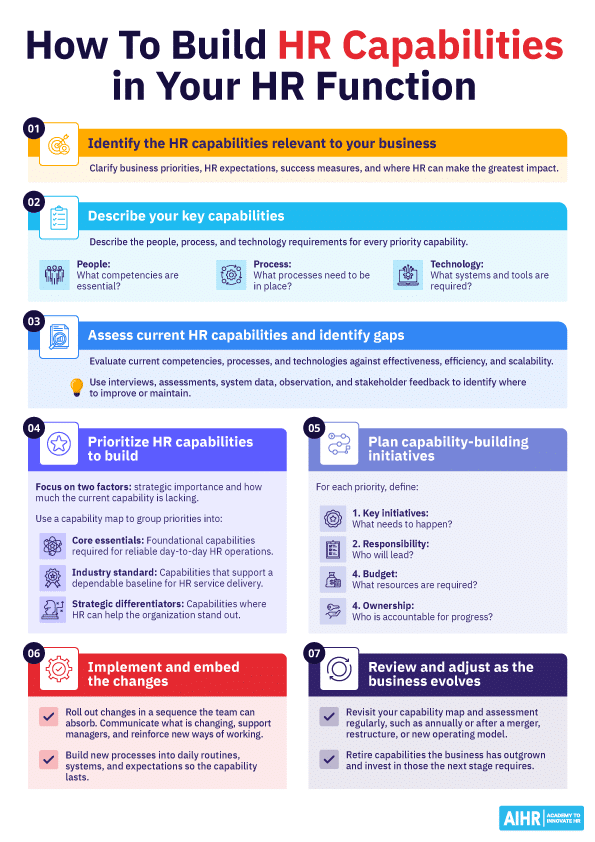
3. Assess current HR capabilities and identify gaps
With each capability clearly described, the next step is to assess the current state of each one. This involves collecting comprehensive data on existing competencies, processes, and technologies using methods such as interviews, assessments, system data analysis, observational studies, and stakeholder feedback. You should evaluate each capability against defined criteria like effectiveness, efficiency, and scalability.
This analysis should reveal gaps, strengths, and targeted actions to bridge areas needing improvement. For example, if talent acquisition technologies are found to be inadequate, this signals a priority for investment. Conversely, you can earmark capabilities assessed as strong for maintenance rather than further development.
By identifying these gaps and strengths, HR leaders can make informed decisions to align capabilities with business goals and support long-term growth. Findings from this assessment will inform the next step in building a robust, future-ready HR function.
Below is an example of a capability analysis with identified strengths and gaps:
Capability | Current status | Competencies | Processes | Systems |
Talent acquisition | Good technologies in place, yet processes are not standardized, and skills are insufficient to operate at this level. | Requires attention | Requires attention | Strength |
Payroll technologies | Basic systems exist, yet processes remain manual with key individual dependencies. | Requires attention | Requires attention | Sufficient |
Learning and development | No technologies in place to capture and deliver learning, yet strong design and in-person facilitation skills. | Strength | Sufficient | Requires attention |
4 steps to develop HR capabilities that meet business needs
Building capabilities requires a structured approach that balances the business’s needs with the availability of HR resources and investments. Here are the steps to put the right HR capabilities in place.
Step 1: Prioritize HR capabilities to build
With the gaps identified, decide which capabilities to build first. Two factors determine the priority: how strategically important a capability is, and how much the current state is lacking.
While all capabilities add value, their significance can vary depending on the business’s current HR needs. So, put simply, some capabilities require more focus than others.
A helpful framework to use is to draw a capability map. A capability map ranks and prioritizes capabilities in terms of three categories:
- Core essentials: These are essential, foundational capabilities necessary for day-to-day operations. They often cover governance, employee relations, and compliance—areas that require consistent investment to maintain functionality.
- Industry standard: These capabilities align with standard industry practices, providing a solid baseline for HR service delivery. They help ensure that our HR offerings meet basic standards without necessarily exceeding them.
- Strategic differentiators: These are the capabilities that distinguish the organization in the market. They might include a compelling employee value proposition, innovative compensation practices, or flexible work policies, reflecting areas where your business aims to stand out.
Let’s look at an example.
Company ABC has reached the maturity stage. Its HR function already runs well, so the priority now is to hold the basics steady and invest where HR can help the business stand out.
At the core essentials level, ABC keeps governance and policies, employee relations, and payroll running reliably. These capabilities have to work every day, so the team invests enough to keep them accurate and compliant without adding features the business does not need.
At the industry standard level, ABC aims to match its peers. This band holds most of HR’s everyday work, from talent acquisition and total rewards to people development, employee engagement, culture, and DEIB, HR technology and data, HR analytics and reporting, and organizational effectiveness. The team builds these to a dependable standard rather than a market-leading one.
At the strategic differentiator level, ABC concentrates on its employer brand and value proposition and on HR strategy execution. These are the capabilities that set the business apart in a competitive talent market, so the team invests more here and holds itself to a higher bar.
Mapping capabilities this way gives ABC a clear view of where to spend and where to hold steady. Below is what the capability map would look like for them in the maturity phase:

Step 2: Plan capability-building initiatives
With priorities set, outline a structured capability-building plan that details:
- Key initiatives: What specific actions are needed to strengthen each capability?
- Responsibility: Who will lead each initiative?
- Budget requirements: What financial resources are necessary to support these initiatives?
- Ownership: Who will take accountability for driving these initiatives forward?
A clear plan keeps effort focused and makes it easy to track progress against each capability.
Strengthening a capability often starts with building the competencies behind it. AIHR helped a food and agriculture company do this for its talent acquisition capability. As the function shifted from transactional hiring to a more strategic role, recruiters needed stronger sourcing, stakeholder management, and consulting skills.
AIHR worked with the company to focus the development on those competencies. The learning was tied directly to real hiring work through a business-focused recruitment plan and practical assignments. The team also got ready-to-use resources to sharpen hiring processes and employer branding.
As the competencies grew, so did the capability. Average time-to-fill dropped from 37 to 23 days, and recruiters became more confident challenging hiring practices and leading process improvements with hiring managers.
Step 3: Implement and embed the changes
A plan only creates value once the team puts it into practice. Roll out changes in a sequence the team can absorb, rather than all at once. Communicate what is changing and why, support managers through the shift, and reinforce new processes until they become the way the team works.
Embedding is what separates a capability that lasts from a project that fades. Build the new processes into daily routines, systems, and expectations so they hold once the initial push is over.
Illustrative case example: Developing HR capabilities at Company BTW
Company BTW, now in its maturity stage, has recently completed a transformation following the implementation of a new operating model. They identified several critical areas for improvement within their HR capabilities.
One primary focus was on HR technologies, where an analysis revealed the need for more advanced functionalities than the current system offered. Collaborating with the procurement division, the company selected a new technology vendor equipped to meet these specific functional requirements.
The review further highlighted the need for greater standardization within recruitment processes. To address this, BTW contracted a process engineer to map, optimize, and streamline these processes. This project included introducing standardized templates and metrics, ensuring consistency, and improving efficiency across recruitment activities.
Additionally, the analysis highlighted a skills gap within the learning team, particularly in digital and modern learning methodologies. In response, the team has engaged in a 12-month development program with a learning provider designed to upskill members in contemporary learning design techniques and equip them to deliver more impactful digital learning experiences.
Finally, the review revealed a need to strengthen workforce planning capabilities. Recognizing the importance of this area, the company has prioritized recruiting specialized talent to enhance this function in the coming months.
Step 4: Review and adjust as the business evolves
Building HR capabilities is not a one-off initiative. As the business moves through its life cycle, priorities shift and new capability gaps open.
Revisit the capability map and assessment on a regular cadence, for example, once a year or after a major change like a merger, restructure, or new operating model. Retire capabilities the business has outgrown, and invest in the ones the next stage will demand.
This keeps HR aligned with the business as it grows, instead of building for a stage the company has already left.
Final words
Identifying, describing, and developing HR capabilities are crucial to the success of any HR team. Aligning these capabilities with the business life cycle stages ensures that HR priorities evolve alongside the company’s needs, from startup to growth, maturity, or reinvention.
Ensuring a structured and holistic approach allows HR teams to execute sustainably and optimize the available resources to invest in capabilities that matter most at each stage of the business journey.