
For years, organizations have encouraged employees to take ownership of their careers. It has become one of the defining messages of modern talent management, appearing in employer brands, leadership principles, development frameworks, and manager toolkits.
Yet there is a contradiction at the heart of that promise.
Most organizations still manage careers through systems that employees do not control. Career opportunities remain hidden, succession decisions happen behind closed doors, and access to development is often determined by a manager’s perception rather than an employee’s ambition. Businesses tell employees to own their careers while designing talent management as though the organization owns them.
That contradiction is becoming increasingly difficult to sustain.
Employees expect greater transparency and agency over their careers. Organizations, meanwhile, need workforces that can continuously develop new skills and adapt to changing business needs. Neither objective is well served by talent systems built around annual reviews, hierarchical career ladders, and exclusive talent pools.
Employee-led talent management offers a different approach. Employee-led talent management shifts career growth from a top-down process to a shared responsibility between the employee and the organization. The organization’s role shifts from directing careers to creating the conditions in which careers can flourish, aligned with the organization’s talent needs.
In this article, we discuss employee-led talent management as an approach for the future and show how it differs from traditional talent approaches.
Contents
What is employee-led talent management?
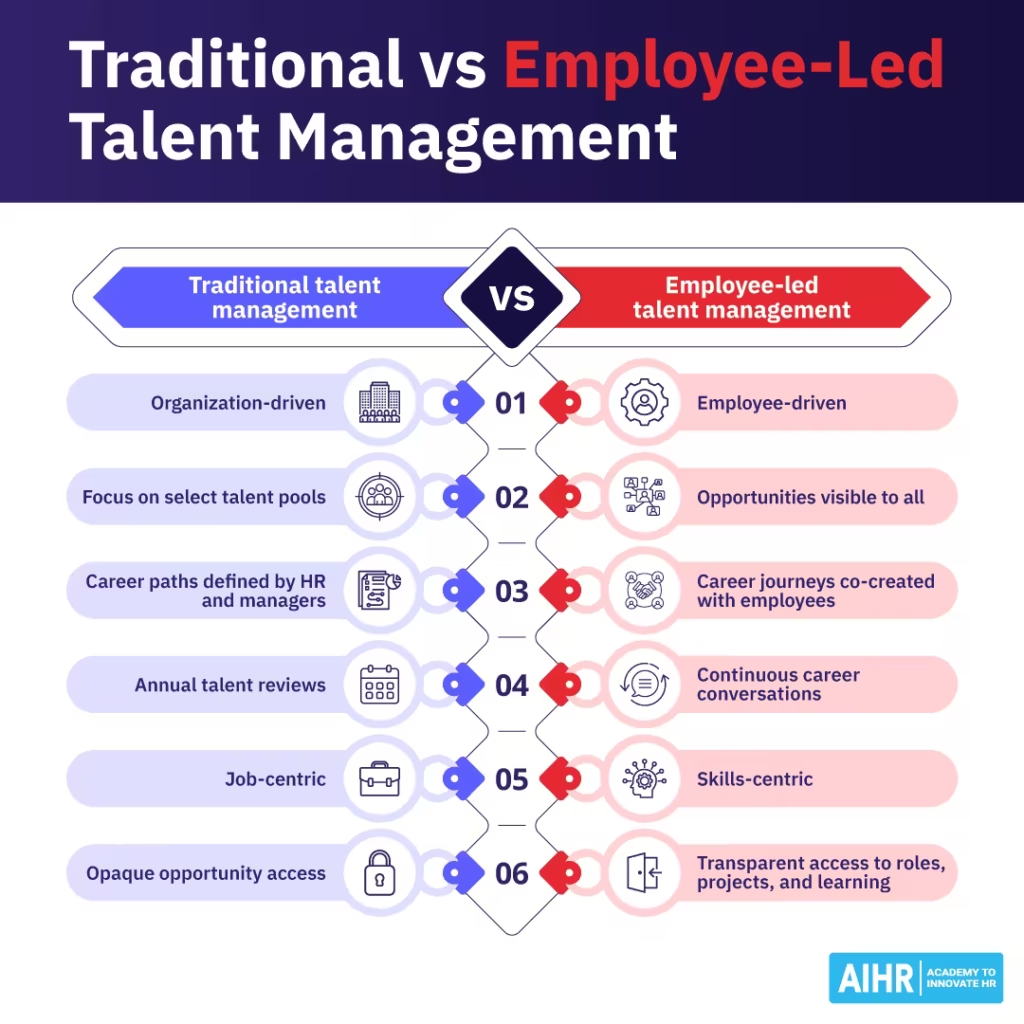
Traditional vs employee-led talent management
Why traditional talent management has reached its limits
Why employee-led talent management makes business sense
Building the conditions for employee-led talent management
How HR’s role has to change from gatekeeper to system architect

What is employee-led talent management?
Employee-led talent management is an approach that gives employees a more active role in shaping their own careers, development, and internal mobility. Rather than treating employees as passive participants in organizational processes, it makes career growth a shared responsibility between employees, managers, HR, and the business.
Traditional talent management often assumes the organization is best placed to decide who has potential, where development should be invested, and when career moves should happen. In an employee-led model, HR still provides the structure and governance, while employees gain clearer visibility into career paths, skills requirements, and development options.
This shift democratizes talent decisions and improves organizational mobility. Employees can see where they could grow next, take informed action, and shape their career path with the right support.
If an employee has more autonomy around what they’re going to do, more of a voice in their career direction trajectory, they’re much more inclined to be motivated, they’re much more inclined to want to do the work, they’re going to be much more invested in their career. Companies, on the whole, aren’t offering this to employees in the way that they can and should.

Traditional vs employee-led talent management
Traditional models are largely job-centric. Careers revolve around fixed roles, reporting structures, and hierarchical progression. Employee-led talent management is skills-centric. Instead of asking, “What job does this person hold?”, organizations begin asking, “What capabilities do they have? What do they want to develop? Where can those capabilities create value?”
That seemingly small shift opens up entirely different possibilities. Instead of following one fixed career ladder, they can build experience through projects, short-term assignments, cross-functional work, mentoring opportunities, and career pathways that may not appear on a traditional organizational chart.
Ultimately, employee-led talent management is not about giving employees complete control. Organizations still define strategic capability needs. HR still shapes workforce strategy. Managers still coach and develop people.
What changes is who owns the conversation.
Why traditional talent management has reached its limits
To understand why this shift matters, it helps to understand the assumptions that shaped modern talent management.
Much of today’s talent infrastructure can be traced back to McKinsey’s influential War for Talent research in the late 1990s. The argument was straightforward. A relatively small group of exceptional employees creates disproportionate organizational value. Competitive advantage, therefore, depended on identifying, developing, and retaining this vital few.
That thinking shaped decades of HR practice:
- High-potential programs concentrated investment on selected employees
- The 9 box grid became the dominant framework for assessing performance and potential
- Succession planning identified future leaders, while career progression followed structured, hierarchical pathways.
These practices were coherent because they served a clear purpose: organizational continuity.
That philosophy made sense in a world where organizational structures were relatively stable, careers followed predictable paths, and critical skills evolved gradually.
Today’s reality is fundamentally different.
AI is reshaping work faster than traditional career frameworks can adapt. Skills become obsolete more quickly, organizational priorities change more frequently, and careers increasingly span functions, projects, and disciplines rather than following linear promotions.
The assumptions that have underpinned talent management over the past three decades no longer fully reflect the world in which organizations now operate:
Reality 1: Narrow talent pools limit workforce potential
Perhaps the greatest limitation of traditional talent management is its focus on a relatively small percentage of employees.
HiPo programs were designed to accelerate the development of exceptional talent. The unintended consequence is that development often becomes concentrated on a select few while the majority wait for recognition.
Research shows that 91% of HR professionals and business leaders continue to rely primarily on manager recommendations and performance ratings when identifying high-potential employees. Yet these approaches are consistently shown to be influenced by visibility, perception, and bias rather than objective capability.
In the current labor market, organizations cannot afford to overlook capable employees simply because they were never identified as part of a high-potential talent pool.
Reality 2: Hidden career systems erode trust
Traditional talent management also relies heavily on information that employees cannot see.
Succession planning often happens behind closed doors. Employees rarely know whether they are being considered for future opportunities, what criteria are being applied, or what capabilities they need to develop.
The result is predictable. According to the recent State of Performance Enablement Report, two in five employees feel completely overlooked by succession planning, while 14% do not even know whether succession planning exists within their organization. Gartner’s research tells a similar story: only 46% of employees believe their organization supports their long-term career growth, and just one in four feel confident about their future with their current employer.
When organizations make decisions about people’s futures without including them in the conversation, they should not be surprised when employees begin looking elsewhere.
Reality 3: Static talent systems cannot keep pace
The final challenge is speed. Traditional talent management was designed around annual planning cycles, while the skills landscape today changes continuously.
McKinsey reports that 87% of CEOs already face—or expect to face—significant skills gaps within their organizations. Reflecting this reality, more than half of organizations surveyed by Workday had already begun transitioning towards skills-based talent management, with a further 23% planning to follow within the next year.
Why employee-led talent management makes business sense
It is tempting to think of employee-led talent management as an employee experience initiative, but this is not an accurate reflection.
Organizations that give employees greater ownership over their careers build workforces that retain talent longer, develop skills faster, and adapt more effectively to changing business needs.
LinkedIn’s research shows that employees working in organizations with strong internal mobility stay 41% longer than those in organizations with limited mobility. Following an internal move, 73% remain with the organization for at least three years, compared with only 56% of employees who never experience internal mobility. Employees rarely leave because they dislike the organization. They go elsewhere because they cannot see a future within it.
Employee-led talent management not only retains talent but also accelerates capability building. Employees who move internally develop new skills four times faster than colleagues who remain in the same role. Ownership changes behavior. People invest more energy in development when they believe they are shaping their own future rather than participating in someone else’s plan.
I think the employee benefits. But happy employees mean growth for your company, so there are definitely both things happening here. At the end of the day, what we’re aiming for is that employees feel enough control over their careers to make the decision that makes sense for them, keeps them engaged, and makes them want to do more for the company. The employee might benefit first, and then the company benefits second.
Finally, employee-led talent management reduces one of the greatest barriers to internal mobility: manager hoarding. LinkedIn reports that 80% of learning and development professionals identify managers blocking internal movement as the biggest obstacle to career mobility. Making opportunities visible beyond the manager changes that dynamic. It creates fairer access to opportunity while enabling organizations to deploy talent where it creates the greatest value.
Organizations that make career growth more transparent and employee-driven improve engagement while building workforces that learn faster, adapt more quickly, and stay longer.
Building the conditions for employee-led talent management
Employee-led talent management requires the right conditions to succeed. Technology can help, and employees need ownership, but neither is enough on its own. Organizations also need to redesign the talent system so career growth becomes visible, accessible, and supported. Five conditions are particularly important.
1. Move from career ladders to career ecosystems
Employee-led talent management works best when careers are not limited to one fixed ladder. The traditional career ladder reflects an era when organizations were more stable, structures changed slowly, and progression followed a predictable path. Employees moved upward one role at a time, often within the same function, with managers and HR determining when they were ready for the next step.
Today’s careers are increasingly shaped by skills, experiences, projects, and continuous learning. Employees build capability by working across functions, contributing to strategic initiatives, taking on stretch assignments, mentoring others, and developing new skills. Progress is defined by capability, not titles alone.
To support this, organizations need to create career ecosystems where employees can discover different ways to apply and build their skills. Career development becomes an ongoing process of exploration, supported by visible opportunities, career guidance, and access to development experiences.
Technology can help make this possible. AI-powered internal talent marketplaces can connect employees with internal roles, projects, mentors, learning opportunities, and short-term assignments based on their skills, interests, and aspirations, rather than relying only on job title or manager recommendation.
Technology, however, is only an enabler. Employee-led talent management succeeds when organizations intentionally redesign the environment in which careers develop.
2. Create fair access to opportunities
A career ecosystem only works when employees have a fair way to pursue the opportunities available to them.
That means setting clear expectations for how people can express interest in projects, apply for internal roles, join mentoring programs, or access learning experiences. Employees should understand what each opportunity requires and how decisions are made.
This reduces dependence on informal sponsorship or manager discretion. It also helps employees take ownership of their growth because they know which opportunities are available, what they need to qualify, and how to take the next step.
3. Redefine the manager’s role
Managers remain central to employee development, but their role must evolve.
For years, managers have acted as gatekeepers, identifying talent, approving development opportunities, and determining readiness for career progression. Employee-led talent management asks managers to become career coaches instead.
This shift also requires organizations to rethink incentives. Managers cannot be expected to encourage internal mobility while being rewarded for retaining their strongest performers. If organizations value talent mobility, they must recognize and reward leaders who develop people for the broader business, not only for their own teams.
4. Build the right infrastructure
Career ownership needs a clear infrastructure.
Employees need accurate skills profiles, useful career insights, accessible learning pathways, and technology that connects them with opportunities across the organization. These elements turn employee-led talent management from a broad idea into a practical operating model.
The goal is to give employees better information, so they can make more informed decisions about how they grow, move, and contribute.
5. Create psychological safety for exploration
Owning a career also requires permission to experiment.
Employees are unlikely to pursue stretch assignments, lateral moves, or unfamiliar projects if doing so carries career risk. Organizations need to normalize exploration as part of career development instead of viewing it as a distraction from performance.
Learning involves uncertainty. If organizations reward only flawless execution, employees will choose safety over growth. Employee-led talent management depends on an environment where exploration is encouraged, not penalized.
We discussed employee-led talent management with Jenny Bates Heaton, organizational strategist, executive & team coach. Watch the full conversation below:
How HR’s role has to change from gatekeeper to system architect
For much of the past three decades, HR has operated as the gatekeeper of talent. The function designed succession plans, identified high-potential employees, allocated development investment, and determined how talent moved through the organization.
That role made sense in a world built around scarcity, where the main objective was to identify and develop a small group of future leaders. Today’s challenge is different. HR needs to unlock potential across a much broader workforce, which requires a different mandate.
Instead of owning careers, HR should design the conditions that enable careers. This means moving from making individual talent decisions to building talent systems, from controlling opportunity to broadening access, and from managing careers to enabling career ownership.
Technology plays an important role in this transition, but only when it is used to give employees direct access to opportunities and insights. Internal talent marketplaces, skills intelligence platforms, AI-powered career guidance, and personalized learning recommendations create value when employees can use them without relying on a gatekeeper. Used well, technology helps employees make more informed career decisions.
Finally, HR needs to reconsider how success is measured. Traditional metrics such as succession coverage, talent review completion rates, and development plan compliance reveal relatively little about whether employees experience career ownership. The more meaningful questions are different:
- How many employees made an internal move this year?
- How many developed new capabilities through projects rather than promotions?
- How quickly are critical skills developing across the workforce?
- How many employees believe they have a future inside this organization?
Those measures indicate whether talent management is creating opportunity rather than simply administering a process.
Final thoughts
Employee-led talent management gives employees more agency while keeping organizational responsibility clear. Organizations still need workforce strategies, succession planning, critical capability planning, and clear business priorities. Managers remain important to development, and HR continues to shape the systems that help talent grow and move across the business.
This approach reflects a broader shift in how work and careers are changing. AI is reshaping roles faster than traditional talent frameworks can adapt, while skills are becoming more important than job titles. Career growth is also more fluid, with employees building capability through learning, projects, internal moves, and new experiences.
For HR, the priority is to create an environment where employees can see opportunities, build emerging capabilities, and move toward work where they can create the most value. That is how employee-led talent management turns career ownership into a practical business advantage.