

Is SHRM certification worth it? It is a fair question to ask before you commit, because the SHRM-CP and SHRM-SCP are an investment of your time, money, and effort, and require you to maintain the credential once you pass.
For some HR professionals, this credential can be the right investment. For others, it might be better if your HR learning builds practical, current skills. Whether the certification pays off depends on what you are trying to achieve, so it helps to look closely at the cost, the time, and what the credential does and does not deliver. Let’s take a closer look.
Contents
What is a SHRM certification?
Why get a SHRM certification? The benefits and the limits
How long does it take to get a SHRM certification?
How much is the SHRM certification? The real cost
So, is SHRM certification worth it? It depends on your goals
How AIHR fits into your HR professional development
How to decide
What is a SHRM certification?
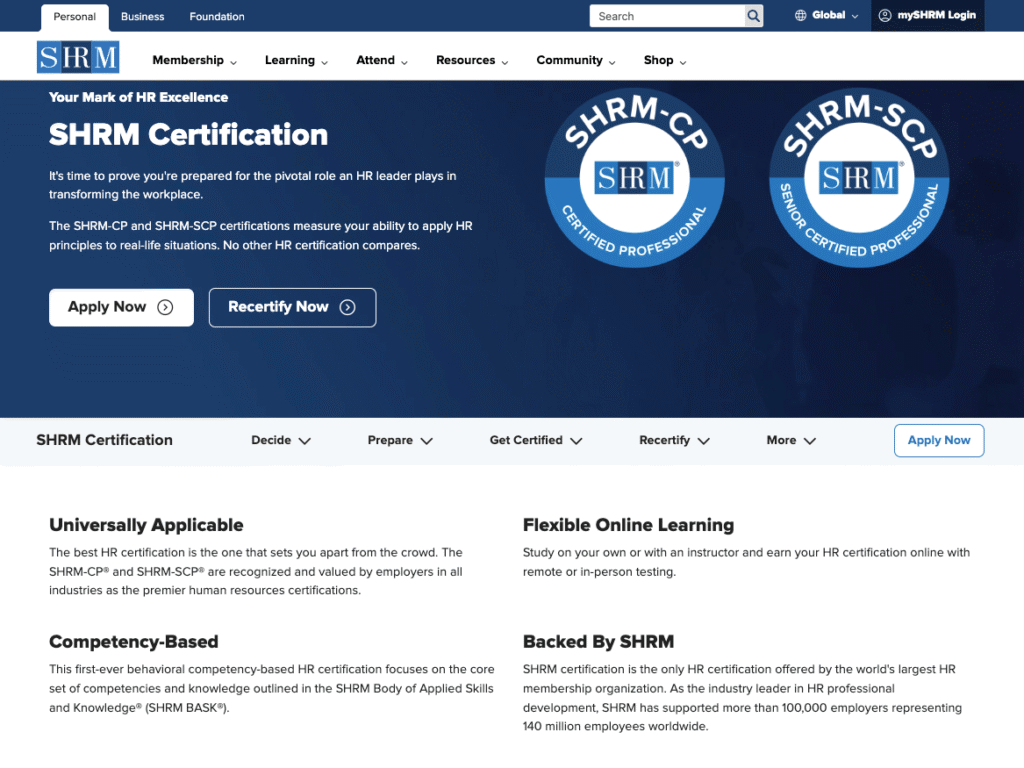
A SHRM certification is a professional HR credential you earn by passing an exam. It confirms that your HR knowledge and your judgment in real workplace situations meet a defined standard, and it gives you a recognized title to put after your name. SHRM (the Society for Human Resource Management) offers two levels: the SHRM-CP (Certified Professional) and the SHRM-SCP (Senior Certified Professional).
SHRM is the largest HR professional association in the U.S., so you will often see these credentials listed as preferred or required in U.S. job postings, especially at larger employers.
Exams for both levels are competency-based. They test a mix of HR knowledge and situational judgment, with items split across three behavioral competency clusters and three HR knowledge domains. You take the exam in person at a Prometric test center. It contains multiple-choice questions, including scenario-based questions that ask you to choose the best response to a realistic workplace situation. The content is grounded primarily in U.S. employment practice.
If you pass, you get the credential for three years, and you have an option to recertify.
SHRM certification requirements
The two credentials have different eligibility rules.
- The SHRM-CP has no degree or HR experience requirement. It suits people who handle operational HR work, and students or career changers moving into the field. SHRM recommends a basic working knowledge of HR practices before you apply for the exam.
- The SHRM-SCP is for HR professionals working at a strategic level. You need at least three years of strategic HR work, measured as 1,000 hours per calendar year, or you need to have held the SHRM-CP for at least three years while moving into strategic work.
One thing to note: SHRM reports that roughly one in five candidates picks the wrong level for their experience. Make sure to choose the right level, as the fee is nonrefundable.
Why get a SHRM certification? The benefits and the limits
Here’s what the credential actually does for you, and what it doesn’t.
Key benefits
- A recognized signal of expertise standard: In the U.S. market, SHRM-CP and SHRM-SCP are well known to recruiters and HR leaders. When a job posting names a preferred certification, holding one helps move your application past that filter.
- Validation of your HR knowledge: Passing a SHRM exam confirms that your understanding of HR functions and workplace judgment meets a defined standard. That helps when you are self-taught in HR and want external proof of your knowledge, when changing employers, or when you’re making the case for a promotion.
- Stronger earning potential: Certified HR professionals tend to earn more than their non-certified peers, and the credential can strengthen your hand in promotion and salary conversations. SHRM’s research found that HR professionals who hold the SHRM certification report salaries 14 to 15 percent higher than peers who don’t. Most of that effect comes from qualifying for higher-paying roles, so treat certification as one factor that supports higher pay rather than an automatic raise.
- A shared professional standard: SHRM certification puts you on a common competency framework (SHRM’s Body of Applied Skills and Knowledge) that many U.S. HR teams use as a reference point. Because every holder is assessed against the same defined standard, your SHRM certification means the same thing to any U.S. employer. A job title or an in-house training record varies from company to company, so it travels less well when you change roles. The credential gives employers a consistent read on what you have proven.
Limits to consider
- It validates knowledge, but doesn’t build hands-on skills: The exam confirms you can reason through HR scenarios. It does not teach you to run a people analytics project, build an HR dashboard, write an AI use policy, or lead a strategic workforce plan. Those capabilities come from doing the work and from practical, applied learning: hands-on training in the specific skills a modern HR role demands. That distinction, between proving what you know and building what you can do, matters later when you weigh whether the credential is the right use of your time and money.
- Its value is strongest in the U.S.: SHRM content centers on U.S. regulations and workplace practice. If you work mainly outside the United States, recognition varies, and the compliance material may not be as relevant in your jurisdiction.
- It’s a generalist credential: It proves a broad HR foundation, not depth in specific HR domains like people analytics, compensation, or L&D. If your next role needs demonstrated depth in one area, a broad credential won’t show it.
- Passing is not guaranteed: The exam is demanding. Recent global pass rates sit between 67 and 71 percent for the SHRM-CP and around 50-56 percent for the SHRM-SCP, so a significant share of candidates do not pass on the first attempt. You can pay the fee, study for months, and still need to retake it.
Knowing these limits up front makes the cost and payoff easier to judge, which is where we go next.

How long does it take to get a SHRM certification?
Plan for two to four months from decision to exam day, because there will be a set exam date you will need to work towards. SHRM runs two testing windows a year, so you will have to apply during the application period for the window you want.
Most candidates prepare for over three to four months to take the exam. Working professionals typically budget somewhere between 80 and 200 hours, depending on their experience and the level they choose.
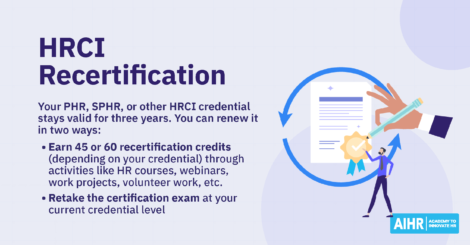
After you pass, the credential stays valid for three years before you need to recertify. To do that, you either earn 60 professional development credits (PDCs) through activities like HR courses recognized for these credits, webinars, and on-the-job HR projects across the three-year cycle, or you retake the exam.
How much is the SHRM certification? The real cost
The exam fee is not the only cost you should factor into your calculations. You also need to include the exam preparation and recertification costs.
Let’s break it down.
- The exam fee: SHRM prices the SHRM-CP and SHRM-SCP identically, and what you pay depends on when you apply and whether you hold a SHRM membership. At the early bird application deadline, the exam costs $350 for members and $450 for nonmembers. At the standard deadline, it costs $399 for members and $499 for nonmembers, so applying early saves you $49. Every rate includes a $50 nonrefundable application fee.
- Membership cost: SHRM membership costs $299 a year and saves you $100 on the exam. This means it doesn’t make sense to get the membership just for an exam discount. However, members also get a discounted price on SHRM’s official prep materials, which is where membership can start to pay off when you’re working towards a certification. Weigh the membership cost against how much you plan to use SHRM’s wider resources.
- Study materials: SHRM’s exams are demanding, and prep can be a substantial line item. The official SHRM Certification Prep System starts at $820 for members and $1,130 for nonmembers. Some third-party options cost less, with quality that varies. All in, most candidates spend between $1,500 and $1,900 to get certified, once you add the exam, prep, and membership.
- Recertification every three years: To keep the credential, you need to earn 60 professional development credits (PDCs) across the three-year cycle or retake the exam. SHRM also charges a recertification fee that starts at $165 for members and $210 for nonmembers. Miss your deadline and a $75 late fee applies during a 60-day grace period. The credential is a recurring commitment, so you need to budget for the upkeep, not only the first exam.
So, is SHRM certification worth it? It depends on your goals
There is no simple yes-or-no answer to this question. What matters is what you want your next HR professional development step to be. Do you need a credential or to build new skills, or both?
SHRM certification serves as a credential that proves your HR knowledge to a U.S. employer. Applied HR learning builds skills and helps you develop modern HR capabilities like business partnering, AI for HR, and people analytics through coursework and practical assignments. Online, self-paced certificate programs and courses like those from AIHR help you build these practical, in-demand skills you can immediately apply on-the-job.
Some HR professionals choose one of the two options, while others choose to take both. Here’s how you can think about which path is right for you.
When it’s likely worth it
- You work in the U.S., or want to, and your target employers list SHRM-CP or SHRM-SCP as preferred or required.
- You are mid-career and want a recognized signal to move into or up within U.S HR.
- You want external confirmation that your HR knowledge meets an operational or strategic standard.
- Your employer reimburses the cost, which many do as professional development.
When applied HR learning may be the better investment
- Your goal is to create real business impact, and you need to upskill in areas such as analytics, HR technology, AI in HR, stakeholder influence, or strategic execution.
- You want practical, in-demand skills you can immediately apply in your role that exam preparation won’t give you.
- You’re looking to close specific HR skills gaps that a broad knowledge exam does not address.
- You work mainly outside the U.S., where SHRM recognition is weaker and local practices differ.
- You’re still deciding whether HR is the right long-term career for you, and you’d rather build practical skills first before committing to taking an exam.
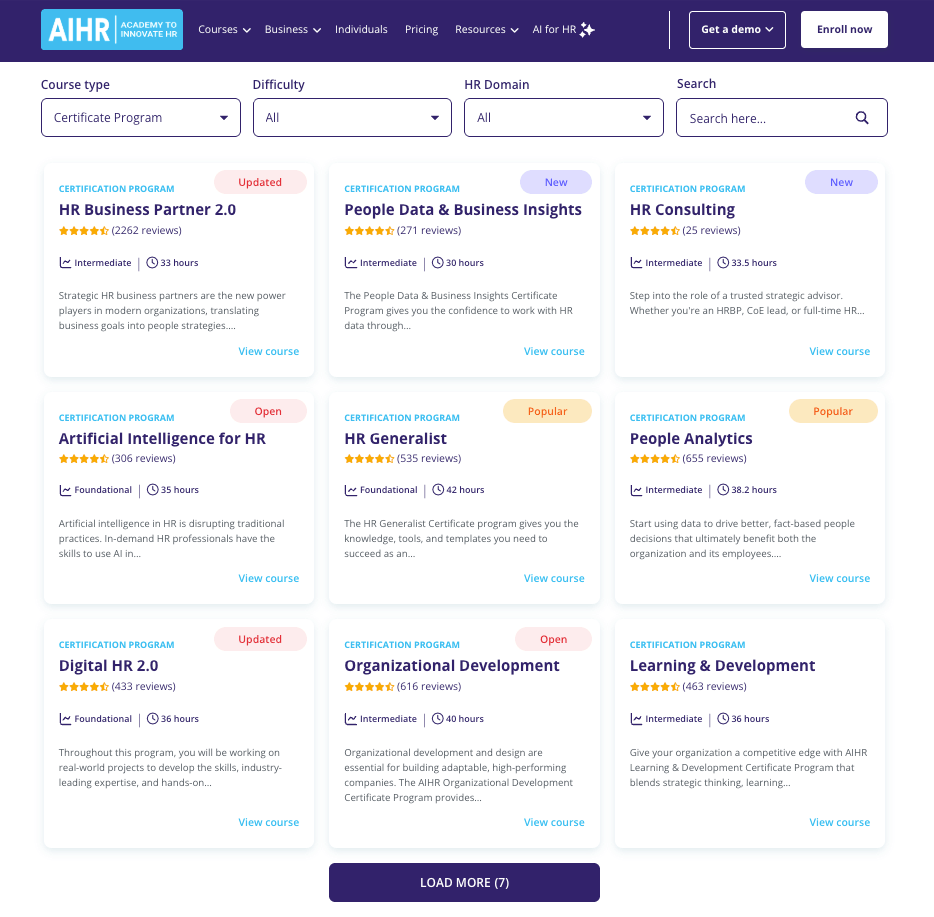
Here are practical HR certificate programs that AIHR offers:
How AIHR fits into your HR professional development
Skill-building is an essential part of professional development in Human Resources. If you want to build modern HR capabilities, AIHR’s online HR learning platform offers self-paced certificate programs covering areas like HR business partnering, AI for HR, people analytics, and organizational development. Each certificate program includes hands-on labs and a capstone project, so you learn by doing. Programs end in a digital certificate that strengthens your professional profile.
If you decide the credential is worth it, AIHR can help you achieve this goal. Maintaining a SHRM certification requires you to earn 60 PDCs every three years, and that upkeep can double as development of in-demand skills. AIHR is recognized by SHRM to offer Professional Development Credits (PDCs) for SHRM-CP or SHRM-SCP recertification activities. So the same programs that build your capability can also count toward staying certified.
A SHRM certification helps you to prove your HR knowledge to employers, while an AIHR certificate program helps you to keep your skills current as the profession changes. Many HR professionals invest in both at different points in their careers.
AIHR’s Demo Portal offers a free preview of practical HR lessons, templates, and resources. See how the learning experience helps HR professionals build relevant, in-demand skills.
How to decide
Run through five quick steps before you apply for a SHRM exam.
- Decide what you actually need. Recognized credential, capability, or both. A credential proves your HR knowledge, applied learning builds the capability, and your answer here drives every step that follows.
- Scan job postings in your market and see if SHRM-CP or SHRM-SCP shows up as preferred or required.
- Confirm eligibility and the right level. Picking the wrong level between CP and SCP is a common and costly mistake.
- Add up the full cost. Consider the exam, prep, and recertification costs across three years, not only the first fee.
- Ask your employer what they fund. Many teams reimburse certification, learning platforms, or both as professional development. If you need both, look for programs that also earn PDCs so the two goals move together.
Is SHRM certification worth it? For many U.S. HR professionals whose employers value it, yes. For others, applied HR learning is a better use of the same time and money. And if you do pursue SHRM, pairing it with practical learning gives you both the signal and the skills to back it up.