The best practical HR courses help you build skills you can use at work right away. Think smoother hiring processes, policies you’ve drafted yourself, difficult conversations you’ve practiced handling, or more accurate salary benchmarking. Plenty of courses explain HR theory, but fewer give you the chance to apply what you’ve learned.
For HR professionals, the most practical option is a Certificate Program from the Academy to Innovate HR (AIHR). Each program combines roleplays, real-world case studies, ready-to-use templates, and a capstone project, so you practice the work instead of only reading about it.
Employers want to know what you can do. To help you choose the most practical HR course, this article compares seven practical courses using four key criteria. You’ll see what each course teaches, what you’ll create, how much it costs, and who it’s best for.
Contents
What makes an HR course practical
The best practical HR courses at a glance
5 best practical HR courses by career goal
How to choose the right practical HR course for you
How to turn your HR coursework into career proof
FAQ
What makes an HR course practical
To see if an HR course is truly practical, check for four things before you enroll:
- You create something you can use at work: A good course helps you produce useful materials, such as an onboarding plan, policy draft, hiring scorecard, or HR budget. If you finish with nothing but a completion badge, you’ve probably learned more theory than practice.
- You work through realistic situations: Case studies, role plays, and simulations help you practice making decisions before you face similar situations at work. For example, watching a performance conversation can teach you useful techniques. Practicing that conversation yourself helps you learn how to handle it.
- You learn to use everyday HR tools: Look for training that covers spreadsheets, HR software, and AI tools. Learning to build a turnover report in Excel gives you a skill you can apply immediately, but simply learning why employee turnover matters won’t get you as far.
- You apply your skills and check your understanding: Look for a final project or scenario that brings everything together, plus an assessment that confirms you’ve understood the material. A course that ends with only a completion badge won’t show you, or an employer, what you can do.
You won’t find every feature in every course, and that’s okay. Use these four criteria to compare your options and identify any skills you’ll need to develop elsewhere.

The best practical HR courses at a glance
Here’s how seven practical HR courses compare on format, cost, and what you’ll learn. Prices and course durations come from each provider’s official page at the time of writing. Prices are in USD. For more options, check out our roundup of the best online HR courses.
Course | Best for | Format, duration | Cost | What you take away |
AIHR Certificate Programs | Practical, job-ready skills in any HR area | Online, self-paced; 25 to 45 hours per program | $1,125, or included in Full Academy Access ($1,850/year) | Assignments, roleplays, case studies, a capstone project, and ready-to-use templates |
HR Essentials (eCornell) | Learning people management skills with faculty feedback | Online, cohort-based; about three months | $3,900 | A structured interview guide, coaching plan, and performance management recommendation |
HR Management and Analytics (Wharton) | Using data to guide HR decisions | Online; about two months | $3,100 | An understanding of people analytics for mid- to senior-level HR roles |
HR for People Managers (University of Minnesota) | Building foundational skills affordably | Online, self-paced, about two months | Included with Coursera Plus ($59 per month or $399 per year) | A peer-reviewed capstone project based on a real workplace |
Alison HR courses | Exploring HR for free | Online, self-paced, up to 15 hours per course | Free to start, with paid upgrades available | An introduction to essential HR topics |
5 best practical HR courses by career goal
Now that you’ve seen how the courses compare, let’s look at what each one offers. We’ve grouped them by career goal to help you find training that suits your experience and what you want to learn next.
1. AIHR Certificate Programs
If you want an HR course built around doing the work, start with AIHR’s Certificate Programs. AIHR offers 16+ online, self-paced programs across every HR area, from HR operations and talent acquisition to people analytics and AI in HR. Each takes 25-45 hours, and you get 12 months of access. Here’s what makes the AIHR approach practical:
- Assignments and roleplays: Every program follows the Tell-Show-Do-Apply method, with video lessons, quizzes, assignments, and roleplays. You prepare for the conversations you’ll face at work, such as a courageous conversation with an employee, and practice difficult conversations and coaching roleplays with AI.
- Real-world case studies and projects: Work through realistic HR problems. For example, you might populate the HR Service Delivery Model Canvas and use it to measure your HR efforts, or redesign an HR process with the OASIS framework to balance human and AI work.
- A two-part capstone project: Every program ends with a capstone project. The optional capstone assignment puts you in a realistic workplace scenario, such as modernizing the HR function of a fictional mid-sized healthcare company. The capstone exam then checks your knowledge. Score 70% to earn a digital certificate you can share and verify on LinkedIn. You can retake the exam as often as you need, and the capstone takes about two hours in total.
- Ready-to-use templates: Each program comes with templates and tools you can adapt for your own organization, such as a 30-60-90 day plan template, an employee onboarding checklist, or an AI policy template. Full Academy Access gives you the full HR Resource Library of 400+ templates, playbooks, and tools.
- Mini courses and tutorials: Build one focused skill in a short, self-paced format. Mini courses typically take two to three hours and award a certificate of completion.
- Weekly live events: Join live sessions with HR experts on trending topics, such as AI in HR and annual HR trends.
- Support while you work: Ask AIHR Copilot, an HR-specific AI assistant built on AIHR’s expert content, for help with an HR task. Swap ideas with 25,000+ HR professionals in the community, and build skills like communication, conflict resolution, and negotiation in the Soft Skills Hub.
The full HR Resource Library, mini courses, weekly live events, AIHR Copilot, and personal coaching are part of Full Academy Access. It also gives you access to all the Certificate Programs:
- Artificial Intelligence for HR
- AI & HR Transformation
- HR Business Partner 2.0
- People Analytics
- Learning & Development
- Organizational Development
- HR Generalist
- Compensation & Benefits
- Digital HR 2.0
- Diversity, Equity, Inclusion & Belonging
- HR Consulting
- HR Coordinator
- HR Manager
- People Data & Business Insights
- Sourcing & Recruitment
- Strategic Talent Acquisition
- Talent Management & Succession Planning
Where to start: If you’re new to HR, try the HR Generalist or HR Coordinator Certificate Program. If you already work in HR, choose a specialist program, such as People Analytics, Strategic Talent Acquisition, or Compensation & Benefits.
Cristiana Rossi, HR Head of Business Transformation at the Ermenegildo Zegna Group, says: “The AIHR certificate programs are the best way to develop the competencies needed to face the challenges created by technology. The courses are professional, well-built, and very concrete. I especially like the examples and case studies. They are not only useful but truly allow you to apply your learning to the real world.”
What members think about AIHR: The practical focus of AIHR’s Certificate Programs shows in learner feedback. 96% of students recommend AIHR, and AIHR has an average rating of 4.66 out of 5 from 12,000+ verified reviews on Reviews.io.
According to verified reviewer Traci H Yewell, who took the Artificial Intelligence for HR Certificate Program: “The content was engaging, practical, and immediately applicable to the evolving role of HR leadership. The capstone case study was particularly valuable because it challenged me to apply what I learned through strategy development, vendor evaluation, data analysis, and executive reporting.”
Another verified reviewer, Richard Shaw, said of the same program: “The practical examples and strategies provided a strong foundation for applying AI in real-world HR and leadership settings. I would recommend this program to HR professionals and organizational leaders who want to develop their AI capabilities, improve productivity, and prepare their organizations for the future of work.
The best HR courses help you turn knowledge into skills you can apply at work. Invest in continuous learning to stay current with evolving HR practices, expand your expertise, and grow into a more well-rounded HR professional.
With AIHR’s Full Academy Access, you’ll be able to:
✅ Build expertise across HR disciplines, including talent acquisition, employee experience, and HR strategy
✅ Apply what you learn through real-world case studies, practical assignments, and hands-on projects
✅ Use ready-to-apply HR resources, including templates, guides, and tools to support your day-to-day work
✅ Develop your skills by exploring new HR topics, earning certificates, and preparing for your next career step.
🚀 Curious about what you could learn next? Explore the AIHR Demo Portal to preview lessons and discover practical learning resources.
2. Human Resources Essentials (eCornell)
Best for: Faculty feedback on people management skills
eCornell’s Human Resources Essentials certificate program includes six courses developed by faculty at Cornell University’s ILR School. It follows a cohort-based format, so you’ll study alongside other learners. You’ll also take part in facilitated discussions and receive feedback on your assignments.
You’ll work on practical projects (including creating a structured interview guide with scoring rubrics), develop a coaching plan, and make a performance management recommendation. The program takes about three months to complete, and costs $3,900.
3. HR Management and Analytics (Wharton)
Best for: Linking HR decisions to data
If you want to get better at using data to make HR decisions, Wharton’s HR Management and Analytics program could be a good fit for you. Delivered online with Emeritus, this two-month certificate program connects HR management with people analytics, and will teach you how data can inform workforce decisions.
The program, which targets mid- to senior-level HR professionals and managers with talent management responsibilities, takes around four to six hours per week and costs $3,100.
4. HR for People Managers (University of Minnesota)
Best for: A low-cost, structured foundation
The University of Minnesota’s HR for People Managers Specialization on Coursera offers an affordable introduction to core HR topics. This beginner-level program includes five courses covering recruitment, performance management, and employee rewards.
You’ll finish with a capstone project that asks you to apply what you’ve learned to a real workplace. You’ll also review other learners’ projects and receive peer feedback. You can study at your own pace. Expect to spend around 10 hours per week over two months to complete this program.
At the same time, the program focuses on HR principles for people managers rather than HR operations. As such, tßou’ll get fewer ready-to-use templates than you would from a dedicated HR training program.
5. Alison HR courses
Best for: Testing your HR interest for free
If you’re curious about a career in HR but aren’t ready to invest in longer training, Alison offers a free starting point. Its online HR courses cover topics such as recruitment, employment law, and other HR fundamentals.
Many courses take just a few hours to complete, making them easy to fit around your schedule. You can explore different HR topics without spending money upfront and decide which areas interest you most.
However, these shorter courses offer fewer opportunities to create practical work or complete in-depth assessments. They’re useful for exploring HR, but won’t replace a structured training program.
How to choose the right practical HR course for you
The best practical HR course for you depends on your experience, career goals, and the skills you want to develop. Here’s how to narrow down your options:
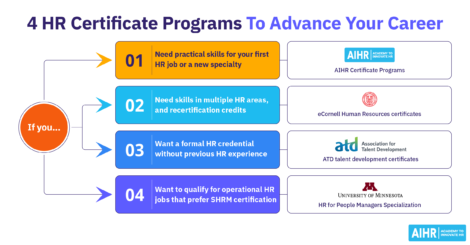
- If you’re switching into HR: Start with a free Alison course to explore the profession. Once you’re ready for more structured learning, try AIHR’s HR Coordinator or HR Generalist Certificate Program. You don’t need previous HR experience to enroll, and you’ll practice real HR tasks through assignments, roleplays, and case studies before your first role.
- You don’t need previous HR experience to enroll. You’ll also get practical resources that can help you prepare for your first role.
- If you already work in HR: Think about which part of your job you’d like to improve. Maybe you struggle with running interviews, creating reports, or handling employee relations.
- Choose a course that lets you practice those tasks: AIHR’s HR Generalist Certificate Program and eCornell’s Human Resources Essentials are worth exploring if you want to strengthen your general HR skills.
- If you’re moving into a specialist or senior role: Focus on developing deeper expertise in your chosen field. AIHR’s Artificial Intelligence for HR, People Analytics, and Strategic Talent Acquisition Certificate Programs are good options.
- If you want to build several skills over time: Compare the cost of individual programs with an annual learning subscription.
A single AIHR certificate program costs $1,125, while Full Academy Access costs $1,850 a year and includes:
- 16+ certificate programs
- 85+ courses and mini courses
- 500+ templates, playbooks, and tools
- Weekly live events with HR experts
- AIHR Copilot and personal coaching.
If you plan to complete at least two certificate programs within a year, Full Academy Access is the more affordable option. Both individual plans come with a money-back guarantee: 30 days for a Certificate Program and 60 days for annual Full Academy Access. See the AIHR pricing page for local currencies.
How to turn your HR coursework into career proof
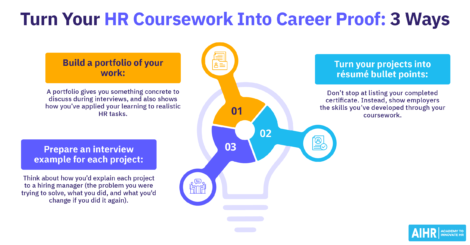
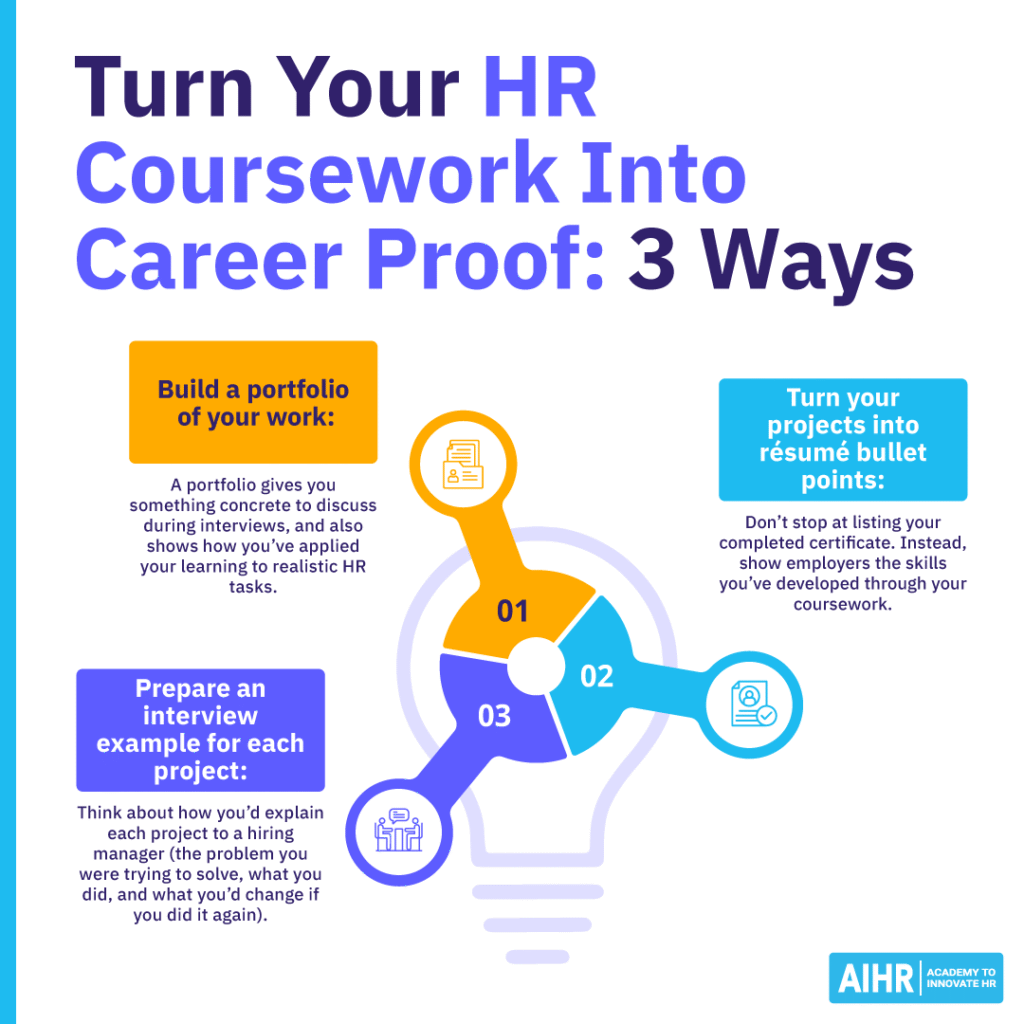
Completing a practical HR course is a good start. But how do you show employers what you’ve learned? The answer is to turn your coursework into examples of your skills. Here are three ways to do it:
Build a portfolio of your work
Save the materials you create during your course. These could include an HR policy, onboarding plan, hiring scorecard, or employee turnover dashboard. Then, remove any confidential information and organize your work in a folder you can share with potential employers.
A portfolio gives you something concrete to discuss during interviews, and also shows how you’ve applied your learning to realistic HR tasks.
Turn your projects into résumé bullet points
Don’t stop at listing your completed certificate. Instead, show employers the skills you’ve developed through your coursework. For example, instead of writing: “Completed HR Generalist Certificate Program by AIHR”, try “Designed a 30-day onboarding plan and new-hire checklist using a structured HR framework.”
Prepare an interview example for each project
For every project in your portfolio, think about how you’d explain it to a Hiring Manager. Be ready to answer the following questions:
- What problem were you trying to solve?
- What did you create, and how did you approach it?
- What would you change or improve if you did it again?
These examples can help you answer questions about handling real HR situations. You’ll also find it easier to explain your skills when you can refer to work you’ve actually completed. Additionally, courses with practical assignments typically help you finish with examples you can use in your job search, as well as a certificate.
Next steps
The best practical HR courses help you develop skills you can use in real workplace situations. Look for training that includes hands-on projects, realistic scenarios, and practical assessments. At the same time, match the course to your career goals, then make a plan to show employers what you’ve learned.
If you want to build practical skills across different HR areas, explore AIHR’s Certificate Programs. They’re self-paced, open to learners at different career stages, and include practical tools, role plays, and projects. For ongoing development, Full Academy Access gives you access to every Certificate Program through one annual subscription.
FAQ
For most HR professionals, AIHR’s Certificate Programs are the most practical HR courses. They combine assignments, roleplays, real-world case studies, ready-to-use templates, and a capstone project, so you practice real HR work as you learn.
Yes. Look for online HR courses that include realistic scenarios, practice with HR tools, and a final project. Self-paced programs let you apply each new skill at work while you’re still learning.
No. Many practical HR courses are open to beginners. AIHR’s HR Generalist Certificate Program, for instance, doesn’t require a degree, previous HR experience, or another certification.