

If you’re a beginner in the HR field looking for HR certifications that are going to help you build the practical skills you need and grow in your new career, you’ve landed on the right article!
Human Resources is a promising career path for beginners. The U.S. Bureau of Labor Statistics projects employment for HR specialists to grow 6% from 2025 to 2035, with approximately 73,700 job openings each year.
We are going to explain how to choose the best HR certifications for beginners based on your specific needs: either to quickly build the skills you need to start performing in your new role, or to learn HR theory to earn an entry-level credential. We’ll unpack when an AIHR Certificate Program for beginners is the right choice and what credentials, like the SHRM-CP or the CIPD Level 3, offer.
Let’s dive in!
Contents
How to choose the best HR certification for beginners
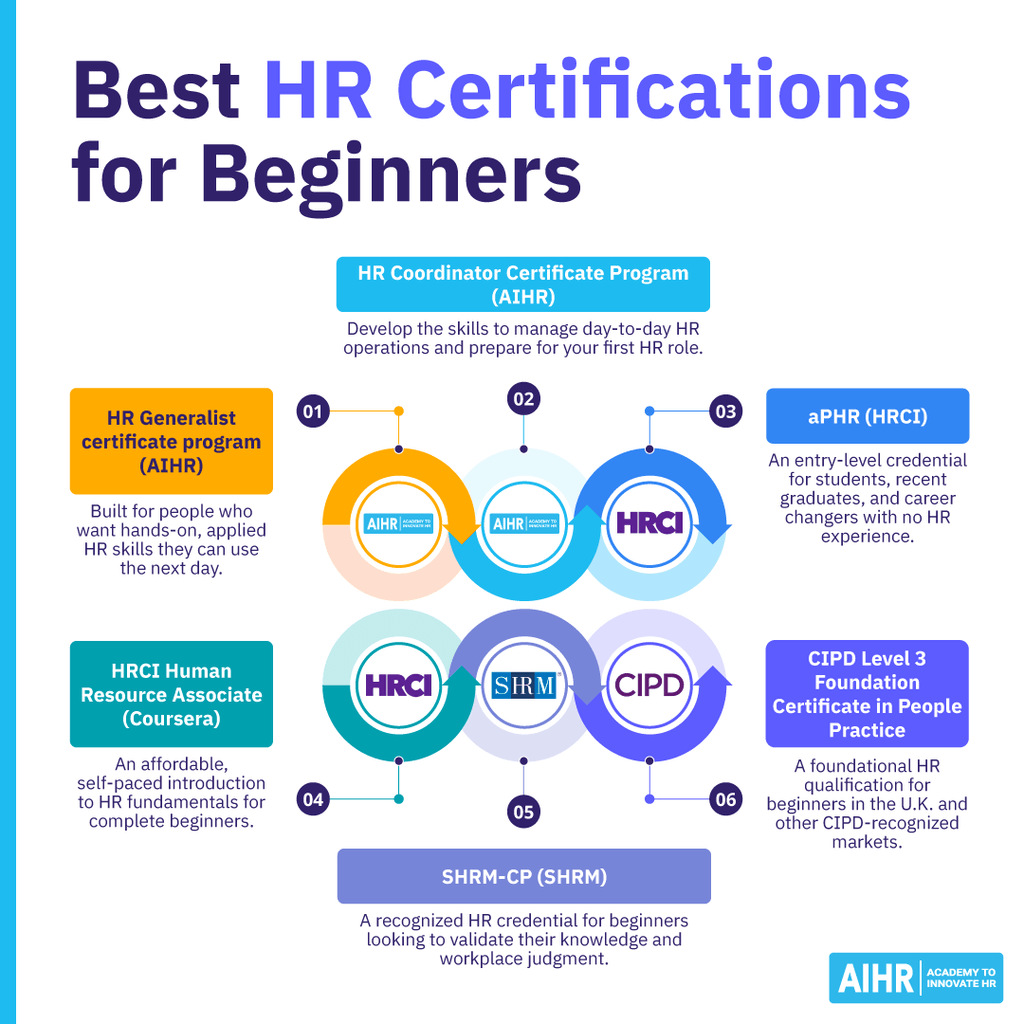
The best HR certifications for beginners, compared
1. HR Generalist Certificate Program (AIHR)
2. HR Coordinator Certificate Program (AIHR)
3. aPHR (HRCI)
4. HRCI Human Resource Associate Professional Certificate (Coursera)
5. SHRM-CP (SHRM)
6. CIPD Level 3 Foundation Certificate in People Practice
Which HR certification should you get first? A simple decision framework
FAQ
How to choose the best HR certification for beginners
The best HR certification for beginners is one you can start now, without eligibility requirements, and that helps you build the skills you need in your first role. Recognition, cost, and study time matter too, but they’re easier to weigh once you know what you need a program to do for you.
Before you compare HR certifications, get clear on what you need the certification to do for you. A student with no work experience, a career changer, and a new HR Coordinator may all be beginners, but they don’t need the same learning path. Start with these five questions.
- What is my next career step? Are you applying for your first HR role, moving into HR from another function, or building confidence in a new HR job?
- Do I need broad HR knowledge or a specialist path? If you’re still exploring HR, choose a certification that covers the full employee lifecycle. If you already know you want to work in recruitment, learning and development, people analytics, or employee relations, a more focused program may be a better fit.
- What will I need to do on the job? If you’re moving into an HR role, review the job description. Then check whether the program you’re considering lets you practice those tasks, or only tests what you know about them.
- How much structure do I need? Some beginners prefer a guided course with practical assignments, while others are ready to study independently for an exam. If you’ve never done HR work, assignments and roleplays give you a safe place to practice before you’re doing it for real.
- What proof do I want at the end? A certificate of completion, exam-based credential, or portfolio project can all help, but they serve different goals.
Once you know what you need, it becomes easier to compare your options. Use the five criteria below to separate a strong first HR certification from one that may not fit your goals.
6 criteria for choosing your first HR certification
- Job readiness: When you finish, will you be able to do the work, such as drafting a policy, running onboarding, or handling a difficult conversation, or will you mainly have proven what you know?
- Eligibility: Can you start now, or do you need experience before you’re allowed to enroll or sit the exam?
- Learning format: Is it a high-stakes exam, a coursework-based qualification, or a self-paced online program with a capstone project? If you’re new to HR, look for practical assignments that let you practice before you’re doing the work for real.
- Time: How long will it take to go from “I’m starting” to “I’m certified”? Check whether you can start right away or need to book a fixed testing window.
- Cost: What is the all-in price, including the application fee, exam fee, prep materials, and recertification? Check whether the price includes training or only the exam.
- Recognition: Does the credential carry weight with employers in the country and industry you want to work in? Check, too, whether the learning earns recertification credits toward a credential you might add later.

The best HR certifications for beginners, compared
Beginners usually choose between two kinds of programs: ones that teach you the practical skills to do the job, and ones that test what you know. Skills-based certificate programs, like AIHR’s HR Generalist and HR Coordinator Certificate Programs, have no eligibility requirements and build the skills you’ll use in your first role. Exam-based credentials like the aPHR and SHRM-CP show employers what you know. Because the fees for exams like the aPHR and SHRM-CP cover your application and the exam itself, you’ll usually find and pay for your own study materials on top.
When you start your first HR job, you’re expected to answer policy questions, support onboarding, and handle sensitive conversations from the first week, and those are skills you build by practicing them. That’s why many people start with practical skills and add a credential later, once they have some experience to anchor what the exam tests. We’ve listed the skills-based options first for that reason.
HR Generalist Certificate Program (AIHR)
The HR Generalist Certificate Program from the Academy to Innovate HR (AIHR) is a skills-based online certificate program, not a professional certification. It’s designed to give you the knowledge, tools, and templates you need to succeed as an HR team of one, which makes it a strong fit if you’ve just joined a growing business as its first HR hire.
The program teaches the day-to-day HR work that exam-based credentials assume you can already do, so it’s a practical first step, whether or not you plan to take an exam later. Instead of studying for a single test, you complete assignments, roleplays, and projects, and you work with templates and tools you can use on the job straight away.
- Best for: Beginners and first HR hires who want practical, applied HR skills they can use on the job, before or alongside an exam-based certification.
- Experience requirements: None.
- What it covers: Linking HR work to business value and measuring its success, policies and processes across the employee lifecycle (including payroll, recruitment, onboarding, performance and rewards, and offboarding), building HR in a scaling business, difficult conversations and conflict management, and using AI in HR operations.
- What you’ll practice: Assignments, roleplays, and real-world case studies, such as developing an onboarding process for a hybrid workforce, supported by ready-to-use templates, guidebooks, and checklists.
- Course/exam format: 100% online, self-paced program with video lessons, quizzes, and downloadable templates. The suggested pace is about 3.5 hours a week over 12 weeks. The program ends with a capstone project consisting of a practical, self-reviewed assignment and a capstone exam. You earn a digital certificate by passing the capstone exam with a score of 70% or higher, and you can retake it as often as you need.
- Cost breakdown:
- $1,125 for the Certificate Program plan, with 12 months of access
- $1,850 per year for Full Academy Access, which includes all AIHR certificate programs and the full course library.
- Prices are in USD and correct at the time of writing.
- Credential validity: Permanent.
- Recertification requirements: None. AIHR is recognized by SHRM to offer Professional Development Credits (PDCs), and its certificate programs are eligible for HRCI recertification credits, so the learning can also help you keep a future credential current.
- Keep in mind: It’s a certificate program, not a professional certification, so it complements a credential like the aPHR or SHRM-CP rather than replacing it. The upfront cost is also higher than an exam fee, because it covers the training, not just an assessment.
HR Coordinator Certificate Program (AIHR)
The HR Coordinator Certificate Program from the Academy to Innovate HR (AIHR) helps beginners develop the skills needed to manage everyday HR operations. Designed for aspiring and early-career HR professionals, it covers employee lifecycle processes, HR policies, project management, communication, and using AI in HR.
As you work through it, you practice core HR Coordinator tasks through activities such as an HR inbox task simulation, a courageous conversation case study, and writing your own policy.
- Best for: Beginners pursuing HR Coordinator, HR Administrator, or HR Assistant roles who want practical skills for managing daily HR operations.
- Experience requirements: None.
- What it covers: HR administration, employee lifecycle management, HR policies and processes, project management, stakeholder communication, digital skills, and AI applications in HR operations, as well as soft skills such as teamwork, emotional intelligence, and time management.
- What you’ll practice: Case studies, roleplays, and hands-on activities, supported by an HR Coordinator resource pack of templates and tools for talent acquisition, onboarding, employee relations, and offboarding.
- Course/exam format: 100% online, self-paced program with hands-on activities and downloadable templates. Learners must successfully complete the required assessments to earn a digital certificate. The suggested pace is about three hours a week over 12 weeks. The capstone project asks you to support a fast-growing company as it scales its sales and support teams, through a self-reviewed capstone assignment and a capstone exam. You earn a digital certificate by passing the capstone exam with a score of 70% or higher, and you can retake it as often as you need.
- Cost breakdown:
- $1,125 for the Certificate Program plan, with 12 months of access.
- $1,850 per year for Full Academy Access, which includes all AIHR certificate programs and the course library.
- Prices are in USD and reflect standard, non-discounted rates.
- Credential validity: Permanent.
- Recertification requirements: None. AIHR is recognized by SHRM to offer Professional Development Credits (PDCs), and its certificate programs are eligible for HRCI recertification credits.
- Keep in mind: The program focuses on HR operations. If you’ll be covering every part of HR on your own, the HR Generalist Certificate Program is the broader fit. Like all AIHR programs, it awards a certificate rather than a professional certification.
aPHR (HRCI)
The aPHR is built for people who are new to HR and have no HR experience. For students about to graduate or career changers building their first HR résumé, the Associate Professional in Human Resources (aPHR) from the HR Certification Institute (HRCI) is a common first credential.
It’s a knowledge-based credential, so it shows employers you understand HR fundamentals, but the fees cover the application and exam rather than training. You’ll prepare on your own or with a separate prep course.
- Best for: True beginners with no HR experience, including students, recent graduates, and career changers
- Experience required: No prior HR work experience
- What it covers: Entry-level HR fundamentals and basic HR knowledge. It signals commitment to learning the foundations of HR, but doesn’t replace hands-on experience.
- Format: Computer-based exam, in person at a Pearson VUE center, or online via OnVUE with 65 scored questions and 25 unscored pretest questions in 1 hour and 45 minutes.
- Cost:
- $100 non-refundable application fee
- $300 exam fee, which is nonrefundable once your application is approved
- $400 in total, plus any study materials you choose
- Credential validity: Three years
- Recertification: 45 recertification credits every three years, or retake the exam. AIHR’s certificate programs are eligible for HRCI recertification credits.
- Keep in mind: The aPHR tests what you know rather than how you apply it, so if you want to practice tasks like onboarding or policy writing before your first role, you’ll need to build those skills separately.
HRCI Human Resource Associate Professional Certificate (Coursera)
The HRCI Human Resource Associate Professional Certificate on Coursera is an entry-level program designed for people with little or no HR experience. Developed by HRCI, it introduces core HR functions through online lessons, activities, and practical projects. It can also help learners build foundational knowledge before pursuing the aPHR certification exam, making it an accessible starting point for a career in HR.
- Best for: Students, career changers, and complete beginners looking for a flexible introduction to HR fundamentals.
- Experience requirements: None. No degree or previous HR experience is required.
- What it covers: Talent acquisition, learning and development, compensation and benefits, employee relations, and compliance and risk management.
- Course/exam format: 100% online, self-paced program consisting of five courses. It takes approximately five months to complete when studying six hours per week. Assessments include quizzes, activities, and practical projects.
- Cost breakdown:
- Available through a Coursera subscription, with pricing varying by location and subscription plan.
- Total cost depends on how long you take to complete the program.
- The aPHR certification exam is separate and requires an additional fee ($400 in total).
- Credential validity: The certificate of completion does not expire.
- Recertification requirements: None. Completing the program awards a Coursera Professional Certificate, not the aPHR certification. Learners must pass the separate HRCI exam to earn the aPHR credential.
- Keep in mind: At around five months of study, it’s a longer route to the aPHR than preparing for the exam directly, and because you pay by subscription, a slower pace means a higher total cost. The program page doesn’t list an exam voucher, so budget for the full aPHR fee if you plan to sit the exam.
SHRM-CP (SHRM)
The SHRM-CP suits U.S. beginners who already have some HR exposure, such as an HR-adjacent role, an internship, or HR coursework. SHRM-CP initially required one to four years’ HR experience (depending on your education), but the Society for Human Resource Management (SHRM) has removed this requirement. However, the exam is still for those who can apply HR judgment in workplace scenarios. It has 134 questions and takes about four hours, including 3 hours and 40 minutes of testing time, and about 40% of its questions are situational judgment items.
- Best for: People performing general HR or HR-related duties, currently enrolled HR students, and people pursuing a career in Human Resource Management (HRM)
- Experience required: No degree or specific HR experience. SHRM recommends a basic working knowledge of HR practices.
- What it covers: HR knowledge and behavioral competencies, tested through knowledge-based and situational judgment questions that assess workplace decision-making.
- Format: In-person exam at a Prometric testing center, taken during fixed testing windows (currently two a year), with application deadlines several months ahead
- Cost:
- Early bird rate of $350 for SHRM members and $450 for nonmembers, including a $50 nonrefundable application fee
- Standard rate of $399 for members and $499 for nonmembers
- Student rate of $150 to $299, depending on membership and timing
- Credential validity: Three years
- Recertification: 60 Professional Development Credits (PDCs) every three years, plus a processing fee of $165 for members or $210 for nonmembers. You can earn PDCs through AIHR’s certificate programs.
- Keep in mind: Because so much of the exam tests workplace judgment, beginners with no HR experience may find it easier to prepare once they’ve practiced real HR tasks. You’ll also need to plan your exam date around the testing windows, rather than starting whenever you’re ready.
CIPD Level 3 Foundation Certificate in People Practice
The CIPD Level 3 Foundation Certificate in People Practice is designed for beginners in the U.K. and other CIPD-led markets. Explore the Chartered Institute of Personnel and Development (CIPD) if you want to work in HR in the U.K., Ireland, the Middle East, parts of Asia, or other regions that follow U.K. qualification standards. CIPD offers the Level 3 Foundation Certificate in People Practice for people starting their HR careers.
- Best for: Beginners in the U.K., as well as international markets that widely recognize CIPD.
- Experience requirements: None. CIPD describes it as suited to people who are new to the profession or working in an HR support role.
- What it covers: Foundational HR and people practice knowledge through coursework, across four units: business, culture and change in context; principles of analytics; core behaviors for people professionals; and essentials of people practice. It’s a qualification-based route rather than a one-day exam.
- Course/exam format: Delivered online, face to face, or blended by more than 170 approved centers worldwide, and typically completed part-time over eight to 12 months. Learners are assessed through coursework, instead of a single exam.
- Cost breakdown: Typically £1,300 to £2,300 in the U.K., depending on the center and study mode. CIPD student membership is included while you study.
- Credential validity: Not a time-limited credential; completion leads to CIPD Foundation Membership.
- Recertification requirements: None. CIPD members can record AIHR programs as verified continuing professional development (CPD).
- Keep in mind: At eight to 12 months, it’s the longest commitment on this list, and its recognition is only strongest in the U.K. and other markets that follow CIPD standards.
Quick-reference comparison table
Program | Best for | Experience required | Format | Cost |
AIHR HR Generalist | Broad, practical HR skills | None | Online, self-paced | $1,125 |
AIHR HR Coordinator | Entry-level HR operations | None | Online, self-paced | $1,125 |
HRCI aPHR | First professional HR credential | None | One exam; self-directed preparation | $400 |
HRCI Human Resource Associate (Coursera) | Affordable HR fundamentals | None | Five online courses; approximately five months | Subscription-based |
SHRM-CP | HR knowledge and workplace judgment | None; HR knowledge recommended | One exam; preparation varies | $350–$499 (student rates available) |
CIPD Level 3 | UK-based and CIPD-recognized HR careers | None | Coursework | £1,300–£2,300 |
What to take after your first certification
Once you have some HR experience, these credentials are the usual next steps. AIHR’s specialist certificate programs, such as HR Business Partner 2.0 and People Analytics, help you build skills for these more senior roles and earn recertification credits along the way.
- AIHR specialist certificate programs, such as HR Business Partner 2.0, People Analytics, and HR Manager, for building expertise in a specific HR area as your career grows. They also earn recertification credits toward SHRM and HRCI credentials.
- PHR (HRCI), for HR professionals with one to four years of experience, depending on education. It costs $495 in total.
- SHRM-SCP (SHRM), for people with three or more years of strategic HR experience. It costs $350 to $499.
- SPHR and GPHR (HRCI), senior and global HR credentials that each cost $595 in total.
- CIPD Level 5 and Level 7, mid-level and senior qualifications for CIPD-led markets.
- CCP (WorldatWork), a specialist credential for compensation professionals.
Which HR certification should you get first? A simple decision framework
Answer three questions in order. Your experience narrows the field, your goal decides between skills and a credential, and your available time settles the choice.
- What is your work situation?
- If you’re about to start, or have just started, your first HR role, begin with the skills you’ll use every day. AIHR’s HR Coordinator Certificate Program fits HR Assistant, HR Administrator, and HR Coordinator roles, while the HR Generalist Certificate Program fits first HR hires and HR teams of one.
- If you have no HR experience and a budget under $500, the aPHR is a good option. It requires no experience and has a lower upfront cost than most other professional certifications, although you’ll need to prepare on your own.
- If you’re exploring HR as a career and want to learn the fundamentals first, consider HRCI’s Human Resource Associate Professional Certificate on Coursera. It’s a flexible, subscription-based option for complete beginners.
- If you’re preparing for your first HR Assistant, HR Administrator, or HR Coordinator role, AIHR’s HR Coordinator Certificate Program helps you develop the practical skills needed for everyday HR operations.
- If you already have some HR experience, consider the SHRM-CP to validate your knowledge. The PHR is another option once you meet its education and experience requirements.
- If you’re starting an HR career in the U.K. or another CIPD-recognized market, CIPD Level 3 is a good entry-level qualification.
- Do you need to build the skills for your first role, or prove what you already know?
- If you want a recognized professional credential for your résumé, consider an exam-based certification like the aPHR or SHRM-CP. Both demonstrate your HR knowledge to employers.
- If you want both, start with skills and add the credential once you have some experience. When you hold a SHRM or HRCI credential, AIHR’s certificate programs can also count toward your recertification credits.
- If you want to develop practical HR skills, AIHR’s HR Coordinator Certificate Program focuses on HR operations, while its HR Generalist Certificate Program covers a broader range of HR responsibilities.
- If you want to build foundational HR knowledge before pursuing a professional certification, HRCI’s Coursera program offers structured training and a certificate of completion.
- How much time can you commit?
- If you want to develop practical HR skills at your own pace, consider AIHR’s HR Coordinator or HR Generalist Certificate Programs. Both are fully online and self-paced, so you can fit your learning around your schedule with a suggested pace of three to four hours a week over 12 weeks, and you can start the day you enroll rather than waiting for a testing window.
- If you can dedicate one to three months to exam preparation, the aPHR is a good starting point. It’s one of the faster entry-level certifications to prepare for.
- If you have several months available, consider the SHRM-CP, which typically requires more extensive preparation, or HRCI’s Coursera program, which takes approximately five months at six hours per week.
- If you’re willing to commit up to a year, CIPD Level 3 typically takes eight to 12 months and involves coursework and written assessments.
Next steps
The best HR certification for beginners is one you can start today, with no eligibility requirements, and that prepares you for the work in your first role. For practical, job-ready skills, consider AIHR’s HR Coordinator Certificate Program for entry-level HR operations or the HR Generalist Certificate Program for broader HR responsibilities.
Once you have some experience, an exam-based credential adds weight to your résumé, and you’ll have real situations to draw on when you prepare. The aPHR is a common starting point for U.S.-based beginners, while the SHRM-CP suits those with some HR exposure. In the U.K. and other CIPD-recognized markets, CIPD Level 3 is another option. If you’d like a low-commitment introduction to the field first, HRCI’s Coursera certificate is another route.
You can explore AIHR’s programs and preview beginner-friendly lessons through the AIHR Demo Portal.
FAQ
The best HR certification for beginners is one you can start now and that builds the skills you’ll need in your first role. AIHR’s HR Coordinator and HR Generalist Certificate Programs have no eligibility requirements and teach the day-to-day work through assignments, roleplays, and templates. For U.S.-based beginners who want an exam-based credential, the aPHR is a common starting point because it requires no HR experience. The SHRM-CP suits those with some HR exposure, while CIPD Level 3 is a good option for beginners in the U.K. and other CIPD-recognized markets.
If you’re new to HR and want to develop practical skills, a certificate program is a good starting point. Programs like AIHR’s HR Coordinator and HR Generalist focus on applying HR knowledge to workplace tasks. Exam-based certifications like the aPHR and SHRM-CP, on the other hand, validate your knowledge through an assessment, and their fees don’t include training. Many beginners start with structured training before pursuing a professional certification, so they’ve already applied the knowledge the exam tests.
The cost depends on the provider and learning format. The aPHR costs $400 in application and exam fees, while SHRM-CP exam fees range from $350 to $499 (or $150 to $299 for students). Both fees cover the exam only, so budget separately for study materials. AIHR’s HR Coordinator and HR Generalist Certificate Programs each cost $1,125, which includes the training, templates, and 12 months of access, and CIPD Level 3 typically costs £1,300 to £2,300. HRCI’s Coursera Professional Certificate is subscription-based, so the total depends on how quickly you finish, and the aPHR exam fee is extra.
The aPHR is one of the fastest exam-based HR certifications, with preparation typically taking one to three months and an exam of 1 hour and 45 minutes. If you’re interested in skills-based learning, AIHR’s HR Coordinator and HR Generalist Certificate Programs are both self-paced, with a suggested pace of three to four hours a week over 12 weeks and no testing window to wait for. CIPD Level 3 is a longer commitment, typically taking eight to 12 months.