
Top-paying HR roles don’t always require 10 or more years of experience. Several specialist HR roles already offer strong earning potential within three to five years, especially when they sit in areas employers are actively hiring for.
We’ve analyzed AIHR’s Career Map salary data (powered by Revelio Labs) and our HR Career Outlook to identify the top-paying, in-demand roles.
Contents
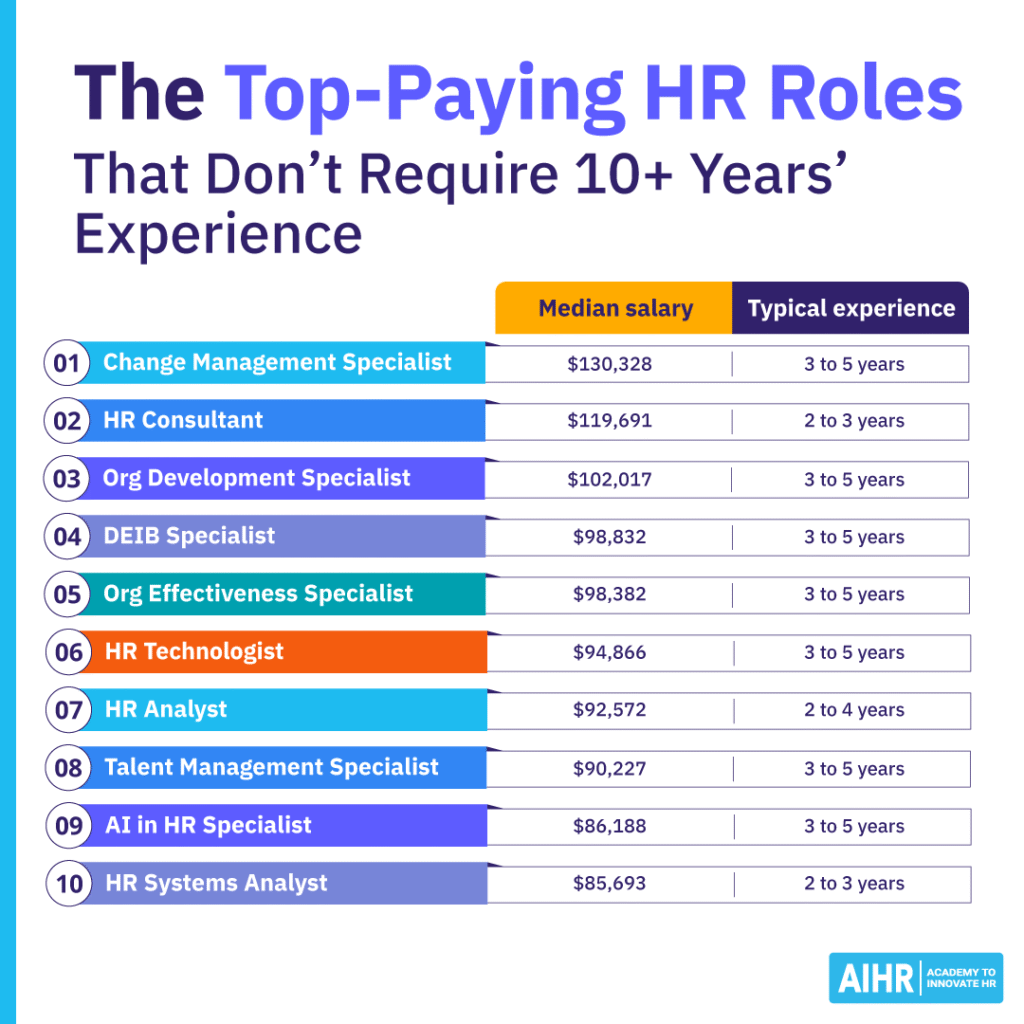
10 top-paying HR roles by median salary
1. Change Management Specialist
2. HR Consultant
3. Organizational Development Specialist
4. DEIB Specialist
5. Organizational Effectiveness Specialist
6. HR Technologist
7. HR Analyst
8. Talent Management Specialist
9. AI in HR Specialist
10. HR Systems Analyst
How to choose the best high-paying HR role for you
Key takeaways
- Change Management Specialist has the highest median salary on this list at $130,328.
- Digital HR, people analytics, and change roles show strong demand.
- Some roles pay well but have lower demand, so salary alone shouldn’t drive your choice.
- The best next move depends on your current skills, experience, and career goals.
10 top-paying HR roles by median salary
Rank | Role | Median salary | Typical experience | Demand level |
1 | Change Management Specialist | $130,328 | 3 to 5 years | Very high |
2 | HR Consultant | $119,691 | 2 to 3 years | Very high |
3 | Organizational Development Specialist | $102,017 | 3 to 5 years | High |
4 | DEIB Specialist | $98,832 | 3 to 5 years | Lower |
5 | Organizational Effectiveness Specialist | $98,382 | 3 to 5 years | Very high |
6 | HR Technologist | $94,866 | 3 to 5 years | Very high |
7 | HR Analyst | $92,572 | 2 to 4 years | Very high |
8 | Talent Management Specialist | $90,227 | 3 to 5 years | Lower |
9 | AI in HR Specialist | $86,188 | 3 to 5 years | Very high |
10 | HR Systems Analyst | $85,693 | 2 to 3 years | Very high |
1. Change Management Specialist
$130,328
3 to 5 years in HR or project management
Very high
Change Management Specialists help employees, managers, and leaders move through major business changes. This can include restructuring, mergers, new technology, culture shifts, or new ways of working.
The role pays well because change is hard to do well. Organizations need people who can manage communication, build trust, prepare teams, and help employees adopt new processes.
This is a strong path if you already support HR projects, transformation work, or business leaders during periods of change.
- Domain: Organizational development
- Seniority: Mid-career
- Salary range: $98,582 to $203,604
- Typical career path: HR or project management experience to Change Management Specialist to Organizational Effectiveness Specialist to Head of Organizational Development
Developing the right skills is often what separates HR professionals who spot career opportunities from those who are ready to pursue them. Focused learning can help you build expertise in the areas that align with your long-term career goals.
Explore AIHR’s Demo Portal and:
✅ Preview lessons from a wide range of HR Certificate Programs and discover different HR career paths
✅ Learn about in-demand skills across areas like People Analytics, HR Business Partnering, Talent Acquisition, Compensation & Benefits, and more
✅ Identify learning opportunities that can help you qualify for higher-impact and higher-paying HR roles
🎓 Explore the Demo Portal and start building the skills that support long-term career growth.
2. HR Consultant
$119,691
2 to 3 years as an HR Generalist or Specialist
Very high
HR Consultants advise teams and business units on HR challenges. They may work on employee relations, compliance, workforce planning, organizational change, or HR process improvement.
This role rewards people who can turn HR knowledge into practical advice. You need to understand the business problem, ask good questions, and recommend a clear next step.
It can be a good move if you enjoy variety and want to influence decisions without managing a large team.
- Domain: HR Business Partnering
- Seniority: Mid-career
- Upper salary benchmark: $152,809
- Typical career path: HR Generalist to HR Consultant to Director of Business Partnering
3. Organizational Development Specialist
$102,017
3 to 5 years in HR, organizational development, or business management
High
Organizational Development Specialists help companies improve how people, teams, and structures work. They often support change initiatives, team effectiveness, culture work, and organizational design.
Organizational development, or OD, focuses on improving how an organization performs through its people and systems.
This role is a natural fit if you like solving bigger people challenges. For example, you might help redesign a team structure, improve collaboration, or support a company-wide reskilling effort.
- Domain: Organizational development
- Seniority: Mid-career
- Upper salary benchmark: $179,292
- Typical career path: OD Coordinator to Organizational Development Specialist to Head of Organizational Development
Why OD and change management are gaining attention
Organizations are under pressure to adapt faster. They need to reskill employees, redesign roles, introduce new technology, and make change feel manageable.
That creates demand for HR professionals who can guide people through change, not just explain what is changing.
For your career, OD and change management can be smart paths if you already have experience in learning, business partnering, facilitation, project delivery, or transformation work
4. DEIB Specialist
$98,832
3 to 5 years in HR or DEIB-adjacent roles
Lower than other roles on this list
Diversity, Equity, Inclusion, and Belonging (DEIB) Specialists design and support programs that help build fairer workplaces.
This can include inclusive hiring, employee resource groups, pay equity support, manager education, and belonging initiatives.
The salary potential is strong, but demand is more limited than in several other roles on this list. That means you should look closely at your local market before committing to this path.
- Domain: Employee Experience and DEIB
- Seniority: Mid-career
- Upper salary benchmark: $180,972
- Typical career path: HR Coordinator to DEIB Specialist to Head of DEIB
5. Organizational Effectiveness Specialist
$98,382
3 to 5 years in OD or a related HR field
Very high
Organizational Effectiveness Specialists help companies improve how work gets done. They may focus on team structures, leadership capability, operating models, decision-making, or performance.
The role sits close to business priorities. You’re not just improving HR processes. You’re helping the organization work better.
This path can suit HR professionals who enjoy diagnosing problems, working with leaders, and designing practical solutions.
- Domain: Organizational development
- Seniority: Mid-career
- Upper salary benchmark: $120,542
- Typical career path: OD Coordinator to Organizational Effectiveness Specialist to Head of Organizational Development
6. HR Technologist
$94,866
3 to 5 years in HRIS or HR systems
Very high
HR Technologists manage HR platforms and help organizations use HR technology well. They may lead system implementations, improve workflows, support automation, and connect HR needs with IT and vendors.
A Human Resources Information System (HRIS) stores and manages employee data, payroll, time off, and other HR records.
This is one of the clearest paths into top-paying digital HR work. It’s a good fit if you like systems, problem-solving, and making HR processes easier for employees and managers.
- Domain: Digital HR
- Seniority: Mid-career
- Upper salary benchmark: $115,571
- Typical career path: HR Systems Analyst to HR Technologist to Head of Digital HR
AI is changing which HR skills employers value
AI isn’t replacing every HR role. The bigger shift is happening at the task level.
Repeatable process work is easier to automate. Work that requires judgment, data interpretation, system design, and change adoption is becoming more valuable.
That makes digital HR, people analytics, and HR systems experience useful career investments. These skills help you stay close to the work organizations are prioritizing.
7. HR Analyst
$92,572
2 to 4 years with strong analytical skills
Very high
HR Analysts turn workforce data into useful insights. They may analyze headcount, turnover, engagement, performance, DEIB, and other people metrics.
This role is a strong option if you enjoy working with data and explaining what it means. The best HR Analysts don’t just build dashboards. They help HR and business leaders make better decisions.
For example, you might identify which roles have the highest turnover risk and help HR plan targeted retention actions.
- Domain: People Analytics
- Seniority: Mid-career
- Upper salary benchmark: $124,098
- Typical career path:
8. Talent Management Specialist
$90,227
3 to 5 years in HR generalist or specialist roles
Lower than other roles on this list
Talent Management Specialists help organizations develop and retain employees. Their work often covers performance management, succession planning, internal mobility, and employee development.
This role can be rewarding if you enjoy helping people grow and connecting talent decisions to business needs.
The main watchout is demand. It pays well, but the market may be more competitive than digital HR, analytics, or change roles.
- Domain: Talent Management
- Seniority: Mid-career
- Upper salary benchmark: $127,439
- Typical career path: HR Generalist to Talent Management Specialist to Head of Talent Management
9. AI in HR Specialist
$86,188
3 to 5 years in HR, technology, or analytics
Very high
AI in HR Specialists help organizations identify and implement AI use cases across HR. This can include recruitment, learning, workforce planning, employee listening, or HR service delivery.
Because this role is still emerging, career paths are less fixed. That can be an advantage if you already have a mix of HR knowledge, technology curiosity, and data awareness.
To move into this area, build proof. Join an AI pilot, help assess vendors, document use cases, or support responsible AI guidelines for HR.
- Domain: Digital HR
- Seniority: Mid-career
- Upper salary benchmark: $108,053
- Typical career path: AI in HR Specialist to HR Technologist to Head of Digital HR
10. HR Systems Analyst
$85,693
2 to 3 years from an HR administrative or analyst background
Very high
HR Systems Analysts support HR system configuration, reporting, troubleshooting, and implementation.
This role often sits between HR, IT, vendors, and employees. You need to understand HR processes and explain system issues in a clear way.
It’s a strong entry point into Digital HR because it gives you hands-on systems experience. From there, you can move toward HR Technologist or broader HR transformation roles.
- Domain: Digital HR
- Seniority: Mid-career
- Upper salary benchmark: $111,571
- Typical career path: HR Administrator to HR Systems Analyst to HR Technologist
How to choose the best high-paying HR role for you
A higher salary is useful, but it shouldn’t be the only factor. A role also needs to fit your skills, interests, and local job market.
Start with your current experience. If you work in HR operations or administration, an HR Systems Analyst may be a realistic next step. If you already work with reports and dashboards, an HR Analyst may be a better fit.
If you support leaders during change, consider roles such as Change Management Specialist, HR Consultant, or Organizational Effectiveness Specialist. If you enjoy learning, culture, or employee development, OD and talent management may be a better fit.
Ask yourself three questions:
- Which skills do I already use often? Look for patterns in your current work, such as data, systems, stakeholder management, facilitation, or project delivery.
- Which skill gap is holding me back? Common gaps include analytics, HRIS knowledge, consulting skills, change management, and OD methods.
- What proof can I build in my current role? Put your hand up for projects that create evidence, such as dashboards, system rollouts, change communications, or process redesign.
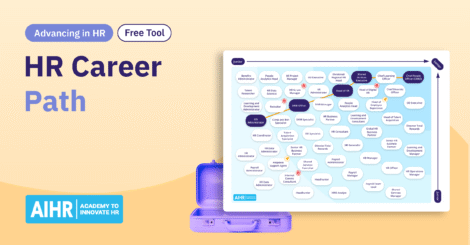
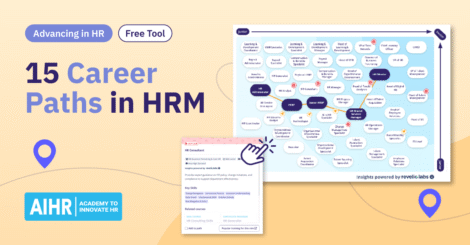
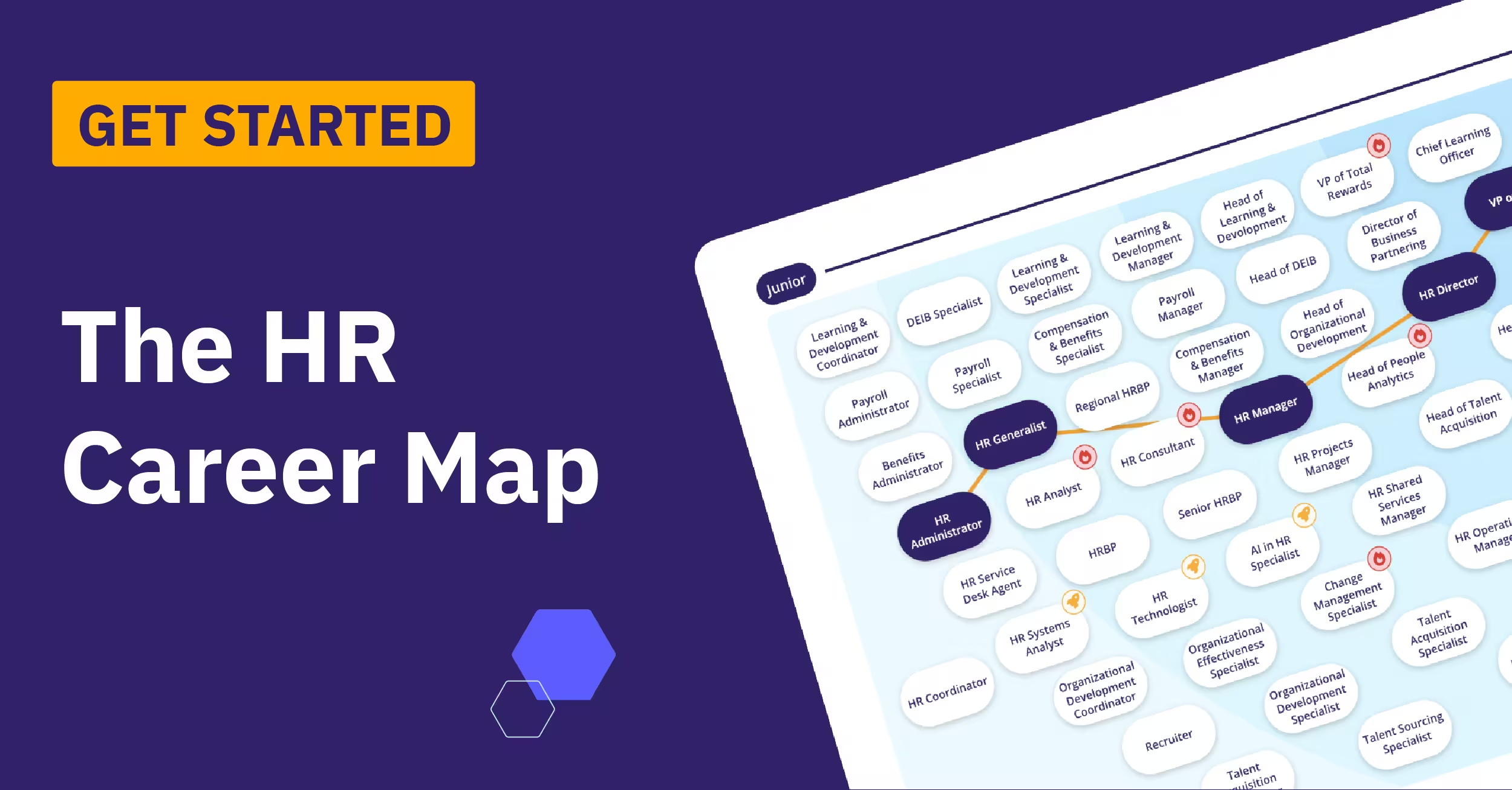
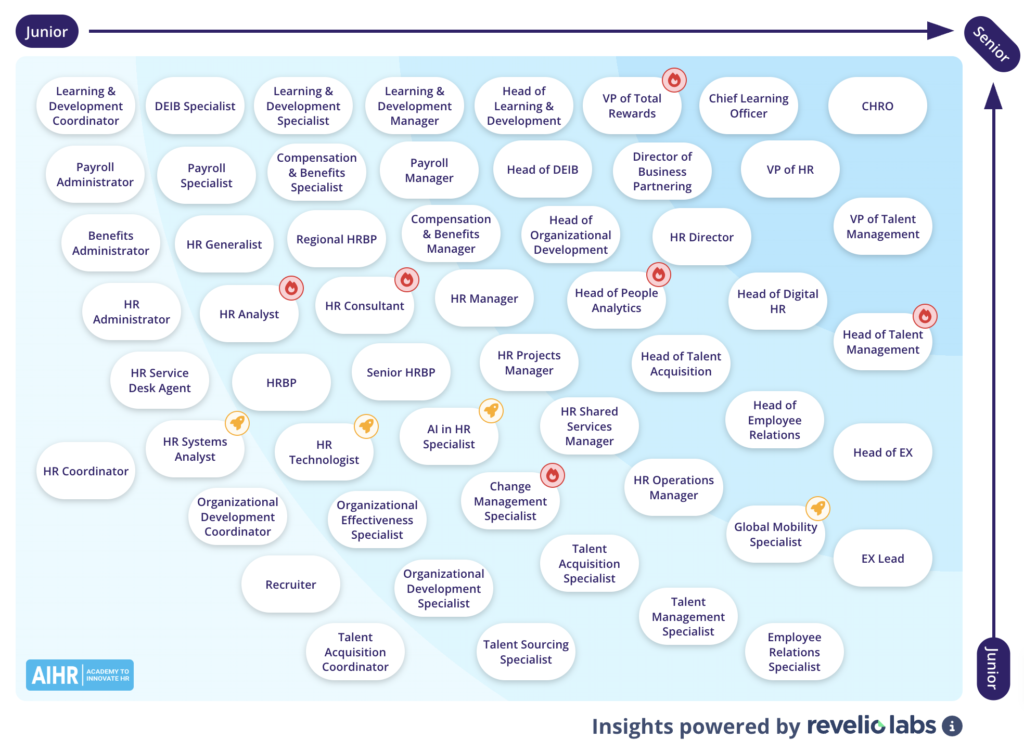
Use AIHR’s free HR Career Map to compare HR roles by salary, skills, demand signals, and career paths.

To sum up
You don’t need to wait 10 years to increase your earning potential in HR. You need a clear skill path.
The strongest opportunities sit where salary, demand, and skill scarcity overlap. Right now, that points to change management, consulting, people analytics, HR systems, and digital HR.
Choose one direction and start building proof. Take on a project. Learn the tools. Ask to support a system rollout, change plan, or dashboard. The sooner you can show evidence of specialist skills, the stronger your next career move becomes.
FAQ
Change Management Specialist pays the most on this list, with a median salary of $130,328. It typically requires three to five years of relevant HR, project management, or transformation experience.
Yes. Roles in change management, HR consulting, organizational development, and digital HR can reach six figures before senior leadership. The key is building skills employers need and can clearly measure.
Useful skills include data analysis, HR systems knowledge, stakeholder management, consulting, change management, process design, AI literacy, and organizational development.
It depends on your starting point. HR operations experience can lead to an HR Systems Analyst. Reporting experience can lead to HR Analyst. Business-facing HR experience can lead to an HR Consultant or Change Management Specialist.