
Your salary in HR has less to do with years of experience than you might think. What matters more is what you can do and how rare that skill set is.
Academy to Innovate HR (AIHR) analyzed data from 334 HR teams on AI readiness, 961 HR teams and 13,665 HR professionals on capability gaps, and a labor market study conducted with Revelio Labs. That study covered 3.88 million HR professionals and 162,000 active job postings.
The pattern we see emerging across all four data sets is surprising. The HR skills driving the largest salary premiums in 2026 are the ones most HR professionals haven’t yet built.
This article dives into the data and unpacks which HR skills pay the most, why some capabilities stay underdeveloped, and how AI is widening the gap.
Contents
Why skill, not seniority, drives your salary
The HR skills that pay the most
How AI is shifting which skills get rewarded
Where to find the biggest salary uplifts
The skills gap that’s keeping your salary flat
How to turn skills into salary growth
Key takeaways
- HR salary growth depends more on scarce skills than tenure alone.
- Data literacy, digital HR, AI fluency, organizational development, instructional design, and Total Rewards expertise carry strong salary potential.
- AI is reducing demand for routine, process-heavy HR work and increasing demand for analytical and systems-focused skills.
- The biggest salary jumps come from moving into tighter labor markets with fewer qualified candidates.
Why skill, not seniority, drives your salary
Our research found that some of the highest-paid HR roles are in the most competitive markets. For example, the VP of HR pays well, but it also draws 757 candidates per vacancy. While a senior HRBP role has 650 candidates per opening. When that many people are chasing the same roles, you don’t have much negotiating power, no matter what the salary range says.
At the other end of the spectrum, HR Technologist roles attract just 5 candidates per vacancy. Head of People Analytics draws 28. Change Management Specialist sits at 35. These professionals aren’t always the most senior in the room, but they’re scarce.
When a role requires a narrow, technical, or analytically demanding skill set, fewer people can fill it. Employers compete for those candidates, which then shows up in compensation. This means that two HR professionals at the same level, with similar years of experience, can face very different markets (and earn very different salaries) based on which specific skills they’ve built.
The HR skills that pay the most
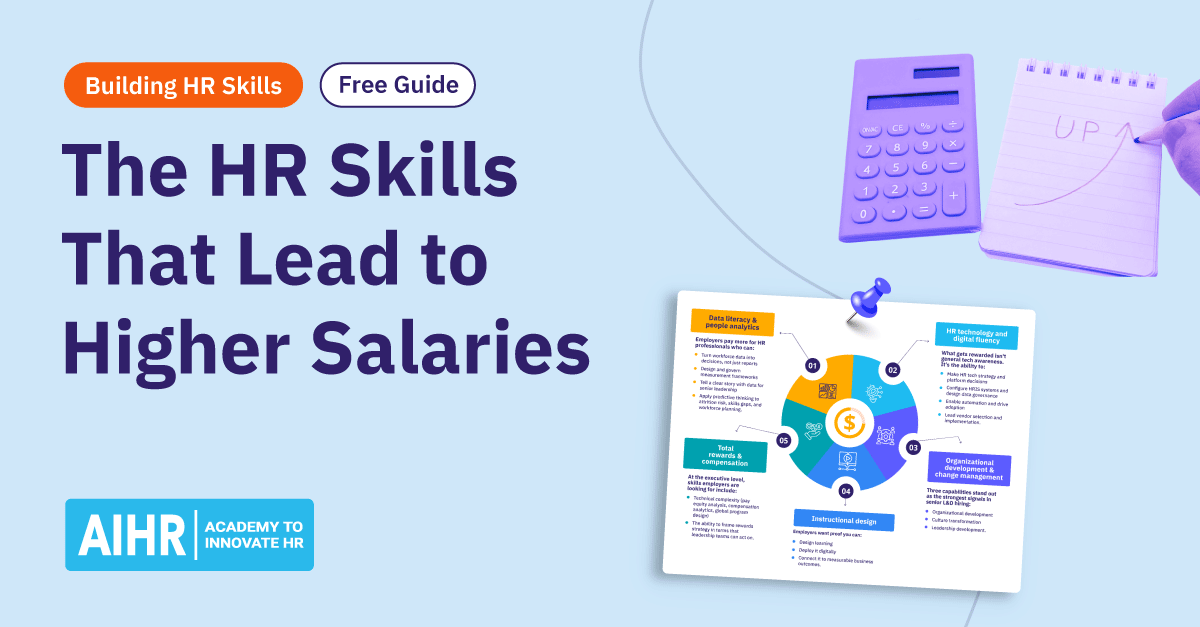
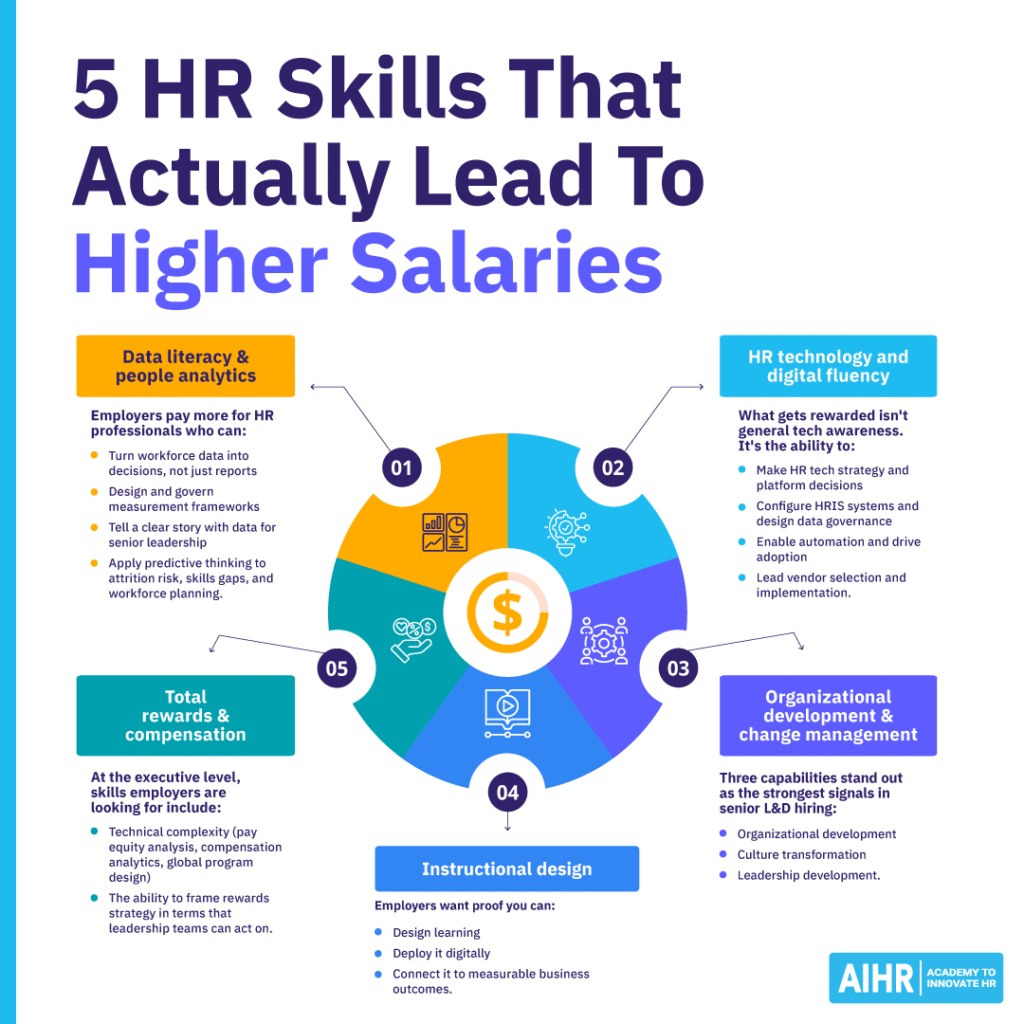
Data literacy and people analytics
AIHR’s Future-Ready HR Skills Report, based on research with 961 HR teams and 13,665 HR professionals, ranks data literacy as the second-lowest skill across the entire HR function. Yet it’s one of the capabilities most closely tied to higher pay.
Only 60% of HR professionals feel confident working with data. And most of those who do still can’t translate insights into real business decisions. The gap between confidence and actual capability is where the salary opportunity lies.
Employers pay more for HR professionals who can:
- Turn workforce data into decisions, not just reports
- Design and govern measurement frameworks
- Tell a clear story with data for senior leadership
- Apply predictive thinking to attrition risk, skills gaps, and workforce planning.
The Head of People Analytics role has 28 candidates per vacancy. HR Analyst roles are also growing fast because organizations want evidence-based workforce decisions. Too few HR professionals can deliver them.
HR technology and digital fluency
Digital agility is the lowest-rated skill across the HR profession in AIHR’s research. It’s also one of the highest-paid areas in the labor market.
The Head of Digital HR role has 25 candidates per vacancy. The HR Technologist role has just five. Salaries in this cluster range from $86,000 to $130,000, putting it at the upper end of HR compensation overall.
What gets rewarded isn’t general tech awareness. Employers pay for HR professionals who can:
- Make HR tech strategy and platform decisions
- Configure Human Resource Information Systems (HRIS)
- Design data governance processes
- Enable automation and improve adoption
- Lead vendor selection and implementation
Our research also found that digital skills don’t develop passively. Even with 15+ years of HR experience, digital fluency improves only with deliberate effort.
Organizational development and change management
Change Management Specialist roles have just 35 candidates per vacancy, while demand for Organizational Effectiveness Specialists grew 65.4% in six months. This shows that employers increasingly see organizational development (OD) and change management as distinct disciplines.
OD is the structured practice of improving organizational effectiveness, adaptability, and health. Change management focuses on helping people and teams adopt new ways of working. Both skills are increasingly important as organizations redesign work, adopt AI, and shift operating models.
At the senior level of the Learning and Development (L&D) career track, AIHR’s job posting analysis shows what separates an L&D Specialist earning $76,000 from a Head of L&D earning $114,000.
Three capabilities stand out:
- Organizational development
- Culture transformation
- Leadership development
The research measures this with a relevance score, which shows how consistently a skill appears and matters across job postings in a role family. All three skills score above 0.80 out of 1.0. That makes them among the most in-demand skills in senior L&D roles. However, traditional L&D career paths don’t always build these skills. That’s why the market rewards them when candidates have them.
Instructional design
Within L&D, instructional design is the highest-scoring specialist skill in the job posting analysis. It appears more consistently and carries more weight in L&D hiring than any other specialist capability.
Instructional design is the practice of designing learning experiences that help people build specific skills or behaviors. It links learning goals, content, practice, feedback, and assessment.
Technology fluency in L&D, such as learning management system (LMS) proficiency and digital delivery, is no longer a major differentiator. Employers increasingly treat it as a baseline requirement.
Facilitation experience alone won’t get you a salary premium anymore. Employers want proof that you can design learning, deliver it digitally, and connect it to measurable business outcomes.
Total Rewards and compensation expertise
Our labor market research shows that the Total Rewards role family saw a 25.2% increase in demand over six months. That was the fastest growth of any HR role family in the data set.
Payroll Administrator demand grew 137.6%, likely driven by rising compliance requirements and pay transparency legislation across markets.
At the executive level, the VP of Total Rewards role commands a premium. This reflects both technical complexity and strategic influence.
The highest-value skills in this area include:
- Pay equity analysis
- Compensation analytics
- Global program design
- Executive rewards strategy
- Translating rewards data into leadership decisions.
Total Rewards expertise pays because it combines technical accuracy, legal risk awareness, and business judgment.
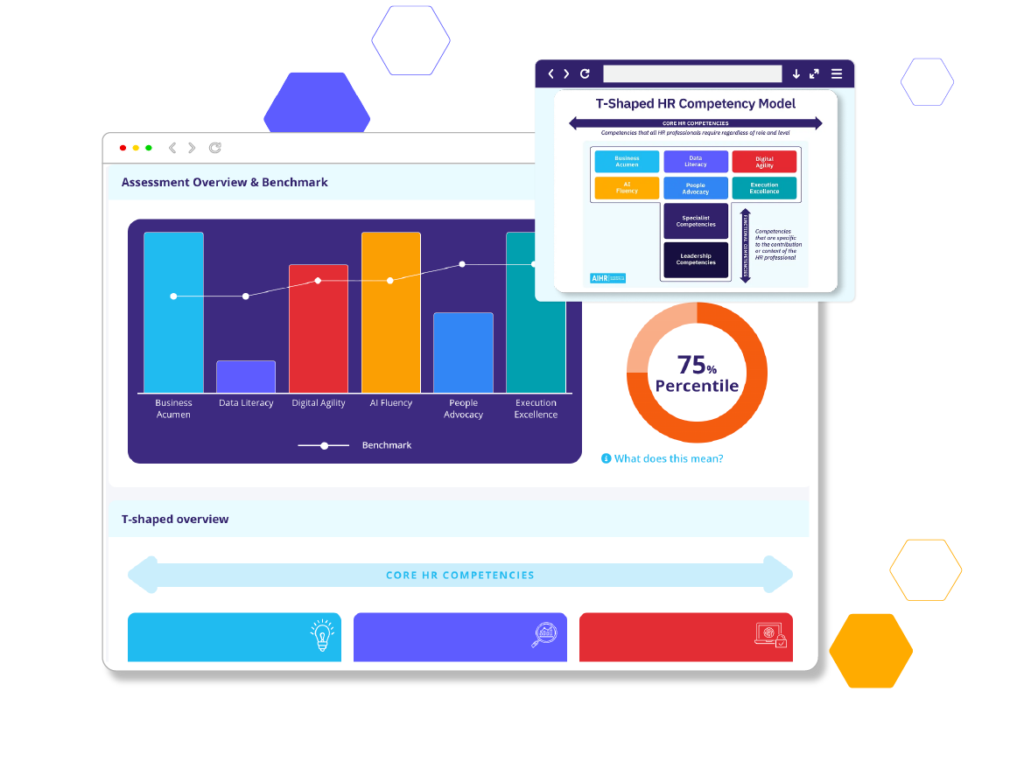
Take AIHR’s T-shaped assessment to assess yourself across six core HR competencies.
The assessment also shows how you compare with HR professionals globally, and pinpoints the areas where you can deepen your expertise.
How AI is shifting which skills get rewarded
The labor market data confirms that AI skill requirements appear in fewer than 1% of HR job posting entries across role families. But don’t mistake low visibility for low impact. AI is already reshaping which HR skills carry value. It’s doing it through task redesign, not through explicit hiring criteria.
AIHR’s AI readiness research, conducted across 334 HR teams, found that:
- 65% of HR teams demonstrate strong buy-in and advocacy for AI
- But only 35% are confident they have the skills and development opportunities to use it effectively in daily work
- Only 30% have a clear strategic purpose for where AI creates value in HR
- Only 29% have the data, tools, and infrastructure to support AI at scale.
Enthusiasm is high, but readiness isn’t, creating an opportunity for HR professionals to differentiate themselves.
AI is automating the work that many HR generalists do most
Scheduling, screening, document handling, and routine reporting are increasingly supported by AI tools. Roles built mainly around repeatable, process-driven work are showing weaker demand. AIHR’s analysis found that demand for HR Service Desk Agents fell 38.3%.
If most of your value comes from moving information through a process, your salary leverage may weaken.
AI creates demand for professionals who can build and govern HR systems
Every AI implementation needs robust systems to support it. That includes HRIS setup, workflow architecture, data governance, integration design, and clear ownership of data quality.
AIHR’s AI readiness research identifies this as one of HR’s biggest capability gaps. Only 29% of teams have the infrastructure readiness to support AI at scale.
As AI becomes more embedded in HR operations, demand will rise for professionals who can build, manage, and govern HR systems. The salary premiums already visible in digital HR and HR technology are likely to keep growing.
AI fluency is becoming a premium skill
Most HR teams are experimenting with AI, including drafting job descriptions, creating L&D content, and automating administrative tasks. But without structured skill development and clear learning pathways, that experimentation stays scattered.
Our research findings illustrate that scattered AI use doesn’t build into a career-level capability that commands a salary premium. What the market will reward isn’t AI awareness. It’s AI fluency: using tools responsibly, interpreting AI outputs critically, assessing data quality, and navigating the ethical implications of AI in workforce decisions.
That skill set is rare now. And based on our research, it won’t develop through casual tool use alone. HR professionals who build genuine AI fluency early, through deliberate practice, are getting ahead of a divide that’s already opening.
Where to find the biggest salary uplifts
The research indicates specific career transitions where building the right skills delivers a clear salary jump and a much stronger market position.
HR Generalist to HR Systems Analyst
Salary uplift: +44% | From $59,000 to $86,000
The supply-demand ratio drops from 117 candidates per vacancy to 39. You move from an oversupplied market to a considerably tighter one. The skills you need (HRIS configuration, data analysis, process mapping) aren’t built solely through generalist experience. But if you already understand the workflows these systems support, you have a useful starting point.
HR Generalist to L&D Specialist
Salary uplift: +27% | From $59,000 to $76,000
L&D Specialist demand grew by 42.7% over six months, and the market shifted from high competition to medium. Employers are looking for instructional design capability, not facilitation or content-delivery skills. If you already understand employee needs and capability gaps (and generalists usually do), adding systematic learning design makes you a strong candidate for this move.
L&D Specialist to Head of L&D
Salary uplift: ~50% | From $76,000 to $114,000
This is where OD and transformation skills pay off most clearly. The jump from specialist to senior leader in L&D depends less on deeper training design and more on demonstrating organizational development capability, culture change experience, and leadership development fluency, the three highest-scoring skills in senior L&D job postings.
The pattern we see across all three
In each transition, the salary uplift comes from moving into a market with fewer candidates and more specific skill requirements. The more targeted your skill set, the less competition you face and the stronger your negotiating position becomes.
The skills gap that’s keeping your salary flat
Our research tells a consistent story. Salary growth often stalls because the skills most HR professionals develop are not always the skills the market rewards.
AIHR’s Future-Ready HR Skills Report found that only 50% of HR teams believe they have the right skills to deliver impact.
The three capabilities that fall short are also closely linked to higher-paying roles:
- Digital agility
- Data literacy
- Business acumen.
Business acumen means understanding how your organization makes money, manages cost, serves customers, and creates value.
The gap is especially clear here. AIHR found that 73% of HR professionals rate their own business acumen highly, while measured commercial fluency remains consistently low.
AIHR’s AI readiness research shows a similar issue. Although enthusiasm for AI is strong, only 35% of HR teams have the skills and development opportunities to use it in daily work. Just 29% have the infrastructure to support AI at scale.
Our analysis of Revelio Labs labor market data shows declining demand for coordination-heavy and generalist roles. It also indicates rising demand for specialist, analytical, and systems-focused roles.
The roles with the strongest momentum include:
- Director of Business Partnering
- Head of Digital HR
- Head of People Analytics
- Organizational Effectiveness Specialist
- HR Analyst.
They all share the same profile: they require specific capabilities that most HR professionals haven’t developed deeply enough.
The key takeaway: The HR skills with the highest market value require structured development. They don’t come from time in the job alone.
How to turn skills into salary growth
The research consistently points to three things you can do right now to improve your market position.
1. Focus on skill specificity, not your next title
The most common career-planning mistake in HR is treating the next promotion as your primary route to a salary increase. But the numbers clearly show that titles in oversupplied markets don’t give you leverage.
Ask yourself honestly: how many HR professionals with your specific skill combination are competing for roles like yours? If the answer is “hundreds,” building a specialist capability in analytics, digital HR, AI fluency, or OD will likely do more for your earnings than chasing the next title.
2. Build the skills that don’t develop on their own and start now
AIHR’s research consistently shows that digital agility, data literacy, business acumen, and AI fluency don’t build naturally through standard HR work. They also don’t accumulate passively with experience. In fact, digital and data skills show minimal growth, even among HR professionals with 15+ years of experience.
Only 8% of HR professionals start their careers in HR, which means most enter the profession without exposure to these foundational capabilities. The professionals who build them early and intentionally access higher-value labor markets. Those who wait (assuming experience will eventually close the gap) tend to keep competing in increasingly crowded fields.
3. Develop T-shaped HR capability, not just depth in one area
Deep expertise in a single HR domain isn’t enough on its own. What the market rewards is your ability to connect that expertise to business outcomes, using data confidently, navigating HR technology, thinking commercially, and influencing at a strategic level.
AIHR’s T-Shaped HR Competency Model illustrates how you can develop these. The vertical bar is your deep domain expertise. The horizontal bar is breadth across data literacy, digital fluency, business acumen, and cross-functional influence.
HR professionals who combine both consistently out-earn those with depth alone. The reason is straightforward: depth without breadth limits your ability to show results that business leaders can see and act on. And that visibility is what gets rewarded.
To sum up
AIHR’s research points to one clear conclusion: your salary grows when your skill set is specific, in demand, and hard to find, not simply when you accumulate years in the profession.
Across four research programs, the same skills keep coming out on top: people analytics, HR technology, organizational development, AI fluency, instructional design, and Total Rewards expertise. They’re all in short supply across the HR profession. And they all require deliberate effort to build.
AI is accelerating the divide. HR teams have the enthusiasm and leadership support to adopt it. But only a third have the skills to use it responsibly and effectively. As AI takes over more transactional HR work, that fluency gap will compound into a salary gap, and it’s already starting to.
So instead of asking “how do I reach the next level?”, ask: “which skills would move me into a tighter market, with less competition and stronger negotiating power?”
AIHR HR Career Outlook 2026 (in collaboration with Revelio Labs; 54 HR roles, 162,000+ active job postings, 3.88 million HR professionals); AIHR Future-Ready HR Skills Report (961 HR teams, 13,665 HR professionals); AIHR HR AI Readiness Research (334 HR teams); AIHR In-Demand Careers in Human Resources (Revelio Labs opportunity signals via AIHR HR Career Map).