

The right career guidance and coaching are essential for success at all career stages and can help reduce career burnout, boost satisfaction, and support people in transitioning to leadership roles. With the help of the right career coach, you can develop new skills, move through a stagnant patch, prepare for a future opportunity, and build a meaningful career.
Career coaching can also help you become more confident and gain clarity on the specific HR direction you want to take. In this article, we’ll explore what career coaching is, what a career coach does, the benefits of career coaching for HR professionals, and how to find the right one to help you advance in your HR career.
Contents
What is career coaching?
9 benefits of career coaching for HR professionals
How career change coaching supports HR professionals
How much does a career coach cost?
How to find a career coach
How to choose the right career coach
Key takeaways
- Career coaching can help HR professionals clarify goals, understand strengths and gaps, and create structured plans for progression or career change.
- A career coach is especially useful for HR professionals feeling stuck, changing specializations, moving into leadership, returning from breaks, or navigating challenges like layoffs or burnout.
- In some cases, an HR-specific platform is more beneficial than coaching and can help you gain clarity and receive guided support on your career path.
What is career coaching?
In an HR context, career coaching is a structured process that a professional career coach uses to help HR professionals understand their strengths and areas for improvement, clarify their career goals, and develop a plan for career progression.
It can be particularly helpful for HR professionals considering role progression, the sector they want to specialize in, business impact, and market demand. For example, HR career coaching services can support decisions like staying in a core HR function and moving up, shifting into a specialty, progressing to leadership, or even entering a new area, such as AI in HR.
It’s important to note that career support like this doesn’t always have to be delivered through a career coach, and can come from structured learning and on-the-job career guidance.

What does a career coach do?
When it comes to HR, a career coach can help you:
- Clarify your career direction: Define what you want from your HR career and identify the path that best matches your interests, strengths, and long-term goals.
- Assess your strengths and skill gaps: Understand where you already add value and what capabilities you need to build to move into your next role.
- Navigate a career move within HR: Get support when shifting into a new HR specialty, such as moving from HR administration into talent acquisition, payroll, L&D, or HR business partnering.
- Build a clear development plan: Turn career goals into a realistic action plan with concrete next steps, learning priorities, and milestones.
- Stay accountable and build confidence: Keep momentum as you work toward your goals, with guidance, feedback, and encouragement along the way.
- Prepare for your next opportunity: Strengthen your position for a promotion, internal move, or new role by improving how you present your experience, skills, and potential.
Career coach vs. mentor vs manager
The roles of a career coach, mentor, and manager can support your career growth in different ways. Here are the main differences among them in this context:
Primary role
Guides reflection and action
Shares experience and advice
Focuses on current role performance
Main focus
Helps you think clearly about where you are, where you want to go, and what steps to take next
Draws on their own career path to help you learn, avoid mistakes, and see the bigger picture
Helps you succeed in your current position and deliver against team or business goals
How they support you
Asks questions, challenges assumptions, and helps turn ideas into a practical plan
Offers insight based on what they’ve learned, often in leadership, stakeholder management (or a specialist area)
Gives feedback, sets expectations, and may support development through stretch assignments or promotion discussions
Career lens
Your long-term direction, decision-making, and accountability
Perspective, informal guidance, and shared lessons
Your day-to-day contribution and growth within the business
Best for
Working out what to do next in your career and how to move forward with confidence
Learning from someone who has already taken a similar path
Improving in your current role and understanding internal growth opportunities
Typical approach
Helps you answer the question: “What should I do next?”
Often says: “Here’s what I’ve learned.”
Helps you meet expectations and grow in the context of business needs
Who should consider career coaching?
Should you consider HR career coaching? Here are some examples of HR professionals who could benefit:
HR professionals who feel stuck
A career coach can offer a fresh perspective on your HR career and help you take the next step in line with your goals and aspirations. They can also help you identify whether you need a role change, a new challenge, or a clearer development plan on your current path. Additionally, they can provide guidance on whether or not you should switch career paths entirely.
HR practitioners considering specializations
Career change coaching can help you understand the skills, knowledge, and experience you need to move into a specialist Human Resources area, and what that path might look like. This can be especially useful if you’re exploring areas such as talent acquisition, learning and development (L&D), compensation and benefits (C&B), people analytics, or employee relations.
HRBPs moving toward leadership
Many senior HR professionals use career coaching to build the leadership skills and strategic mindset they need to transition into leadership team roles. If you’ve decided to move from administration to strategy, a career coach can also help you prepare for the shift from operational delivery in HR to roles that involve broader business influence and decision-making.
HR professionals returning after a career break
Taking time out from full-time work can leave you unsure about your next career move, or make you want to head in a different direction. In either case, a career coach can help you assess your available options. They can also help you rebuild confidence, position your professional experience effectively, and identify job opportunities you may not have considered before.
HR professionals facing layoffs, burnout, or restructuring
A Human Resources career coach can provide necessary guidance and support during a difficult period, and help you explore similar HR roles in another organization or industry. They can also identify transferable skills for a different HR career path, or help you make more confident decisions when a career change may feel urgent, uncertain, or overwhelming.
Anyone considering digital HR, HR analytics, HR tech, or AI in HR
HR career coaching can help you understand which skills and areas of knowledge you need to move into an emerging field, and how to build credibility in these fields (even if your background is in a more traditional HR role). It can also help you separate short-term trends from long-term career opportunities, so you can make more informed career decisions.
9 benefits of career coaching for HR professionals
Career coaching can offer real value to HR professionals at different stages of their careers. Whether you are exploring your next move, aiming for leadership, or considering a specialist path, a career coach can help you make clearer decisions and take more focused action.
- Career clarity: A career coach can help define what you want from your career, identify the paths that best fit your strengths and interests, and focus on the next step you should take, rather than the one that’s simply available.
- Self-awareness: Career coaching can help you better understand your strengths, weaknesses, motivators, and working style. It’s then easier to choose suitable roles and build a career path aligned with your capabilities and long-term goals.
- Better decision-making: When weighing different HR career options, a career coach can help you assess your choices more objectively, challenge assumptions, and make decisions more quickly and confidently.
- Targeted skill development: Career coaching can help you focus on the most crucial skills for your next role, enabling you to identify the knowledge, capabilities, and experience that will have the biggest impact on your progression.
- Stronger positioning: A career coach can help you position your experience more effectively by showing how your day-to-day work supports business goals. This can strengthen your case for a promotion, pay raise, or new role.
- Structure and accountability: A career coach can help you set realistic goals, break them into milestones, and stay accountable. This makes it easier to keep moving forward, even when day-to-day work gets busy.
- Support through change: Career coaching can be useful in periods of uncertainty (e.g., layoffs, burnout, restructuring). It can help you assess your options, identify transferable skills, and make more confident decisions.
- Greater confidence: Career development coaching can help you build confidence to support you in preparing for a promotion, negotiating a salary, moving into a new sector, or stepping into a more strategic role.
- More intentional career growth: Career coaching gives you the clarity, structure, and support you’d need to make better-informed decisions and move forward with greater purpose and confidence in your career.
Invest in continuous learning to help reinforce your Human Resources knowledge, develop new skills in specific HR domains, and drive your career progression
AIHR’s Demo Portal allows you to:
✅ Preview HR certificate programs, courses, and lessons in different specialty areas
✅ Explore practical guides, templates, playbooks, and resources you can use in your role
✅ Access the AIHR HR Career Map to help you plan a detailed career path in HR
✅ Identify skills gaps, learn to fill them, and discover learning paths aligned with your goals
How career change coaching supports HR professionals
Career change coaching can support you as an HR professional when navigating common HR moves. An example would be moving from an HR Coordinator role to an HR Generalist role, then to an HRBP role, and finally to an HR Manager or HR Director role.
It’s also common to engage a career coach when moving from an HR Generalist role to a specialist HR role. This could be a move to a role within People Analytics, L&D, Talent Acquisition, or C&B, or from traditional HR into digital HR or AI in HR.
Career development coaching supports career change by helping HR professionals assess the transferability of their current skills and experience, identify missing skills, build a learning plan, update personal brand and job materials, and set realistic timelines.
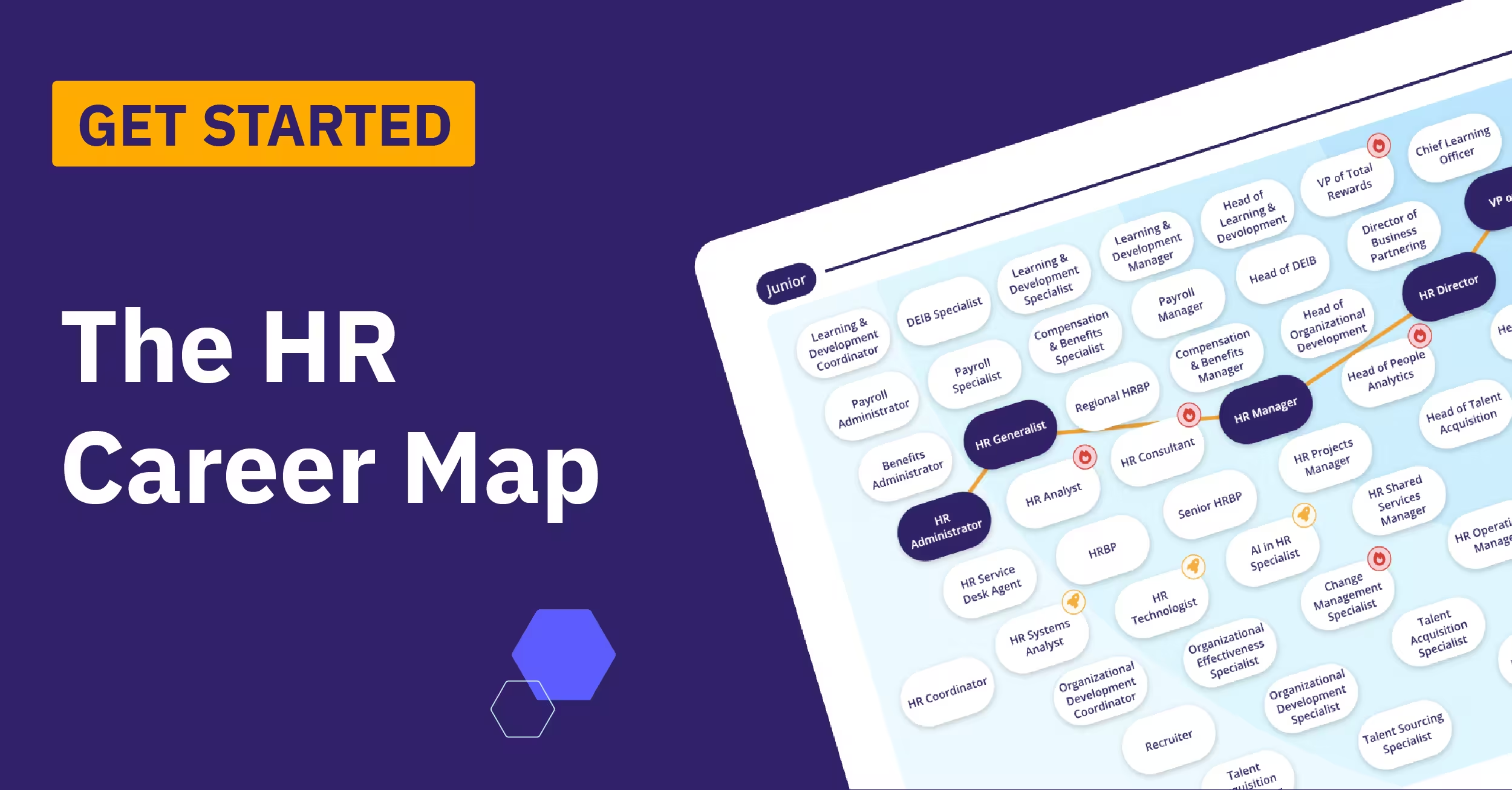
AIHR’s HR Career Map can help you explore different HR career paths and gain insights into salary expectations, role demands, and emerging skills in the future. It’s particularly useful if you’re interested in different areas or roles, or are unsure where your current role can take you.
How much does a career coach cost?
The cost of a career coach depends on many factors, including the coach’s specialization and level of seniority, the format of the coaching (in person or online), and the length of each session. Pricing is typically calculated per session, per package (e.g., a block of 10 sessions or a three-month package), as part of a subscription, or per person or group.
Aside from the cost, consider your needs before investing in a coach. Ask yourself the following questions:
- Do I need strategy, accountability, or skill-building?
- Am I seeking a coach who helps me with decision-making, motivation, or accountability?
- Would a structured HR learning platform be more useful and practical right now?
AIHR currently offers career coaching as part of its Full Academy Access. In addition to career guidance, it also grants you access to 16 certificate programs, practical resources and templates, and key industry insights.
How to find a career coach
Before paying for career coaching services, research alternatives to one-on-one career coaching for HR professionals. These include finding a mentor at work, getting support from your current manager, or joining a peer community or an HR-specific learning platform. The latter, for instance, can help you gain clarity on the direction of your career, identify skills gaps, and get guided support.
Check out AIHR’s HR Career Map to explore the possible HR career paths available to you, compare roles, and determine the skills needed for your next move. This is a great place to start, especially if you’re wondering which HR path suits you best, which skills you should develop, and the career path with the strongest long-term potential for your professional goals.
AIHR’s Full Academy Access membership can then provide career guidance, help future-proof your skills, and offer access to learning coaching and a range of relevant courses, templates, and assessments. A standalone career coach may not combine career clarity, HR-specific career direction, and structured skills development and progression, but the AIHR Academy does.
Once you’ve explored all the resources available above, you can then assess whether you may still benefit from career development coaching and take the steps to hire a career coach if you need one.
How to choose the right career coach
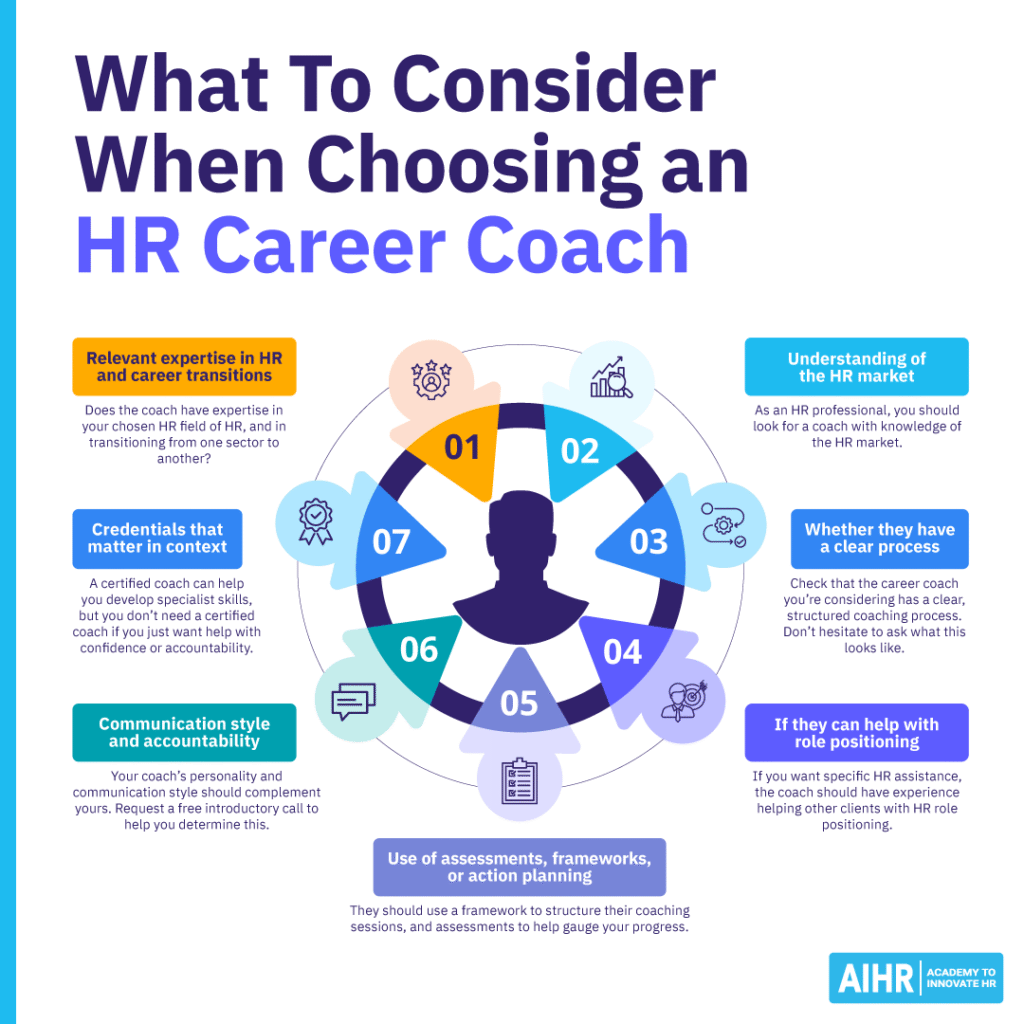
So, you know you want to hire a career coach, but what do you need to consider so that you make the right choice?
- Relevant expertise in HR and career transitions: Does the coach have expertise in your chosen HR field of HR, and in transitioning from one sector to another?
- Understanding of the HR market: Some career coaches offer general career advice, but as an HR professional, you should look for one with knowledge of the HR market.
- Whether they have a clear process: Check that the career coach you’re considering has a clear, structured coaching process. Don’t hesitate to ask what this looks like in detail.
- If they can help with role positioning, not just motivation: Some coaches focus on building confidence and motivation. If you want specific HR assistance, confirm that they have experience helping other clients with HR role positioning.
- Use of assessments, frameworks, or action planning: An effective career coach should use a framework to structure their coaching sessions, assessments to help gauge your progress, and a clear action plan that they co-create with you.
- Communication style and accountability: Qualifications and experience aside, your career coach’s personality and communication style should complement yours. Most coaches offer free introductory calls so potential clients can get to know them better before deciding whether to invest in their services.
- Credentials that matter in context: If you want a coach to help you develop specialist skills, certification is important. However, if you want one to help you primarily with confidence, accountability, and goal setting, certification may not be essential.
Next steps
Career coaching is most beneficial when you need direction, structure, and accountability, as well as clarity on the next role you want to progress into. It can also help you understand the skills and experience you need to get there. From here, you can consider the best approach to develop these credentials.
If you’re looking for HR-specific direction and development, AIHR’s HR Career Map and Full Academy Access can offer practical next steps to help you gain clarity on your HR career path, set detailed professional goals, and start moving in the right direction to advance your career.