

HR recertification courses can help you earn recertification credits, like for SHRM, HRCI or CIPD, to keep your professional HR development on track. Some HR training providers, like AIHR, also help you to build practical HR skills while you earn the credits.
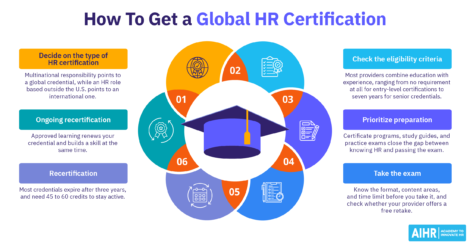
Most major HR credentials run on a three-year cycle. For instance, SHRM and HRCI require 60 recertification credits every three years. If you miss the deadline, your certification will lapse, and you may incur a costly late fee.
In this article, we’ll unpack what counts as a recertification credit, how AIHR’s Certificate Programs can help you earn credits across SHRM, HRCI, HRPA, CPHR, ATD, and CPD UK for CIPD members, and how to choose a course that’s worth your time. We’ll also cover how credits can work across borders if you hold a Canadian or U.K. credential alongside a U.S. one.
Contents
What are HR recertification credits?
How many credits do you need for recertification?
8 best HR recertification courses to consider
– Recognized HR recertification courses
– HR courses offered by HR associations
Other ways to earn HR recertification credits
How to choose an HR recertification course worth your time
What are HR recertification credits?
HR recertification credits are the currency HR professionals use to keep a certification active after earning them. Every major credentialing body issues its own version, under its own name, but the mechanics are similar: complete a pre-approved learning activity, log the hours or points it’s worth, and submit them before your certification cycle ends.
The terminology differs by body. SHRM calls its credits professional development credits (PDCs), while HRCI simply calls them recertification credits and ATD awards points toward its APTD and CPTD credentials.
HRPA and CPHR both track continuing professional development (CPD) hours in Canada, as do IHRP in Singapore and SABPP in South Africa. IHRIM’s HRIP credential runs on recertification credit hours (RCH). Despite different labels, they’re based on the same underlying idea: proof that you kept learning after you passed the exam.
What doesn’t change across these systems is the pre-approval requirement. A course must be submitted to and accepted by your specific credentialing body before the hours you spend on it count toward your total. General “CE eligible” language on a course page isn’t the same as confirmed pre-approval with your body, so it’s worth checking before you enroll rather than after.

How many credits do you need for recertification?
To keep your SHRM-CP or SHRM-SCP active, you need 60 SHRM PDCs every three years. HRCI recertification runs on the same three-year cycle for the PHR and PHRi, which also require 60 credits.
Some HRCI credentials include extra category rules. The SPHR, GPHR, and PHRca require 15 of your 60 credits in a specific area: business strategy for SPHR, global HR for GPHR, and California law for PHRca. The remaining 45 can come from general HR activities. Every HRCI cycle also needs one ethics activity, which counts toward your 60 credits.
Credit requirements outside SHRM and HRCI follow the same three-year logic, just with different totals. ATD requires 40 points over three years for the APTD and 60 for the CPTD. HRPA asks its CHRP, CHRL, and CHRE members for 66.67 CPD hours every three years, and CPHR designations across Canada generally follow a similar structure.
IHRIM (HRIP), IHRP in Singapore, and SABPP in South Africa each run their own CPD or RCH systems, so if you hold one of those credentials, check your specific body’s portal rather than assuming SHRM or HRCI’s numbers apply.
As a rule of thumb, one hour of qualifying learning time usually equals one credit, often rounded to the nearest quarter hour. That means a 30-hour program and six five-hour webinars can close the same credit gap, though they’re likely very different in practice.
Say you’re three months from your PHR deadline and still need 20 credits. A single AIHR Certificate Program, which typically lasts 25 to 45 hours, could close the gap in one enrollment, with credit to spare. Six shorter webinars could get you there, too, but you’d need six sign-ups and six certificates.
What counts as an HR recertification course
HR courses must be recognized by your HR associations for recertification credits.
AIHR’s Certificate Programs, for example, are recognized by SHRM, HRCI, HRPA, CPHR, ATD, and CIPD. Before you pay for a recertification course, remember to check the provider’s page for your specific credential. Don’t rely on a vague “CE eligible” label, but look for the exact number of credits you’ll earn, and which credentialing body recognizes the provider and course.
Recertification helps keep your HR knowledge current while developing practical skills you can apply at work. Invest in ongoing learning to expand your expertise across the areas most relevant to your HR role and career goals.
AIHR’s Full Academy Access can help you:
✅ Explore courses across key HR domains, from people analytics and AI to recruitment and employee experience
✅ Build practical skills through expert-led lessons, case studies, assignments, and ready-to-use resources
✅ Choose learning that supports your evolving role, interests, and professional development priorities
✅ Develop your HR expertise while working toward eligible recertification credits across AIHR Certificate Programs
💡 Explore preview lessons and resources in the AIHR Demo Portal to see what you can learn next.
8 best HR recertification courses to consider
Courses that qualify for recertification credit usually fall into two groups: some certificate programs build a skill while helping you earn credits across multiple bodies, and shorter courses can help you meet a single credit requirement quickly.
Recognized HR recertification courses
1. AIHR’s Certificate Programs
AIHR’s Certificate Programs are built for HR professionals who want both the credit and the capability. Since they span every major HR domain, you can usually find one that closes a skills gap and helps you meet your recertification deadline and requirements. Below are a few examples:
HR Business Partner 2.0: The HR Business Partner 2.0 Certificate Program covers business acumen, HR consulting skills, HR metrics knowledge, employee experience skills, data literacy, and AI fluency. It’s most suitable for mid-level HR professionals, and aspiring and current HRBPs.
Credits earned upon completion:
- 33.5 PDCs with SHRM
- 33.5 HR (general) credits with HRCI
- 42 CPDs with HRPA and CPHR
- 33 CPDs with CPD
People Analytics: Through the People Analytics Certificate Program, you’ll learn how to use people data to make better decisions. It covers HR analytics, Excel analysis, HR dashboards, Microsoft Power BI, and data visualization.
If you want to use data to answer questions about turnover, absence, performance, recruitment, and workforce planning, consider this program.
Credits earned upon completion:
- 36 PDCs with SHRM
- 36 (general) credits with HRCI
- 40 CPDs with HRPA and CPHR
- 35 CPDs with CPD
Artificial Intelligence for HR: The Artificial Intelligence for HR Certificate Program teaches you how to use AI in practical HR work. It covers the AI landscape, responsible AI use, prompt design, AI-supported workflows, productivity use cases, and AI strategy. It’s best for HR professionals who want to save time, improve work quality, and use AI with sound judgment.
Credits earned upon completion:
- 28 PDCs with SHRM
- 28 (general) credits with HRCI
- 28 CPDs with CPD
Compensation & Benefits: With AIHR’s Compensation & Benefits Certificate Program, you’ll learn how to design a modern total rewards strategy, implement benefits and wellbeing plans, and conduct job evaluation and grading.
You’ll also learn about pay structures, sales compensation, compensation analytics, benchmarking, and pay gap data. Consider this program if you want to move into a C&B role, strengthen your rewards knowledge, or improve pay and benefits processes.
Credits earned upon completion:
- 27 PDCs with SHRM
- 27 (general) credits with HRCI
- 32 CPDs with HRPA and CPHR
- 27 CPDs with CPD
HR Generalist: The HR Generalist Certificate Program teaches you how to set up, run, and improve core HR processes. It covers recruitment, employee engagement, payroll, policy frameworks, business support, HR operations, and stakeholder conversations.
If you’re new to HR, are an HR department of one, or are moving into a broader generalist role, this program is for you.
Credits earned upon completion:
- 34 PDCs with SHRM
- 34 (general) credits with HRCI
- 26 CPDs with HRPA and CPHR
- 26 CPDs with CPD
Each program focuses on skills you can apply on the job, and ends with a capstone project that allows you to apply what you’ve learned to a real business problem. This helps you earn a digital certificate alongside the relevant recertification credit. The exact credit count varies by program, so check the eligibility page before you enrol.
A single Certificate Program costs $1,125 for 12 months of access. You can also get all 16+ programs plus the full course library through Full Academy Access for $1,850 a year. The latter can provide better value if you’re maintaining more than one credential, or plan to keep learning after the current recertification cycle.
Credits earned upon completion:
- 12 HR (general) credits with HRCI
- Also eligible for SHRM PDCs (the provider doesn’t publish a fixed PDC value, so confirm the exact number before you enroll)
2. Business Acumen and Communication Strategies in Total Rewards (WorldatWork)
This WorldatWork course covers business finance fundamentals and how compensation and benefits connects to broader company operations. It prepares Certified Compensation Professional (CCP) and Global Remuneration Professional (GRP) candidates to communicate total rewards strategy to executives and employees.
Credits earned upon completion:
- 16 (general) recertification hours with HRCI
- 16 PDCs with SHRM
3. HR Analytics Certificate (eCornell)
Delivered by Cornell’s ILR School, this instructor-led certificate covers strategic talent analytics, applied predictive analytics, sourcing and visualizing HR data, and communicating ROI to stakeholders.
Credits earned upon completion:
- 40 PDCs with SHRM
- 40 professional development hours (4 CEUs)
4. Strategic Workforce Planning (SWP) Certification (HCI)
HCI’s SWP Certification covers workforce planning readiness, role segmentation, environmental scanning, current-state analysis, scenario planning, gap analysis, and action planning.
Credits earned upon completion:
- 13 PDCs with SHRM
- 13 credits with ATD, HCI, and HRCI
HR courses offered by HR associations
5. AI+HI Specialty Credential (SHRM)
SHRM’s AI+HI Specialty Credential covers AI foundations, prompt engineering, strategic AI integration across the employee life cycle, and responsible AI leadership, delivered across three sequential lab stages that culminate in a capstone project.
Credits earned upon completion: 30 PDCs with SHRM
6. Talent Acquisition Specialty Credential (SHRM)
SHRM’s Talent Acquisition Specialty Credential covers talent acquisition strategy, global hiring, inclusive recruiting, virtual talent acquisition, and candidate experience.
Credits earned upon completion: 22 PDCs with SHRM (for SHRM-CP or SHRM-SCP).
7. Workplace Investigations Specialty Credential (SHRM)
SHRM’S Workplace Investigations Specialty Credential teaches workplace investigation planning, bias management, investigation interviews, risk reduction, and a seven-step investigation framework.
Credits earned upon completion: 13.5 PDCs with SHRM (for SHRM-CP or SHRM-SCP).
8. HRCI Pro: AI for HR (HRCI)
HRCI’s HRCI Pro: AI for HR bundles three self-paced courses (Artificial Intelligence and the Employee Experience, Generative AI for HR Professionals, and Responsible Implementation and Compliance) into a single certificate with a digital badge on completion.
Other ways to earn HR recertification credits
Courses aren’t the only way to earn recertification credit. Most associations also recognize live events, in-house training, and the work you do on the job, provided the activity is documented and comes from an approved source.
Live events and webinars
Some HR associations award recertification credit for attending a live event or webinar, which is separate from enrolling in a full course. SHRM, for example, credits in-person and virtual events like conferences, seminars, and workshops under its Advance Your Education category.
AIHR’s live events also count towards recertification. As a SHRM recertification provider, each AIHR live event you attend is worth 1 PDC, which adds up steadily if you’re a Full Academy Access member attending them regularly.
Shorter webinars and e-learning courses can still help if you’re only a few credits short. HRCI, for example, awards one credit hour for every hour of qualifying interactive e-learning, and calculates conference and seminar credit based only on educational time. This makes short courses useful for closing small credit gaps, but you should track activity IDs, certificates, and reporting rules carefully.
In-house training
Many credentialing bodies accept the structured training your own organization delivers, whether it’s an internal workshop, a recurring lunch-and-learn series, or a formal program you help build for your HR team.
SHRM and HRCI generally allow in-house training to count in their general education categories, as long as it’s HR-relevant, and you can document what it covered and how long it ran. If your company uses outside training, an AIHR Boot Camp or Team License, for instance, counts the same way a recertification course would, provided your credentialing body recognizes the provider.
On-the-job experience
For some associations, on-the-job experience counts too. SHRM’s Advance Your Organization category lets you earn PDCs for leading or managing an HR project at your organization, from roughly 10 PDCs for 40-plus hours of project work up to 30 PDCs for 120-plus hours, capped at 30 PDCs per cycle.
This is where the skills from an AIHR Certificate Program tend to pay off twice. After getting your certificate and earning recertification credits, you can apply what you’ve learned directly to a project at work to earn even more credits.
How to choose an HR recertification course worth your time
Credit eligibility is the starting point, but shouldn’t determine your whole decision. Once you know a course counts, treat it like any other investment in your career.
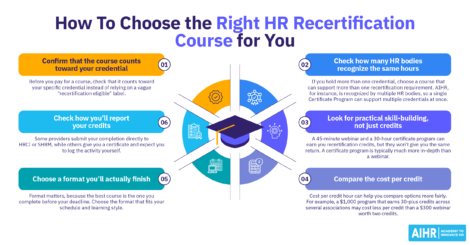
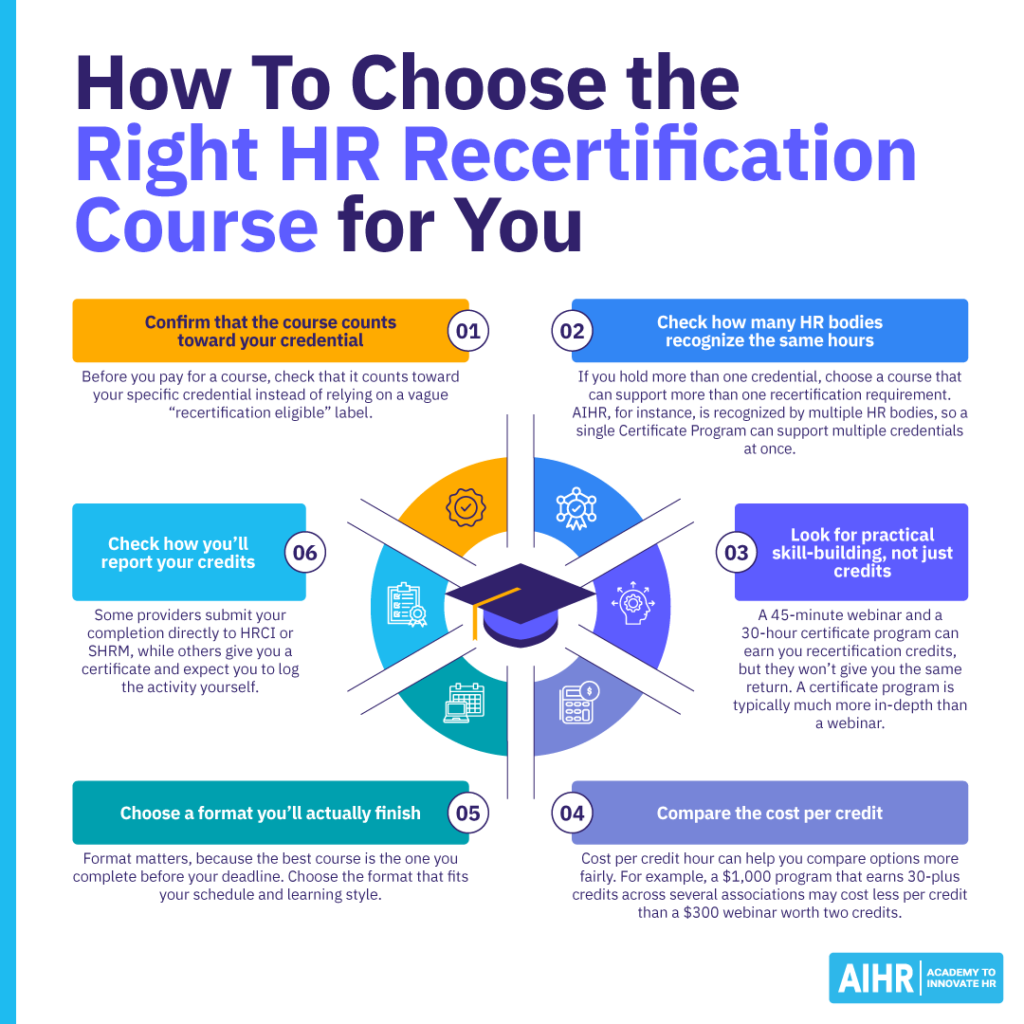
Confirm that the course counts toward your credential
Before you pay for a course, check that it counts toward your specific credential. Don’t rely on a vague “recertification eligible” label, but look for the exact credentialing body, the number of credits you’ll earn, and any category rules that apply. For example, some HRCI credentials need credits in business strategy, global HR, or California law. If the provider’s page doesn’t make this clear, ask before you enroll.
Check how many HR bodies recognize the same hours
If you hold more than one credential, choose a course that can support more than one recertification requirement. AIHR’s Certificate Programs are recognized by HRCI, SHRM, HRPA, and CPHR, so a single program can often support multiple credentials at once. That helps if you already hold two credentials, or are working toward a second one while maintaining the first.
Look for practical skill-building, not just credits
A 45-minute webinar can earn you recertification credits, but it may not provide the same value. While a certificate program is typically much more in-depth than a webinar, as it teaches you practical HR skills you can apply on the job immediately, or discuss in an interview, performance review, or team meeting.
Compare the cost per credit
Cost per credit hour can help you compare options more fairly. A $1,000 program that earns 30-plus credits across several associations may cost less per credit than a $300 webinar worth two credits. While the program costs more upfront, but it gives you greater value for money if it covers several requirements and builds a skill you need.
Choose a format you’ll actually finish
Self-paced online courses, like AIHR’s Certificate Programs, work well if you need to study around a full-time HR job. Live, instructor-led courses can benefit you if you need discussion, structure, and a fixed deadline. Choose the format that fits your schedule and learning style.
Check how you’ll report your credits
Finally, check how the credits are reported. Some providers submit your completion directly to HRCI or SHRM, while others give you a certificate and expect you to log the activity yourself. Each approach can work, but if you have to self-report, be sure this step to your calendar as soon as you finish the course, so you’ll report your credits on time.
Next steps
The best HR recertification course for you is the one that meets your specific credential’s requirement and teaches you a new skill you can use to improve your day-to-day work or even advance your HR career. Start by checking your credentialing body’s portal for your exact hour count and deadline, then work backward from there.
If you want both the credit and the capability, AIHR’s Certificate Programs are a practical place to start. There are multiple domains to choose from, a capstone project in every program, self-paced online coursework you can fit around a full-time HR job, and recertification credits recognized by major HR credentialing bodies. You can access these programs with Full Academy Access, and preview lessons before committing via the AIHR Demo Portal.