
Technological developments are reshaping the workplace fast, and the HR function is no exception. Today, employers prioritize skills and hands-on experience over formal degrees, making the path into HR more accessible than ever.
Whether you’re a student, a career changer, or an HR professional ready to advance professionally, this guide gives you a clear picture of what it takes to land and grow in an HR role this year. It also covers how AIHR’s certificate programs can help you build the future HR skills employers are actively hiring for.
Contents
What are HR job requirements?
Entry-level HR job requirements
How to get into HR
Preparing for a career in HR: 5 tips
AIHR certificate programs to take

What are HR job requirements?
HR job requirements refer to all the qualifications, skills, behaviors, and experiences employers look for when hiring HR professionals. They vary depending on the job level, industry, and company size, with larger organizations potentially having more specialized expectations. They typically include:
- Formal education (usually a degree in Human Resources, Business Administration, or a similar field)
- Soft skills (communication, decision-making, discretion, etc.)
- Relevant technical abilities (e.g., HRIS or payroll).
This article discusses each category in more detail in the sections below. Certificate programs like AIHR’s HR Generalist or Digital HR 2.0 can help fill the gap if you lack one or more of these HR skills.
Entry-level HR job requirements
If you want to embark on an HR career path, the proper foundational knowledge and competencies are indispensable. Here’s an example of what entry-level HR job requirements may look like:
Education
- High school diploma (minimum)
- An Associate’s or Bachelor’s degree in Human Resources, Business Administration, or Business Psychology.
Skills
- Strong communication and organizational skills
- Familiarity with workplace laws, regulations, and standard HR software (e.g., HRIS, ATS, Excel, etc.).
Relevant experience
- HR internships
- Experience working in an administrative or customer service role.
Examples of entry-level HR jobs
Here are some examples of entry-level HR roles you can apply for if you meet the above job requirements:
HR Assistant
A Human Resources Assistant provides support across different HR functions and manages administrative tasks. Common HR Assistant responsibilities include:
- Maintaining employee records
- Assisting with payroll and recruitment processes
- Handling administrative tasks
- Working closely with HR managers and other HR professionals to support HR initiatives.
Educational, skill, and other requirements:
- A Bachelor’s or Associate degree in HRM, Business Administration, or a related field.
- Attention to detail
- Strong communication, time management, organizational, and technical skills
- Relevant previous experience (e.g., as an executive or administrative assistant).
HR Coordinator
A Human Resources Coordinator facilitates an organization’s key HR programs and functions. Their work focuses on improving HR processes, practices, and policies. Typical HR Coordinator responsibilities include:
- Conducting audits and generating reports on existing HR processes
- Providing recommendations to HR management based on the findings of these audits and reports
- Providing support in areas such as performance management, comp and ben, and onboarding.
Educational, skill, and other requirements:
- A Bachelor’s degree in HR or a related field
- A minimum of one to two years of relevant working experience (e.g., as an administrator or coordinator)
- Experience working with HRIS databases and HR (payroll) software.
Recruiting Assistant
A Recruiting Assistant’s job is to support the hiring team with its recruiting and onboarding activities to ensure a smooth recruitment process for both candidates and the hiring team. Common Recruiting Assistant responsibilities include:
- Maintaining an up-to-date applicant database
- Assisting candidates throughout the recruitment process
- Screening candidates and reviewing applications.
Educational, skill, and other requirements:
- Strong listening skills
- Familiarity with applicant tracking systems (ATS)
- Excellent communication skills (written and verbal)
- High degree of discretion
- Previous experience as a recruiter or in a similar role.
Onboarding Specialist
An Onboarding Specialist ensures a smooth transition from candidate to employee and a soft landing in the organization for new hires. Typical onboarding specialist responsibilities include:
- Creating and updating employee resources
- Processing paperwork
- Answering company-related questions
- Introducing new hires to their teams.
Educational, skill, and other requirements:
- A degree in HR, communications, psychology, or business administration, or a good certification program such as AIHR’s Strategic Talent Acquisition Certificate Program.
- Strong interpersonal and communication skills
- Problem-solving skills
- Organizational and planning skills
- Familiarity with (onboarding) software
- Relevant experience from internships or other entry-level HR positions
Payroll Administrator
A Payroll Administrator (or Payroll Clerk) works closely with other HR professionals and the IT department to manage the payroll process and ensure timely and correct salary payment. Common payroll clerk responsibilities are:
- Preparing monthly payroll reports
- Ensuring the company complies with the latest payroll regulations
- Managing all issues related to payroll activities (e.g., calculating overtime, wages, bonuses, etc.).
Educational, skill, and other requirements:
- Certification in payroll administration or bookkeeping
- Great attention to detail
- Strong decision-making, data entry, and communication skills
- Discretion and confidentiality, especially regarding employee records
- Ability to work in a time-sensitive environment with strict deadlines.
Benefits Administrator
A junior-level Benefits Administrator supports their company’s development, implementation, and maintenance of benefits plans and employee benefits administration. Typical Benefits Administrator responsibilities are:
- Ensuring compliance with regulatory requirements
- Analyzing benefit data and administering employee benefit programs
- Addressing benefit queries and conducting benefit orientations
- Managing accurate employee records.
Educational, skill, and other requirements:
- A Bachelor’s degree in HR, Business Administration, or a related field
- Strong analytical, communication, and problem-solving skills
- Previous experience in benefits administration or a similar role.
How to get into HR
Depending on your starting point, there are various pathways into HR. We explain these pathways below:
For fresh graduates
Fresh graduates can apply for some of the entry-level HR positions mentioned in the previous section. Depending on the organization’s specific requirements for its entry-level HR roles, you may need a college degree in HR, Business Psychology, or Communications. One or more HR internships, in addition to your educational qualifications, can also boost your chances.
For people transitioning from another industry
Depending on your previous experience, you might be able to pursue an entry-level, mid-level, or senior HR position if you’re transitioning into HR from a different industry. The specific job requirements will depend on the role you’re applying for. However, if you’ve held roles in admin, customer service, or operations, you’d likely have gained some relevant experience.
For people transitioning from other HR roles
If you’re moving from one HR role to another, consider upskilling through one of AIHR’s certificate programs to accelerate the transition and develop the core skills you’ll need to excel in your new role.
You could also use job rotation to learn more about and prepare for HR roles you’re targeting, as it will give you practical exposure to different HR functions. This option is useful especially if you’re targeting a large organization, since they often look for HR professionals with both specialist skills and broad business understanding.
HR tip
AI is quickly changing the way we work, and HR professionals must have the skills to use AI confidently, accurately and ethically to boost the HR function. To build the AI skills required to future-proof your HR career, check out our AI for HR certificate program.
Preparing for a career in HR: 5 tips
Here are five helpful tips for anyone considering a career in HR or aiming to transition from one HR role to another:
Tip 1: Network
Build or extend your network of HR professionals. You can do this on platforms like LinkedIn, but also by joining one or more of the many great HR communities, like the AIHR community. A strong network can help you learn about different HR paths, stay close to industry developments, and hear about opportunities earlier.
Tip 2: Gain experience
There are various ways to gain relevant experience, including internships, admin roles, volunteer work, job rotation, mentorships, and more. Choose what suits you best; this could be a combination of more than one way to gain experience. Even small, practical experiences can help you build confidence and show employers you understand how HR works in practice.
Tip 3: Develop transferable (soft) skills
Transferable skills such as communication, problem-solving, discretion, empathy, and resilience are valuable not just in HR, so developing them will come in handy for future career changes. These skills matter because HR roles often involve working with people, handling sensitive issues, and supporting decision-making across the business.
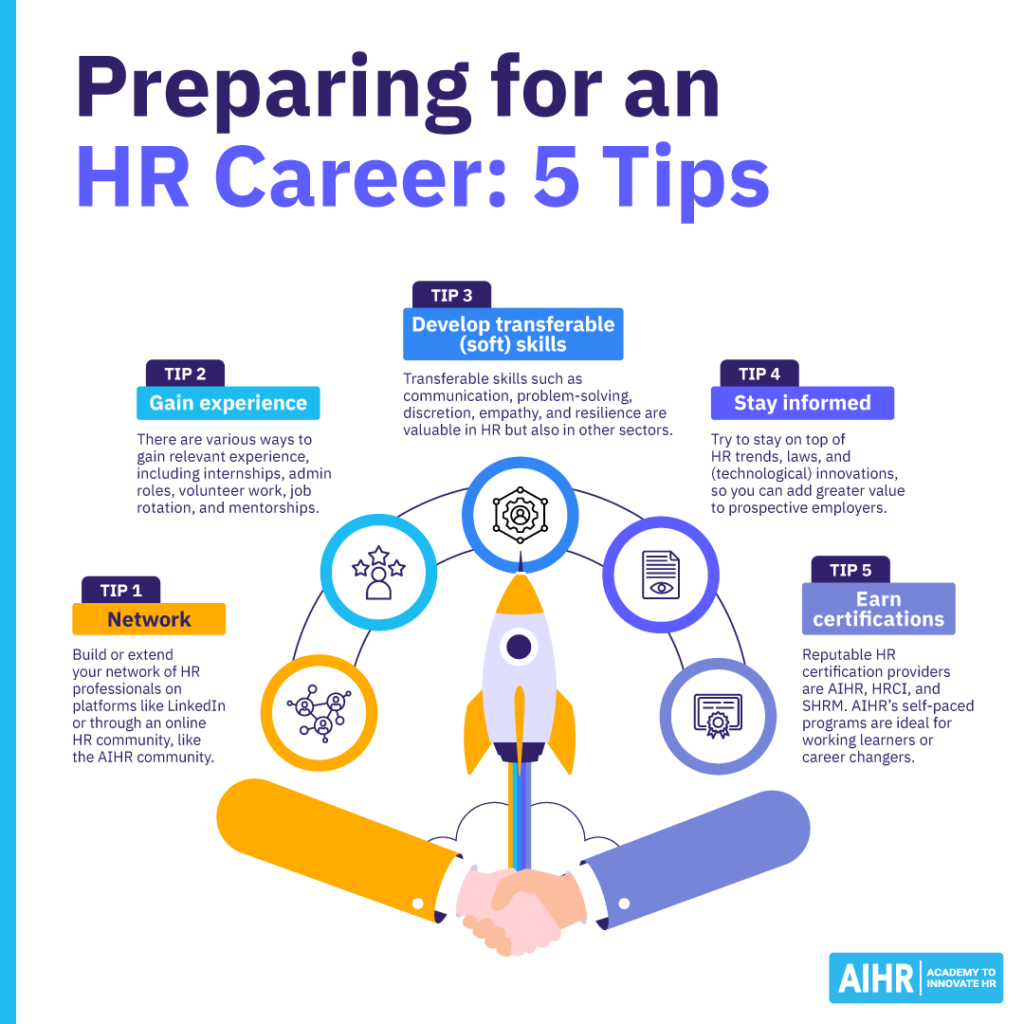
Tip 4: Stay informed
An involved and engaged HR professional stays up to date in their field. Try to stay on top of HR trends, laws, and (technological) innovations to ensure you can add greater value to prospective employers. This will also help you speak more confidently in interviews, and show prospective employers you understand the challenges shaping the HR profession.
Tip 5: Earn certifications
Consider taking one or more certifications to prepare for your future HR role. Reputable HR certification providers include AIHR, HRCI, and SHRM. AIHR’s self-paced programs, for instance, are ideal for working learners or career changers. Certifications can strengthen your profile by showing employers you’re serious about building relevant, up-to-date HR knowledge.
AIHR certificate programs to take
Here are some useful AIHR certificate programs you can take to help you meet the HR job requirements mentioned in this article:
- HR Generalist Certificate Program: This program is designed to teach you how to engage with employees throughout the seven stages of the employee life cycle.
- Talent Management and Succession Planning: Learn how to support employee growth and align people strategies with business goals with this certificate program.
- Diversity, Equity, Inclusion & Belonging: This program teaches you how to spot and minimize bias to make HR practices fairer and more inclusive.
- Digital HR 2.0: Through this program, you’ll be able to build skills related to data-driven decision-making, HR tech, and digital transformation.
- Sourcing & Recruitment: This program teaches practical skills in attracting, sourcing, screening, and hiring talent, as well as building a strong employer brand and using recruitment analytics.
- People Analytics: With this program, you’ll learn to collect, analyze, and interpret HR data to enable evidence-based decision-making and to effectively communicate insights to stakeholders.
You can explore the full AIHR course offering here to choose a certificate program that aligns with your current skill set and career goals.
Next steps
Wherever you are professionally, and depending on the HR job requirements of the job you want, you can start preparing yourself right away. As a first step, create a simple timeline spanning a couple of weeks (or months) and commit to one specific, manageable action per week. Your timeline may look something like this:
- Week 1: Join at least one professional HR community.
- Week 2: Reflect on possible knowledge or skill gaps, and how to close those.
- Week 3: Explore AIHR’s certificate programs.
- Week 4: Choose one area to focus on and start learning.
Of course, the exact steps you take may differ, but that doesn’t matter. What matters is that you take action and start moving towards your ideal HR position while developing yourself along the way.