
A career change in your 40s can make sense. You’ve likely worked for over a decade, gained relevant experience in one or more fields, and developed enough self-awareness to know and embrace your strengths and weaknesses.
This article explores how to switch professions and start a new career in HR at 40, whether HR is indeed a good career for you, the potential obstacles to overcome, and how to transition successfully.
Contents
Why start a new career in HR?
Is Human Resources a good career?
How to successfully start an HR career at 40+: 5 steps
Checklist: Assess your readiness for starting an HR career at 40+
Key takeaways
- Starting an HR career at 40+ isn’t as unrealistic as you may think; many HR professionals enter the field after working in other roles or industries.
- HR can be a strong career option for mid-career professionals because the field is growing, more strategic than before, and offers transferable skills.
- Common challenges include limited direct HR experience, building an HR network, keeping up with HR tech, and overcoming possible age bias.
- A successful transition requires clear goals, foundational HR knowledge, relevant exposure, a tailored résumé, and strong interview preparation.
Why start a new career in HR?
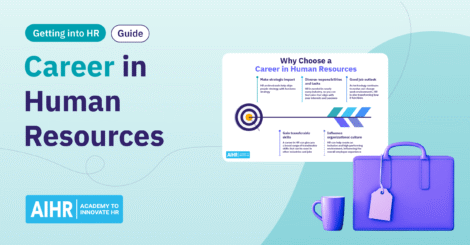
Some who choose a career in Human Resources do so because they want to make a strategic impact on the workforce, or enjoy the diverse responsibilities and tasks that come with the job. For others, it’s because they want to influence organizational culture and employee experience, or want to be in a position that allows them to develop a wide range of transferable skills.

Is Human Resources a good career?
If you’re wondering whether HR is a good career to transition to, the following data may make your decision easier:
- Growth of the profession: According to the U.S. Bureau of Labor Statistics, the employment of HR specialists is expected to grow 8% over the next decade, faster than the average for all occupations.
- Changes in the profession: The role of HR today is much more strategic and varied than before. Modern HR professionals are often actively involved in their organizations’ strategic planning and people strategy.
- HR is a promising option for professionals over 40: The AIHR State of HR Report shows most people move into HR as a second, third, or even fourth job, indicating that getting into HR later in one’s career is a common, feasible option.
- Develop transferable skills: Working in HR helps develop transferable HR skills you can use in other jobs and industries. Examples include communication, active listening, commercial awareness, and tech-savvy.
Did you know?
According to a OECD report, voluntary job changes in mid- and later career stages can help increase salary and job satisfaction. The AARP Global Employee Survey also found that over 50% of workers who changed jobs voluntarily experienced improvements in mental health and work flexibility.
Challenges to overcome when switching careers in your 40s and 50s
Here are some challenges to prepare yourself for if you intend to switch careers later in life:
- Lack of direct HR experience: 92% of HR professionals transitioned into HR from a different job (many from admin or non-business roles), creating a need to upskill in strategy, process, and business.
- Building a professional network: Finding and connecting with HR professionals from other organizations is important for an HR newbie, as is joining an HR community to exchange ideas and learn from peers.
- Demonstrating past experience relevance: Depending on your previous role and industry, proving the relevance of your professional experience to your future HR role can be challenging.
- Keeping up with HR tech and trends: Staying on top of the latest HR technology trends — a must for anyone in HR — can be somewhat overwhelming for someone switching careers.
- Possible ageism: While workplace ageism can affect all generations, it’s usually more common among older workers — especially those changing careers or starting new jobs in their 40s or 50s.
Learn skills in core HR Generalist areas like recruitment, employee relations, and HR operations to better prepare you for entry-level or transition roles in Human Resources.
🎓 AIHR’s HR Generalist Certificate Program will teach you:
✅ How Human Resources systems and processes keep an organization running efficiently
✅ How to create an end-to-end HR process, from recruitment to employee engagement
✅ An HR Generalist’s key responsibilities, and how they ensure organizational success
✅ The crucial skills every HR Generalist needs to successfully drive business value
How to successfully start an HR career at 40+: 5 steps
Switching careers in your 40s can seem daunting. You’ve likely already established your career and network, might have a family to care for, and have financial obligations to fulfill. With careful preparation, however, switching careers can make you happier and more successful. Here are some steps to consider when preparing for a career change into HR at 40+:
Step 1: Self-assessment and goal-setting
Start by speaking to experienced HR professionals. This could be an HR team member at your current company, a former co-worker, or someone you know who works at the type of company or industry you’re eyeing. They can tell you what it’s really like to work in HR and manage your expectations.
Next, determine your motivations for considering this career change, and assess if they’re valid. This is important because the reasons people start an HR career and what they like about the job often don’t reflect reality. If you still want to get into HR, define your ideal HR role and specialization (e.g., recruitment, L&D, or C&B), and the kind of company you want to join.
After this, set realistic timelines and goals for your career transition. What’s realistic and what’s not depends on your circumstances — relevant factors include your current employment status, the relevance of your professional experience and skills, and the type of role you’re seeking.
Step 2: Develop foundational HR knowledge and skills
A good place to begin learning about an HR professional’s required skills, knowledge, and abilities is AIHR’s HR Competency Model. You can also check out AIHR’s HR certifications, which cover a broad, well-rounded range of HR skills and competencies to set you up for success in an HR career.
You can also consider engaging a mentor who can provide valuable guidance, advice, and support. Their experience can help you prepare for your career change and supplement any HR training or course you decide to take. Additionally, you can benefit from books, webinars, industry publications, and online courses — some of which are affordable or even free.
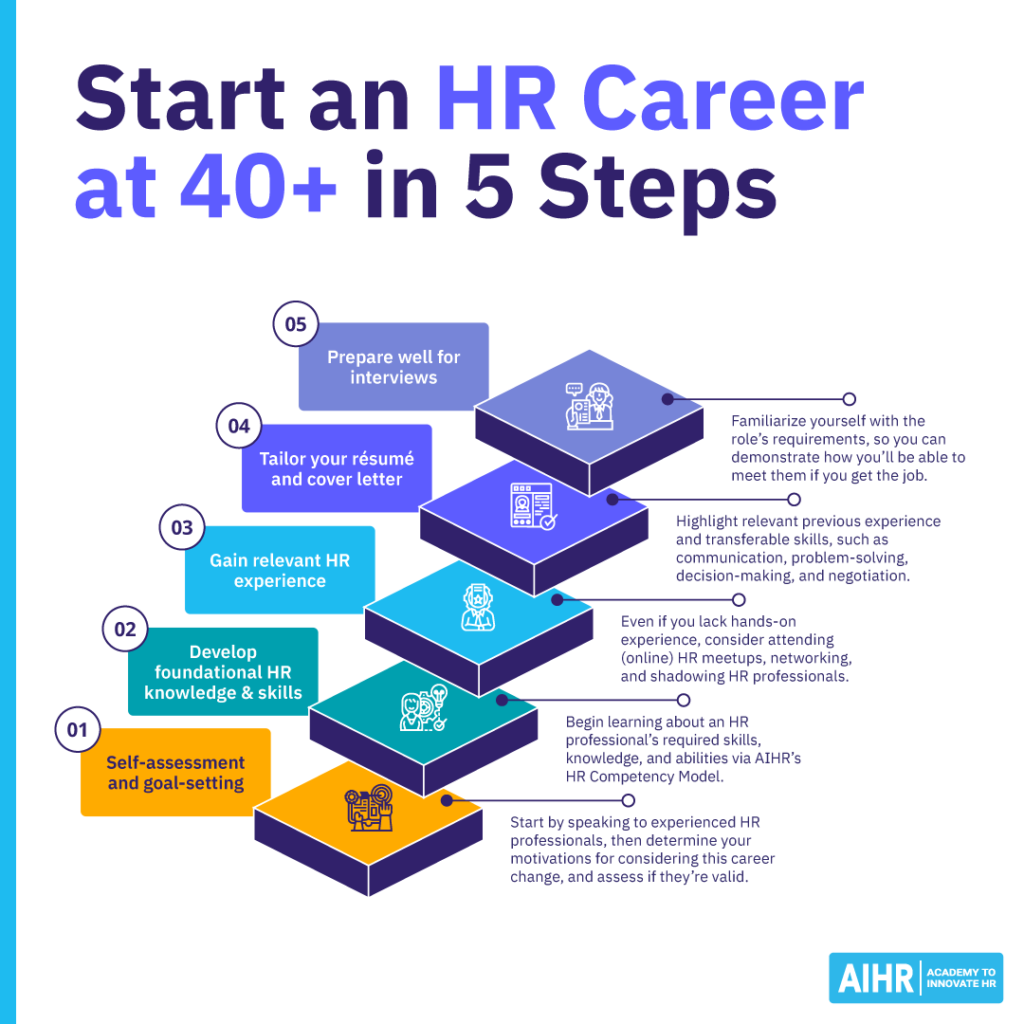
Step 3: Gain relevant HR experience
If you’re preparing for your midlife career change while still in your current role and company, any relevant HR experience you can gain will not be hands-on. Still, there are some things you can consider, such as attending (online) HR meetups, networking, and shadowing HR professionals.
Many HR communities organize regular meetups. Contact a chapter near you, tell them you’re changing careers, and ask them if you can join their next meetup. And while building your new professional network, be sure to ask HR professionals about their respective roles and industries. This should give you a clearer picture of what to expect.
At the same time, if you have a good relationship with your current manager and HR team, you might be able to shadow someone from HR for a couple of days to better understand the profession.
HR career tip
HR conferences can be a great place to learn about the latest trends in Human Resources, hear from industry experts, and meet with (future) peers. Attending one, in-person or online, might be something to consider when preparing for your career change.
Step 4: Tailor your résumé and cover letter
Switching careers requires tailoring your résumé and cover letter. Highlight relevant previous experience and transferable skills, such as communication, problem-solving, decision-making, negotiation, resilience, and emotional intelligence. Relevant prior experience can come from administrative roles, supervisory positions, or customer experience.
Aside from listing relevant transferable skills and previous experience, explain briefly how you applied these in practice. For example, you could state: “As a manager of a team of six customer service representatives, I constantly sought and offered solutions that resulted in customer satisfaction, and accommodated my team’s needs wherever possible.”
Step 5: Prepare well for interviews
Thorough interview preparation is key, regardless of the specific HR position you’re considering. Familiarize yourself with the role’s requirements, so you can demonstrate how you’ll be able to meet them if you get the job. Be aware of both your strengths and weaknesses — you can use them to your advantage by tailoring them to the role and company culture.
Additionally, learn about the company’s history and culture; this shows you’re truly interested in the job and have done your research. You can also practice answering common types of interview questions and prepare questions you’d like to ask about the job and company.
Here are some types of general and HR-focused interview questions you can prepare to answer:
- Screening interview questions
- Cultural fit interview questions
- Conflict interview questions
- Recruiter interview questions
Checklist: Assess your readiness for starting an HR career at 40+
Use the checklist and questions below to help you assess your readiness for starting an HR career in your 40s and beyond:
Understand your motivations
Why do you want to start a career in HR?
- ✔ I want to make a strategic impact
- ✔ I find the job outlook and career growth options attractive
- ✔ I want to contribute to a great employee experience
- ✔ It fits my previous experience and skills well.
What career goals do you have within HR?
- ✔ I want to be an HR Generalist for a small, family-owned business
- ✔ I want to work in a fast-growing scale-up
- ✔ I want to be part of the DEIB team in a large corporate organization.
Evaluate transferable skills
What transferable skills do I have?
- ✔ Communication
- ✔ Resilience
- ✔ Emotional intelligence
- ✔ Problem-solving
- ✔ Decision-making
- ✔ Project management
- ✔ Negotiation
- ✔ Data analysis.
You can use a simple table like the one below to determine which HR-specific and common transferable skills you have:
What training and skills do I need to start a career in HR?
- ✔ HR competency framework: Use an HR competency model to identify key HR knowledge areas and skills to develop.
- ✔ Type of training: Assess relevant training options (e.g., AIHR’s Full Academy Access, or any relevant HR certifications).
- ✔ Practical experience: Consider shadowing an HR professional, finding a mentor active in HR, or joining an HR meetup, etc.
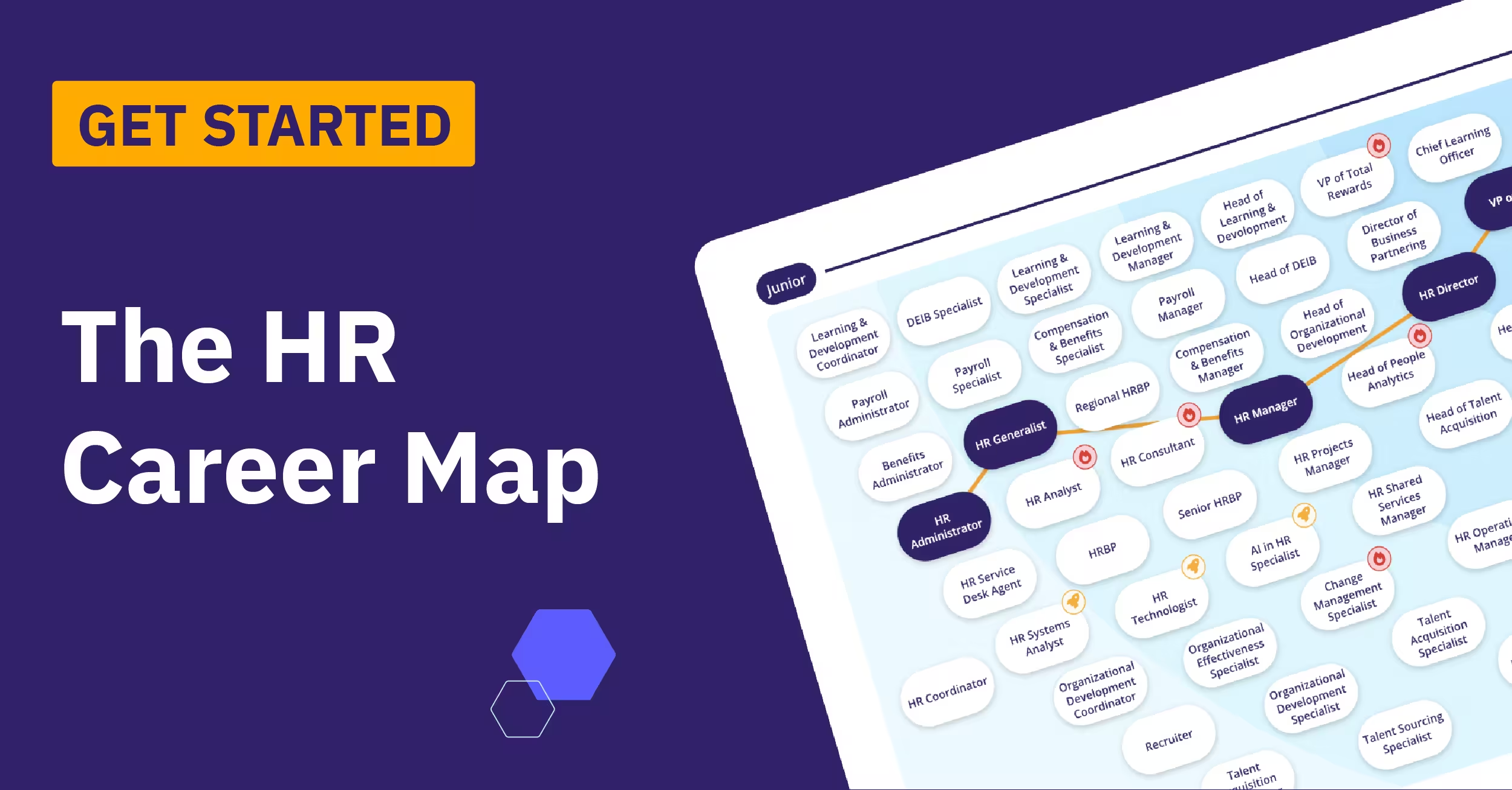
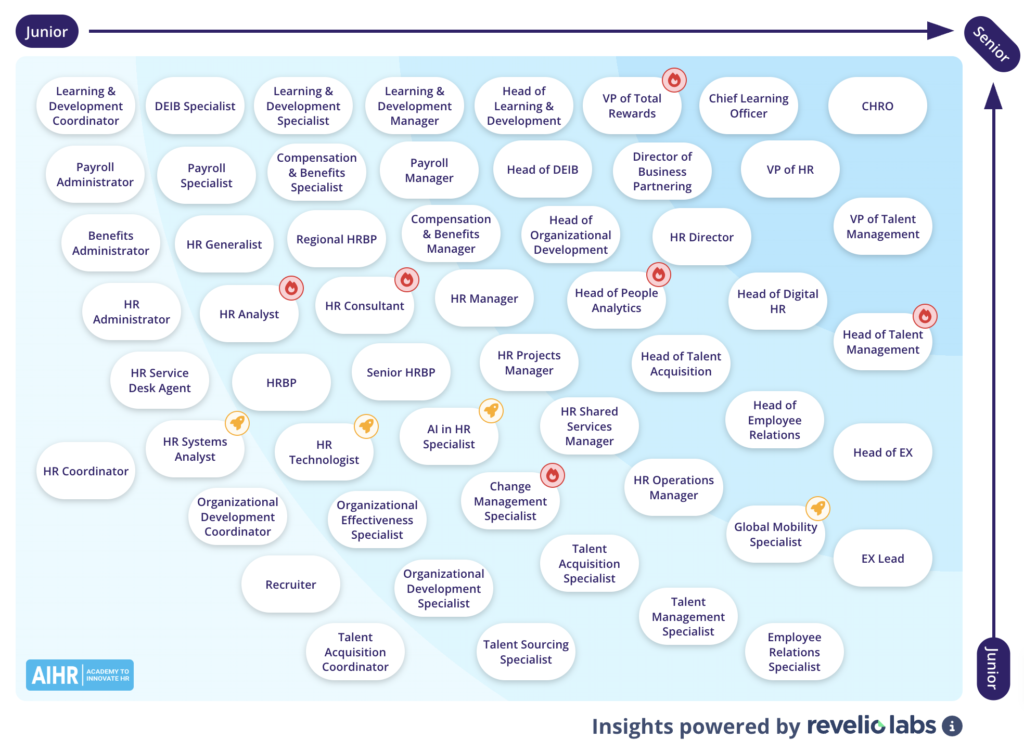
You can also use AIHR’s HR Career Map to plan your HR journey:
What are the relevant financial considerations?
- ✔ Overview of current situation: List what comes in and goes out to help decide how to remain financially stable for the transition to an HR career.
- ✔ Necessary adjustments: Find out how and how much to budget while preparing for and starting a new career in HR.
- ✔ Earning potential in HR: Use AIHR’s salary guide to determine long-term earning potential in HR to inform what to aim for during salary negotiations.
Next steps
Starting a career in HR at 40 can be a good move if you approach it with clarity and a skills-first mindset. Your previous experience can help you understand people, solve problems, and work across teams. The key is learning the HR skills that support the role you want, from recruitment and HR operations to people analytics, L&D, or employee relations.
Start by mapping where you are now and where you want to go next. AIHR’s HR Career Map can help you explore HR roles, compare career paths, and identify the skills you need to build for your next move. From there, focused learning can turn your career change into a clear, practical plan.