
Prompt engineering for HR professionals has become a key workplace skill. To properly develop this skill, it’s important to remember that AI tools are only as useful as the instructions they receive. While it can benefit you to choose suitable generative AI tools to improve efficiency, how you “talk” to the AI matters, regardless of the platform you use.
Weak prompts create vague, misleading, or even biased outputs, while strong prompts create usable drafts, sharper analysis, and more reliable decision support. This article explores what prompt engineering is, how it differs from prompt design, its four key elements, and what to do in case your HR output fails.
Contents
What is prompt engineering?
Prompt engineering versus prompt design
The 4 elements of prompt engineering
How your HR output can fail (and what to do)
From prompt engineering to context engineering
How to use context engineering when prompting
Key takeaways
- Prompt engineering is less a technical skill and more a communication skill that helps you guide AI tools more effectively.
- Good prompts reduce AI risks like hallucinations, assumption gaps, and compliance issues in HR work.
- The most effective HR professionals treat prompts as repeatable systems they can test, refine, document, and share.
- Context engineering is the next step. The more relevant information you give AI, the more useful and accurate the output becomes.
What is prompt engineering?
A prompt is any instruction, question, or input you give to an AI tool. Prompt engineering is the practice of deliberately designing those inputs to achieve specific target outputs, rather than simply entering whatever comes to mind and hoping for the best.
Vague prompts produce generic, unhelpful output. Structured, detailed prompts, however, produce more accurate, relevant, and reliable responses. AI fluency can ensure you constantly use the latter, as it’s essentially the ability to communicate effectively with AI systems, understand their limits, and critically evaluate their outputs.
That’s why prompt engineering is less about coding and more about structured communication. HR professionals who build AI fluency can use generative AI more safely and strategically across recruiting, learning, analytics, employee experience, and workforce planning. It also helps you get better AI outputs, though human review is always necessary to ensure accuracy.

Prompt engineering versus prompt design
You may have heard some people use “prompt engineering” and “prompt design” interchangeably, but while there’s some overlap, they’re not the same thing. Prompt design focuses on creating a single well-structured prompt for a specific task. A strong prompt design gives the AI a clear objective, relevant context, and a defined output format.
For example, compare these two prompts:
Weak prompt: “Write an onboarding email.”
Strong prompt: “Write a welcoming onboarding email for a newly hired sales manager joining a remote-first company. Keep the tone professional but warm. Include first-day expectations, login instructions, and a reminder about the virtual welcome meeting. Limit the email to 250 words, max.”
The second prompt is better than the first because it provides the AI with enough structure to produce something tailored to your requirements.
Prompt engineering sits one level above prompt design. It focuses on building systems that consistently generate reliable outputs across teams, workflows, and use cases. Prompt design asks, “How do I write this prompt well?”, whereas prompt engineering asks, “How do we create prompts that consistently work well regardless of who uses them?”
This distinction becomes especially important when you scale AI use. One recruiter may write excellent prompts naturally, while another may struggle. Prompt engineering creates repeatable, consistent standards, so output quality doesn’t fully depend on individual skill.
Get the right mix of AI fundamentals, prompting skills, and responsible judgment to explore topics faster, compare sources, and support better-informed decisions.
AIHR’s Artificial Intelligence for HR Certificate Program will help you:
✅ Understand how AI tools work and where they can add value across HR
✅ Write effective prompts that produce more accurate, relevant outputs
✅ Apply generative AI to practical HR tasks across different domains
✅ Use AI responsibly by considering safety, privacy, and secure usage
The 4 elements of prompt engineering
Most major AI providers define prompt engineering similarly. AWS, IBM, Databricks, and GitHub all describe it as an iterative process that includes designing, testing, evaluating, refining, and repeating.
Here are the four elements of prompt engineering HR professionals should focus on:
1. Testing
Testing involves running prompts across multiple scenarios to identify where they break down. A prompt isn’t necessarily “good” because it worked once. You may write a strong prompt for a hiring workflow, get an impressive result, and assume the prompt is reliable. But the same prompt likely produces weak outputs when applied in a different context.
For instance, a recruiting prompt that performs well for software engineers may fail for frontline manufacturing roles. Another example is a leadership competency prompt that works in one region but misses cultural nuances in another region.
Consider the following:
- Does the prompt still work across different job families?
- Does it handle incomplete information appropriately?
- Does it create unintended bias in some contexts?
- Does it overgeneralize from small data sets?
Databricks recommends baseline and A/B testing across prompt versions to identify inconsistencies. This approach is particularly useful to HR, since organizational context can change constantly. Without testing, you risk treating AI outputs as universally reliable when they’re not.
2. Iteration
Iteration means improving prompts gradually instead of rewriting everything from scratch. The first AI output is usually diagnostic information, not the final answer. That’s because strong prompt engineering treats every output as feedback. If the AI misunderstood something, it likely means the prompt wasn’t clear enough.
Imagine you ask an AI to summarize the themes of an employee engagement survey, and the output feels too generic. Instead of discarding the prompt entirely, you can refine one or more of the following components:
- Specify business units separately
- Add demographic segmentation
- Define what counts as a “theme”
- Require evidence quotes
- Exclude recommendations.
This process changes the guesswork for prompting into more structured experimentation. IBM describes this as a refinement cycle involving the following steps:
- Generate
- Evaluate
- Identify gaps
- Modify.
Over time, prompts become more resilient because they’re tested against real failure patterns.
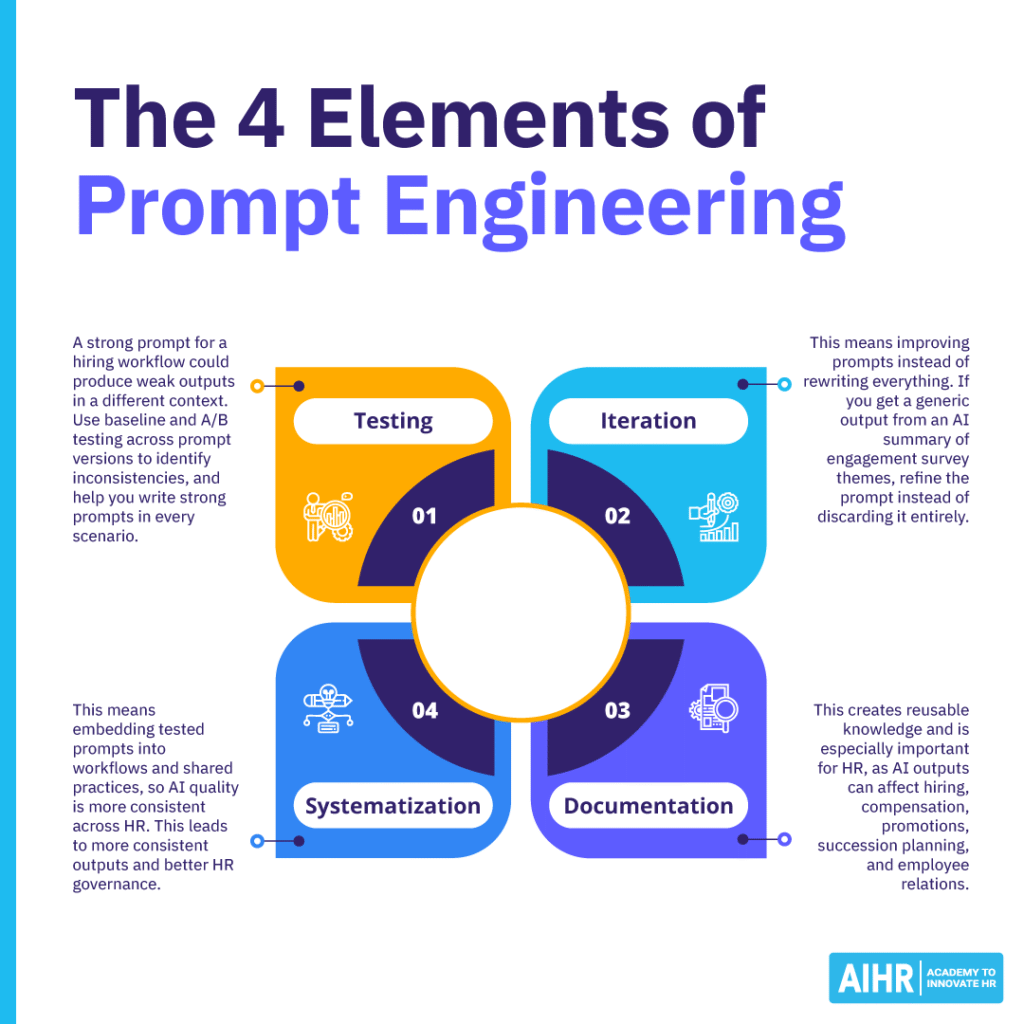
3. Documentation
Prompt engineering creates organizational knowledge, but that knowledge can’t scale if only one person has it. Documentation means capturing:
- Prompt versions
- Inputs used
- Output quality
- Known weaknesses
- Refinements that improved results.
This creates reusable knowledge. Documentation is especially important for HR, because AI outputs can affect hiring, compensation, promotions, succession planning, and employee relations. This is why you need traceability and consistency.
GitHub recommends storing successful prompts as reusable templates to help standardize high-value workflows. These include creating job descriptions, developing interview guides, drafting HR policies, and skills mapping. Instead of creating new prompts repeatedly, you can build shared “prompt libraries” with known strengths and limitations.
4. Systematization
The final stage is moving from personal productivity to organizational capability. Systematization means embedding tested prompts into workflows, playbooks, and shared practices, so AI quality becomes more consistent across the HR function. This is where prompt engineering creates solid business value.
For example, if HR operations develops a highly effective prompt for policy summaries but only one HRBP knows it, its impact stays limited. But if you document, test, and standardize that prompt within a shared workflow, everyone benefits.
This leads to faster onboarding, more consistent outputs, reduced compliance risk, better HR governance, and fewer instances of duplicated efforts.
In practice, systematization often involves shared prompt libraries, AI policy, team-approved templates, and governance protocols. Over time, these systems become part of how HR operates.
How your HR output can fail (and what to do)
Before you improve on your prompts, you need to understand how and why they failed. Below are four of the most common AI failure modes in HR work, with examples of vague prompts that lead to output failure and engineered prompts that can help you succeed.
Failure mode 1: Assumption injection
When prompts lack detail, the AI fills in the gaps itself by making assumptions it doesn’t tell you about.
Vague prompt: “Analyze our salary data and identify pay gaps.”
Engineered prompt: “Analyze the attached salary data by job family and grade, using our four job families and six grades. Identify roles where base pay falls below the 50th percentile benchmark from Mercer market data. Flag patterns by gender or tenure for human review. Do not draw inaccurate or discriminatory conclusions.”
Why it works: The second prompt defines the framework, limits the AI’s role, and reduces hidden assumptions.
Failure mode 2: Plausible but wrong
This is the classic hallucination problem. AI outputs can sound polished, structured, and authoritative while still being incorrect. This is especially risky if you use AI to support decision-making in sourcing, recruitment, hiring, promotions, C&B, or policy frameworks.
Vague prompt: “What are best practices for variable pay structures in financial services?”
Engineered prompt: “Based only on the attached compensation plan and salary benchmarking data, summarize the principles governing variable pay in our organization. Where the documents do not address a topic, say so explicitly instead of relying on external assumptions.”
Why it works: Note the key phrase, “say so explicitly”. Good prompts define what the AI should do when information is missing.
Failure mode 3: Context collapse
AI often blurs important distinctions, which can create misleading conclusions. You must explicitly define these distinctions to prevent AI from conflating them.
Vague prompt: “Summarize the main themes from our exit interviews.”
Engineered prompt: “Analyze the attached exit interview transcripts. For each theme, identify whether it appears systemically across the organization, or is localized to a specific team or management layer. Do not combine localized and systemic findings.”
Why it works: The engineered prompt defines the key distinction upfront, requires each finding to be classified by scope, and explicitly prevents the AI from merging localized issues into organization-wide conclusions.
Failure mode 4: Constraint drift
AI sometimes follows instructions initially but gradually pays less attention to them in later responses. This can create major compliance risks in HR if left unchecked.
Vague prompt: “Review succession data and flag flight risks confidentially.”
Engineered prompt: “Analyze the attached succession data at cohort and function level only. Do not name or infer individual employees. Identify observable patterns only. Before finalizing your response, verify that no individuals have been referenced.”
Why it works: The final verification instruction matters, as it forces the AI to self-check before producing the output.
From prompt engineering to context engineering
Prompt engineering is evolving, and the next level of AI use is context engineering. The difference between the two is simple: prompt engineering focuses on developing one strong instruction, while context engineering focuses on designing the entire information environment around the AI.
Think of it this way: Prompt engineering creates the brief, and context engineering provides everything else AI needs to understand the assignment properly. This includes:
- Organizational policies
- Tone of voice
- Historical examples
- Competency models
- Compliance rules
- Background documents
- Workflow constraints.
The term became popular through AI researcher Andrej Karpathy and Shopify CEO Tobi Lūtke, who have said AI performance depends heavily on surrounding context, not just isolated prompts. This is vital for HR professionals because HR work depends on the details of each organization (its people, culture, and policies).
How to use context engineering when prompting
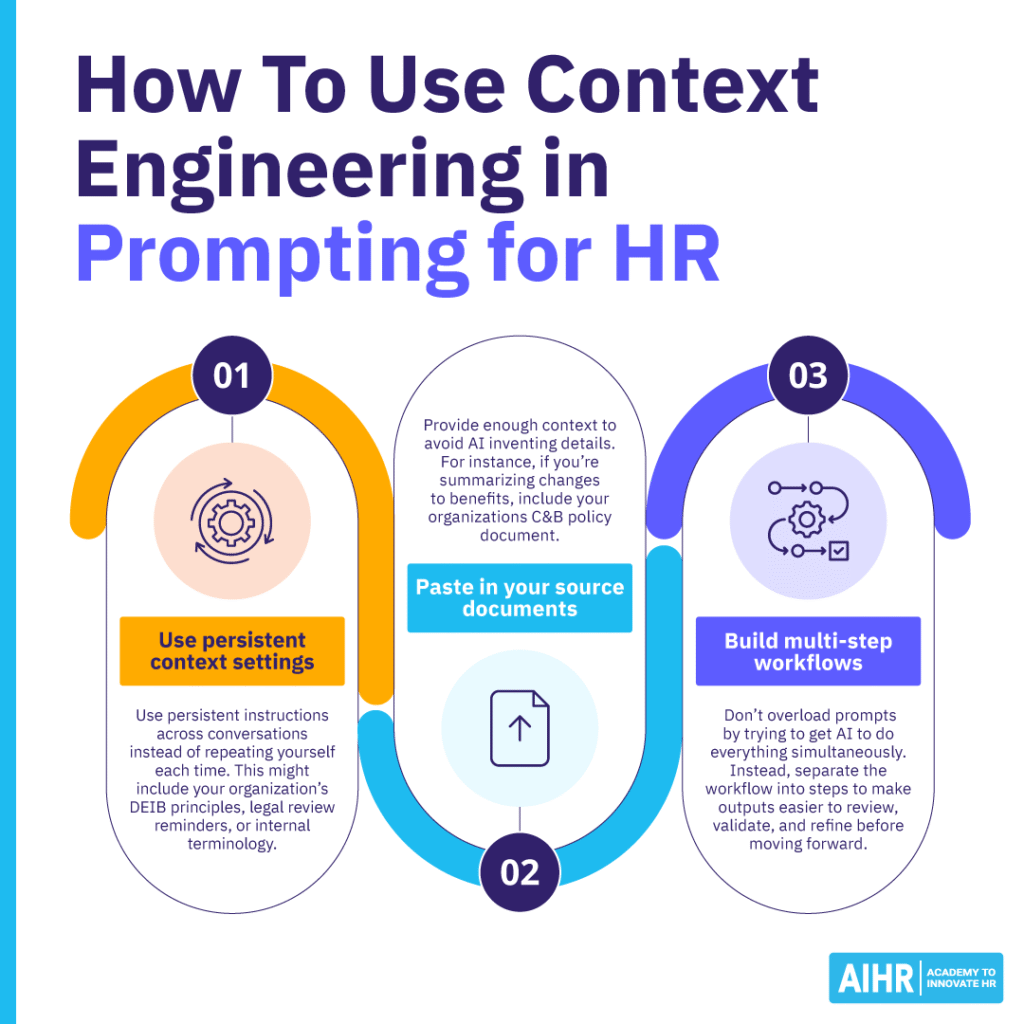
You don’t need advanced AI systems to start using context engineering. Here are three practical ways to apply it:
Use persistent context settings
Most AI platforms now allow persistent instructions across different conversations. This means you can define standing guidance once, instead of repeating yourself each time you need an output. For HR, useful persistent context might include organizational tone of voice, DEI principles, legal review reminders, confidentiality requirements, and internal terminology.
Examples:
- “Always recommend legal review for policy-related outputs.”
- “Use inclusive language and avoid assumptions about protected characteristics.”
These standing instructions improve consistency across every AI interaction and output.
Paste in your source documents
AI performs better when it has access to relevant context. The less context you provide, the more likely AI is to invent missing details. For instance, you should include a relevant competency framework when drafting a job description, or the policy document when summarizing changes to your compensation and benefits system.
This points to a key mindset shift HR professionals need to make. AI is not a search engine replacement but rather, a reasoning assistant that performs best when given real and relevant organizational information.
Build multi-step workflows
Complex HR tasks work better when broken up into steps or stages. Be careful not to overload prompts by asking AI to do everything simultaneously. Instead, separate the workflow into steps/stages to make outputs easier to review, validate, and refine before moving forward.
Imagine you are redesigning an interview process. Below is a possible multi-step workflow for this task:
- Step 1: Summarize the job requirements.
- Step 2: Map competencies to interview themes.
- Step 3: Generate structured interview questions.
- Step 4: Instruct it to review the questions for bias and redundancy.
Each step narrows the task down and improves quality control. This staged approach also makes outputs easier to review, validate, and refine before moving forward.
Next steps
AI tools are already reshaping HR work. The competitive advantage now comes from using them thoughtfully, safely, and consistently. Prompt engineering helps you move from simply experimenting with AI to integrating it into real HR workflows with more confidence and control.
The good news is this skill is learnable. You don’t need to be a technical expert to get better results from AI but rather, stronger communication habits, structured testing, and a clearer understanding of how AI systems interpret context. AIHR’s Artificial Intelligence for HR Certificate Program can help you build those skills and apply them across the HR function.