
Do you know how to prompt AI to write HR policies so it produces documents tailored to your organization’s size, culture, and industry? Effective AI use can help HR work faster and spend more time on meaningful, people-focused work. But while SHRM’s report finds that most surveyed organizations plan to use AI, only 39% have already implemented it in HR.
The biggest barrier for HR professionals is knowing how to use AI effectively for tasks that take a long time in-house or cost a lot to outsource. In this article, we’ll show you how to write effective AI prompts to generate strong, aligned HR policies you can actually use.
Contents
Why prompting matters in HR policy writing
What to prepare before prompting AI to draft an HR policy
How to write HR policy prompts using the BRIEF framework
How to prompt AI to write HR policies: 6 steps
4 sample HR policy AI prompts
How to refine AI-generated HR policy drafts
Risks of AI use in HR policy writing
AIHR’s resources for HR professionals embracing AI
Key takeaways
- Effective prompts help AI produce accurate, tailored HR policies. Vague instructions can lead to risks like compliance drift and tone mismatch.
- AIHR’s BRIEF framework offers HR a structured way to give AI the context, limits, and tone it needs to draft usable, organization-specific policies.
- Human review is still essential. AI can expose data, invent legal references, include bias, or create drafts that feel complete but are still missing key details
Why prompting matters in HR policy writing
An effective HR policy should reflect your organization’s jurisdiction, culture, and risk tolerance. A poor prompt, such as “write an HR policy on employee misconduct”, creates several risks. AI may add clauses that don’t reflect local law, or use a tone that doesn’t match your company’s voice. It could also invent legal definitions or include biased language.
Learning how to prompt AI to write HR policies can reduce these risks. Prompting is now a core skill for HR professionals and managers because it helps them provide clearer instructions and review AI outputs more effectively. The good news is that every HR professional can build this skill and use it to draft comprehensive HR policies (as well as other types of HR documents).

What to prepare before prompting AI to draft an HR policy
One of the main reasons AI-generated HR policies turn out generic or incorrect is poor preparation. AI tools work with the information you give them, so if you don’t share company-specific details, the draft won’t feel specific. Using AI to write HR policies can save time, but to ensure accuracy, you need a few key details before you write your prompt:
- Policy scope: Specify the roles, locations, contract types, and entities the policy is supposed to cover.
- Jurisdiction: Include the country, state or province, and any sector-specific rules, such as healthcare, finance, or public sector requirements.
- Existing references: Add the current policy, employee handbook section, collective agreement, or competitor benchmark you’re trying to improve.
- Company voice: Choose two to three adjectives that describe your tone, and include a sample paragraph from existing company communications. If you have a document detailing your company’s voice, you can use that to train the AI.
- Non-negotiables: List legal must-haves, DEI principles, accessibility standards, and plain-language requirements.
- Tool choice and data sensitivity: Use the AI tool your organization has approved, and be clear on which employee and company data you should never share with AI.
AIHR covers these details in the Prompt Design Fundamentals module in the Artificial Intelligence for HR Certificate Program. A well-designed prompt for HR requires some preparation, but it saves time later. You’ll spend less time fixing mistakes, tone, and wording, and you’ll get more useful outputs.
How to write HR policy prompts using the BRIEF framework
You can use AIHR’s BRIEF framework to create your HR policy AI prompts. This framework provides an anchor structure for any AI prompt used to draft an HR policy by setting clear context and parameters before the AI tool begins drafting.
It’s currently taught in AIHR’s Gen AI Prompt Design for HR mini course, and underpins policy-writing examples in the Artificial Intelligence for HR Certificate Program. Here’s what each letter stands for, and how this framework can improve your prompt design for HR policies.
Background
This is the context the AI needs, including company size, industry, jurisdictions, why you’re drafting or updating this policy, and what existing policy or handbook section it builds on or replaces. At this stage, you must help the AI understand the environment in which the policy will operate. Without this, you may end up with a generic policy that doesn’t fit your workforce, location, or business realities.
Request
This is the specific task you want the AI tool to complete. For example, “Draft a paid parental leave policy of around 800 words covering eligibility, duration, pay, return-to-work, and edge cases.” A strong request tells the AI exactly what to produce and how far to go. Be clear on whether you need a full draft, an outline, a rewrite, a manager FAQ, or a plain-language employee version.
Instruction
This refers to how to structure the output (e.g., headings, bullet points, reading level, or tone of voice). You should also mention any “don’ts”, such as “no legal citations that cannot be verified”, or “no assumptions about family structure”. Instructions turn a broad request into a usable draft and help reduce cleanup time by stating upfront how the policy should read, the format to follow, and the risks to avoid.
Expectation
This is what the finished output should look like. Provide a short sample paragraph from an existing company policy or describe the model (e.g., “close to how Atlassian writes its public handbook”) for clear reference. This helps the AI match your organization’s voice and quality standards. The more specific your example, the easier it is for the AI to produce something consistent with your existing HR documents.
Focus
This involves the scope and constraints (e.g., what to emphasize and leave out, non-negotiable clauses, key jurisdictions, and what to flag for legal review). Focus helps prevent the AI from trying to cover everything at once. It also gives HR more control by making clear which areas need careful handling, such as compliance, sensitive employee data, or manager discretion.
Example of a BRIEF-structured request
Background | “We’re a 1,200-employee technology company with offices in the U.S., U.K., Germany, and the Netherlands. We’re updating our current parental leave policy because it’s outdated, too legalistic, and difficult for employees and managers to understand. The new policy will replace the parental leave section in our employee handbook and should support a more inclusive, plain-language approach.” |
Request | “Draft a parental leave policy of around 900 words for all permanent employees. Cover eligibility, types of leave, notice requirements, pay during leave, return-to-work support, manager responsibilities, and where employees can go for help.” |
Instruction | “Use clear, direct language at around a Grade 8 reading level. Structure the policy with short headings and bullet points where useful. Use a warm, professional tone. Do not include legal citations unless they are clearly flagged for legal review. Do not assume a specific family structure, gender, or caregiving arrangement.” |
Expectation | “The policy should sound supportive and practical, similar to a modern employee handbook. It should help employees understand their options without needing to ask HR to explain every sentence. Use this tone as a guide: ‘We want employees to feel supported before, during, and after parental leave. Managers are expected to handle these conversations with care, consistency, and respect for privacy.’” |
Focus | “Emphasize inclusion, clarity, manager accountability, and a smooth return to work. Leave out country-specific legal details unless they are flagged as areas for local legal review. Treat eligibility, pay, notice periods, privacy, and manager responsibilities as non-negotiable sections. Flag any legal or compliance-sensitive wording for HR and legal review before the policy is finalized.” |
How to prompt AI to write HR policies: 6 steps
Unlike one long prompt (e.g., a wall of text), a series of connected prompts usually gives you more control and better results. This applies whether you use ChatGPT, Claude, Microsoft Copilot, or Gemini. Below, we’ll walk you through a chained-prompt workflow using the BRIEF framework to guide your core prompt structure.
Step 1: Brief the AI on the company
Give the AI tool the background it needs to tailor the HR policy to your organization. For example, include the role group, sector, company size, jurisdiction, company values, and tone you want the document to use.
When using AI to write HR policies, ask the tool to confirm it has sufficient context before drafting the policy. Never paste real employee data, salary numbers, or identifying details into a public AI tool. Instead, use anonymized examples or approved enterprise tools.
Step 2: Define the policy goal
Use the “Request” and “Focus” parts of the framework to ask the AI tool for an outline before it completes a full draft. A specific request with clear constraints and a clear goal helps AI deliver an outline that supports what you need.
This step lets you check whether the policy is heading in the right direction before the AI writes a full version. It’s easier to fix a weak outline than to rewrite a long draft built on the wrong structure.
Step 3: Draft each section
Next, use one BRIEF-structured prompt for each policy section. This helps the AI tool focus on the details that matter for that section and build a stronger document. It also lets you review the policy section by section, rather than a single large draft.
This approach is especially useful for complex policies that require varying levels of detail across sections. For example, the “Eligibility” section may need tighter wording, while the “Return-to-work support” section may need a more supportive tone.
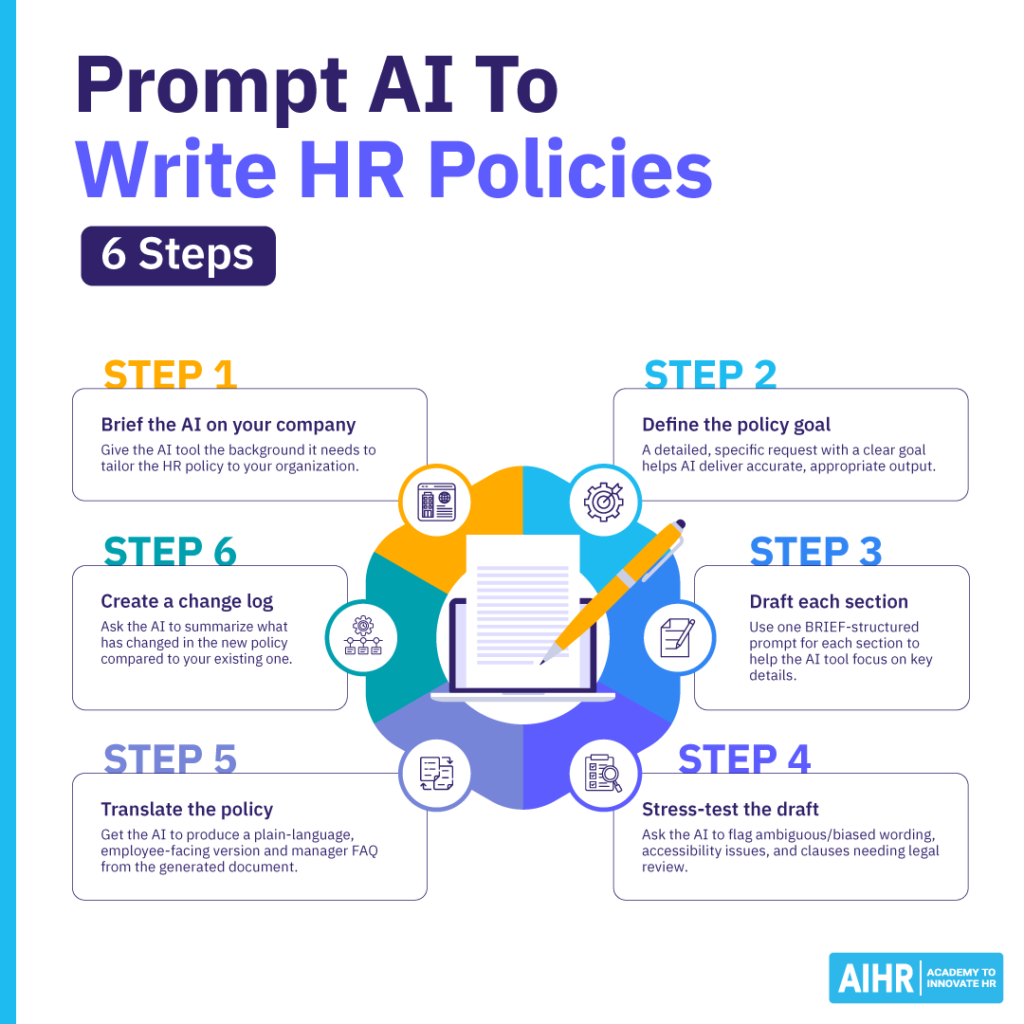
Step 4: Stress-test the draft
Once you have a full draft, ask the AI tool to flag ambiguous or biased wording, missing edge cases, accessibility issues, and clauses that may require review from a legal professional. This acts as a second edit and improves the overall quality of your document.
However, it’s important to remember that this step does not replace HR, legal, or leadership review. It simply helps you spot obvious gaps before humans spend time reviewing the draft.
Step 5: Translate the policy
At this stage, you can use the policy document you have and ask AI to produce a plain-language employee-facing version and a manager FAQ from the same source. This helps you turn a formal policy into practical communication materials. This can help employees understand what the policy means for them, and provide managers with clear guidance on how to apply it fairly.
Step 6: Create a change log
The final step is to ask the AI to summarize what has changed in the new policy compared to your existing one. This helps HR, legal, and internal communications teams align before the policy is finalized or announced.
A change log is also useful for stakeholder review. It makes the update easier to scan and helps decision-makers see whether the new version changes employee rights, manager responsibilities, approval steps, or tone.
Get the right mix of AI fundamentals, prompting skills, and responsible judgment to explore topics faster, compare sources, and support better-informed decisions.
AIHR’s Artificial Intelligence for HR Certificate Program will help you:
✅ Understand how AI tools work and where they can add value across HR
✅ Write effective prompts that produce more accurate, relevant outputs
✅ Apply generative AI to practical HR tasks across different domains
✅ Use AI responsibly by considering safety, privacy, and secure usage
4 sample HR policy AI prompts
Here are four example HR policy AI prompts you can copy and adapt to help you draft relevant, accurate, and sound policies that match your company’s voice and standards:
1. Remote and hybrid work policy
“You are an HR policy writer. Draft a remote and hybrid work policy for a [mid-size], [EU-based] [tech] company that is updating its employee handbook and replacing its old Flexible Work Arrangements section.
The policy should apply to [all employees] and clarify expectations for remote and hybrid work. Cover the following areas:
- Eligibility for remote and hybrid work
- Approval process and decision criteria
- Employee and manager responsibilities
- Equipment and workspace standards
- Expense reimbursement
- Working hours and time zone coverage
- Information security and data protection requirements
- Extended travel while working remotely
- Cross-border work or working outside the employee’s home country
- Situations where remote or hybrid work may be changed, paused, or withdrawn.
Write the policy in clear, plain language. Use a friendly, direct, and professional tone, similar to a modern employee handbook. Use short sections with clear headings and bullet points where helpful.
Treat security requirements, equipment standards, and rules for working outside an employee’s home country as non-negotiable. Do not include legal citations or country-specific legal claims unless you clearly flag them for HR and legal review.”
2. Paid time off (PTO) policy
“You are an HR policy writer. Draft a paid time off policy for a [regional] [healthcare] organization with employees in the [U.K., E.U., and U.S.]. The organization is updating its employee handbook to modernize how PTO is explained, requested, approved, tracked, and managed.
The policy should cover:
- Who is eligible for PTO
- How PTO accrues
- How employees request time off
- How managers review and approve requests
- How employees track PTO balances
- Carryover rules and limits
- What happens when an employee becomes ill during scheduled PTO
- How PTO requests are handled during staffing shortages or clinical coverage gaps
- Employee and manager responsibilities
- Where employees can go for help.
Write the policy in clear, supportive, and practical language. Use a tone similar to a contemporary healthcare employee guide. Keep the policy easy for employees and managers to understand.
Treat accrual rules, request steps, approval responsibilities, and carryover limits as essential sections. Do not include legal references or statutory claims unless you clearly flag them for HR and legal review.”
3. Workplace AI use policy
“You are an HR policy writer. Draft a workplace AI use policy for a [national] [retail] organization that uses AI tools across [merchandising, operations, and customer support]. The goal of the policy is to support responsible, transparent, and safe AI adoption across the workforce.
The policy should cover:
- What counts as AI use in the workplace
- Acceptable and unacceptable uses of AI
- Employee responsibilities when using AI tools
- Data privacy and confidential information requirements
- When employees must disclose that AI helped create or support their work
- Human review requirements for AI-assisted work
- Rules for using AI in decisions that may affect customers or employees
- Examples of appropriate and inappropriate AI use
- Where employees can go for support or approval.
Write the policy in practical, plain language. Use a clear and direct tone suitable for a retail workforce. Avoid legal citations and overly technical language.
Treat sensitive data, disclosure, transparency, and required human oversight as non-negotiable. Make clear that AI should support human work, not replace human judgment in decisions affecting customers, employees, or employment outcomes.”
4. Code of conduct or anti-harassment policy
“You are an HR policy writer. Draft a code of conduct and anti-harassment policy for a [national] [hospitality group] with [hotels and venues] across the [US]. The organization is updating its policy to set clear behavior expectations for [all staff], including frontline employees, managers, and corporate employees.
The policy should cover:
- Respectful workplace expectations
- Examples of acceptable and unacceptable conduct
- Harassment, bullying, discrimination, retaliation, and other harmful behavior
- Employee responsibilities
- Manager responsibilities
- How employees can report concerns
- What employees can expect after making a report
- How the organization handles concerns fairly and confidentially
- Protection against retaliation
- Where employees can go for support.
Write the policy in accessible, plain language. Use a direct, professional, and supportive tone that works for a hospitality workforce. Make the policy easy for employees at all levels of the organization to understand.
Avoid legal citations and AI-generated legal language that has not been reviewed by counsel. Clearly flag any compliance-sensitive language for legal review. Treat respectful behavior, reporting channels, manager accountability, confidentiality, and zero-tolerance principles as non-negotiable.”
How to refine AI-generated HR policy drafts
Once you’ve generated your HR policy draft, check for the following four criteria when reviewing it:
- Accuracy: Are facts, definitions, and statutory references correct for the jurisdiction? Flag every legal-sounding claim for legal review.
- Fairness and inclusion: Check for bias, exclusion, and assumptions about family, ability, seniority, or work norms. Also, check whether the language may land differently across cultures.
- Clarity: Check the reading level, sentence length, and whether an employee in their first 90 days could follow the policy without extra help.
- Voice: Does it sound like your company, or does it sound like generic AI? Edit for active verbs, contractions, and concrete examples.
When using AI to write HR policies, a second-prompt technique can save even more time. Ask AI to critique its own draft against the factors above before a human reviews it. This can help spot obvious issues early, so you can focus on more nuanced decisions.
Effective prompt design for HR can help you draft a wide range of HR policies and documents, but a human should always handle the final sign-off. Usually, this means someone from HR, legal, and, where relevant, a sponsor in the affected business area.
Risks of AI use in HR policy writing
In addition to knowing how to effectively prompt AI in HR policy-writing, it’s important to be aware of the potential risks in this area, such as:
Data exposure
Pasting confidential or personal data into public-tier AI tools poses safety and security risks for your organization. This can include employee names, salary details, performance information, health-related data, or internal business plans. Use anonymized examples and approved enterprise tools, and follow internal data protection rules before sharing any information with AI.
Hallucinated legal references
Even with careful prompt engineering for HR policies, the AI tool may invent a statute, case, or clause that doesn’t exist. It may also present outdated or incorrect legal information in a confident tone, making errors harder to spot. Treat any legal-sounding output as a draft only, and hand it to qualified legal counsel for review before using it in a policy.
Embedded bias
The AI tool may default to assumptions about workforce demographics or work norms based on just one segment of your workforce. For example, it may assume a standard office schedule, traditional family structure, or full-time employment model. As such, you should review AI-generated policies for inclusive language, accessibility, and fairness across different roles, locations, family situations, and work arrangements.
Over-reliance on AI
Relying too much on AI to draft HR policies, or anything else, can lead to publishing what feels like a complete policy but hasn’t had sufficient human review or input. AI can help create a strong first draft, but it can’t understand your organization’s culture, employee relations history, or risk appetite the way you can. The final review should always involve HR, legal, and relevant stakeholders.
Inconsistency
Different team members using different prompts can lead to drift across policies and a lack of cohesion. This can create policies that vary in tone, structure, detail, and interpretation, even when they cover related topics. To reduce this risk, HR teams should create a shared prompt library, standard policy templates, and a clear review process for AI-assisted drafts.
Here are some things you can do to mitigate these risks at the organizational level:
- Create an internal AI prompt library with BRIEF-structured templates: This helps reduce the risk of poorly written prompts producing weak or risky policy drafts. Include approved prompts for common policy types (e.g., PTO, remote work, AI use), and update them as your organization’s needs change.
- Develop and publish a list of approved AI tools: Make it clear which tools employees can use for HR work, what each tool is approved for, and what data they can and can’t enter. This helps prevent employees from using public or unapproved tools for sensitive HR content.
- Reinforce the importance of seeking legal advice: Professional guidance can support HR decision-making, but it’s not legal advice. Any policy language that affects employee rights, compliance, pay, leave, discipline, or termination should be reviewed by qualified legal counsel before it’s finalized.
- Publish a disclosure norm on AI-assisted drafts: Set a clear expectation that employees should disclose when AI helped create or revise an HR policy, template, or employee communication. This need not be complicated; a simple note, such as “AI-assisted draft reviewed by HR and Legal,” can maintain transparency and accountability.
- Establish an annual review cadence: Review AI-generated or AI-assisted HR policies at least once a year to check for legal changes, outdated language, inconsistent tone, and gaps in coverage. Assign clear owners for each policy so the review process doesn’t rely on ad hoc updates or individual memory.
AIHR’s resources for HR professionals upskilling in AI
AIHR offers practical learning resources to help HR teams use AI more efficiently across recruitment, workforce planning, communication, analytics, and HR operations.
Artificial Intelligence for HR Certificate Program
AIHR’s Artificial Intelligence for HR Certificate Program helps you effectively use AI in real HR scenarios. It covers GenAI tools, prompt design, AI strategy, automation, governance, ethics, and practical implementation across HR functions. It also includes responsible, ethical use and business impact. Participants learn how to:
- Evaluate AI tools
- Improve operational efficiency
- Strengthen decision-making
- Lead responsible AI adoption inside their organizations.
Gen AI Prompt Design for HR Mini Course
AIHR’s Gen AI Prompt Design for HR Mini Course teaches you how to write better prompts for day-to-day tasks. It covers prompt structure, practical frameworks, and HR use cases, including policy creation and employee communication.
You’ll also get reusable templates you can apply across tools like ChatGPT, Claude, Gemini, and other GenAI platforms. This helps you progress from one-off experiments to more consistent, accurate, and review-ready AI outputs.
Next steps
Now that you know the basics of how to prompt AI to write HR policies tailored to your organization, it’s time to put what you’ve learned into action. Experiment with different AI tools to find the ones best suited to your needs, and keep refining your prompts until they produce accurate results that meet your goals.
Learn more about how to integrate AI into your day-to-day workflow, and use it safely and effectively by signing up for the Artificial Intelligence for HR Certificate Program. You’ll gain fundamental and advanced skills to create effective HR AI prompts and get high-quality output.