
AI for internal mobility can help you see the skills, ambitions, and career paths already inside your organization. Without it, you risk hiring externally for skills employees already have, which is typically a longer, more expensive process than hiring internally. However, only 8% of organizations have reliable workforce skills data, and under 20% move talent effectively to fill skills gaps.
This article explains how artificial intelligence supports internal mobility, where the risks lie, which tools to review, and how to pilot the process with strong governance.
Contents
What is AI for internal mobility?
Benefits of using AI for internal mobility
Risks of AI in internal mobility
7 ways to use AI for internal mobility
AI tools for internal talent mobility
AI for internal mobility case studies
8 steps to bring AI into your internal mobility process
What is AI for internal mobility?
Internal mobility is the movement of employees within your organization. This can include promotions, lateral moves, moves into lower-level roles, mentorships, short-term projects, job shadowing, and job swaps.
AI for internal mobility applies machine learning (ML) and natural language processing (NLP) to this process. ML means the system learns patterns from data, while NLP helps the system read and interpret text, such as résumés, performance reviews, and project records.
Instead of relying only on internal job boards, manager nominations, and manual skills tracking, AI can scan employee data and map skills across the workforce. It can then match employees to open roles, projects, learning opportunities, and career paths.
Core capabilities
Most AI internal mobility tools offer some mix of these capabilities:
- Skills inference and mapping: Scans résumés, performance reviews, learning records, and project data to surface skills employees haven’t formally listed.
- Predictive matching: Recommends internal candidates for open roles, including people with adjacent skills.
- Personalized career pathing: Shows possible next roles based on an employee’s current skills, goals, and performance.
- Talent marketplace matching: Connects employees to projects, gigs, mentorships, and stretch assignments, not just full-time roles.
- Learning recommendations: Links missing skills to relevant courses, mentors, rotations, or on-the-job development opportunities.

Benefits of using AI for internal mobility
Internal mobility programs can help employees grow and enable the business to better use existing skills. AI can make that process faster, more visible, and easier to scale.
Retention
Employees are more likely to stay when they can see a future inside the organization. They’re also more likely to be satisfied and engaged at work, and perform better. In addition, AI predictive analytics can identify employees at high risk of leaving, and potentially match them with upcoming opportunities that could help retain them and increase their job satisfaction.
Cost and speed
External hiring can be expensive and slow. In fact, it can cost three to five times more than internal hiring when you include time, financial, and other related costs. Internal hiring, on the other hand, is not only cheaper but can reduce recruitment time by up to 20 days. AI can help your talent acquisition team find internal matches faster, freeing up budget for reskilling, upskilling, and better onboarding for internal movers.
Skills gap closure
Traditional internal mobility often relies on outdated employee profiles and static skills lists in HRIS systems. These records may miss informal learning, project experience, and adjacent skills. AI can pull information from performance reviews, training records, project documents, and career profiles. It can then show where skills already exist and where the business still needs development.
Equity
AI can widen the candidate pool beyond manager networks, but only with the right governance. This is important, as manager nominations can overlook employees who are less visible, newer to the organization, or outside informal networks. However, AI shouldn’t replace human judgment; it should help HR and managers see more people, ask better questions, and audit mobility outcomes for fairness.
Risks of AI in internal mobility
AI-driven internal mobility can improve skills visibility, accelerate matching, and expand access to opportunities, but it also poses risks if the process lacks governance, transparency, and human oversight. Here are the main risks to address before you scale AI across your internal mobility process:
Bias in training data and recommendations
AI learns from the data you give it. If past promotion, hiring, or project staffing decisions favored certain groups, the system may repeat those patterns, leading to unfair recommendations and limiting access for employees who already face barriers to visibility.
Audit AI outcomes regularly by demographic group, job level, function, location, and tenure. Track who is recommended and left out, and who applies and moves. Keep managers involved at key decision points, so AI supports fair decisions rather than replacing judgment.
Opaque matching and low employee trust
Employees may not trust AI recommendations if they don’t understand how the system works. If someone is matched to a role they don’t want, or doesn’t see opportunities they expected, the process can feel random or unfair.
To ensure transparency and trust, explain which data points the tool uses (e.g., skills, experience, learning records, and career interests), and let employees update their profiles and challenge inaccurate information. You can also share internal success stories to show how AI-powered matching supports real career growth.
Data privacy and consent issues
AI skills inference uses personal data, such as résumés, performance reviews, learning records, project history, and career preferences. If employees don’t know how you use that data, they may see the tool as surveillance rather than support.
Align the process with your privacy policy, local law, and employee communications. At the same time, be clear about what data you collect, why you collect it, who can see it, and how long you keep it. Where needed, you should also involve legal, privacy, IT, and works councils early.
Over-reliance on scores
AI can rank employees against roles, projects, or skills gaps, but a score doesn’t tell the full story. It may miss motivation, readiness, personal goals, team context, or recent work that hasn’t entered the system yet.
As such, you should treat AI recommendations as a starting point, not a final decision. Managers and HR should still discuss employees’ goals, interests, and readiness with them. This helps you avoid pushing people into roles that look right on paper but don’t fit their aspirations.
Manager resistance and talent-hoarding
AI can surface strong internal candidates, but managers may still block moves. Some managers worry about losing high performers, especially when their own team metrics depend on them.
Treat this as a culture and change management issue. Set clear expectations that managers should develop talent for the wider organization, not just their own team. Recognize and reward managers who support internal moves, share talent, and help employees grow beyond their current role.
AI can help HR identify transferable skills, surface suitable career opportunities, and support more informed internal mobility decisions. Build practical AI expertise so you can use these tools responsibly, while improving EX.
AIHR’s Artificial Intelligence for HR Certificate Program teaches you how to:
✅ Identify practical ways to apply AI across internal mobility and talent management processes
✅ Write effective prompts that generate relevant, high-quality HR insights
✅ Select suitable generative AI tools for different HR challenges and workflows
✅ Develop an AI strategy that supports responsible adoption and long-term business value
💡 Visit AIHR’s Demo Portal to preview lessons from the program, and explore what you can learn next.
7 ways to use AI for internal mobility
Here are seven practical ways to use AI for internal mobility in your organization.
1. Build a live, AI-inferred skills profile
Instead of relying on self-reported employee profiles, use AI to scan your HRIS, résumés, performance reviews, project documents, and learning records. The model can use NLP to identify skill keywords and infer related skills from context, building a live skills inventory across the workforce. It can also surface employees with relevant or adjacent skills not listed on a résumé.
Tip: Refresh this profile continuously, rather than just once a year. Skills change quickly, and an annual update can become outdated within months.
2. Match employees to open roles, gigs, and projects
Many organizations still search externally first when a role opens. AI can help you check internal talent first. A matching engine can compare each employee’s skills profile with each role’s requirements.
For example, Gloat describes its knowledge graph as a living map of people, jobs, skills, and their relationships. This helps the system spot adjacent-skill matches that a keyword search may miss.
Tip: Hire from within for gigs and projects, not just full-time moves, to let employees prove new skills without the risk of a permanent switch. This gives you a lower-cost way to test a fit before you promote anyone.
3. Map personalized career paths
Career pathing tools compare an employee’s current skills with roles across the organization. They can show realistic next steps and the exact skills needed to close each gap. This matters for retention because 47% of top performers leave within two years if they can’t see relevant opportunities or a path forward with their company.
Tip: Share career paths directly with employees, not only with managers. Employees need clear visibility into where they can go next.
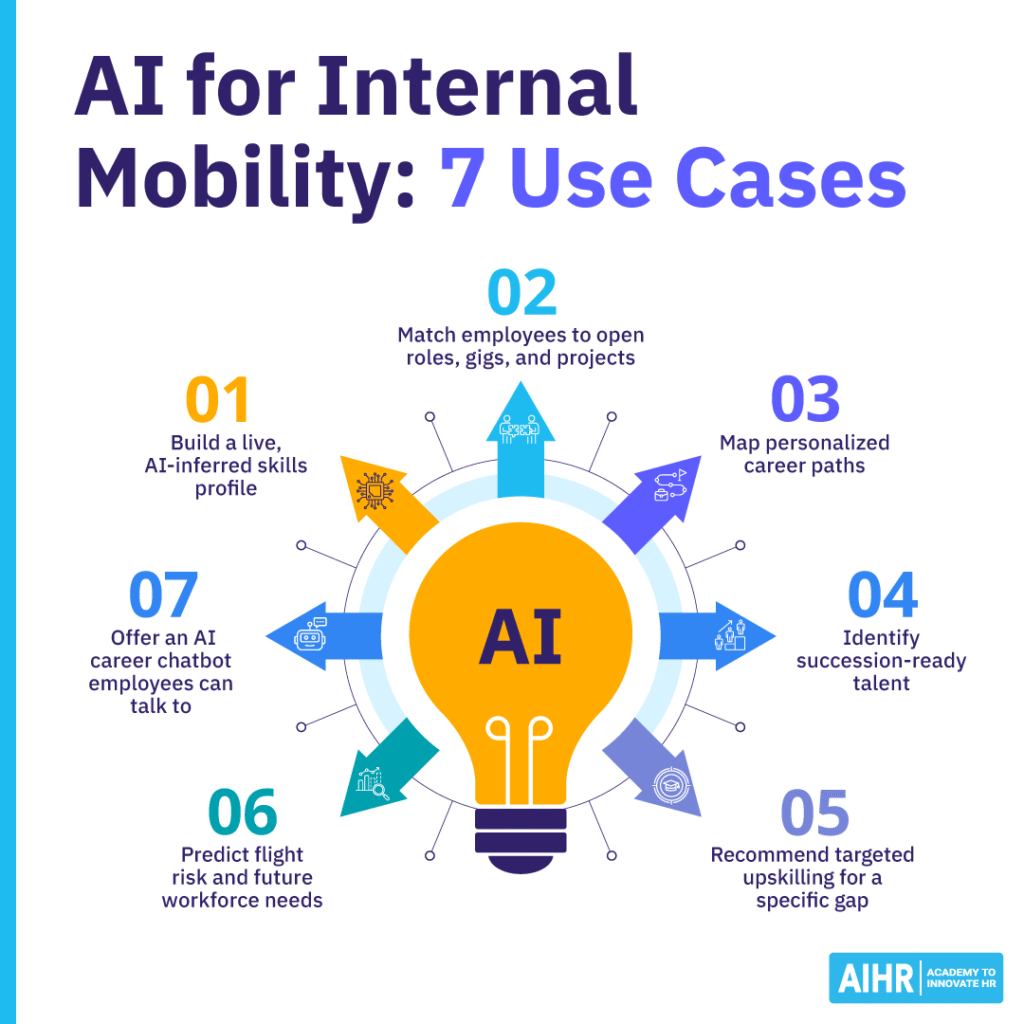
4. Identify succession-ready talent
AI succession tools can compare employees against the skills and competencies a critical role requires. They can use live skills profiles, performance history, and 360-degree feedback when available.
Gloat’s succession planning agent is one example; it identifies high-potential talent and helps build leadership pipelines. This can surface candidates that a traditional 9-box review might miss.
Tip: Use the AI output to start a conversation. Before you act on a recommendation, confirm the employee’s interests and readiness.
5. Recommend targeted upskilling for a specific gap
AI can identify the exact skills an employee needs for a target role, then match those missing skills to a course, mentor, job rotation, or project. This makes development more practical. Instead of telling someone to “build leadership skills”, you can point them to a specific action (e.g., leading a cross-functional project or completing a people management course).
Tip: Share recommendations directly with employees, and give them one clear next step, not a long list of vague development areas.
6. Predict flight risk and future workforce needs
A flight-risk model compares employees who left with employees who stayed, then looks for patterns across tenure, pay position, performance trends, workload, engagement data, and career movement.
These signals can help managers act earlier. The same type of model can also forecast which roles may open in the next six to 12 months, so you can plan internal moves before a gap appears.
Tip: Don’t wait for the annual review cycle. Use continuous signals from performance, engagement, and skills growth while there’s still time to retain people.
7. Offer an AI career chatbot employees can talk to
AI career chatbots sit atop the same matching engine, and employees can ask what roles, projects, or learning paths fit their skills and goals. For example, Eightfold’s Career Coach Agent gives staff conversational career guidance based on skills, aspirations, and available paths. Sapia.ai’s Phai Career Coach also supports career mobility through conversation.
Tip: Position the chatbot as a starting point for career conversations. It should guide employees toward a manager, mentor, or HR conversation.
AI tools for internal talent mobility
Here are some AI tools you can use for your internal talent mobility strategy, depending on your unique needs and goals:
- Dedicated internal talent marketplace platforms: These are best suited for organizations building a comprehensive internal mobility program. Examples include Gloat, Fuel50, and Eightfold.
- AI features inside HCM suites: These work well if you want mobility inside your existing system of record. Tools like Workday (HiredScore) and SAP SuccessFactors offer this functionality.
- ATS and internal recruitment tools with AI matching: These can help when your main goal is to surface open roles and match internal candidates. Try HiBob, Workable, and Ashby.
- General-purpose AI assistants: These tools can help draft internal job posts, career conversation guides, mobility policy communications, and manager enablement materials. Try using the free version of ChatGPT, Claude, or Copilot (if your organization already pays for Microsoft licenses).
Not sure where to start? Review your data maturity, integration needs, privacy requirements, and whether you need a full marketplace or matching only.
AI for internal mobility case studies
It’s useful to see what happens when large organizations apply AI to internal mobility and skills visibility. Here are two examples:
Ericsson
Ericsson worked with the skills intelligence platform TechWolf to build a global skills language across systems such as SuccessFactors, Degreed, and Eightfold. TechWolf’s customer story reports that 100,000 employees now have personalized AI-inferred skills signatures. This helps managers and employees connect skills to learning, hiring, and career growth.
Unilever
Unilever used its AI-powered internal talent marketplace, FLEX Experiences, to connect employees to projects and opportunities. According to The Case Center, Unilever redeployed about 8,300 employees during the pandemic without a single external hire. It also reported a 41% rise in overall productivity and 20% increase in internal collaboration time.
While individual case studies are useful, broader research supports what Ericsson and Unilever experienced. Employees at organizations with strong internal mobility programs stay 41% longer than those at organizations with weak mobility practices, according to LinkedIn’s Talent Blog.
8 steps to bring AI into your internal mobility process
Once you understand the use cases and tool options, focus on implementation. Here are eight steps to bring AI into your internal mobility process.
Step 1: Audit your current internal mobility process
Start by mapping how internal moves happen today. Look at internal fill rate, internal application rate, time to fill, transfer approval steps, and manager involvement. You should also identify where employees get stuck, whether it’s managers blocking moves or incomplete employee profiles. This baseline will help you see where AI can improve the process.
Step 2: Define your internal mobility strategy and success metrics
Decide what problem AI should help you solve first (e.g., reduce external hiring costs, close skills gaps, improve retention, or increase project staffing speed). Next, define what good looks like over the next six to 12 months. Useful metrics include internal fill rate, time to fill, project match rate, employee satisfaction, and retention among internal movers.
Step 3: Clean and connect your skills data
AI is only as useful as the data behind it. Incomplete employee records, job architecture, and skills data will result in weak recommendations. Clean your data before switching on a matching engine, and standardize job titles, levels, departments, skill names, and role requirements. Additionally, it helps to work with department leaders to enrich employee profiles.
Step 4: Select the right tool for your maturity
Choose a tool that fits your organization’s size, industry, goals, and tech stack, and involve IT, legal, privacy, and works councils early where relevant. At the same time, ask vendors how their tools explain recommendations, protect employee data, and audit outcomes for bias. This knowledge will help you choose the tool that best fits your organizational maturity.
Step 5: Pilot with one department or use case
Start with a pilot group where data quality is strong, and leaders support the change. For example, you might test AI matching for project staffing in one function. Explain the purpose to employees, and clarify that the tool is supposed to help them find growth opportunities, not replace career conversations. Gather feedback from employees and managers before scaling.
Step 6: Enable managers and address talent hoarding
Manager resistance can slow down internal mobility. This resistance stems from managers’ worry about losing their best people, especially when team performance depends on them. Work with senior leaders to embed talent development into manager expectations, and recognize managers who develop employees, support internal moves, and export talent to other teams.
Step 7: Set up governance and bias monitoring
AI can repeat and perpetuate human bias if you don’t continually monitor it. To avoid this, review matching outcomes by demographic group, job level, function, geography, and tenure, and keep people involved in final decisions. Explain to employees how matching works, what data the tool uses, and how they can update their profile or raise concerns.
Step 8: Measure, iterate, and scale
Return to your baseline metrics after the pilot. Review what’s improved, what hasn’t, and where the tool has created friction. Remember to scale only when the process works. In the meantime, keep collecting feedback from employees, managers, your HR team, and legal. Internal mobility needs ongoing support and maintenance, so a one-time launch is insufficient.
Next steps
Start with one high-friction internal mobility use case, then audit how internal moves happen today, clean the data behind that process, and pilot an AI tool with clear success metrics. Next, track internal fill rate, time to fill, employee satisfaction, and manager adoption before rolling it out more widely.
HR teams also need practical AI skills to lead this work well. AIHR’s Artificial Intelligence for HR Certificate Program covers AI use in HR, prompt design, ethical AI use, and AI strategy. It’s a relevant next step if you’re responsible for AI-enabled mobility, workforce planning, or HR transformation.